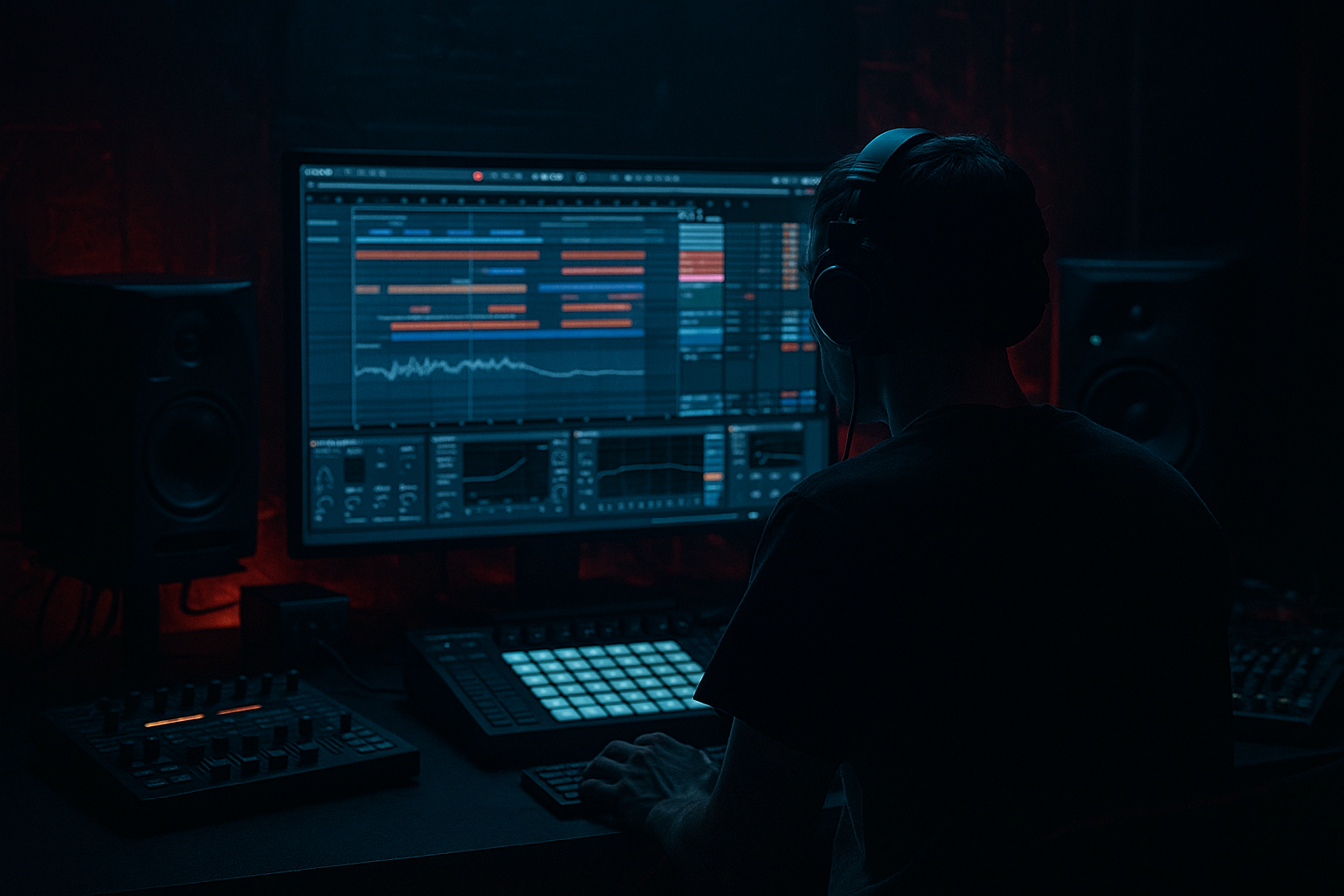
Main tutorial
Lesson Overview
In this lesson, you’ll build a Concrete Echo-style air horn hit in Ableton Live 12 from scratch, designed for oldskool jungle / DnB / rollers energy. The goal is to create that aggressive, chant-like horn stab that can punch through a breakbeat, hype up a drop, and instantly give your track a rave-ready vocal personality 🎺
This technique matters because in Drum & Bass, a good air horn hit is more than a sound effect — it’s a rhythmic accent, a call-and-response tool, and a mix translation trick. Used right, it can mark transitions, signal drop sections, and add that authentic warehouse / soundsystem flavor without needing a full vocal performance.
In a DnB track, this kind of hit often sits:
- at the start of a drop,
- between kick/snare phrases,
- before a rewind or fill,
- or as a “reply” to the bassline.
- a sharp initial bark
- a midrange brass/vocal body
- a short echo tail that feels like concrete walls bouncing sound back
- a distorted, slightly rough texture suitable for DnB
- enough control to use it as:
- a short vocal chop,
- a shouted syllable,
- an “oh,” “aye,” “yeah,” or “ho” style sample,
- or any short brass/vocal one-shot you already have.
- Set it to Classic mode
- Turn on One-Shot
- Shorten the Fade to around 5–20 ms if the sample clicks
- Keep the sample short and punchy
- +3 to +7 semitones for a more excited, rave-style feel
- -2 to +2 semitones if you want a deeper, gruffer hit
- one hit at normal pitch,
- one hit slightly higher,
- one hit pitched down for variation.
- Oscillator: Saw
- Second oscillator: Square or another Saw
- Slight detune: 5–15 cents
- Filter: low-pass around 1.5–4 kHz
- Envelope: quick attack, short decay, no sustain
- Oscillator A: Saw
- Envelope: fast attack, decay around 200–500 ms
- Add a little Filter cutoff movement if needed
- Drive: 3–8 dB
- Soft Clip: On
- Output: trim so the level doesn’t jump too much
- Ratio: 2:1 to 4:1
- Attack: 5–20 ms
- Release: 50–120 ms
- Threshold: adjust so you get light gain reduction on the peak
- Select a moderate drive mode
- Keep tone bright but not harsh
- Delay Time: 1/8 or 1/16
- Feedback: 10–25%
- Dry/Wet: 8–20%
- Filter: High-pass around 200–400 Hz
- Low cut / high cut: reduce low rumble and tame harsh top end
- Modulation: low, around 5–15%
- try 1/8 dotted
- raise feedback slightly to 20–30%
- then automate the dry/wet only on specific hits
- use a Low-Pass filter
- set cutoff around 6–10 kHz
- add a small resonance bump if needed
- use a gentle High-Pass around 120–200 Hz
- then lift the midrange with a broader EQ curve later
- cut a little around 250–400 Hz if the horn sounds boxy
- gently boost around 1.5–3 kHz for presence
- tame harshness around 5–8 kHz if needed
- Attack: 0–5 ms
- Decay: 150–400 ms
- Sustain: 0%
- Release: 50–180 ms
- Echo Dry/Wet
- Filter cutoff
- Drive amount
- or even Track Volume for a quick fade-out shape
- a snare ghost hit
- a rimshot
- a short break slice
- or a very short impact
- put the horn hit on the upbeat before a snare
- layer a tiny break chop underneath
- pan the extra layer slightly left or right if needed
- keep the main horn centered
- bar 1 of the drop
- last beat before a bass switch
- end of a 4-bar drum fill
- right before a rewind moment
- in a call-and-response with the reese bass
- Bars 1–4: break intro with rising tension
- Bar 5: horn hit on the “and” before beat 1
- Bar 6: bass answer
- Bar 8: repeat horn but pitched lower, with more echo
- Bar 16: full stop or fill, then another horn for the return
- keep it mono or mostly centered
- make sure it doesn’t mask the snare crack
- trim the output so it sits above the break, not on top of the whole mix
- use Utility if you need to narrow the stereo field
- Does the horn dominate 2–5 kHz too much?
- Does the echo fill the low mids?
- Does it clash with the bass drop?
- Does it still read clearly at low volume?
- chop it tighter,
- reverse pieces,
- warp slightly,
- or layer it with another hit for a more ragged underground feel.
- Amount low
- Rate slow or synced
- Phase reduced if you want it to stay more centered
- Use the same vocal sample in Simpler
- Duplicate the track twice
- On version 1, keep it simple and punchy
- On version 2, add Echo with short filtered delay
- On version 3, add Saturator or Amp, then EQ the harshness
- bar 1: dry hit
- bar 3: echoed hit
- bar 7: heavy hit
- bar 8: silence or drum fill
- Which version cuts through the break best?
- Which version sounds most like an oldskool DnB horn?
- Which one feels best before the drop?
- a short vocal-style source
- pitch shaping to make it shout like a horn
- light saturation or amp drive for attitude
- a short, filtered echo for concrete-space bounce
- EQ and envelope control to keep it tight
- smart placement in the arrangement as a drop marker or call-and-response accent
The approach here is beginner-friendly and uses Ableton stock devices only, while still giving you a result that feels rooted in jungle, oldskool ragga energy, and darker bass music.
---
What You Will Build
By the end of this lesson, you’ll have a tight, resonant air horn-style vocal hit with:
- a one-shot,
- a drop marker,
- a switch-up accent,
- or a layered vocal FX element in your arrangement
It will sound like a raw soundsystem horn rather than a polished pop vocal effect, which is exactly what you want for jungle and darker DnB contexts.
---
Step-by-Step Walkthrough
1) Start with a clean vocal-style source
Open a new MIDI track and load Simpler. For a beginner-friendly air horn hit, you want a source that has a strong vocal or horn-like attack. You can use:
If you don’t have a sample, use a short recorded vocal from your own voice. Even a rough “HAA!” can work.
Inside Simpler:
Why this works in DnB: oldskool jungle energy often comes from short, recognisable vocal hits that cut through fast breaks. You’re not trying to make a full vocal line — you’re making a percussive vocal weapon.
2) Shape the pitch so it feels like a horn, not a normal vocal
In Simpler, use the Transpose control to bring the sample into a more “shouted horn” zone. Try:
If the sample becomes too chipmunky or too dull, adjust the Formants if available in your setup through Simpler’s mode controls, or choose a different source sample.
For extra movement, add MIDI pitch automation:
This gives the air horn phrase a more human, call-like rhythm — very useful in DnB breakdowns and transitions.
3) Add a tonal body with Drift or Operator
If your vocal sample alone doesn’t feel horn-like enough, layer a second track underneath.
Create a new MIDI track and load Drift or Operator.
Option A: Drift
Set up a basic brass-like tone:
Option B: Operator
Use a simple synth layer:
Keep this layer subtle. It should support the sample, not replace it.
Why this works in DnB: many classic air horn and chant-style hits are basically vocal energy plus synth reinforcement. The synth gives the sound more size and makes it hold up against loud drums and bass.
4) Make the sound hit hard with Amp and Compressor
On your Simpler track, add Amp or Saturator first. If you want a rougher edge, start with Saturator.
Saturator starting point
If you want more controlled impact, add Compressor after that:
For a more aggressive vocal bark, use Amp:
This stage helps the horn feel like it belongs in a loud DnB system. The saturation adds harmonics, which makes the hit read better on club speakers and on smaller systems too.
5) Add echo, but keep it short and “concrete”
Now create the signature “Concrete Echo” feel using Echo.
Add Echo after your distortion/compression.
Start with:
If the echo gets too smeary, shorten the time and lower feedback.
For a more oldskool, dubby bounce:
This gives you that “space bouncing off a wall” vibe without cluttering the mix.
Why this works in DnB: fast tempos can turn normal delay into mush. A short, filtered delay keeps the horn rhythmic and percussive, so it supports the break rather than fighting it.
6) Filter the high end so it stays sharp, not painful
Add Auto Filter after Echo or before Echo depending on the tone you want.
If the sample is too bright or spiky:
If the hit is too dull:
A useful beginner move is to add EQ Eight:
Keep the sound focused in the upper mids, because that’s where air horn energy lives in jungle and DnB.
7) Use an envelope to make it feel like a hit, not a note
If the sound is lingering too long, shape it with Simpler’s Amp Envelope or use Volume Automation.
A good starter shape:
If you’re using the sound as a one-shot hit in the arrangement, a short decay is key. You want it to feel like an announcement, not a pad.
If the tail needs more life, automate:
This is where the vocal element becomes really useful in arrangement: you can make the same horn feel like a short stab, a longer shout, or a transition swell.
8) Layer the horn with a break or impact for extra DnB weight
To make the hit feel more authentic in a jungle mix, layer it with:
Keep the layer subtle. The point is not to make it huge in an EDM sense — it’s to make it feel like part of the breakbeat ecosystem.
Try this:
This gives the hit more attitude and helps it lock into the rhythm.
9) Place it in the arrangement like a DJ would
In oldskool jungle and DnB, horn hits work best when they behave like arrangement punctuation.
Good places to use your air horn hit:
Example musical context:
A good DnB horn doesn’t need to appear constantly. Use it as a highlight, not wallpaper.
10) Final mix checks: keep it loud, but not messy
Before you call it done, do a quick mix check.
On the horn track:
Check these things:
If yes to any of those, reduce echo, cut low mids, or shorten the decay.
---
Common Mistakes
1) Making the echo too long
A long delay can turn your horn into mush at DnB tempos.
Fix: shorten delay time to 1/16 or 1/8, lower feedback, and high-pass the echo return.
2) Overloading the low mids
Horn hits can get muddy fast, especially with vocal samples.
Fix: use EQ Eight and cut around 250–400 Hz if needed.
3) Too much top-end harshness
Air horn-style sounds can become painful when layered with bright breaks.
Fix: use a small cut around 5–8 kHz or lower the filter cutoff.
4) Not enough transient
If the sound feels weak, it won’t cut through the break.
Fix: shorten the amp envelope, add light saturation, or use a transient-friendly source sample.
5) Using the horn too often
If everything is an air horn, nothing feels special.
Fix: place it at key transition points only.
6) Stereo widening the main hit too much
Wide horns can sound messy and phasey, especially in club playback.
Fix: keep the main hit centered and use width only on the echo or supporting layer.
---
Pro Tips for Darker / Heavier DnB
1) Distort the return, not just the source
Send the horn to a return track with Saturator or Pedal and blend it quietly. This adds grit without destroying the main hit.
2) Use a tiny reverse pre-hit
Duplicate the horn, reverse it, and fade it in before the main hit. This adds tension before a drop or switch-up.
3) Automate filter movement across 8 bars
Open the filter slightly over time leading into the drop, then snap it shut when the hit lands. That’s a classic tension/release move in darker DnB.
4) Pair it with a reese answer
Use the horn as a call, then let the bassline answer. This makes the arrangement feel intentional and very “scene-aware.”
5) Push the midrange, not the sub
A horn hit should live in the upper mids. Leave the sub for the kick and bass. That separation is what keeps heavy DnB clean.
6) Resample for extra character
Once you like the sound, bounce it to audio and re-import it. Then you can:
7) Add a touch of movement with Auto Pan
Use Auto Pan very subtly:
This can make the echo tail feel alive without pulling the main hit off-center.
---
Mini Practice Exercise
Set a timer for 15 minutes and build three horn variations in Ableton:
Task
Create:
1. a dry short horn hit
2. a horn with echo
3. a heavier distorted horn for drop accents
Workflow
Arrangement test
Place the three versions across 8 bars:
What to listen for
Save the best one as a preset or audio clip so you can reuse it later.
---
Recap
A strong Concrete Echo-style air horn hit in Ableton Live 12 comes from:
In DnB, the magic is not just the sound — it’s the timing, restraint, and rhythmic placement. Keep it punchy, keep it focused, and let it hit like part of the track’s energy system, not just an effect.

