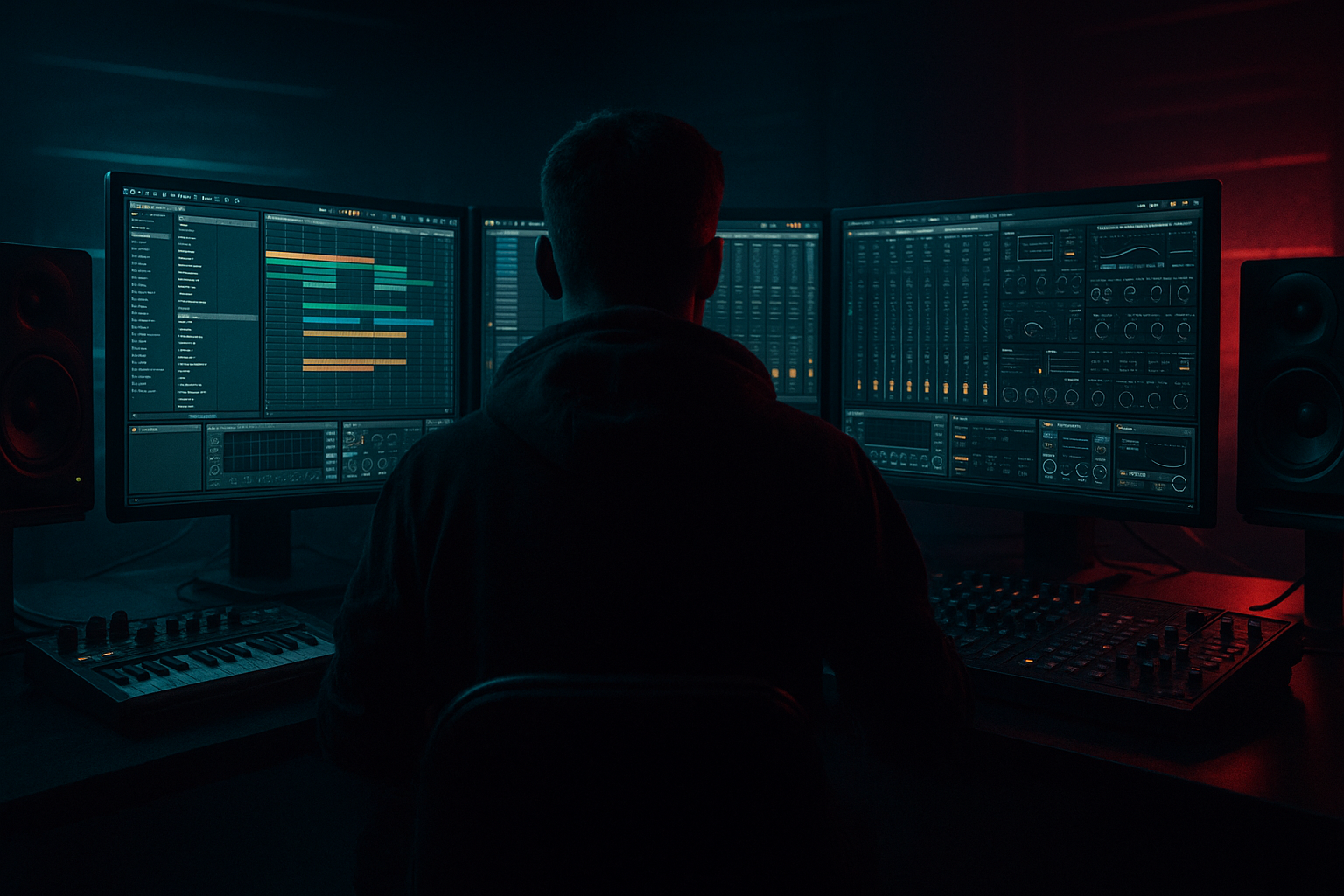
Main tutorial
Lesson Overview
In this lesson, you’ll build a Concrete Echo edit: a gritty, oldskool-style DnB breakbeat swing made from scratch in Ableton Live 12, designed for jungle / oldskool DnB / rollers and useful as a DJ tool for mixes, transitions, and tune intros. The goal is not to make a full song yet — it’s to create a loopable 8-bar break section with enough groove, swing, and character to sit before a drop, ride under a DJ mix, or act as a tension builder between sections.
Why this matters: in DnB, the break is often the “engine” that gives a tune its identity. A solid break edit can make a track feel instantly more authentic, more dancefloor-ready, and more mix-friendly. Oldskool jungle energy comes from tight drum editing, swung ghost notes, chopped break logic, and contrast between dry punch and spacious echo. That’s exactly what you’re learning here.
We’ll use only Ableton stock devices and beginner-friendly moves:
- slicing a break
- building swing with timing and velocity
- layering a sub-support kick/snare pattern
- adding echo as a DJ tool for transitions and phrase glue
- shaping the drum bus so it feels powerful but not messy
- an 8-bar jungle breakbeat loop with a swung, rolling feel
- a tight kick + snare anchor supporting the break
- ghost notes and small edits that make the groove breathe
- a subtle echo send for oldskool space and DJ-friendly transitions
- a drum bus with light saturation and control for punch
- a loop that works at 170–174 BPM for classic DnB energy
- bars 1–4: the groove establishes itself with a dry, punchy break
- bars 5–6: slight variation and extra ghost hits
- bars 7–8: echo tail or fill to help transition into a drop or next phrase
- Making the break too quantized
- Using too many slices
- Letting the echo smear the low end
- Overdriving the drum bus
- Weak snare in the mix
- No phrase structure
- Use a darker echo tone
- Layer a reese-friendly drum pocket
- Add tension with empty space
- Keep the snare dry, make the tail wet
- Use velocity for ghost-note realism
- Think like a selector
- Resample for grit, not chaos
- Build the groove from a real breakbeat, not from over-programmed drums.
- Use slicing, timing nudges, and velocity to create swing.
- Support the break with a simple kick/snare layer for weight.
- Use Echo on a return track for DJ-friendly transitions and oldskool space.
- Shape the drum group with Drum Buss, Saturator, and EQ Eight.
- Make 4-bar and 8-bar phrases so the loop works in an actual DnB arrangement.
- Keep the low end clean, the snare strong, and the groove alive.
By the end, you’ll have a reusable drum loop that can be dropped into a DnB arrangement, looped for a mix intro, or turned into a full oldskool section later.
What You Will Build
You will build a Concrete Echo edit with these features:
Musically, it should feel like:
Think of it as a tool loop that can sit under a vocal, intro a tune, or bridge into a heavier bass section.
Step-by-Step Walkthrough
1. Set the tempo and build a simple starting lane
Open a new Ableton Live set and set the tempo to 172 BPM to stay in classic DnB territory. If you want a slightly more urgent jungle feel, 174 BPM also works отлично. Create three MIDI tracks:
- Drums - Break
- Drums - Support
- FX - Echo
Put Drum Rack on the Break track so you can work with slices or samples easily. Put a simple Utility on the master later for mono checking, but don’t worry about that yet.
For a beginner workflow, keep the Session view or Arrangement view simple. Loop 8 bars from the start so you can hear changes immediately. This is a DJ tool mindset: short loops, quick decisions, clear phrasing.
2. Load a classic break and warp it cleanly
Drag in a breakbeat sample with a clear kick/snare identity — a classic amen-style break, a funky oldskool break, or any raw drum loop with character. You’re not aiming for polished EDM drums; you want something with movement and attitude.
In Clip View:
- turn Warp on
- set the mode to Beats
- try Preserve: 1/16 for tighter slicing
- lower Transient Loop Length if the break feels smeared
- if the break is too stretched, set the Seg. BPM close to the source tempo before warping
Then listen for the main kick/snare hits and check that the groove feels natural. If the hats start sounding too robotic, don’t over-fix it. A little roughness is part of the oldskool character.
Why this works in DnB: jungle and oldskool DnB often rely on sample rhythm rather than perfectly quantized drums. The small imperfections create bounce, urgency, and that “human machine” feel that makes breaks breathe.
3. Slice the break and rebuild the groove in Drum Rack
Right-click the break clip and choose Slice to New MIDI Track. Slice by:
- transients if the break is well recorded
- or 1/8 notes if you want a more controlled beginner result
Ableton will create a Drum Rack with the slices mapped across pads. Now program a simple 2-bar loop using the original break hits as your foundation.
Start with this logic:
- keep the main snare on beats 2 and 4 feeling strong
- place the kick hits where the original break pushes forward
- use a few ghost hits before or after the main snare
Don’t try to use every slice. Choose only the hits that support the groove. In oldskool DnB, less often means more punch.
Beginner tip: if slicing feels overwhelming, keep the original break on one track and use the sliced Drum Rack only for extra ghost hits and fills. That’s a very practical way to stay musical without getting lost in editing.
4. Program the swing using timing, not just a swing knob
This is the heart of the lesson. Your “Concrete Echo” groove should feel slightly behind the beat in some places and slightly ahead in others, like a real break being ridden by a DJ.
In the MIDI editor:
- place some 1/16 ghost notes just before the snare
- nudge a few hat or percussion hits late by 5–15 ms
- leave the main snare mostly locked to the grid
- pull some kick slices a little earlier if the groove feels lazy
If you want extra swing control, use Ableton’s Groove Pool:
- try a swing groove around 54–58%
- keep the Timing amount moderate, around 20–40%
- add a little Velocity if the groove needs more life
You want a groove that feels danceable, not drunk. The goal is a breakbeat swing that nods like a rolling sound system tune.
5. Build the “Concrete” part: add kick/snare support underneath
To give the edit more weight, add a simple support layer. On Drums - Support, use Operator or Simpler for a short kick and snare reinforcement.
Suggested starting point:
- Kick: short, punchy, around 50–60 Hz fundamental
- Snare: 180–220 Hz body with a crisp top layer
In practice, keep it simple:
- place a kick on beat 1 and a light push before the snare if needed
- reinforce the snare on 2 and 4
- keep these hits quieter than the break so the sample remains the star
Use EQ Eight:
- high-pass non-bass drum elements around 100–150 Hz
- if the snare is boxy, cut a bit around 300–500 Hz
- if the kick clashes with the break, carve a small dip around the break’s lowest peak
This layer is your concrete foundation. It makes the break feel more intentional and club-ready without losing jungle rawness.
6. Add a return track echo for oldskool space and DJ utility
Create a Return Track with Echo on it. This is where the “Concrete Echo” character really comes alive.
Good starter settings for the Echo return:
- Time: 1/8 or 1/4, try dotted 1/8 for a more classic bounce
- Feedback: 20–35%
- Dry/Wet: 100% on the return track
- Filter: high-pass around 200–400 Hz
- Modulation: very subtle, just enough to soften repeats
- Noise: low or off if you want cleaner DJ-tool clarity
Send only selected hits to the echo:
- the last snare of a phrase
- a ghost hit before a transition
- a chopped hat fill at bar 8
For a proper DJ tool feel, automate the send amount so the echo appears only at the end of 4-bar or 8-bar phrases. This gives you a clean loop that still has movement and atmosphere.
7. Shape the drum bus for punch, glue, and clarity
Route Break and Support into a Drum Group. On the group, add:
- Drum Buss for weight and transient control
- Saturator for gentle grit
- EQ Eight for cleanup
Starter settings:
- Drum Buss Drive: small amounts, around 5–15%
- Boom: use carefully, or off if your sub is already busy
- Transient: slightly positive if the break needs more snap
- Saturator: Soft Clip on, drive low to moderate
Keep the mix clean:
- don’t let the drum group get cloudy in the low mids
- use EQ Eight to trim a little around 250–450 Hz if the break feels muddy
- if cymbals get harsh, gently reduce around 7–10 kHz
This is where the loop starts sounding like a record rather than a practice pattern. The bus processing should unify the loop, not flatten it.
8. Create a 4-bar variation and an 8-bar phrase
A good DnB DJ tool needs phrasing. Don’t make one loop and stop there — add variation so the loop can sit naturally in a mix.
In bars 1–4, keep the groove steady.
In bars 5–6, add:
- one extra ghost snare
- a short hat slice
- a tiny kick pickup
In bars 7–8, create a transition:
- automate Echo send up on the last snare
- mute one kick hit for tension
- add a reverse cymbal or short noise swell if you want a little lift
Arrange it like this:
- Bar 1: intro groove
- Bar 2: same groove, slightly more velocity
- Bars 3–4: full loop
- Bars 5–6: variation
- Bars 7–8: fill and echo tail
That phrase structure is what makes the loop useful in an actual track. It can hold a DJ mix, support a breakdown, or lead into a drop without sounding static.
9. Check the low end and make it mix-safe
Even though this is a drum lesson, low-end control matters in DnB. Open Utility on the drum group or master and check mono. The kick and snare should remain solid.
Do a quick mix check:
- if the break has too much low rumble, cut some sub below 30–40 Hz
- if the kick support is fighting the bassline later, keep its level modest now
- if the snare feels weak in mono, add a little body with an EQ boost around 180–220 Hz, but only a small amount
Imagine this loop under a reese bass. The drums need to stay clear while leaving room for the bassline to speak. That’s the right DnB mindset.
10. Resample a hit or phrase for extra texture
For a more underground, finished feel, resample your best 1-bar or 2-bar moment. Create a new audio track and record:
- the break with echo tail
- a transition fill
- a full 2-bar phrase
Then you can chop this resample and use it as an FX layer or intro texture. This is a classic DnB workflow: build, resample, reuse.
If you want extra grit, place Redux very lightly on the resampled audio:
- small bit reduction only
- keep it subtle
- use it more for texture than obvious lo-fi effect
That resampled layer can become a signature detail in a darker tune.
Common Mistakes
- Fix: leave small timing differences. Nudge some hats and ghost notes slightly off-grid.
- Fix: keep only the hits that support the groove. Oldskool DnB is about rhythm and space, not over-editing.
- Fix: high-pass the Echo return around 200–400 Hz so the tail stays clean.
- Fix: back off Drum Buss Drive and Saturator until the loop punches without fizzing.
- Fix: reinforce with a support snare layer, then check EQ around 180–220 Hz and 2–5 kHz.
- Fix: make 4-bar and 8-bar variations. A DJ tool needs a beginning, a middle, and a transition.
Pro Tips for Darker / Heavier DnB
- Try slightly lower feedback and filter the repeats so they sit behind the drums instead of on top of them.
- Leave a small gap around the kick/snare pocket so later bassline movement has room. This helps when you add a rolling reese or neuro bass later.
- Pull one kick or hat out before a snare. Silence can feel heavier than another hit.
- A strong dry snare with a delayed echo tail sounds more powerful than an overly wet snare.
- Make ghost notes much softer than main hits. A good range is often 20–60 velocity for ghosts and 90–120 for main strikes, depending on the sample.
- Ask: can a DJ mix this into another tune? If the intro is too busy, simplify it. If the phrase is too flat, add one well-placed fill or echo hit.
- A tiny bit of resampling can make the break feel like it came from hardware or an old dubplate era recording. Just keep it readable.
Mini Practice Exercise
Spend 10–20 minutes making one loop:
1. Set Live to 172 BPM.
2. Load one break and slice it into a Drum Rack.
3. Program a 2-bar groove with a strong snare on 2 and 4.
4. Add 3–5 ghost hits around the snare.
5. Put Echo on a return and send only the last snare of bar 2.
6. Add a drum support kick/snare layer under the break.
7. Use Drum Buss very lightly on the group.
8. Duplicate to 8 bars and make a small variation in bars 7–8.
9. Check the loop in mono with Utility.
10. Export or resample the best 2-bar section and name it clearly.
Goal: make one loop that feels like a real jungle intro / DJ tool / oldskool break edit.

