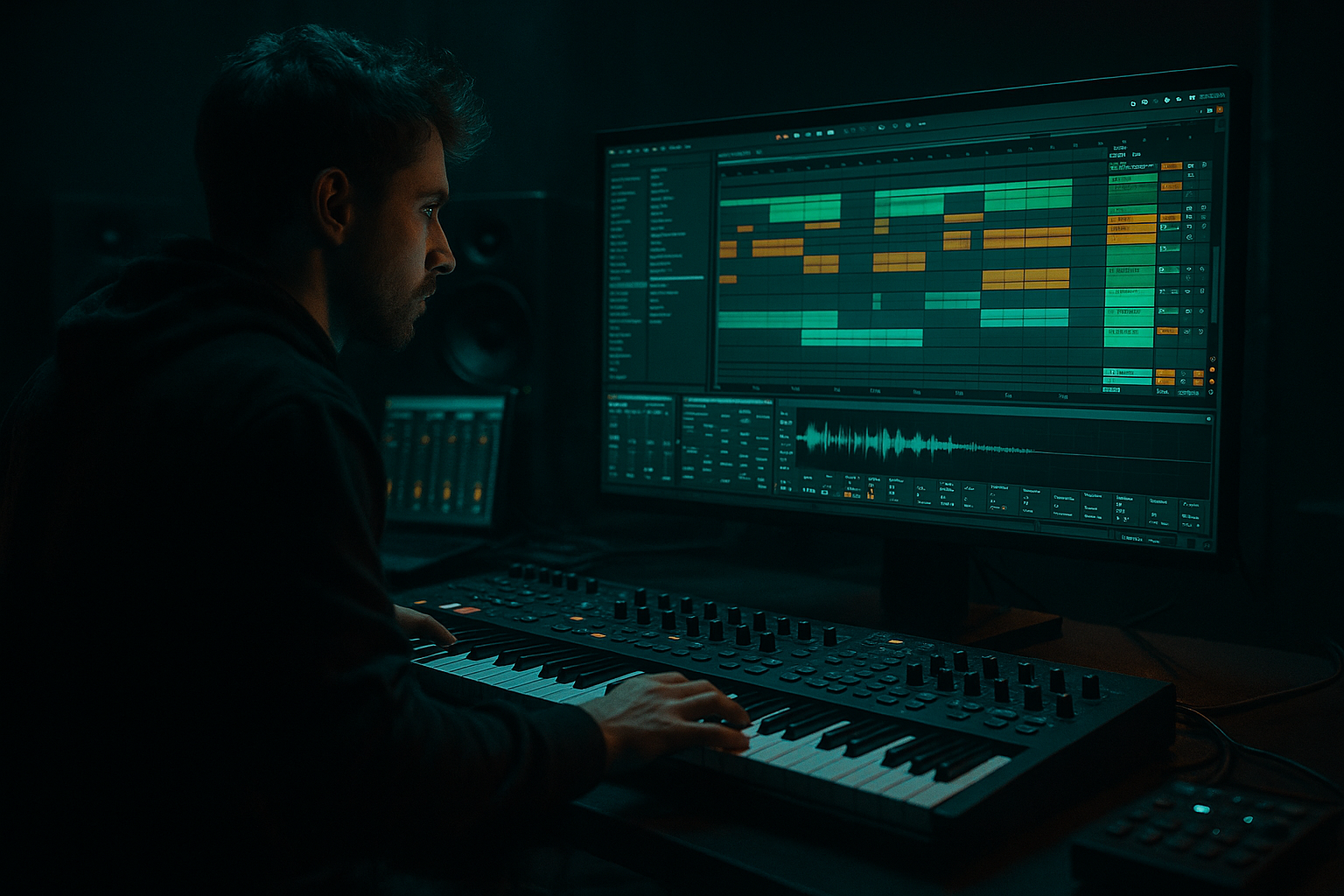
Main tutorial
Lesson Overview
The Concrete Echo formula is a fast way to turn a plain breakbeat into a tight, punchy oldskool DnB / jungle roll that still feels gritty and alive. The idea is simple: start with a concrete break — a raw, dusty drum loop with character — then use echo, slicing, and tight groove control to make it bounce like classic jungle, while still fitting cleanly into a modern Ableton Live 12 session.
This technique sits right in the drum programming and groove part of a track, usually in:
- the main drop drums
- a second half switch-up
- a build into the drop
- a DJ-friendly intro loop that slowly opens up
- a raw break loop
- a short echo-based roll that adds movement and tension
- a tightened drum edit with cleaner transients and stronger grid control
- a drum bus with light saturation and compression for weight
- a version that works well with:
- a half-bar bass call-and-response
- an 8-bar drop section
- a switch-up before a breakdown
- a jungle-style intro where the break grows more intense over time
- Overusing Echo
- Making the break too tight too early
- Too much low end in the break
- Ignoring velocity
- Bus compression too hard
- No arrangement variation
- Layer a clean kick under the break
- Add subtle saturation to the snare channel
- Keep bass and drums in different jobs
- Use call-and-response between bass and break
- Try a darker return track
- Check mono on the low end
- Use short fills before switch-ups
- Resample the best grimy moment
- start with a characterful break
- slice and program it into a simple DnB groove
- use Echo for movement and tension
- tighten the drums with timing, transients, and gentle bus processing
- arrange it in short DnB phrases so it evolves every few bars
Why it matters: oldskool DnB and jungle often feel exciting because the drums are not perfectly rigid. They have micro-timing movement, ghost hits, echoes, and edited repeats that create pressure and momentum. In Ableton Live, you can do this without overcomplicating things. You’ll build a break roll that starts rough, then gets tighter and more focused using Echo, Simpler, warp control, transient shaping, and subtle groove timing.
This is especially useful if your drums feel too static or too clean. The Concrete Echo formula gives you that rolling, “machine + human” feel: dusty break texture, echo tails for motion, and tightened edits so the groove still slams on a club system. 🔥
What You Will Build
By the end of this lesson, you’ll have a 4-bar drum loop that sounds like a classic jungle / oldskool DnB break, but polished enough for a modern session.
Specifically, you will create:
- a sub bass
- a reese
- a dark atmosphere
- a drop arrangement
Musically, this could sit under:
The goal is not just “making a loop.” It’s making a loop that feels like it can drive an entire DnB section.
Step-by-Step Walkthrough
1. Find or create a break with real character
Start with a break that already has some movement. A classic amen-style break, a dusty funk break, or any broken beat with clear transients works well. Drag it into an audio track in Ableton Live 12.
Good beginner approach:
- Choose a break around 160–175 BPM.
- If your project is already set to 174 BPM, keep it there.
- Turn on Warp if needed, but avoid stretching the loop so much that it loses punch.
If the loop feels too loose, use Ableton’s Warp markers to straighten the first downbeat only. You do not need to perfectly quantize every hit yet. Some irregularity is good for jungle energy.
Useful workflow choice:
- Loop just 1 bar at first.
- Make sure the kick/snare relationship feels strong before you add more processing.
Why this matters: classic jungle rhythm comes from a break that keeps some of its original swing and texture. If you start with a dead, over-edited loop, the final result often sounds flat.
2. Slice the break into playable pieces
Right-click the audio clip and choose Slice to New MIDI Track. In the slice settings, use:
- Transient slicing for a more natural drum chop
- Or 1/16 if the break is already very even
Ableton will create a Drum Rack with each hit on separate pads. This is where the Concrete Echo formula starts to become controllable.
Now clean the rack:
- Keep the key hits: kick, snare, hats, ghost hits
- Mute or delete slices you don’t need
- Duplicate the snare slice to a few pads if you want easier re-triggering
Beginner-friendly goal:
- Build a 4-step or 8-step phrase using only 4–6 slices
- Focus on one strong snare and one kick, then add small ghost notes
You are not trying to create a complex drum map yet. You’re creating a small set of break ingredients you can repeat and vary.
3. Program a rolling pattern with ghost notes
In the MIDI clip for the Drum Rack, place the break hits into a simple DnB pattern. Start with:
- Snare on beat 2 and 4 or the classic DnB backbeat feel
- A kick before or after the snare to create forward motion
- A few ghost notes around the snare and between hats
Practical beginner pattern idea:
- Put your main snare on 2 and 4
- Add a kick just before beat 2 or just after it
- Add one or two quieter ghost hits between the main hits
Then open the MIDI Note Editor and use Velocity to make the ghost hits softer:
- Main snare velocity: 95–115
- Ghost notes: 25–60
- Supporting hats: 40–75
This is where the groove starts. In DnB, ghost notes are not decoration — they are the “engine noise” that makes the rhythm feel busy without becoming crowded.
Why this works in DnB: fast tempos leave very little time for percussion to feel interesting. Ghost notes fill the gaps between the main impacts, so the loop feels like it’s rolling forward even when the main snare is holding the listener in place.
4. Add the “Concrete Echo” using Echo on a return or drum bus
Now create movement with Ableton’s Echo. You have two clean beginner options:
Option A: Put Echo on a Return Track
- Send only specific drum hits, like snare ghosts or chopped fills
- This keeps the main loop clear
Option B: Put Echo directly on the Drum Rack’s group/bus
- Better for a more obvious effect
- Use it sparingly so the loop doesn’t blur
Good starter settings for Echo:
- Time: 1/8 or 1/16
- Feedback: 15–35%
- Dry/Wet: if on a return, use 100% wet
- Filter: cut low end below 200–400 Hz
- Modulation: keep low, around 5–15%
- Character: use a little Drive if you want grit
Keep the echoes short and rhythmic. You want them to feel like drum dust trailing behind the hits, not a huge delay wash.
Automation idea:
- Automate send level up at the end of every 4th or 8th bar
- Push more echo only on a transition snare or fill
- Pull it back at the start of the drop so the rhythm stays tight
This is the “Echo” part of Concrete Echo: the break gets a trail of repeated motion, which creates tension and a sense of depth.
5. Tighten the break so the roll stays locked in
The “tighten” part means making the groove feel more controlled after the echo creates movement. You do this with timing, transient shaping, and some clipping control.
On the Drum Rack group or individual break track, add:
- Drum Buss for punch and transient control
- Or Compressor for light glue
- Optionally Saturator for warmth and edge
Starter settings:
- Drum Buss Drive: around 5–15%
- Boom: off or very low for now
- Transient: small boost, around 5–20%
- Compressor Ratio: 2:1 to 4:1
- Attack: 10–30 ms
- Release: 50–120 ms
If the break feels too loose, use the Groove Pool:
- Drag in a swing groove, such as a subtle MPC-style swing
- Apply it lightly to the MIDI clip or drum group
- Keep Timing or Random subtle so the hits don’t fall apart
For beginner-friendly tightening, try:
- Less than 30% groove amount
- Shorten the note lengths in MIDI if ghost hats feel messy
- Nudge the main snare slightly if the pocket feels awkward
The goal is simple: let the break breathe, but make sure the main hits still land with authority.
6. Resample or freeze the best version of the roll
Once your break roll feels good, resample it to audio. This is a classic jungle workflow and makes the next steps easier.
In Ableton:
- Create a new audio track
- Set its input to Resampling
- Record 4 or 8 bars of the drum loop
Why resampling helps:
- You commit to a groove shape
- You can see the waveform and edit it precisely
- You can chop the best moments into fills, drops, or intro variations
After recording:
- Use Fade handles on the clip edges to avoid clicks
- Cut the audio into 1-bar or 2-bar pieces
- Duplicate the best bar and vary it every 4th or 8th bar
This is a strong beginner move because it turns “a loop” into “arrangement material.” Jungle and oldskool DnB are built on variation from repeated material.
7. Shape the drum bus for weight without killing the vibe
Group your drums and add a basic chain on the drum bus. Keep it simple.
A practical beginner drum bus chain:
- EQ Eight
- Drum Buss
- Glue Compressor or Compressor
- Saturator if needed
EQ Eight:
- High-pass very gently if there’s unwanted sub rumble below 25–35 Hz
- Dip harshness around 4–8 kHz if the hats bite too much
- Avoid over-cutting the low mids; that’s where break body lives
Drum Buss:
- Add a little Drive
- Use Transient to bring back attack
- Keep Boom low unless you specifically want extra kick weight
Saturator:
- Use Soft Clip if available in your version
- Keep Drive low, around 1–4 dB
- Use it to thicken, not to crush
If your drums start pumping too much, lower the compressor amount before touching EQ. In DnB, clarity is king: the drums need to be hard, but not bloated.
8. Place the break into a simple 8-bar arrangement
Now make the groove usable in a track.
A beginner-friendly arrangement idea:
- Bars 1–4: stripped break with less echo
- Bars 5–8: add the echo return and a few extra ghost hits
- Bar 8: fill or reverse-style transition into the next section
This is perfect for a jungle or oldskool DnB build where tension gradually increases.
You can automate:
- Echo feedback from 20% to 35% in the last bar
- Drum Buss transient slightly up in the second half
- Filter cutoff on a noise layer or ambience to open up the section
Musical context example:
- Imagine a 4-bar intro loop with just break + sub
- Then an 8-bar drop where the echoed snare ghosts become more active
- After that, a switch-up bar strips the drums back down for impact
This gives the tune a DJ-friendly shape and keeps the groove from feeling copy-pasted.
Common Mistakes
- Problem: the break turns into a mushy delay cloud.
- Fix: keep Echo filtered, lower the feedback, and only send specific hits.
- Problem: all human feel disappears.
- Fix: leave some original swing and ghost-note looseness before tightening with bus processing.
- Problem: clash with the sub bass.
- Fix: use EQ Eight to clean sub-rumble below about 30 Hz, and keep the break’s low end controlled.
- Problem: every hit feels the same.
- Fix: use velocities for ghost notes and accents. DnB groove depends on dynamic contrast.
- Problem: transients vanish and the break sounds lifeless.
- Fix: use gentle compression with slower attack and moderate release.
- Problem: the loop gets boring after 8 bars.
- Fix: add a fill, remove a kick, increase echo, or switch the last bar to a new chop.
Pro Tips for Darker / Heavier DnB
- Use a tight kick sample low in the mix to reinforce the drop without replacing the break.
- A little Saturator or Drum Buss drive can make the snare feel more like a club weapon.
- Let the break provide the midrange movement, while the sub stays mono and clean.
- Leave small gaps in the bassline so the break can breathe, then answer with a reese stab or low growl.
- Put Echo on a return with a filtered, slightly distorted tail for snare throws and transition hits.
- Keep the kick and sub centered. Let the break texture spread only in the upper range if needed.
- One chopped snare roll or reversed break hit before bar 8 can make the drop feel much bigger.
- Once you find a happy accident, print it to audio and reuse it. This is a classic underground workflow and helps you finish faster.
Mini Practice Exercise
Spend 15 minutes making one Concrete Echo drum loop.
1. Load a break into Ableton and slice it to MIDI.
2. Program a 1-bar loop with:
- one strong snare
- one kick variation
- 2–4 ghost notes
3. Send only snare ghosts to an Echo return.
4. Set Echo to:
- 1/16 or 1/8
- 15–25% feedback
- filtered low end
5. Put Drum Buss on the drum group with a light transient boost.
6. Duplicate the loop across 4 bars.
7. In bar 4, automate a little more Echo send and add one extra chop.
8. Resample the result and listen back once in mono.
Goal: make the groove feel like it rolls forward, then tightens at the end of the phrase.
Recap
The Concrete Echo formula is:
If your loop feels too plain, add echo and ghost notes. If it feels too messy, tighten the bus and filter the delays. That balance — dusty motion plus controlled impact — is the core of great jungle and oldskool DnB groove.

