Main tutorial
Lesson Overview
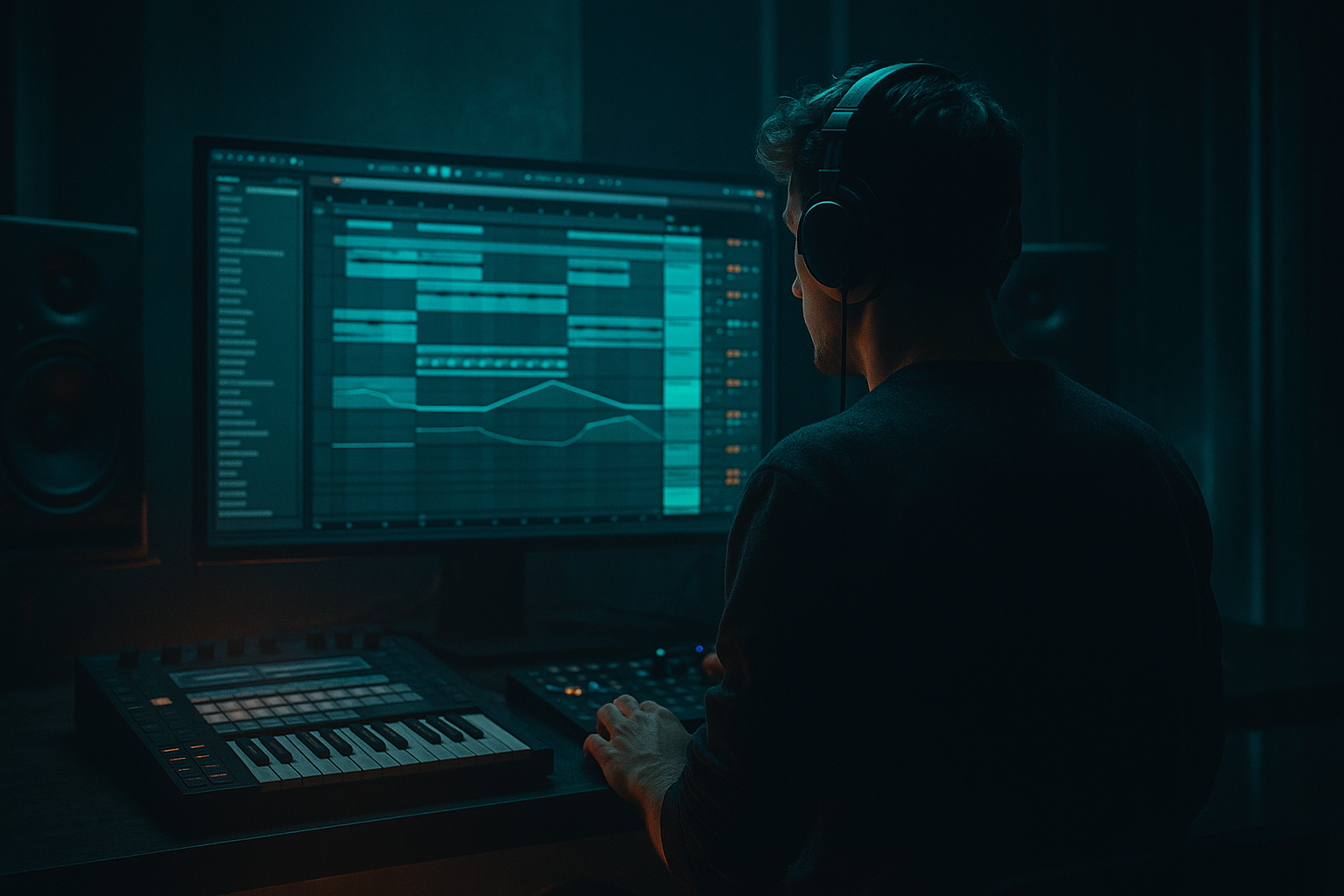
The Concrete Echo system is a practical way to build a DJ-friendly intro drive for jungle and oldskool DnB in Ableton Live 12. The idea is simple: instead of dropping into your main drum pattern immediately, you create an intro that feels like a gritty tunnel or concrete stairwell—tight drums, pressure-heavy low end hints, echo tails, and controlled movement that makes a DJ want to mix into it.
This matters because in Drum & Bass, the intro is not just “dead space before the drop.” It’s your mix-in lane, your energy ramp, and often your first chance to signal genre, mood, and weight. A strong intro drive does three jobs at once:
1. It gives DJs a clean entry point.
2. It establishes groove and character before the full drum arrangement lands.
3. It sets up the drop with tension, contrast, and momentum.
In oldskool jungle and darker rollers, the intro often carries the identity of the tune. You might hear clipped breaks, dubby echoes, filtered bass pulses, chopped atmospheres, or a teaser of the main reese. The Concrete Echo system leans into that language, but keeps it modern and Ableton-friendly.
We’ll build a focused intro that feels like:
- a dusty warehouse tunnel
- a DJ mix-in section with drive
- a break-led groove that moves forward without overcrowding the mix
- a bass tease that hints at the drop, not reveals it too early
- a filtered breakbeat loop that feels chopped and alive
- a sub or bass ghost that teases the drop without dominating it
- a dubby echo system built with Ableton stock delay and reverb
- subtle ghost hits, atmospheres, and tonal fragments
- a groove that sits in the pocket and pushes forward
- enough space for a DJ to beatmatch cleanly
- Bars 1–4: filtered drums + atmosphere, minimal low-end content
- Bars 5–8: bass hints, more break motion, extra ear candy
- Bars 9–16: stronger drum presence, pre-drop tension, or a switch-up into the main section
- Making the intro too full too soon
- Over-widening the bass teaser
- Letting echo muddy the low end
- Quantizing the break until it loses feel
- Using too many fills in the mix-in zone
- Skipping arrangement variation
- Ignoring mono compatibility
- Use saturation in layers, not extremes
- Resample your intro movement
- Let the bass tease be rhythmically smart
- Darken the room without killing clarity
- Add industrial texture very quietly
- Use transient contrast
- For neuro-leaning weight, hint at modulation early
- Keep the intro mix dark but not dull
- Does the intro breathe?
- Is the low end controlled?
- Does the groove feel like it’s pulling forward?
- Would a DJ have an easy 16-bar mix point?
- a chopped break with groove
- controlled echo and reverb
- a bass tease instead of a full bassline
- clear 4-bar phrasing
- automation for tension and movement
- clean low-end discipline for mixing
You’ll use stock Ableton devices, groove timing, automation, resampling, and arrangement choices to create something that’s functional for mixing and still hard enough to hold attention. 🥁
What You Will Build
By the end of this lesson, you’ll have a short 8- or 16-bar DJ intro section for a jungle / oldskool DnB track with:
Musically, this intro should work like a pressure build:
The result is not a full drop. It’s a controlled runway that says, “this track is about to move.”
Step-by-Step Walkthrough
1. Set up a clean intro template in Ableton Live 12
Start with a blank section or a dedicated intro group. Create these tracks:
- Drum Break
- Ghost Perc
- Bass Tease
- Atmos FX
- Return A: Echo
- Return B: Reverb
Keep the session organized from the start. For DnB, speed matters. You want to make decisions fast and avoid clutter. Set your project tempo around 170–174 BPM for jungle and oldskool DnB, or around 172 BPM if you want a neutral center.
On your Master, leave headroom. Aim for roughly -6 dB peak while building. That gives space for the drop later and stops the intro from feeling prematurely “finished.”
Why this works in DnB: the intro needs room to breathe because the drop will likely be dense. If your intro is already crushing the limiter, the energy curve collapses and the DJ mix point feels less useful.
2. Build the drum foundation with a chopped break
Load a classic break or your own resampled break into Simpler or an Audio track. If you’re using Simpler, go for Slice mode if the break has clear hits, or Classic if you want to play a looped phrase.
For a jungle feel, use a break that has snare character and ghost-note movement. If needed, layer:
- one break with punch
- one break with texture
- a separate kick or sub-hit only on key downbeats
Use the Warp controls carefully if the loop needs timing cleanup. In many jungle contexts, you don’t want the break too grid-perfect. Keep the human push-pull. Then apply Ableton’s Groove Pool:
- Try an MPC-style groove or a subtle swing around 54–58%
- Keep Timing around 20–40%
- Keep Random low, around 0–8%
Add Drum Buss on the break group and start gentle:
- Drive: 5–15%
- Boom: very low or off at first
- Damp: moderate if the break is harsh
- Transients: slightly up if you need snap
The goal is a break that already moves without sounding like a loop slapped onto a grid. Let the snare and ghost notes carry the groove.
3. Shape the Concrete Echo feel with delay and controlled space
Create an Audio Effect Rack or just use the return tracks for your echo space. On Return A, add Echo. This will be your signature “Concrete Echo” layer.
Good starting settings for a DJ-intro echo:
- Time: 1/8 Dotted or 1/4
- Feedback: 25–45%
- Filter: high-pass the repeats so the low end stays clean
- Modulation: subtle, around 5–15%
- Dry/Wet: 100% on the return
On Return B, place Reverb with a darker character:
- Decay: 1.2–2.5 s
- Pre-delay: 10–25 ms
- Low Cut: around 150–250 Hz
- High Cut: around 5–8 kHz
Send selected break hits, ghost percussion, or atmospheric stabs into Echo sparingly. Don’t flood the intro. In oldskool DnB, the echo is part of the architecture, not decoration.
Use automation on the send level rather than the return dry/wet. That gives more precise control over when the room “lights up.” For example:
- Bars 1–4: Echo send at -18 to -12 dB
- Bars 5–8: push to -10 to -6 dB for key hits
- Then pull back before the main drop
4. Create the bass tease without giving away the drop
Make a dedicated Bass Tease track. Use Operator or Wavetable to build something simple and tough. For this stage, you don’t need the full drop bass. You need a short hint of sub pressure or reese identity.
Two effective approaches:
- Sub pulse: sine or very soft triangle, short notes, filtered, mostly mono
- Reese fragment: detuned saw layers, filtered low-mid focus, short swells or call-and-response hits
If using Operator:
- Oscillator A: sine
- Add very light saturation later with Saturator
- Filter the top end using Auto Filter
- Keep notes short and sparse
If using Wavetable:
- Choose a basic saw or analog-style table
- Slight unison, not too wide
- Use filter movement with moderate resonance
Suggested bass intro settings:
- Low-pass filter cutoff: 100–250 Hz for teaser stages
- Saturator Drive: 2–6 dB
- Width: keep under control; mono below around 120 Hz
- Envelope decay: 150–400 ms for short phrases
Write the bass as question-and-answer phrases rather than a constant line. For example, let the bass answer the snare on bar 2, then disappear for a bar. That negative space creates more drive than overplaying.
5. Use arrangement phrasing to make the intro DJ-friendly
This is where the Concrete Echo system becomes a real intro and not just a loop. In Arrangement View, structure your intro in clear 4-bar phrases.
A strong example:
- Bars 1–4: filtered break + atmosphere only
- Bars 5–8: add bass tease and one extra ghost perc
- Bars 9–12: open the break slightly, add more snare accents
- Bars 13–16: tension peak, snare fill, delay swell, then drop
Keep the first 8 bars mixable. DJs need time to count in, phase, and blend. That means avoiding sudden fills in the first half unless they’re very controlled.
Use automation to open the filter gradually on the break group:
- Start with Auto Filter cutoff around 200–500 Hz
- Open toward 2–6 kHz by bar 8 or 12
- Automate resonance lightly for movement, but don’t whistle the intro into chaos
Also automate your bass teaser so it becomes more present as the intro progresses. This creates forward motion without turning the intro into the drop.
6. Add ghost percussion and micro-edit details for groove
The groove in oldskool jungle often comes from tiny accents: hats, rim ghosts, chopped tails, reversed bits, and occasional vocal or texture fragments. This is where your intro gets personality.
Add a Ghost Perc track with:
- a rimshot, tick, or quiet snare layer
- occasional offbeat hat stabs
- one or two reversed percussion hits before phrase changes
Process lightly with Drum Buss, EQ Eight, or Transient shaping via clip gain and envelopes. Keep ghost hits low in the mix; they should be felt more than heard.
Practical groove ideas:
- Put a ghost hit just before the main snare on bar 4 or 8
- Use a half-bar pickup into the next phrase
- Shift one percussion hit slightly late to create drag
- Keep some elements dry and some echoed so the intro has depth
If the break is too static, duplicate it and edit a second variation:
- remove one kick
- add a tiny snare flam
- reverse a tail into the downbeat
- change the last two hits before the switch
This keeps the intro alive without sounding over-arranged.
7. Shape the low end so it supports the mix-in, not the whole tune
In a DnB intro, the low end should be controlled. You want enough weight for identity, but not so much that the DJ’s incoming track has nowhere to sit.
On the bass teaser and break group:
- Use EQ Eight to high-pass non-bass elements
- Keep sub information mostly mono
- Cut muddy low mids around 200–400 Hz if needed
- Check for harshness around 3–6 kHz on the break if the hats get spitty
If you want a stronger intro bass feel, layer a very low sine under the teaser and keep it short:
- note length: 1/8 to 1/4
- velocity variation: subtle
- sidechain or volume-shape it with the kick if needed
A clean intro often wins over a busy one. The DJ needs certainty. The listener needs tension. The low end should imply power, not already spend it.
8. Create movement with automation, not extra layers
Intermediate producers often add too many parts when the intro feels flat. In DnB, a better move is usually automation.
Automate one or more of these:
- Echo feedback from 20% up to 45% on phrase endings
- Filter cutoff opening on the break or atmosphere
- Reverb send spikes on selected snare hits
- Saturator drive rising slightly before the transition
- Drum Buss transient boost for the last 2 bars
- Bass volume fade-in from almost silent to subtle presence
A strong move is to automate the Echo return so the final hit of the intro blooms, then quickly ducks. That creates the “Concrete Echo” sensation: reflective, industrial, and forward-moving.
Keep automation curves intentional:
- long, smooth arcs for atmosphere
- sudden jumps for fill hits
- short dips before important downbeats to create punch
This is the difference between a loop and an intro that actually drives.
9. Finish with a transition that points into the drop
The end of the intro should feel like a handoff. You can do this with:
- a snare fill
- a reverse cymbal
- a delayed break tail
- a filtered bass pickup
- a final bar with reduced drums then a full re-entry
A classic DnB move is to strip back the last 1–2 beats before the drop so the first downbeat lands harder. Another option is to keep the break rolling but remove the bass for one beat, then slam it back with the drop.
Use Utility on the pre-drop section if you need to tighten mono control or reduce width briefly before impact. A little narrowing before the drop can make the drop feel wider.
If you’re building a DJ intro rather than a full track intro, make sure the first 16 bars are beatmatch-friendly:
- stable tempo feel
- not too many one-shot surprises
- clear kick/snare anchors
- predictable phrase lengths
Common Mistakes
Fix: keep the first 4–8 bars sparse. Save your bass identity and fills for later in the phrase.
Fix: keep sub mostly mono. Use width for top harmonics, not the actual low end.
Fix: high-pass your Echo and Reverb returns. The repeats should create space, not low-end fog.
Fix: keep some human swing. Use Groove Pool lightly and preserve break character.
Fix: DJs need stable phrasing. Keep early bars clean and predictable.
Fix: duplicate the loop and make at least one subtle variation every 4 bars.
Fix: check the intro in mono, especially the sub and break group. If the groove collapses, simplify the stereo effects.
Pro Tips for Darker / Heavier DnB
Try Saturator before Drum Buss for a denser tone, then keep drive moderate. Small amounts stack well.
Bounce 4 bars of your break-plus-echo chain to audio, then chop the best moments. This often creates more authentic jungle motion than endless MIDI editing.
Instead of playing on every downbeat, answer the snare or leave a bar empty. Space creates menace.
Use Reverb with a high cut around 6–8 kHz and a low cut around 200 Hz. You get depth without hiss and boom.
Faint vinyl noise, metallic hits, or field-recorded ambience can make the intro feel like concrete and steel. Keep these tucked low.
A dry snare hit followed by a washed-out echo makes the groove feel bigger than if everything is wet all the time.
A tiny filter wobble or formant shift in the bass tease can foreshadow the drop without becoming flashy.
Don’t roll off all the top end. A bit of hat and break sparkle helps DJs lock in the rhythm.
Mini Practice Exercise
Spend 10–20 minutes building a 16-bar Concrete Echo intro:
1. Choose one break and one bass sound.
2. Set the tempo to 172 BPM.
3. Build bars 1–4 with only filtered break + atmosphere.
4. Add a bass tease in bars 5–8 using only 2–4 short notes.
5. Send one snare hit or ghost perc to Echo on each 4-bar phrase ending.
6. Automate the break filter to open gradually from bar 1 to bar 12.
7. Add one fill or reversed hit in bars 13–16.
8. Export or loop the section and listen as if you were a DJ mixing in.
Now ask yourself:
If any answer is no, simplify one layer and increase movement through automation instead.
Recap
The Concrete Echo system is about building a DJ-ready DnB intro that feels gritty, spacious, and alive. Focus on:
In jungle and oldskool DnB, the intro is part of the identity. Make it feel like a tunnel, a warehouse, or a concrete stairwell—then let the drop explode out of it.

