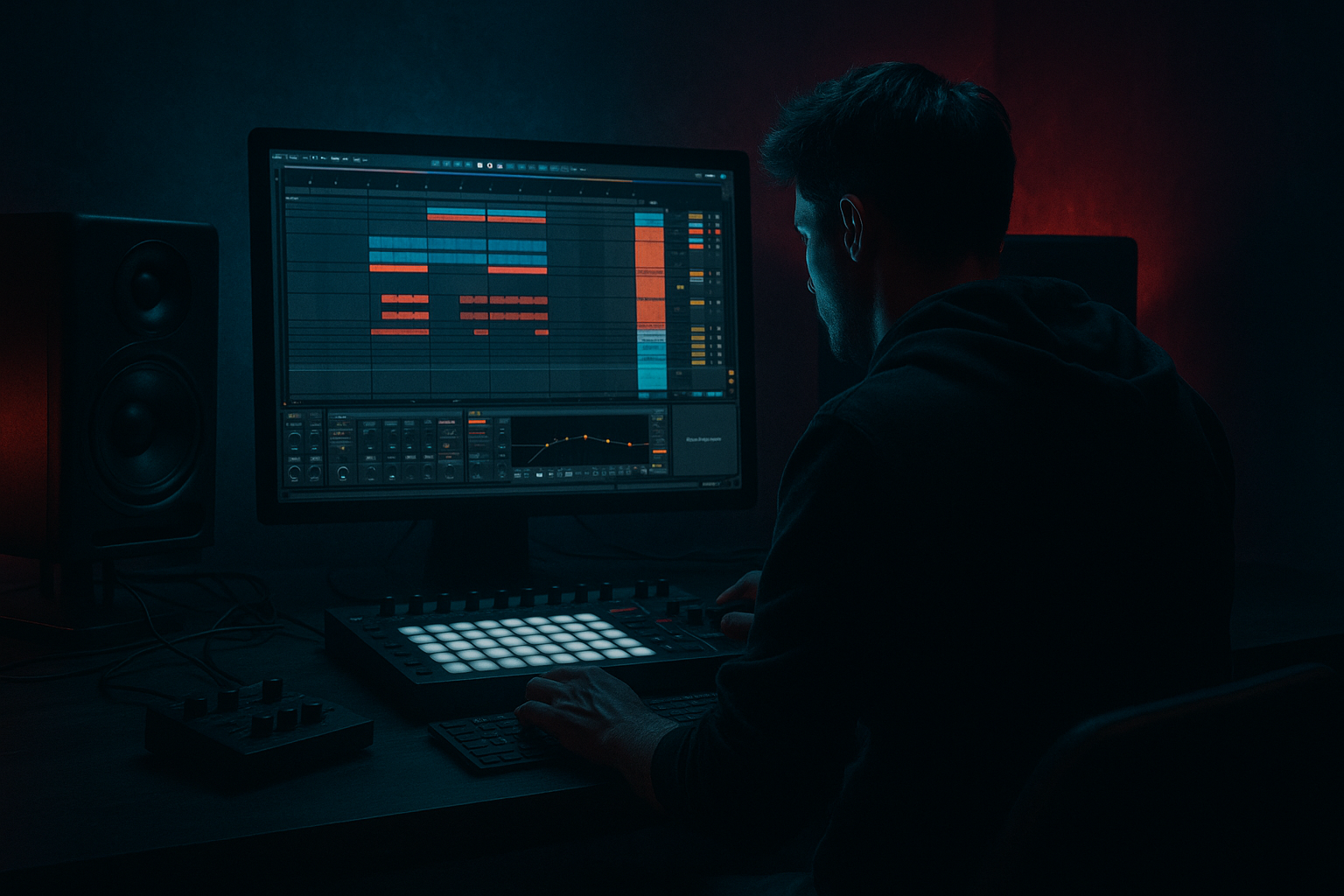
Main tutorial
Contrast Between First and Second Drops for Clean Mixes in Drum & Bass
1. Lesson overview
In advanced drum & bass arrangement, the second drop should not just be “more stuff.” If you stack extra layers without a plan, the mix gets cloudy, the bass loses impact, and the drums stop feeling dangerous. 😈
The goal of this lesson is to show you how to create meaningful contrast between your first and second drops while keeping the mix clean, punchy, and controlled inside Ableton Live.
In DnB, especially darker, rolling, or jungle-inspired tracks, the second drop often needs to feel:
- heavier
- wider
- more aggressive
- more developed
- but still tighter than the first
- density management
- frequency allocation
- drum variation
- stereo contrast
- automation
- call-and-response bass writing
- strategic subtraction
- Drop 1 is controlled, stripped, and groove-focused
- Drop 2 is heavier and more exciting, but still clean
- dark roller low-end
- jungle energy in the breaks
- modern neuro/tech movement in the bass arrangement
- a focused first drop with one main bass idea
- a contrasting second drop with added movement, fills, switch-ups, and width
- a mix-safe transition plan
- grouped channels with utility-based control
- automation that creates intensity without overload
- the bass may become more syncopated in drop 2
- the drums may open up with more ghost notes
- the reese may widen while the sub stays mono
- the lead stab may become a response instead of a constant layer
- fills may become more frequent, but shorter
- kick
- snare
- hats/top loop
- sub
- main bass midrange layer
- one supporting texture or riff
- minimal FX
- occasional fills
- DRUMS
- BASS
- MUSIC
- FX
- VOCALS if applicable
- A: Short Drum Room
- B: Bass Atmos Send
- C: Long FX Verb
- the sub pattern is simple
- the main bass motif is repetitive and memorable
- the drums carry the groove
- there’s clear space between bass phrases
- a second bass response every 2 bars
- a jungle break layer on bars 5–8
- a higher-octave stab phrase
- a distorted fill bass at the end of each 4-bar phrase
- shorten the pad tails
- remove a constant top loop
- mute a texture on bars where the new bass enters
- reduce FX clutter
- another reese
- another sustain bass
- more distortion
- another atmosphere layer
- Sub: pure sine or filtered triangle, mono
- Main mid bass: focused distorted tone, mostly 200 Hz–2.5 kHz
- Texture layer: low in volume, maybe a noisy top around 2 kHz+
- Main bass still handles the groove
- Add a response bass only in the gaps
- Automate distortion or filter movement
- Widen only the upper harmonics, not the low-mids
- Side channel low-cut up to 150–200 Hz
- keep low-end mono with Utility > Bass Mono if needed
- core kick/snare hitting hard
- one main hat groove
- one break layer tucked in low
- ghost notes minimal
- add a higher-energy break layer for 4 or 8 bars
- increase ghost snares before the 2 and 4
- add ride or shuffly top percussion
- add micro fills at the end of phrases
- switch one snare hit to a flam or layered transient every 8 bars
- bars 1–4: main drums only
- bars 5–8: break comes in
- bars 9–12: break drops out, hats change
- bars 13–16: break + snare fill variation
- sub mono
- bass mids mostly centered
- hats moderately wide
- pads controlled
- widen hat loops
- add stereo FX responses
- widen upper reese harmonics
- automate return sends on stabs or fills
- Width on hats/top loops: 120–160%
- Width on upper texture bass: 110–130%
- Gain automation for arrangement lift
- 1/8 dotted or 1/4
- low feedback
- filtered tone
- automate send only at phrase ends
- Chain 1: Low Band
- Chain 2: Mid/High Band
- bass filter cutoff
- distortion drive
- send amount to delay/reverb
- hat loop volume
- break layer volume
- utility width
- transient emphasis on drums
- EQ tilt on atmos/textures
- bar 4: bass send to Echo rises briefly
- bar 8: break layer comes in + hat width increases
- bar 12: response bass distortion increases slightly
- bar 16: short fill + reverb throw into transition
- filter cutoff
- distortion amount
- width
- send level
- familiar groove from Drop 1
- one new element introduced
- increased drum movement
- bass response enters
- maybe one vocal chop or stab accent
- partial reset
- remove one busy top layer
- let the sub and drums breathe
- biggest variation
- fill bass or jungle chop
- stronger FX into transition/outro
- BASS group
- DRUMS group
- Master
- is the low-end still mostly one source at a time?
- do added layers introduce rumble?
- are kick and bass fighting more in Drop 2?
- did added reese layers thicken too much?
- did new snare layers, bass grit, and hats pile up?
- remove one mid-bass layer before EQ-ing everything harder
- shorten bass tails with clip editing or gating
- high-pass support layers more aggressively
- reduce break level by 1–2 dB
- automate atmos down when the bass phrase hits
- narrow wide bass texture if center detail disappears
- thin out the sub or fully cut it for a moment
- reduce full drums to kick pattern, percussion, or filtered breaks
- automate low-pass filters on music/atmos
- use one focused riser, not five
- include a short silence or drum cut before the impact
- Auto Filter for riser filtering
- Hybrid Reverb for reverse swells
- Echo for dubby pre-drop throws
- Redux very lightly on fills for grit
- Reverb Freeze moments with Hybrid Reverb for texture swells
- cut the sub
- let a snare fill or reversed break lead in
- leave a tiny gap
- slam back in with dry kick, snare, and sub first
- bring the extra Drop 2 layers in on beat 2 or bar 2
- sub follows core groove
- mid-bass response creates the complexity
- Operator or Wavetable noise component
- Saturator
- Auto Filter band-pass
- subtle stereo spread
- bring in the break for bars 5–8
- cut it for bars 9–12
- reintroduce with edits in bars 13–16
- decay 1.2–2.2s
- high-pass around 500 Hz
- automate send only on phrase-ending hits
- Saturator or Roar
- EQ Eight high-pass at 200 Hz
- Compressor
- maybe Chorus-Ensemble lightly
- Utility to trim output
- kick
- snare
- hats
- sub
- one main bass
- one atmosphere
- main drums
- sub
- one bass motif
- one subtle atmosphere
- one fill every 8 bars maximum
- no more than 6 active elements at once
- keep bass mostly mono and dry
- keep drums punchy and uncluttered
- Does Drop 2 feel bigger immediately?
- Can you still clearly hear the kick, snare, and sub?
- Is the added bass actually helping, or just filling space?
- Does the second drop have at least one reset moment?
- Does the stereo image feel bigger without the low-end getting blurry?
- choosing a specific type of contrast
- holding back elements in Drop 1
- adding only one or two major new ideas in Drop 2
- subtracting something whenever you add something
- keeping sub stable and mono
- letting drums and automation create excitement
- using phrase resets so the drop breathes
- a bar-by-bar 32-bar Ableton arrangement template
- a DnB drop checklist
- or a stock-device rack setup for first-drop/second-drop contrast
That means arrangement decisions must support the mix. Instead of throwing in random FX and extra basses, you’ll build contrast through:
This tutorial focuses on advanced arrangement thinking using Ableton stock devices and a practical workflow you can apply immediately.
---
2. What you will build
You will build a two-drop DnB arrangement concept where:
Target style
Think of a hybrid of:
By the end, your arrangement will include:
Core production principle
Contrast is not just adding layers. Contrast is changing the role of existing elements.
For example:
That’s how you get the second drop to feel like a payoff without ruining the mix.
---
3. Step-by-step walkthrough
---
Step 1: Build the first drop as the clean reference point
Before you design contrast, make sure Drop 1 works on its own.
A strong first drop in DnB should usually have:
Ableton session setup suggestion
Group your channels like this:
- Kick
- Snare
- Hats
- Percs
- Breaks
- Sub
- Mid Bass Main
- Mid Bass Support
- Reese / Texture
- Pads
- Stabs
- Atmos
- Risers
- Impacts
- Reverses
Then create return tracks:
- Hybrid Reverb
- Decay: 0.35–0.6s
- HP filter around 400 Hz
- Echo
- 1/8 or 1/4 ping-pong
- High-pass around 500 Hz
- Low-pass around 6–8 kHz
- Hybrid Reverb
- 2–4s decay
- mostly for transitions only
Arrangement target for Drop 1
Keep it to 8 or 16 bars with restrained energy.
A strong first drop often works best when:
Practical rule
Mute everything non-essential and ask:
> “If I remove this, does the drop lose identity?”
If not, leave it out of Drop 1.
---
Step 2: Define the exact contrast type for Drop 2
Before touching the arrangement, decide what kind of contrast you want.
Here are the most effective options in DnB:
#### Option A: Rhythmic contrast
Drop 1 = steady roller
Drop 2 = more syncopated, more fills, more stop-start edits
#### Option B: Tonal contrast
Drop 1 = dry, focused, midrange-controlled
Drop 2 = wider, more distorted, brighter top movement
#### Option C: Drum contrast
Drop 1 = tight 2-step or stripped roller
Drop 2 = additional break layers, ghost snares, extra percussion
#### Option D: Bass dialogue contrast
Drop 1 = one main bass voice
Drop 2 = call-and-response between two bass sounds
#### Option E: Space contrast
Drop 1 = dry and mono-feeling
Drop 2 = wider hats, more FX tails, more stereo movement
For clean mixes, pick only 1–2 main contrast types.
If you try all five at once, the second drop becomes bloated.
---
Step 3: Duplicate Drop 1 and rebuild Drop 2 from it
In Ableton Arrangement View:
1. Select the full first drop section
2. Duplicate it
3. Label the second one clearly:
- `DROP 1 - CONTROL`
- `DROP 2 - PAYOFF`
Now instead of adding random content, use this workflow:
#### Pass 1: Add one new “headline” idea
Examples:
Pick one.
#### Pass 2: Remove one thing that would mask it
Examples:
This is the key advanced move:
Every new feature in Drop 2 should be paid for by subtracting something else.
---
Step 4: Use bass contrast without wrecking the low-mid mix
This is where many producers lose clarity.
In DnB, the second drop often gets muddy because the producer adds:
All of that lands in the 150 Hz to 1.5 kHz range, which is already crowded.
Better strategy: contrast by role, not just frequency
#### Example Drop 1 bass setup
#### Example Drop 2 bass setup
Keep the sub the same or nearly the same.
Then change the mid bass structure:
Stock Ableton chain for a controlled main bass
On your Mid Bass Main track:
1. EQ Eight
- HP around 80–120 Hz
- small dip around 250–400 Hz if boxy
2. Saturator
- Analog Clip or Soft Sine
- Drive: 2–6 dB
- Output compensated
3. Drum Buss
- Drive: 5–15%
- Crunch: low or off
- Damp to control top end
4. Compressor
- fast-ish attack if peaks are wild
- medium release
5. Utility
- automate gain for phrase balancing
Stock chain for a Drop 2 response bass
1. Auto Filter
- automate movement between phrases
2. Roar or Saturator
- more aggressive than Drop 1
3. EQ Eight
- cut lows below 120 Hz
- notch harshness around 2.5–4 kHz if needed
4. Utility
- Width: 120–140% only if the sound is safely high-passed
Important low-end rule
If your second bass layer has useful energy below 150 Hz, it will likely fight your sub.
Use EQ Eight in Mid/Side mode if needed:
---
Step 5: Create drum contrast through groove, not just louder drums
A clean second drop often comes from drum variation, because drums can increase excitement without stealing bass headroom.
Drop 1 drum strategy
Drop 2 drum strategy
Try these changes:
Ableton workflow
Group all drums into a DRUMS bus.
On that bus, try:
1. Glue Compressor
- Attack: 3 or 10 ms
- Release: Auto or 0.3
- Ratio: 2:1
- Aim for 1–3 dB reduction
2. Drum Buss
- Drive: 3–8%
- Transients: adjust carefully
- Boom: usually off for DnB bus processing unless very controlled
3. Utility
- automate +0.5 to +1 dB for drop lift if needed
Advanced arrangement idea
In Drop 2, don’t run the full break all the time.
Instead:
This creates movement while preserving mix clarity.
---
Step 6: Use stereo contrast carefully
One of the cleanest ways to make Drop 2 feel bigger is to increase stereo excitement above the low-end.
Drop 1
Keep things tighter:
Drop 2
Expand selected layers:
Useful stock devices
#### Utility
#### Chorus-Ensemble
Great for upper bass harmonics or air textures, but high-pass first.
#### Echo
Use subtly on fills or vocal chops with:
Pro move
Split a bass into bands using an Audio Effect Rack:
- EQ Eight low-pass around 120 Hz
- Utility width 0%
- EQ Eight high-pass around 120 Hz
- Chorus-Ensemble / Saturator / Utility width 120%
Now your second drop can feel wider while the sub remains stable.
---
Step 7: Create contrast with automation, not extra layers
This is one of the smartest advanced arrangement habits in Ableton.
Instead of adding another sound, automate what you already have.
Best things to automate in DnB drops
Example automation plan for Drop 2
Every 4 bars:
This creates development without overcrowding the spectrum.
Ableton tip
Use clip automation for repeated phrase ideas and track automation for macro arrangement changes.
If using an Audio Effect Rack, map:
to 1–4 macros and automate the macros instead of several devices at once.
---
Step 8: Control phrase density with 4-bar and 8-bar logic
DnB listeners feel arrangement through phrase structure. If your second drop is full-power every bar, it stops feeling special.
Use this 16-bar Drop 2 map
#### Bars 1–4
#### Bars 5–8
#### Bars 9–12
#### Bars 13–16
This gives the drop contour and keeps your mix from being pinned at 100% density.
---
Step 9: Use frequency checkpoints while arranging
Don’t wait until final mixdown to discover Drop 2 is clogged.
As you arrange, do quick frequency audits.
Fast audit method in Ableton
Put Spectrum on:
Then solo-check these zones:
#### Sub zone: 30–90 Hz
#### Punch zone: 90–200 Hz
#### Mud zone: 200–500 Hz
#### Presence zone: 1–5 kHz
Practical fix list
If Drop 2 gets messy:
Arrangement solves many mix problems before processing ever will.
---
Step 10: Transition into the second drop properly
The impact of Drop 2 depends on the setup before it.
If the pre-drop riser section is already too noisy and wide, the second drop can actually feel smaller.
Strong pre-Drop-2 transition recipe
In the 4–8 bars before Drop 2:
Ableton stock devices for transitions
Classic DnB impact move
1 beat before Drop 2:
That way the drop lands hard and still has room to open up.
---
4. Common mistakes
1. Adding too many bass layers in Drop 2
This is the biggest one.
Fix: add one response layer, not three. If you add a new bass, high-pass it and make it rhythmic rather than sustained.
---
2. Making both drops equally busy
If Drop 1 already contains every idea, Drop 2 has nowhere to go.
Fix: hold back in Drop 1. Save one drum layer, one bass variation, and one stereo element for later.
---
3. Widening the whole bass
Wide low-end kills punch and translation.
Fix: use an Audio Effect Rack to separate sub from upper harmonics. Keep lows mono.
---
4. Using FX to fake contrast
More downlifters, impacts, and risers do not equal a better second drop.
Fix: build contrast through writing, groove, and phrase evolution first.
---
5. No reset moments inside Drop 2
If every bar is maxed out, listener fatigue sets in fast.
Fix: remove layers for 1–2 bars mid-drop, then bring them back.
---
6. Over-compressing the drum bus to compete with a busy bass stack
That just flattens the groove.
Fix: simplify arrangement first, then use bus compression lightly.
---
7. Letting pads, verbs, and atmos sit under the bass constantly
This often causes hidden mud in darker rollers.
Fix: automate these down during core bass phrases, especially in the 200–600 Hz range.
---
5. Pro tips for darker/heavier DnB
If you’re making techy, dark, or heavyweight rolling DnB, here’s how to make the second drop feel savage without losing cleanliness 🔥
Use menace through timing, not just distortion
A delayed bass answer, a late snare ghost, or a one-beat dropout can feel darker than just adding more saturation.
---
Keep the sub pattern disciplined
Even in Drop 2, don’t overcomplicate the sub rhythm. Let the mids go wild, but keep the low-end readable.
A great trick:
---
Add one “ugly” texture, filtered hard
A noisy layer can add aggression if it lives mostly above 1.5 kHz.
Try:
This gives hostile character without muddying the body.
---
Jungle break energy works best in bursts
For darker DnB, full-time break layering can make things feel softer or too busy.
Instead:
---
Automate reverb throws on the snare or bass fill only
Heavy tracks stay impactful when the core hit remains dry.
Use Hybrid Reverb on a send:
---
Try controlled parallel aggression on bass
Create a return track:
#### Return D: Bass Smash
Send only selected bass fills or upper layers to it in Drop 2.
This gives the impression of more violence without crowding the main bass channel.
---
Use silence as a weapon
In darker DnB, a half-beat or full-beat cut before a phrase can make the next bass hit feel massive.
Dead space = contrast.
---
6. Mini practice exercise
Here’s a focused Ableton exercise you can do in 30–45 minutes.
Exercise goal
Create a clean contrast between two 16-bar drops using the same core loop.
Starting point
Use an existing DnB loop with:
Part 1: Build Drop 1
Arrange 16 bars with:
Rules:
Part 2: Duplicate to create Drop 2
Now make exactly these changes:
1. Add one response bass in the gaps
2. Add one break layer only in bars 5–8 and 13–16
3. Widen hats by 20–30% using Utility
4. Automate slight extra distortion on the response bass
5. Remove or lower the atmosphere during the busiest bass phrases
6. Add one 1-beat dropout before bar 9 or bar 13
Part 3: Mix-check
Ask these questions:
Bonus challenge
Make Drop 2 feel heavier while keeping the master peak within 1 dB of Drop 1.
That forces you to use arrangement and contrast, not just loudness.
---
7. Recap
Let’s lock in the core lesson:
Clean second-drop contrast in DnB comes from:
Best mindset
Don’t think:
> “How do I make Drop 2 fuller?”
Think:
> “How do I make Drop 2 more intentional, more dynamic, and more dangerous while protecting the mix?”
That’s the advanced arranger mindset.
If you want, I can next turn this into:

