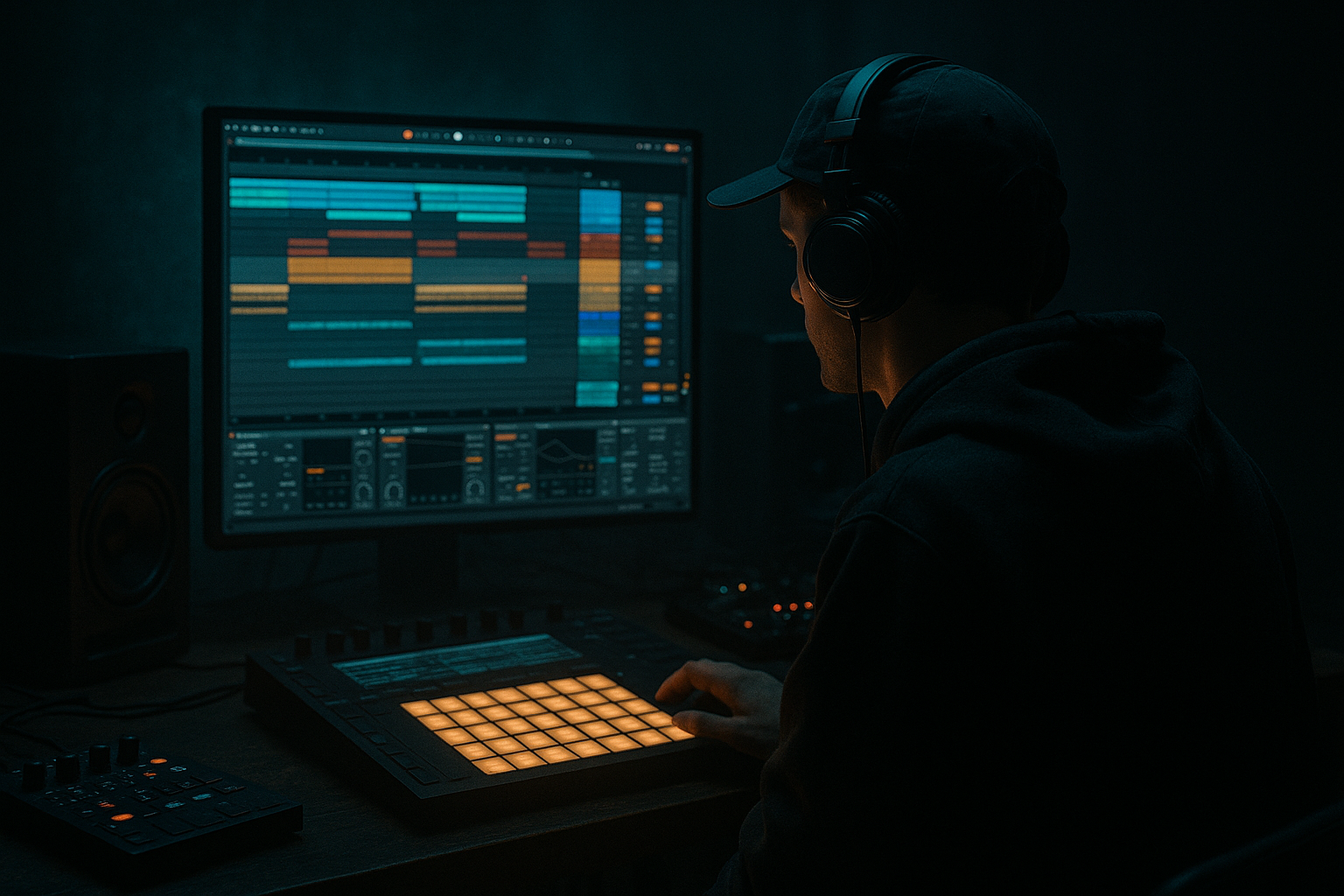
Main tutorial
Course: FX Chain for Smoky Warehouse Vibes in Ableton Live 12
For Jungle / Oldskool DnB with Ragga Elements 🎛️🔥
---
1. Lesson overview
In this lesson, we’re building an FX chain designed to make your DnB and jungle ideas feel like they’re echoing through a damp warehouse at 3AM. The goal is not just “make it lo-fi” or “add reverb.” We want a specific atmosphere:
- dark, smoky, and dub-influenced
- wide but controlled
- gritty, with ragga energy
- spacious, but still punchy enough for breakbeats and rolling bass
- styled for oldskool jungle / DnB rather than modern clean dance music
- ragga vocal chops
- siren stabs
- dub FX hits
- reese bass accents
- break edits
- atmosphere layers like crowd noise, vinyl crackle, rain, or warehouse ambience
- smoky tape-worn echoes
- dub-style spatial depth
- grimy pre-delay and movement
- band-limited haze
- filtered delay throws
- controlled saturation and glue
- ragga vocal slices
- snare hits
- rimshots
- ghost percussion
- horn stabs
- FX one-shots
- chopped amen fills
- ragga vocal phrase: “come again”, “selecta”, “run come”
- short stab: horn, organ, synth hit
- breakbeat accent: snare, tom, ride, hat
- dub FX: impact, noise burst, reverse swell
- You can send multiple elements to the same vibe
- It keeps the mix consistent
- It lets the dry drums stay punchy while the ambience sits behind them
- High-pass filter around 120–180 Hz
- Low-pass filter around 8–12 kHz
- Optional mid dip:
- Drive: 2–6 dB
- Soft Clip: On
- Output: compensate so the level stays controlled
- Drive gently, around 10–25%
- Use a darker tone or low emphasis if available
- Keep it subtle on sends
- Drive: 5–15%
- Crunch: subtle
- Boom: usually off for FX returns unless you want extra thump
- Time: sync to project tempo
- Feedback: 20–45%
- Dry/Wet: if on a return, set to 100%
- Filter:
- Modulation: small amount
- Character:
- Noise: a touch if you want tape/hardware flavor
- 1/8 dotted for vocal stabs
- 1/4 for atmospheric swells
- Ping-pong for wide dub throws, but watch the low end
- “yeah”
- “come again”
- snare accents
- end-of-bar fills
- Decay: 1.8–4.5 sec
- Pre-delay: 15–35 ms
- Size: medium to large
- Diffusion: medium-high
- Low cut: 200–400 Hz
- High cut: 5–9 kHz
- Stereo width: fairly wide, but not maxed
- Combine a Room/Convolution style with a lush algorithmic tail
- Keep the tail darker than the direct reflections
- Filter type: Low-pass
- Drive: small amount if desired
- LFO: on, but subtle
- Rate: 1/2, 1 bar, or 2 bars
- Amount: low to medium
- Resonance: keep moderate
- slow dark opening sweep into a drop
- moving ragga vocal texture
- “breathing” ambience under breaks
- controlled filter throws at the end of phrases
- Width: 80–120%
- Mono below: if needed, keep low-end mono by not sending bass-heavy content to the return
- Gain: use to compensate for output level
- Reduce bit depth subtly
- Sample rate reduction: very light
- Use sparingly on vocals or FX stabs
- Delay time short
- Dry/wet low
- Randomization moderate
- Filter dark
- Dark atmosphere
- low-level ragga vocal send
- filtered dub delay tails
- minimal drums
- increase send on vocal chop or horn stab
- open filter slowly
- shorten delay feedback slightly as drums get busier
- reduce reverb send on kicks and main break
- keep only select FX throws
- use the chain on the last snare of every 4 or 8 bars
- send more heavily into the warehouse chain
- automate feedback and cutoff for a smoky dub wash
- bring in ambient layers, sirens, or chopped vocal fragments
- Return A: short dub delay
- Return B: long warehouse reverb
- Sidechain from kick or main drum bus
- Fast attack
- Medium release
- Aim for subtle ducking, not pumping
- reverse swells
- tape stop-style edits
- stuttered vocal echoes
- impact layers for transitions
- snare rolls
- ghost hats
- vocal punctuations
- percussion accents
- mute the dry vocal/stab
- send one word or hit hard into the return
- automate feedback up briefly
- print the tail
- a ragga vocal chop
- a rimshot
- a short synth stab
- a siren hit
- High-pass at 150 Hz or higher
- Keep the return mostly dark
- Use one sync delay time like 1/8 dotted
- Automate the filter cutoff over 8 bars
- Create one moment where feedback briefly rises for a dub throw
- EQ darker
- more saturation
- less reverb decay
- tighter feedback
- EQ to darken and clean
- Saturation to thicken and age
- Echo for dub movement
- Reverb for warehouse space
- Auto Filter for motion
- Utility for stereo control
- Optional degradation for extra grime
- a ready-made macro mapping template
- a version for vocal chops specifically
- or a full 8-bar arrangement example for this FX chain in Ableton Live 12
This is especially useful for:
We’ll build the chain in Ableton Live 12 using stock devices so you can drop it into any project without relying on third-party plugins.
---
2. What you will build
By the end, you’ll have an FX return chain that can transform dry sounds into:
Final chain concept
You’ll build a chain like this:
1. EQ Eight – filtering and shaping
2. Saturator or Roar – grit and harmonic weight
3. Echo – dub delay movement
4. Reverb – warehouse space
5. Hybrid Reverb or Reverb – deeper tail option
6. Auto Filter – movement and darkening
7. Utility – stereo control
8. Optional: Redux or Drum Buss – texture and edge
We’ll set it up as an Audio Effect Rack or Return track, then use it with:
---
3. Step-by-step walkthrough
Step 1: Start with the right source material
This chain works best on sounds that already feel slightly raw or rhythmic. For example:
Tip: Don’t start with a perfectly polished sound. A smoky warehouse chain needs a source with character.
---
Step 2: Create a Return track for send-based processing
For jungle and DnB, this is often better than inserting the FX directly.
1. Create a Return Track in Ableton.
2. Rename it something like “Warehouse Dub FX”.
3. Set the track to 100% wet if you’re using it as a send effect.
Why this matters:
---
Step 3: Add EQ Eight first
Place EQ Eight at the start.
#### Suggested settings:
- This clears out low-end mud from the reverb/delay chain
- This removes harsh top-end and creates that smoky, aged feel
- 300–600 Hz, reduce by 2–4 dB
- Helps reduce boxiness in warehouse-style ambience
#### Why this works:
Oldskool dub and jungle FX often sound dark because they are band-limited. You’re not trying to create pristine width; you’re creating depth with shadow.
---
Step 4: Add saturation for grime and density
Use either Saturator, Roar, or even Drum Buss if you want a rougher edge.
#### Option A: Saturator
#### Option B: Roar
If you want more modern dirty harmonics:
#### Option C: Drum Buss
Useful if the source is percussion or a snare hit:
#### Goal:
You’re adding a little smoke and glue, not destroying the signal. The sound should feel warmed by tape and time.
---
Step 5: Add Echo for dub pressure
Now the fun part 😈
Place Echo after saturation.
#### Core settings:
- Try 1/8, 3/16, or 1/4 dotted
- Higher if you want long tail throws
- High-pass around 200–400 Hz
- Low-pass around 4–8 kHz
- Use Age or Wobble lightly for movement
#### DnB-friendly delay ideas:
#### Pro move:
Automate send levels or feedback on specific words or hits:
That’s classic jungle energy.
---
Step 6: Add Reverb for warehouse size
After Echo, add Reverb or Hybrid Reverb.
#### Reverb starting point:
#### Hybrid Reverb suggestion:
For a more cinematic warehouse feel:
#### Important:
Do not let the reverb wash out the groove. Jungle depends on rhythmic clarity, even when it’s atmospheric.
---
Step 7: Add Auto Filter for motion and dark sweeps
This is where you make the FX feel alive.
Place Auto Filter after Reverb.
#### Suggested setup:
#### Use cases:
#### Practical tip:
Automate the filter cutoff so the FX opens slightly before a snare fill and closes again after the drop. That movement is very warehouse, very sound system, very jungle.
---
Step 8: Add Utility to control the stereo image
Finish with Utility.
#### Suggested settings:
#### Why this matters:
A smoky FX chain should feel wide, but not phasey or blurry. Utility helps you keep the ambience controlled.
---
Step 9: Optional texture layer with Redux or Lo-Fi-style degradation
If you want that extra oldschool edge, add one of these near the end:
#### Redux
#### Grain Delay
Great for weird jungle atmospheres:
#### Result:
You get a slightly broken, pirate-radio texture without killing the musicality.
---
Step 10: Build an Audio Effect Rack for quick control
Now wrap the whole chain in an Audio Effect Rack and map macros.
#### Suggested Macros:
1. Smoke – drives saturation amount and low-pass cutoff
2. Space – reverb decay and send amount
3. Dubs – delay feedback
4. Wobble – echo modulation / filter LFO depth
5. Grime – saturation drive / Redux amount
6. Width – Utility width
7. Tone – EQ high-cut control
8. Throw – a macro for automating sends or delay feedback boost
This is huge for workflow. You can jam the rack live, automate it across a 16-bar breakdown, or use it for arrangement variation.
---
Step 11: Use it in an arrangement like a real jungle track
Here’s a practical arrangement idea:
#### Intro
#### Build
#### Drop
#### Breakdown
This keeps the mix from becoming a foggy mess while preserving vibe.
---
4. Common mistakes
1. Too much low end in the FX return
If your delay and reverb are bloating the sub region, the whole track will feel muddy.
Fix: High-pass your FX chain aggressively enough. Often 150–250 Hz is fine for returns in DnB.
---
2. Making it too bright
Warehouse vibe is not sparkling EDM gloss.
Fix: Use low-pass filtering and darker reverb tones. Keep the top end aged and smoky.
---
3. Too much feedback
Long dub delays can quickly swamp the groove.
Fix: Automate feedback for specific moments only. Don’t leave it maxed all the time.
---
4. Overusing stereo widening
Excessive width can cause phase issues and weaken the impact of the drums.
Fix: Keep the return wide, but check mono compatibility and avoid wide low mids.
---
5. Putting the chain on the master
This is a common beginner mistake.
Fix: Keep these FX on returns or specific sends. DnB needs a strong dry core.
---
6. Not automating enough
A static FX chain sounds like an insert, not a vibe.
Fix: Move cutoff, feedback, decay, and send amount throughout the arrangement.
---
5. Pro tips for darker/heavier DnB
Tip 1: Parallel the darkness
Run two returns:
Blend them differently depending on the section.
---
Tip 2: Use sidechain ducking on the return
Add Compressor after reverb/delay and sidechain it to the kick or break.
#### Suggested idea:
This keeps the ambience behind the beat and preserves punch.
---
Tip 3: Filter the FX into the drop
Before the drop hits, automate the low-pass down and then snap it open slightly on the downbeat. That contrast gives the drop more impact.
---
Tip 4: Use resampled FX fills
Record a few bars of the return track, then chop the resampled tail into:
That’s very authentic jungle workflow.
---
Tip 5: Combine with a break chop bus
If your break edits are busy, send only selected hits:
Don’t send every drum hit equally. Use the FX as a phrase tool.
---
Tip 6: Add a dub-style “one shot” moment
At the end of every 8 or 16 bars:
This creates that classic system-music vibe.
---
6. Mini practice exercise
Exercise: Build a smoky warehouse FX return in 15 minutes
#### Source:
Pick one of these:
#### Task:
Build a return chain with:
1. EQ Eight
2. Saturator
3. Echo
4. Reverb
5. Auto Filter
6. Utility
#### Constraints:
#### Challenge:
Bounce the result and resample it into a new audio track. Then chop it into 3 usable FX fills.
If it doesn’t sound like it belongs in a smoky jungle rave, adjust:
---
7. Recap
You’ve now got a practical Ableton Live 12 FX chain for smoky warehouse vibes in jungle / oldskool DnB with ragga flavor.
Core idea:
The big takeaway:
In DnB, atmosphere works best when it supports the groove instead of smearing it. Your FX chain should feel like fog in a sound system room: thick, moving, and alive — but never blocking the drums or bass.
Build it as a reusable return, automate it musically, and resample the best moments. That’s how you turn a dry ragga chop or stab into a proper jungle weapon 🥁🔥
If you want, I can also give you:

