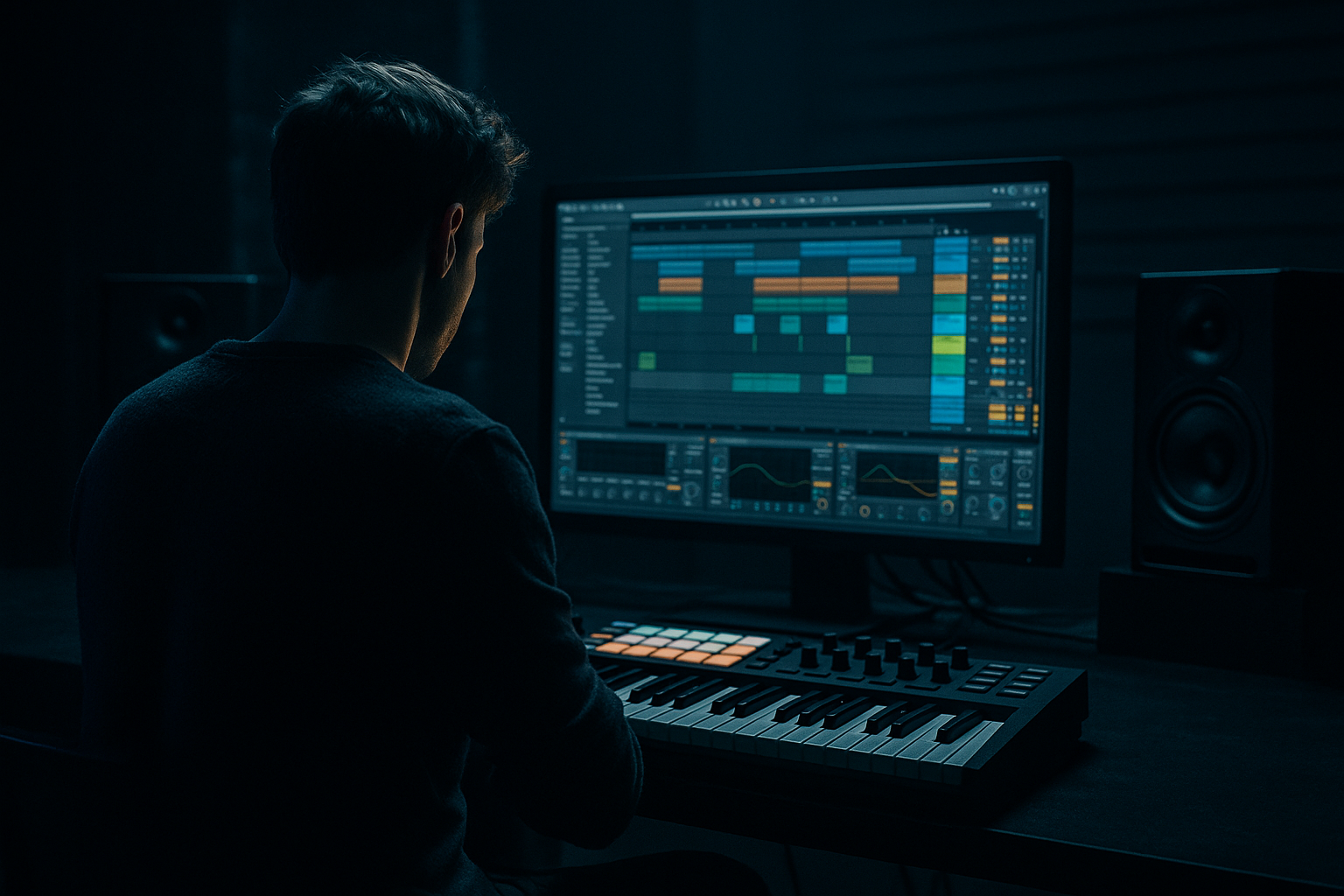
Main tutorial
Course Lesson: Crunchy Sampler-Texture Transitions in Ableton Live 12 (Oldskool Jungle / DnB) 🎛️🥁
1. Lesson overview
This lesson is all about building proper oldskool jungle / early DnB-style transitions using crunchy sampler texture inside Ableton Live 12—think: gritty resample vibes, aliasing, pitch dives, tape-ish wobble, and “hardware sampler” dirt… but done with stock devices.
You’ll learn a repeatable workflow to create transitions that feel like they came from an SP-1200/Akai era: downsamped, filtered, noisy, and energetic, perfect for moving between 16-bar sections (intro → drop, drop → variation, breakdown → second drop).
---
2. What you will build
A 16-bar transition rig that can generate multiple DnB/jungle transition flavors:
- Crunchy riser made from resampled drums (classic jungle move)
- Pitch-down “tape stop-ish” slam into the drop
- Filtered noise + vinyl-ish air layer for tension
- Break slice stutter (oldskool fill energy)
- One-knob macro control (via Instrument/Effect Rack) to perform the transition live
- Simpler / Sampler
- Redux
- Auto Filter
- Saturator
- Echo
- Reverb
- Utility
- Limiter
- (Optional) Roar for heavier grit
- In Simpler, find Transpose (or pitch control).
- Automate from:
- Automate Freq from:
- Automate Downsample from 8 → 3 over the 4 bars
- Redux (same vibe, but harsher is fine)
- Auto Filter (LP24)
- Reverb (tiny, 10–20% wet)
- Utility
- Clip Transpose (audio clip transpose) or Pitch automation:
- Auto Filter Freq:
- Bars 13–16: crunchy riser
- Last 1/2 bar: slam pitch-down
- Bar 17: drop hits with clean drums (contrast = impact)
- Bar 15–16: stutter + filter sweep + short echo throws
- Bar 17: variation drop (add a new ghost snare or extra hat)
- Too much low end in the transition
- Over-reverbing the whole thing
- Crunch that’s just “loud harsh”
- No contrast at the drop
- Timing not locked to phrasing
- Parallel “monster crunch” layer:
- Use Roar (optional) for industrial weight:
- Short gated reverb on a snare slice:
- Automate stereo width:
- Bring in a single “dread” note:
- You resampled your own drums (cohesive jungle vibe) 🎙️
- You used Simpler Slice mode to get break-driven movement
- You built a crunch chain with stock devices: Redux + Saturator + Auto Filter + Echo
- You created tension with pitch + filter automation
- You added a slam moment to exaggerate impact
- You kept the drop powerful by maintaining contrast
All inside Ableton Live 12 using:
---
3. Step-by-step walkthrough
Step 0 — Set the jungle-friendly session
1. Set tempo to 165–172 BPM (try 170 BPM).
2. Create your basic loop first (even rough):
- A breakbeat (Amen, Think, or any chopped break)
- A sub/bass (simple sine/triangle is fine)
3. Make an arrangement grid:
- 16 bars intro
- 16 bars drop
- 16 bars variation
- 8 bars breakdown
- 16 bars second drop
Oldskool transitions shine when your arrangement has clear “blocks.”
---
Step 1 — Create a “Resample Transition” audio track
1. Add a new Audio Track named: `TX Resample`.
2. Set its input to Resampling (top of the input chooser).
3. Arm the track.
Goal: record a few bars of your own drums/bass and then mangle them like a sampler.
---
Step 2 — Record a transition source (your own drums)
1. Loop a section where drums are playing (your drop drums work well).
2. Record 4 bars into `TX Resample`.
3. Consolidate it (Cmd/Ctrl + J) so it’s one clean clip.
Now you’ve got material that already matches your track’s vibe—this is a huge “pro” move for cohesive transitions.
---
Step 3 — Slice it into Simpler for crunchy manipulation
1. Drag the recorded audio clip into a MIDI Track to create Simpler.
2. In Simpler, set Mode: Slice.
3. Choose slicing:
- By: Transients (good for breaks)
- Or 1/16 for steady rhythmic stutters
DnB tip: For jungle, transient slicing usually gives the most authentic “break chop” vibe.
---
Step 4 — Build the Crunch Chain (stock devices)
On the Simpler track, add this Audio Effect chain in order:
#### Device chain (core)
1. Redux
- Downsample: start around 4–8
- Bit Reduction: 6–10 bits (don’t be afraid of ugly)
- Mix is fixed, so adjust with next devices
2. Saturator
- Drive: 3–8 dB
- Soft Clip: ON ✅
- If it gets harsh, reduce Drive and compensate later with Utility
3. Auto Filter
- Filter type: LP24
- Set Freq initially around 200–500 Hz (closed)
- Add a bit of Resonance: 0.7–1.2 for tension
4. Echo (for dubby jungle space)
- Sync: ON
- Time: 1/8 or 1/4
- Feedback: 20–35%
- Filter: HP around 200 Hz, LP around 6–9 kHz
5. Reverb (subtle, dark)
- Size: Medium
- Decay: 1.5–3.5 s
- Low Cut: 200–400 Hz (keep low end clean)
6. Utility
- Use it as your output trim + width:
- Width: 80–120% (careful; keep subs mono elsewhere)
7. Limiter (safety)
- Ceiling: -0.3 dB
- Just catching peaks from resonance + distortion
This chain is your “crunchy sampler transition printer.” 🧱
---
Step 5 — Make the classic jungle “riser-from-drums”
We’ll create a riser using pitch + filter automation, but with break slices so it feels oldskool.
1. In your MIDI clip feeding Simpler, program:
- 1 bar of steady 1/16 notes using one slice (or alternate 2 slices)
2. Duplicate it to make 4 bars.
3. Now automate (Arrangement View is easiest):
#### Automation lane 1: Simpler Transpose
- Start of bar 1: -12 semitones
- End of bar 4: +7 semitones
That upward pitch ramp + aliasing from Redux = instant 90s sampler tension.
#### Automation lane 2: Auto Filter Frequency
- Start: 250 Hz
- End: 10–14 kHz
Keep resonance around ~1 for that whistling jungle “edge.”
#### Optional automation: Redux Downsample
This “increases clarity” as you approach the drop—feels like opening up the machine.
---
Step 6 — Add the “slam” into the drop (pitch-down / stop vibe)
Oldskool transitions often do a quick “fall” right before the drop hits.
1. Take the last 1 beat of your riser clip.
2. Consolidate that tiny audio section (or resample it again).
3. Put it on an Audio Track named `TX Slam`.
Add devices:
Now automate on that last beat:
- from 0 → -12 (or -24) over 1/8 to 1/4 bar
- from 8k → 300 Hz quickly
This creates a “falling off a cliff” moment that makes the drop feel bigger. 💥
---
Step 7 — Add texture layer (noise/vinyl air) for oldskool glue
Transitions feel more authentic when there’s a constant, gritty air layer.
1. Create a MIDI Track: `TX Noise`.
2. Add Simpler with a noise sample (or any “air”/foley).
- If you don’t have one, record a second of room tone, or use a very quiet sample.
3. Add effects:
- Auto Filter (HP12 at 500–1k)
- Redux (light: downsample 2–4, bits 10–12)
- Auto Pan (optional)
- Rate: 1/4 or 1/8
- Amount: 20–40%
Automate its volume so it rises into the drop, then cuts.
Key: Keep it subtle; it’s “air,” not a white noise EDM riser.
---
Step 8 — Make it playable with a Rack + Macros (beginner-friendly performance)
Select your transition chain (on the Simpler riser track) → Cmd/Ctrl + G to Group into an Audio Effect Rack.
Map these to Macros:
1. Macro 1: Filter Open → Auto Filter Freq (range: 200 Hz → 14 kHz)
2. Macro 2: Crunch → Redux Bits (12 → 6) AND Saturator Drive (2 dB → 8 dB)
3. Macro 3: Space → Echo Dry/Wet (0% → 25%) AND Reverb Dry/Wet (0% → 18%)
4. Macro 4: Output → Utility Gain (-inf safety not needed; do -6 dB → 0 dB)
Now you can “perform” the transition with 1–2 knobs while arranging. 🎚️
---
Step 9 — Placement in the arrangement (DnB phrasing)
Here are two reliable oldskool placements:
#### Option A: 4-bar transition into a 16-bar drop
#### Option B: 2-bar fill between drop and variation
Classic jungle move: Let the transition get wide and crunchy, then make the drop tighter and cleaner.
---
4. Common mistakes
If your transition has sub, it’ll fight your drop. High-pass your transition layers (often 150–300 Hz).
Jungle is roomy but punchy. Use dark, controlled reverb.
Use Saturator soft clip and trim with Utility. If it hurts, reduce resonance or open the filter less.
If the drop is as distorted as the riser, it won’t hit. Keep the drop cleaner or at least differently saturated.
DnB loves structure: 2, 4, 8, 16 bars. Make your transition end exactly on the downbeat.
---
5. Pro tips for darker/heavier DnB 🖤
Duplicate your riser track, make one extremely destroyed (Redux 4–6 bits + heavy Saturator), then mix it very low (-18 to -24 dB). It adds menace without wrecking clarity.
Put Roar before the filter. Try:
- Drive low-to-mid
- Tone darker
- Mix 10–30%
Keep it controlled; let the filter do the musical movement.
Put a single snare hit into Simpler → add Reverb → bounce it → shorten tail. Use it as a marker right before the drop.
Transition gets wider, drop snaps back narrower:
- Transition Utility Width: 120%
- Drop drums/bass: tighter/mono-compatible
A low mid stab (Reese-ish) pitched up into the transition, then muted on the drop, can make the drop feel darker by contrast.
---
6. Mini practice exercise (15–25 minutes) 🧪
1. Make a simple 16-bar loop:
- Breakbeat + sub
2. Resample 4 bars of your drums to `TX Resample`.
3. Load into Simpler (Slice mode).
4. Create a 4-bar riser:
- 1/16 MIDI stutter
- Pitch automation: -12 → +7
- Filter automation: 250 Hz → 12 kHz
5. Add a 1/2-bar slam:
- Pitch down: 0 → -12 quickly
- Filter closes rapidly
6. Add a noise texture layer that rises in volume for the last 2 bars.
7. Export a quick bounce and listen:
- Does the drop feel bigger?
- Is the transition crunchy but not painfully loud?
---
7. Recap
If you want, tell me your tempo and whether you’re using Amen/Think-style breaks, and I’ll suggest a specific 8-bar transition pattern (MIDI rhythm + exact automation points) tailored to your groove.

