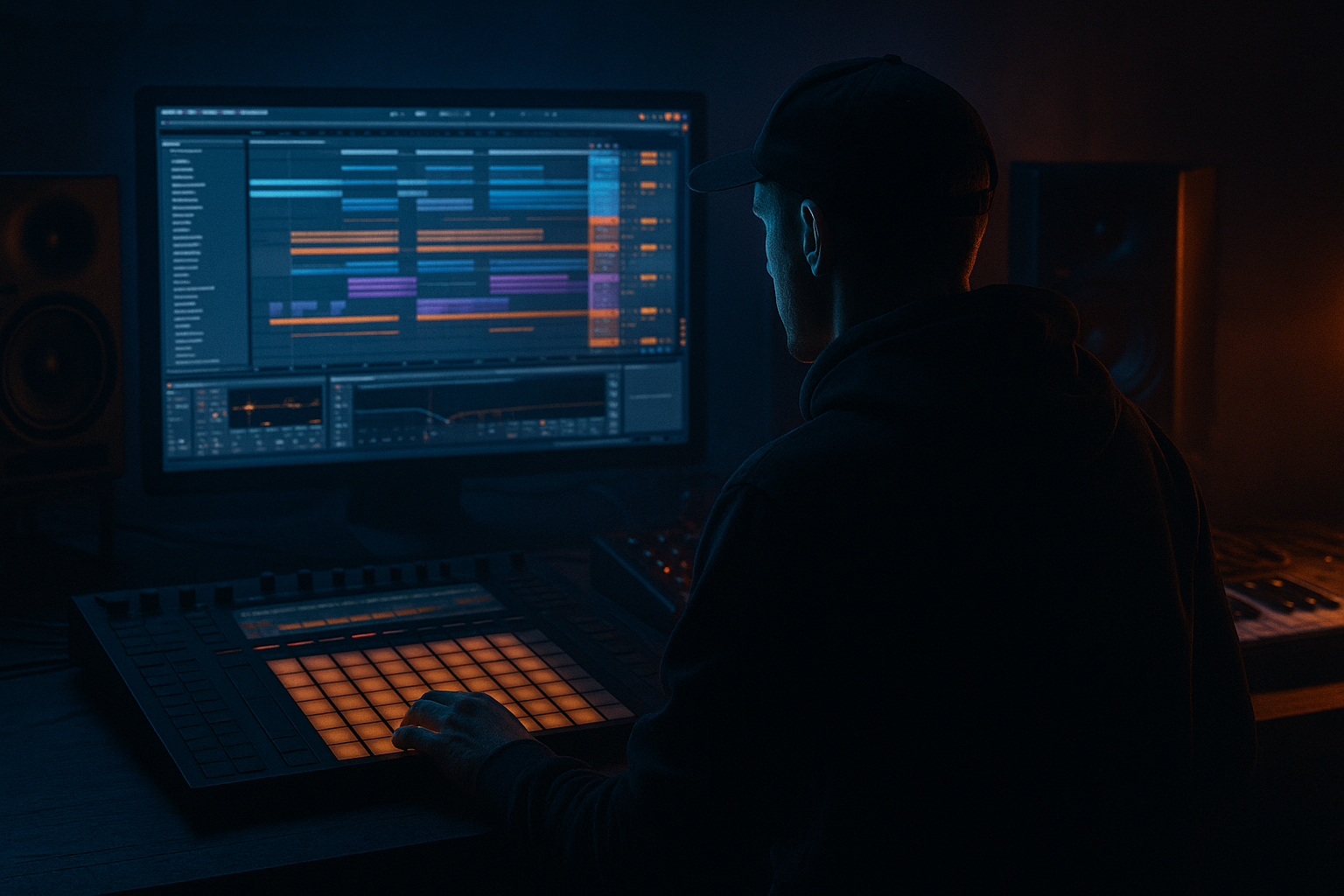
Main tutorial
```markdown
CPU‑Friendly Jungle Projects from Scratch (Ableton Live) — Jungle Rollers Workflow 🥁⚡
1. Lesson overview
In jungle, you often stack lots of drums, edits, breaks, FX, resampling, and heavy bass processing. That can crush your CPU fast—especially at 170–175 BPM.
This lesson gives you a repeatable Ableton Live template/workflow to build rollers from zero while staying CPU‑efficient: smart routing, resampling at the right moments, and using stock devices in lean ways.
Target vibe: rolling jungle/DnB with punchy breaks, a tight sub, and controlled grit—without 70 tracks and 30 reverbs running. 😅
---
2. What you will build
A CPU‑friendly “roller” project containing:
- Drum Group with:
- Bass Group with:
- Music/Atmos:
- FX:
- Arrangement: 64–96 bars with a proper roller groove: intro → drop → switch → outro
- DRUMS (Group)
- BASS (Group)
- MUSIC (Group)
- A Reverb (Hybrid Reverb or Reverb)
- B Delay (Echo)
- C Drum Parallel (optional global, but I prefer inside Drum Group)
- Add Groove Pool: try MPC 16 Swing 55–60% or a shuffled break groove.
- Apply lightly: Timing 30–60, Velocity 10–25, Random 5–10.
- Right click clip → Slice to New MIDI Track
- Slicing preset: Built‑in or Warp Marker
- In the Drum Rack, keep processing minimal.
- When it’s working: Freeze + Flatten this track to audio.
- Use a Drum Rack with:
- Keep it simple: no big chains.
- Program:
- Keep them thin:
- Reverb (stock):
- Keep sends small (‑20 to ‑12 dB range).
- Osc A: Sine
- Voices: 1
- Glide: On, Time 60–120 ms (roller slides)
- Add Saturator very lightly:
- EQ Eight
- Utility:
- 2‑bar phrase with note repeats + small gaps (space makes it roll).
- Put a few 1/16 anticipations before snares to pull forward.
- Make the mid bass, then resample to audio.
- Create new audio track: “Mid Print”
- Set input to Resampling (or route from Mid Bass track)
- Record 8–16 bars, then disable the synth track.
- Muting layers
- Clip changes
- One‑shot fills
- Automation on a few key macros
- 1–17 (Intro):
- 17–49 (Drop 1):
- 49–65 (Switch / Breakdown):
- 65–81 (Drop 2):
- 81–End (Outro/DJ‑friendly):
- One Auto Filter on DRUMS group (instead of filters on every drum track)
- One Utility on BASS group for quick gain staging/mutes
- Reverb/Delay send automation (returns are cheap vs multiple inserts)
- Break edits working? → Freeze + Flatten
- Mid bass sound done? → Resample to audio
- Atmos pad set? → Bounce to audio and disable instrument
- Rumble control on breaks:
- Darker tone without extra plugins:
- Harder snare presence (without harshness):
- Bass “weight” without CPU:
- Tension FX cheap:
- Use groups + shared returns to avoid duplicate heavy FX.
- Keep drum warping Beats mode unless there’s a real reason not to.
- Build your break edit, then print it.
- Keep sub clean + mono, and resample mid bass early.
- Use parallel processing on a drum bus for punch rather than stacking inserts everywhere.
- Arrange with muting, clip swaps, and a few macros, not 50 new tracks.
- 1 main break loop track (warped + edited)
- 1 drum one‑shot layer track (kick/snare support)
- 1 hats/percs track
- 1 “Ghost/Fill” track (optional)
- A Drum Bus return inside the group for parallel punch
- Sub bass (clean, mono)
- Mid bass (resampled audio for grit)
- 1 pad/atmos track (printed to audio early)
- 1 stab or vocal chop track (also printed)
- 1 shared reverb return
- 1 shared delay return
---
3. Step‑by‑step walkthrough
Step 0 — Project setup (CPU first) 🧠
1. Tempo: `172 BPM` (classic roller pocket).
2. Sample Rate / Buffer (Preferences → Audio):
- While producing: 44.1 or 48 kHz, Buffer 256–512 samples.
- While recording MIDI live: drop to 128 if needed.
3. Warp Mode defaults (important for breaks):
- For full break loops: Complex Pro can sound nice but costs CPU.
- Start with Beats mode (CPU‑light), then use Complex Pro only on specific material if necessary.
CPU rule: If it’s not a featured element, it doesn’t get expensive processing.
---
Step 1 — Build a lean routing template (groups + returns) 🧩
Create tracks like this:
Groups
- Break Main (Audio)
- Kick/Snare Layer (MIDI or Audio)
- Hats/Percs (MIDI/Audio)
- Ghost/Fills (Audio) (optional)
- Sub (MIDI)
- Mid (Audio)
- Atmos/Pad (Audio)
- Stab/Vox (Audio)
Return tracks (global)
Why this saves CPU: shared FX returns > individual reverbs on every track.
---
Step 2 — Break workflow: warp, tighten, and slice without CPU bloat 🥁
1. Drop in a classic break (Amen/Think/Hot Pants style).
2. Warp settings (Clip View):
- Warp: On
- Mode: Beats
- Preserve: Transient
- Transient Loop Mode: Off (usually cleaner for breaks)
- Set Seg. BPM so the loop fits 172 tightly.
3. Consolidate the loop to exact 1–2 bars (Cmd/Ctrl+J).
This keeps edits tidy and reduces “mystery” warp markers.
#### Tighten the groove (without killing the swing)
#### Slice efficiently
Option A (CPU‑light and flexible):
Option B (even lighter later):
Do your edits in MIDI for 10 minutes, commit to audio ASAP.
✅ Commit point: once your 2‑bar break pattern is rolling, Freeze + Flatten. That’s your “Break Print”.
---
Step 3 — Add punch layers (kick/snare support) with minimal devices 🔥
Create a Kick/Snare Layer track:
If MIDI (Drum Rack):
- Kick (tight, short)
- Snare (crack layer)
- Rim/Clap (optional)
Processing chain (track level):
1. EQ Eight
- Kick: low shelf up a touch at 60–90 Hz only if needed
- Snare: small boost 180–220 Hz (body) and/or 3–6 kHz (crack)
- Cut mud 250–400 Hz if boxy
2. Drum Buss (Ableton stock)
- Drive: 5–15%
- Crunch: 0–10 (careful)
- Boom: 0–20%, Freq around 50–60 Hz (only if kick needs weight)
- Transients: +5 to +20
3. Limiter (optional) just catching peaks: 1–2 dB GR max.
CPU tip: one Drum Buss on a bus/group is often better than many saturators on individual pads.
---
Step 4 — Hats & percs: use simple patterns + one shared “air” reverb ✨
Create a Hats/Percs track (audio or MIDI).
- Closed hats: off‑beat 1/8 with slight velocity variation
- Ghost shuffles: quiet 1/16 hats, but don’t overfill
- EQ Eight high‑pass at 200–400 Hz
- Tiny dip around 6–8 kHz if harsh
Send to Return A Reverb lightly:
- Decay: 0.6–1.2s
- Pre‑delay: 10–25 ms
- High cut: 7–10 kHz
- Low cut: 250–500 Hz
---
Step 5 — Bass: sub stays clean, mid gets resampled 🧱🎛️
#### Sub bass (MIDI track)
Use Operator (super CPU‑friendly):
- Drive 1–3 dB
- Soft Clip On
- Low pass around 120–180 Hz
- Mono On
- If needed, Bass Mono: keep below 120 Hz
Pattern idea (roller):
#### Mid bass (commit to audio early)
Create a MIDI sketch (Operator/Wavetable), but the trick is:
Mid bass device chain (while designing):
1. Wavetable (or Operator)
2. Auto Filter
- LP24, Drive 2–6
- Envelope amount small, for movement
3. Saturator
- Drive 4–10 dB, Soft Clip On
4. Amp (stock) for bite (optional)
5. EQ Eight (remove sub below 120 Hz)
Now Resample/Print:
Why this is huge: you stop running synth + modulation + distortion live.
---
Step 6 — Drum bus: parallel smack without killing CPU 🥊
Inside the DRUMS group, create a Return track (group return) called “DRM PAR”.
Send Break + Kick/Snare to it.
DRM PAR chain (light + effective):
1. Glue Compressor
- Attack: 3 ms
- Release: Auto
- Ratio: 4:1
- Threshold: aim 4–8 dB gain reduction (parallel can be heavy)
- Makeup: as needed
2. Saturator
- Drive 2–6 dB, Soft Clip On
3. EQ Eight
- High‑pass at 30 Hz
- Optional dip 250–400 Hz if it clouds
Blend return level low under the dry drums until the groove “stands up.”
---
Step 7 — Arrangement: a roller that evolves with minimal extra tracks 🧭
Keep arrangement changes mostly via:
Suggested 80‑bar layout:
- Atmos + filtered break (Auto Filter on DRUMS group)
- Tease a bass note every 4 bars
- Full break + layers
- Sub + mid print
- Small ear candy every 8 bars (crash, reverse, vocal)
- Drop drums to hats + ghost break
- Automate reverb send up briefly, then cut (classic tension)
- Same groove, but:
- New break variation (swap 1–2 hits)
- Bass rhythm variation (remove one note, add a slide)
- Remove mid, keep sub + drums, then strip to drums only
CPU‑smart automation targets:
---
Step 8 — Freeze, flatten, and “commit” like a pro ✅
This is where CPU‑friendly becomes a lifestyle.
Commit checkpoints:
Rule of thumb: if you’re not actively changing it, print it.
---
4. Common mistakes 🚫
1. Complex Pro on every loop
Sounds nice, but it adds up. Use Beats for drums unless you need Complex.
2. A reverb on every track
Use Return tracks. One good reverb beats ten mediocre ones.
3. Over-layering breaks
Two breaks + one‑shots is usually enough. Too many breaks = phase mess + CPU.
4. Uncontrolled low end
Mid bass and break rumble fighting the sub = muddy roller. High‑pass aggressively where needed.
5. Never committing to audio
Unlimited “tweakability” is how projects become unfinishable and heavy.
---
5. Pro tips for darker/heavier DnB 🖤
On the break track, add EQ Eight:
- High‑pass 30–45 Hz
- Dip around 120–200 Hz if it steps on sub punch
Use Redux very lightly on drum prints:
- Downsample: 2–6
- Dry/Wet: 5–15%
- Add Saturator (soft clip) + small EQ boost at 4.5 kHz
- Then tame with De-esser style trick: Multiband Dynamics on highs only (gentle)
Duplicate the Sub track → make it a Reese low-mid (120–300 Hz), print to audio, and keep it quiet.
White noise audio clip + Auto Filter sweep + shared reverb send. No synth needed.
---
6. Mini practice exercise 🎯
Goal: Build a 32‑bar jungle roller loop with CPU under control.
1. Start a new set at 172 BPM.
2. Add:
- 1 break loop → warp Beats → slice → make a 2‑bar edit.
3. Add kick/snare one‑shots supporting the break (simple).
4. Make sub with Operator (sine + glide).
5. Design a mid bass for 10 minutes, then resample to audio and disable the synth.
6. Create one reverb return and one delay return; use sends only.
7. Arrange 32 bars:
- Bars 1–9 intro (filtered drums)
- Bars 9–25 drop (full)
- Bars 25–33 outro (strip layers)
8. Freeze + flatten at least two tracks before you’re done.
Check: You should be able to play the set with comfortable headroom and no crackles.
---
7. Recap ✅
If you want, tell me your Ableton version (Live 11/12, Suite/Standard) and what kind of roller you’re after (90s jungle, modern deep, techy rollers), and I’ll give you a ready-to-build template layout with exact track naming + macro mapping. 🧠🥁
```

