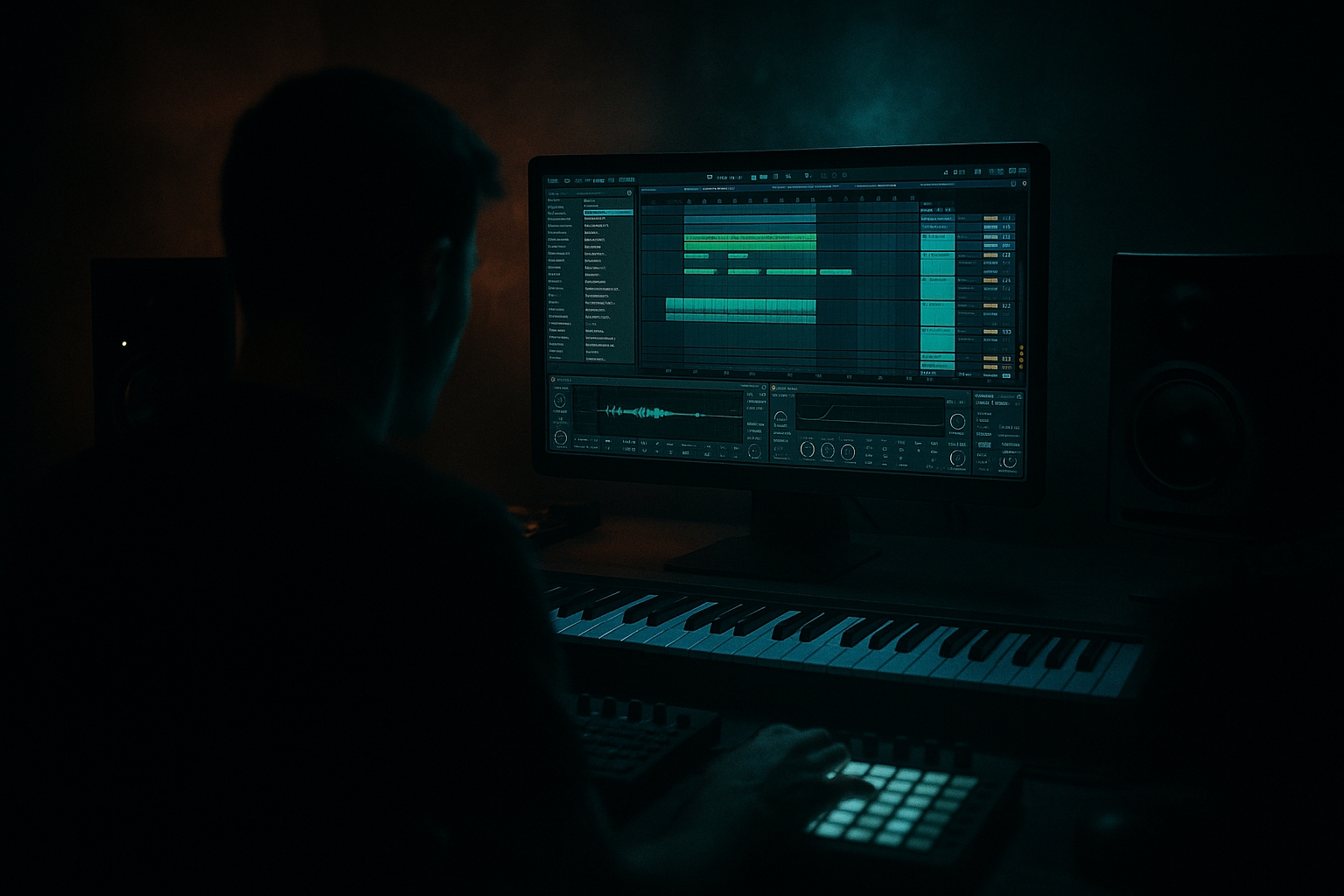
Main tutorial
```markdown
Crash Design with Resampling Masterclass (Smoky Late‑Night Moods) 🌙💥
Ableton Live | Drum & Bass FX | Intermediate
---
1. Lesson overview
In rolling DnB and jungle, a crash isn’t just “a crash”—it’s a mood setter, a transition engine, and sometimes the hidden glue that makes your drop feel wider and more expensive. In this lesson you’ll design a smoky, late-night crash using Ableton stock devices, then resample it into multiple usable assets: impacts, reverse swells, gated tails, and “air layers” that sit beautifully above breaks and bass.
We’ll focus on:
- Designing a crash from raw sources (not just picking a sample)
- Resampling workflows (fast, repeatable, creative)
- Shaping tone for dark/late-night aesthetics: warm, dusty, wide, not harsh
- Tempo: 172–176 BPM
- Create these tracks:
- In Arrangement View, mark a drop point (bar 33 is a classic).
- Hybrid Reverb
- After Hybrid Reverb: Saturator
- Echo
- After Echo: Auto Filter
- Optional: Utility → Width 120–160% (keep it subtle)
- Crash cymbal (clean-ish)
- Noise layer (vinyl noise, room tone, or white noise burst)
- Optional: Foley metal (key jingle, ride tip, field recording)
- Crash: 0 dB (as reference)
- Noise: -12 to -18 dB
- Foley: -10 to -16 dB
- Enable High-pass: 24 dB slope at 120–200 Hz (remove rumble)
- Dip harshness: bell dip -2 to -5 dB at 7–10 kHz (sweep to find the “ice pick”)
- If it feels thin, add a gentle bell +1 to +3 dB around 500 Hz–1.2 kHz (body)
- Drive: 3–7 dB
- Soft Clip: On
- If it gets too fizzy, pull down output slightly.
- Drive: 5–15%
- Crunch: 0–10%
- Boom: 0–10% (often OFF; crashes can get tubby)
- Damp: 10–30% (helps tame top end)
- Mode: Lowpass
- Cutoff: 8–12 kHz
- Envelope: 5–15% so the crash opens slightly then relaxes
- Optional: automate cutoff to open up into the drop.
- Send A (DARK VERB): -12 to -6 dB
- Send B (SMOKE DELAY): -18 to -10 dB
- Create another track `CRASH WET ONLY`
- Put your reverb/delay directly on that track (not returns)
- Then record that track to audio via resampling
- Warp: Off (often best for cymbals)
- Fade in: 0–5 ms (avoid click)
- Fade out: taste
- Trim length: often 1–2 bars for DnB (long enough to feel lush, not washing the groove)
- Duplicate the clip
- Trim to just the first 50–150 ms
- Add EQ Eight
- Add Transient shaping with Drum Buss
- Duplicate clip → Reverse
- Add Auto Filter
- Add Utility
- Take the tail region (after the initial hit)
- Put it on a new track `CRASH GATE`
- Add Gate
- Add Sidechain compression (Glue Compressor or Compressor)
- Duplicate main crash
- EQ Eight
- Utility
- Keep this layer low in the mix: -18 to -10 dB usually.
- Bar 1 intro: quiet, filtered crash tail for atmosphere (high-pass at 300–600 Hz)
- Pre-drop (last 1/2 bar): reverse suck-in + tiny impact
- Drop downbeat: impact layer + main crash (main slightly delayed 5–15 ms for depth)
- 16-bar switch: use gated tail texture for energy without adding drums
- Break-to-drop: automate reverb send up, then hard cut (or freeze) right before drop for drama
- Use Saturator before reverb for a denser, smoky tail (reverb “grabs” harmonics).
- Mid/Side EQ:
- Resample at different pitches:
- Make a “ghost crash”:
- Hybrid Reverb trick: short convolution early reflections + longer algorithm tail = “real room + cinematic smoke”.
- You designed a crash as a system, not a one-shot.
- You used stock Ableton devices to shape tone, movement, and space.
- You resampled multiple variations quickly for real-world production speed.
- You turned one sound into an FX kit: impact, reverse, gated tail, and air layer.
- You placed it in a DnB arrangement so it supports rolling drums and heavy bass rather than smearing them.
---
2. What you will build
By the end you’ll have a small “crash kit” derived from one design session:
1. Main Smoky Crash (full-band, controlled highs)
2. Impact Layer (short, punchy, low-mid “thunk”)
3. Reverse Suck-In (pre-drop tension)
4. Gated Tail Texture (rhythmic, rolling ambience)
5. High-Air Layer (stereo shimmer that doesn’t fight hats)
All made inside Ableton, ready to drop into a DnB arrangement (intros, drops, 16-bar switches, breakdown-to-drop moments).
---
3. Step-by-step walkthrough
Step 0 — Session setup (DnB-friendly defaults) 🧱
- Audio Track: `CRASH SOURCE`
- Return Track A: `DARK VERB`
- Return Track B: `SMOKE DELAY`
- Audio Track: `RESAMPLE PRINT` (set input to Resampling)
Return A: DARK VERB (stock)
- Mode: Convolution + Algorithm (or just Algorithm if you want lighter CPU)
- Predelay: 18–30 ms
- Decay: 3.0–6.0 s
- Size: Large
- EQ (inside Hybrid Reverb):
- Low cut: 200–350 Hz
- High shelf: -2 to -6 dB around 6–10 kHz (reduces “splashy” harshness)
- Drive: 2–5 dB
- Soft Clip: On
Return B: SMOKE DELAY
- Time: 1/8 dotted or 1/4
- Feedback: 25–40%
- Filter: HP around 300 Hz, LP around 6–8 kHz
- Mod: 5–15% for movement
- Mode: Lowpass
- Cutoff: 4–8 kHz, Resonance low
---
Step 1 — Choose and layer crash sources (don’t overthink, do it fast) 🎯
On `CRASH SOURCE`, drop in 2–3 audio samples:
DnB vibe tip: pick crashes that are not too bright. If it already sounds like a EDM festival crash, you’ll spend time fighting harsh highs.
Quick starting balance
---
Step 2 — Shape the raw tone (late-night = controlled top, confident mids) 🌓
Add devices on `CRASH SOURCE` in this order:
1) EQ Eight
2) Saturator
3) Drum Buss (yes, on a crash—carefully)
4) Auto Filter (motion)
Send the track to your returns:
---
Step 3 — Turn one crash into a “moment” with resampling 🧪🎛️
Now we print variations. This is where the masterclass starts.
#### Option A: Fast print using Resampling
1. Arm `RESAMPLE PRINT`
2. Set its input to Resampling
3. Solo `CRASH SOURCE` (and returns if you want them printed)
4. Record multiple hits while tweaking:
- Auto Filter cutoff
- Reverb send amount
- Echo feedback
- Saturator drive
Record 8–16 takes quickly. Don’t aim for perfect—aim for options.
#### Option B: Print separate “wet only” layers (clean workflow)
This helps you keep a dry impact + wet tail you can balance later.
---
Step 4 — Edit your resampled audio into usable crash assets ✂️
Take your best printed audio and consolidate:
1) Main Crash
2) Impact Layer
- Lowpass: 7–10 kHz
- Small boost: 200–500 Hz if you want a “thunk”
- Transients: +5 to +20 (careful—too much sounds plastic)
3) Reverse Suck-In
- Automate cutoff rising into the drop (classic “inhale”)
- Automate gain up in the last 1/4 bar for tension
4) Gated Tail Texture (rolling vibe)
- Threshold: set so it opens on the tail energy
- Return: short (tight gate)
- Sidechain input: your kick (or a ghost kick)
- Ratio: 4:1
- Attack: 1–5 ms
- Release: 80–150 ms
- Aim: tail “breathes” with the groove
This makes the crash tail roll instead of smear.
5) High-Air Layer (sparkle without harshness)
- High-pass: 6–9 kHz
- Tiny dip around 10–12 kHz if it’s spitty
- Width: 140–180%
---
Step 5 — Place it in a DnB arrangement (where it actually works) 🧩
Here are practical placements that feel authentic in rolling DnB/jungle:
DnB mixing reality: if your hats are busy (shuffles, rides), your crash must be controlled or it’ll mask groove detail.
---
4. Common mistakes ⚠️
1. Too bright / too wide early in the chain
Wide harsh highs become painful fast. Control brightness first, widen later.
2. Printing returns without intention
Printing reverb + delay is great—just make sure you also keep a dry version for punch.
3. Over-long tails in rolling sections
Long tails can blur ghost notes and break detail. Keep “drop crashes” tighter than “breakdown crashes.”
4. No high-pass on the verb/delay
Low-mid reverb mud kills bass clarity. High-pass reverbs aggressively in DnB.
5. Warp artifacts
Cymbals often sound best with Warp Off unless you’re deliberately stretching for texture.
---
5. Pro tips for darker/heavier DnB 🖤
- Keep mids (center) calmer in 6–10 kHz
- Push “air” mostly on the sides (Utility width + careful EQ)
- Transpose printed crash -2 to -5 semitones for weighty darkness
- Then high-pass to remove mud—this gives “big” without low-end chaos.
Very low-level crash tail tucked under drops at -24 to -18 dB creates club-size space without obvious cymbal.
---
6. Mini practice exercise (15–20 min) 🏁
1. Pick one crash sample and one noise/foley layer.
2. Build the chain: EQ Eight → Saturator → Drum Buss → Auto Filter.
3. Create two returns (Dark Verb + Smoke Delay) and send into them.
4. Resample 10 takes while automating:
- Auto Filter cutoff
- Reverb send
- Echo feedback (one “crazy” take included)
5. Chop your best take into:
- 1 main crash (1–2 bars)
- 1 impact (≤150 ms)
- 1 reverse (1/2 bar)
6. Drop them into a simple DnB grid:
- Reverse in last 1/2 bar
- Impact + main crash on the drop downbeat
- Main crash tail ducked with sidechain
Goal: make it feel deep, expensive, and non-harsh at 174 BPM.
---
7. Recap ✅
If you want, tell me what subgenre you’re aiming for (deep rollers, techstep, jungle, halftime) and I’ll suggest a crash chain and arrangement placements that match it.
```

