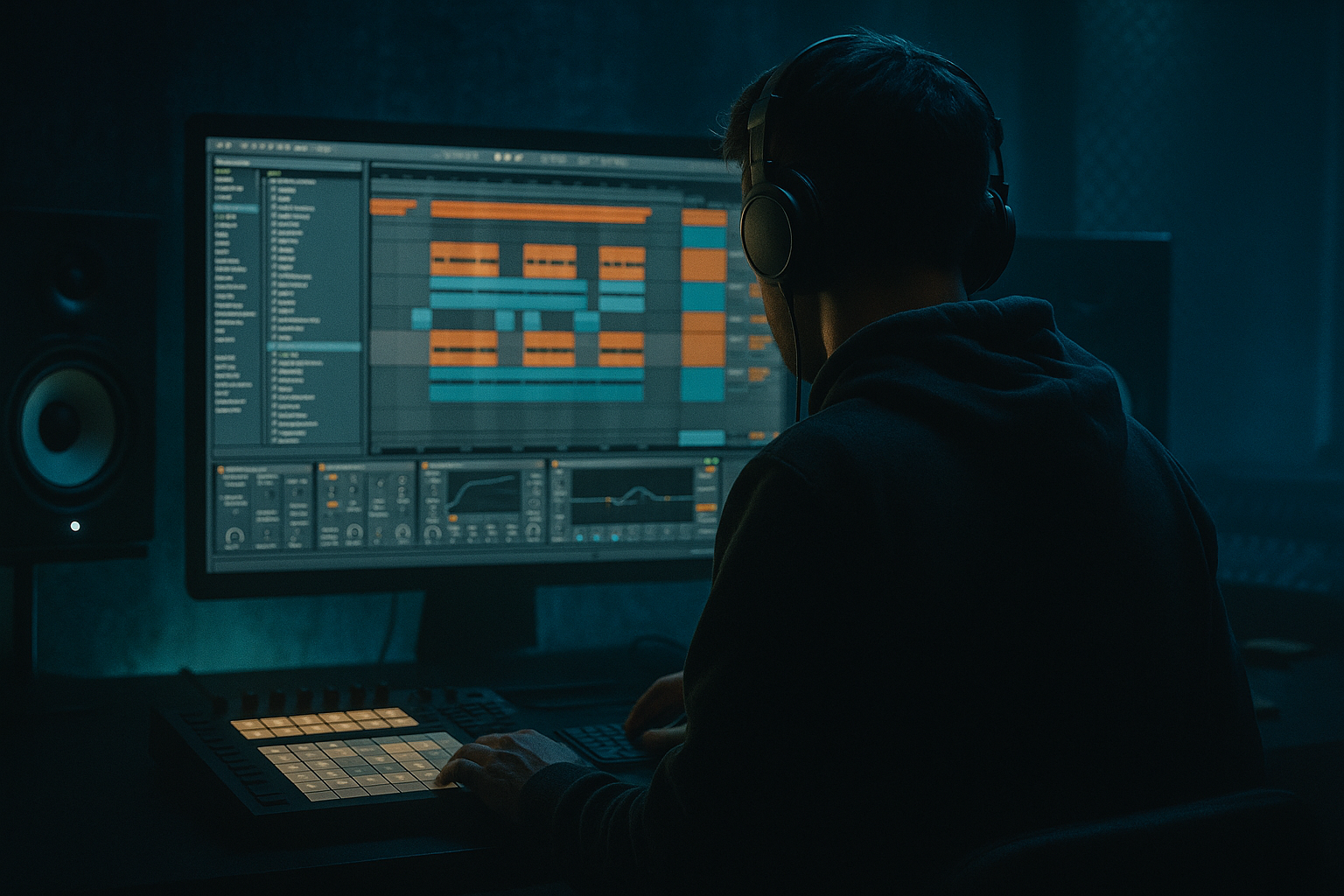
Main tutorial
Lesson Overview
This lesson builds an Amen-style call-and-response vocal riff blueprint in Ableton Live 12: a short, chopped vocal hook that behaves like an instrument, not a full sung topline. The goal is to create a tight, menacing, DJ-friendly vocal motif that sits inside a Drum & Bass track as a rhythmic conversation between the break, the bass, and a vocal phrase.
In DnB, this lives most effectively in:
- the first 8 or 16 bars of the drop as a signature hook
- a mid-drop switch-up to reset energy
- an intro or breakdown teaser that hints at the drop identity
- darker jungle, rollers, neuro-leaning DnB, and club-focused tracks where the vocal is used as percussive punctuation
- a dry, close, gritty center
- enough filtering and saturation to feel urgent
- controlled stereo width, with the core reading solid in mono
- a rhythmic feel that can sit against an Amen break without smearing it
- a role as a signature hook, not a verse vocal or melodic lead
- answer the drums in short bursts
- leave negative space for snares and ghost hits
- create a recurring phrase that the listener can latch onto quickly
- be polished enough to use in a drop, but still rough enough to feel underground
- Use negative space as weight. In darker DnB, a shorter vocal often feels bigger than a busy one because the silence around it lets the break and sub hit harder.
- Push menace by reducing brightness rather than cranking distortion. A vocal that is slightly band-limited and dry often reads more underground than a glossy, high-shelf-heavy sample.
- If the phrase needs more aggression, try parallel dirt: duplicate the vocal, distort the duplicate harder with Saturator, then blend it quietly under the clean core. Keep the dirty layer low enough that the words remain intelligible.
- For a more neuro-leaning feel, automate a narrow band-pass sweep across the response only. This creates movement without turning the whole phrase into a special effect.
- If the track is very bass-heavy, let the vocal live above the strongest sub energy. A hook that stays mostly out of the fundamental zone will translate better on systems where the low end is already dominant.
- Keep the main call dry and central, then give the response just enough processing to feel like a shadow version. That contrast reads huge in a club.
- If you want a really oppressive vibe, shorten the release of any dynamics processing on the vocal so it stays clipped and immediate, not soft and breathy.
- Revisit the Amen loop and ask: does the vocal reinforce the break’s forward motion, or interrupt it? The best dark vocal hooks feel like they were cut from the same record as the drums.
- use one vocal source only
- use no more than 4 chopped fragments
- keep the main vocal center-focused
- use only stock Ableton devices
- create one call and one response, not a full melody
- an 8-bar loop with a clear call-and-response vocal riff
- one automated change by bar 8
- one version checked in context with an Amen break and bassline
- can you mute the drums for one bar and still identify the hook immediately?
- does the vocal leave space for the snare to land hard?
- does it still make sense in mono?
Why it matters: a great vocal riff gives your track a human identity without cluttering the low end. It adds narrative, tension, and memorability while leaving room for drums and bass to do the heavy lifting. Technically, it also forces discipline: you need to shape transients, control space, and make the phrase work in mono and in a loud club system.
By the end, you should be able to hear a sharp, repeatable call-and-response vocal hook that feels locked to the Amen energy, cuts through without fighting the snare, and can survive being looped over a drop without sounding like a generic chant. A successful result should feel like a dark vocal is answering the break rather than sitting on top of it.
What You Will Build
You will build an 8-bar vocal riff blueprint made from a single vocal source chopped into short phrases, then reworked into a call-and-response pattern that behaves like a drum element and a lead motif at once.
Sonically, it should have:
Musically, it should:
Success sounds like this: when the drums and bass are playing, the vocal line should snap into the pocket immediately, feel like it belongs to the same record, and still read clearly after you mute the drums for a second and bring them back. If it only works soloed, it is not finished.
Step-by-Step Walkthrough
1. Set up the vocal source as a rhythm instrument, not a song part
Start with one vocal phrase that is short, dry, and characterful. In this style, a spoken line, a shout, or a half-phrase works better than a long melodic performance. Drag the sample into an audio track and trim it so the useful attack is right at the start of the clip.
If the source is too polished, strip it down immediately:
- high-pass with EQ Eight around 100–180 Hz
- remove obvious room tone if it blurs the groove
- tighten clip start points so consonants land cleanly
Then warp it just enough to lock the phrase to your project grid. In Live 12, use Beats or Complex Pro depending on whether you want the vocal to feel chopped and percussive or more fluid. For this blueprint, Beats is often better if the phrase is being used like a rhythmic stab.
What to listen for: the consonants should feel like transients. If the vocal sounds like it is dragging the timing of the groove, it is too long, too wet, or too heavily warped.
2. Chop the phrase into call and response units
Slice the phrase into 2 to 5 small fragments that can be rearranged into a conversation. The “call” should be the more recognizable part; the “response” should be shorter, more reactive, or more percussive. Think in terms of drum phrasing: one part asks a question, the next answers with less information.
A strong starting structure for an 8-bar loop is:
- bars 1–2: call
- bars 3–4: response
- bars 5–6: repeat with variation
- bars 7–8: empty space or a turnaround
Use Clip View to create clean slices or consolidate each fragment once you’ve placed it. If the vocal has natural syllables, preserve the attack of each one. If it is a shout, use the start of the word as the rhythmic anchor.
Why this works in DnB: the Amen break is already busy, so the vocal needs to behave like a percussive motif instead of a long line. Call-and-response gives the ear a repeating identity while leaving room for snare movement and bass weight.
3. Build the first pass with strict rhythmic discipline
Place the vocal pieces against the bar line with the same seriousness you would apply to a snare placement. Start by quantizing the first version to the grid, then deliberately pull a few fragments late by a tiny amount if the groove needs air.
Useful starting moves:
- keep the main call landing on a strong beat or offbeat that mirrors the break
- place the response on the next space after the snare, not directly on top of it
- keep some fragments short enough to fit inside 1/8 or 1/16 note pockets
- if one slice feels too long, shorten it to the next consonant instead of fading it out
A good rule: if the vocal phrase is fighting the break, it should usually be shorter, drier, and less wide, not louder.
What to listen for: the vocal should feel like it is dancing with the break, not leaning on it. If the groove tightens when you mute the vocal, the timing is too intrusive.
4. Choose between two valid flavours: raw chopped or pitched menace
Here is the main A/B decision point.
A. Raw chopped flavour
Keep the vocal close to its original pitch and use it as a hard rhythmic object. This suits rugged jungle rollers, stripped-back drops, and anything where the vocal should sound like a sample quote or a found object.
B. Pitched menace flavour
Drop selected fragments by 3–7 semitones using Clip Transpose or Repitch-style handling, then darken with filtering and saturation. This suits neuro-leaning DnB, deeper rollers, and more sinister drop statements.
Trade-off:
- A gives you immediacy and authenticity
- B gives you more character, but can smear intelligibility if overdone
If you pick B, watch the lower midrange carefully. Too much downward pitch on a vocal can crowd 200–500 Hz and blur with the bass synth. If that happens, pull back the resonance, thin the vowel, or shorten the sustain of the chop.
5. Shape the tone with a practical stock-device chain
A very usable starting chain is:
EQ Eight → Saturator → Auto Filter → Compressor
Use it like this:
- EQ Eight: high-pass around 120–200 Hz depending on the source; cut any boxy build-up around 250–450 Hz if needed
- Saturator: start around 2–6 dB Drive for grit; keep the output compensated so you’re judging tone, not loudness
- Auto Filter: low-pass or band-pass to focus the vocal into a narrower, more menacing lane; a sweep between roughly 1.5 kHz and 6 kHz can create useful evolution
- Compressor: gentle control, not squashing; aim for a few dB of reduction so the consonants stay even
If the vocal needs more edge, place the Saturator before EQ Eight and then clean up the harshness after. If it needs clarity first, EQ before saturation. Both are valid; the order changes whether you are distorting a fuller tone or a trimmed one.
What to listen for: the vocal should become smaller in frequency width but bigger in attitude. If it gets louder but less distinct, you’ve added density without focus.
6. Build the response with contrast, not repetition
The response should not simply repeat the call. It should answer it with a different rhythm, length, or register. This is where the hook becomes memorable.
Three effective response options:
- shorter fragment: one or two syllables after the main call
- octave-shifted fragment: lower for menace, higher for tension
- filtered whisper: same phrase but band-passed, so it feels like the second voice in the conversation
If you want the vocal to feel embedded in the drum arrangement, make the response land after a snare or ghost fill rather than over the loudest part of the bar. This creates a pocket where the listener hears the answer clearly.
Workflow efficiency tip: once the response idea works, consolidate it to audio and duplicate the consolidated clip for variation. This keeps your session fast and prevents you from endlessly nudging transient slices.
7. Check the riff in context with the Amen and bass immediately
Do not finish the vocal in isolation. Drop your Amen break and bassline in right away. The vocal is only working if it can survive the full track context.
Build a test loop:
- Amen break on one or two bars
- sub and mid-bass playing the drop pattern
- vocal call-and-response over 8 bars
Now listen for two things:
- Does the vocal phrase leave enough air for the snare to punch?
- Does the bass lose focus when the vocal is active?
If the bass and vocal collide in the same midrange area, try one of these fixes:
- move the vocal up or down a few semitones
- shorten the tail of the vocal
- use Auto Filter to remove competing upper mids
- reduce stereo width so the center remains for kick, snare, and bass
Mono-compatibility note: the vocal’s core identity should still read when you collapse to mono. If the hook disappears, your width or phase treatment is doing too much.
8. Automate the phrase like a drop element
Treat the vocal like arrangement material, not a static loop. Automate filter cutoff, reverb send, or clip gain across the 8 bars so the phrase evolves.
Practical moves:
- open the filter slightly on the first call, then close it on the response
- increase saturation very slightly into the last bar of the phrase
- reduce reverb in the first half so the hook is dry and direct, then allow a little wash in the transition into the next section
- automate clip gain down by a dB or two on repeated hits to stop them from overstaying their welcome
A useful arrangement example: in bars 1–4, keep the vocal relatively dry and central. In bars 5–8, add a short delay throw on only the final response, then cut it hard at the next drop restart. This gives you a DJ-friendly phrase that feels like it is preparing the room for a switch-up.
9. Decide whether to keep it sample-based or resample it into a new instrument
Once the pattern works, you have a choice.
Option 1: keep it as separate clips
Best if you want flexibility, easy lyric editing, and quick arrangement changes.
Option 2: resample the vocal phrase into a new audio track
Best if you want a unified tone and faster creative commitment.
If you resample, print the chain once the timing and tone are right. This is especially useful if the vocal is being processed by repeated saturation and filtering, because the printed version often feels more cohesive in the track. Stop here if the loop already has character and you are starting to overwork it. A committed audio bounce often protects the musical idea from endless micro-editing.
10. Finish the hook with arrangement psychology
The last job is to make the vocal feel like part of the record’s language. Place it in a way that supports the track’s phrasing:
- use it in the first drop as the identity statement
- remove it for 4 or 8 bars to create tension
- bring it back altered on the second drop
- or answer it with a different bass motif on the B-section
A strong second-drop evolution is:
- first drop: original call-and-response
- second drop: same call, but response is pitched lower or filtered darker
- final 4 bars: vocal only every other bar, leaving larger spaces for drums and bass to hit harder
That is the moment where the vocal stops being an overlay and becomes part of the arrangement architecture.
Common Mistakes
1. Making the vocal too long
- Why it hurts: long phrases smear over snares and erase the snap of the break
- Fix: cut the phrase to the consonant, trim tails, and keep most hits under a beat unless the arrangement deliberately opens up
2. Over-widening the vocal
- Why it hurts: wide vocals can sound exciting soloed but lose center in mono and weaken the track’s core
- Fix: keep the main vocal mostly center, use width only on throws or responses, and check mono regularly
3. Too much low-mid buildup
- Why it hurts: the vocal competes with reese bass, pad haze, and snare body around 200–500 Hz
- Fix: use EQ Eight to carve the mud, or move the vocal pitch and filter to make room
4. Relying on reverb to create atmosphere
- Why it hurts: big reverb washes destroy the impact of a tight DnB call-and-response
- Fix: use short room-style ambience or delayed throws, and automate them only on phrase endings
5. Quantizing everything rigidly
- Why it hurts: perfect grid-lock can make the vocal feel pasted on top of the break
- Fix: nudge selected fragments slightly late or early by a few milliseconds so the hook breathes with the drums
6. Making the response too similar to the call
- Why it hurts: repetition removes the “conversation” effect and makes the riff feel looped instead of composed
- Fix: alter length, pitch, filter tone, or silence between the call and response
7. Forgetting the drop context
- Why it hurts: a vocal that sounds great alone may still crowd the kick/snare/bass balance
- Fix: always audition the riff with the Amen and bassline before committing the arrangement
Pro Tips for Darker / Heavier DnB
Mini Practice Exercise
Goal: build a usable 8-bar Amen-style vocal hook that can survive over drums and bass without cluttering the mix.
Time box: 15 minutes
Constraints:
Deliverable:
Quick self-check:
Recap
Build the vocal like a rhythmic answer to the break, not a sung headline. Keep it short, dry, and contrast-based. Use stock Ableton tools to trim, filter, saturate, and automate with purpose. Check it against the Amen and bass early, and protect the center so the track stays punchy in mono and in the club. The best result is a vocal riff that feels inevitable, dark, and embedded in the groove.

