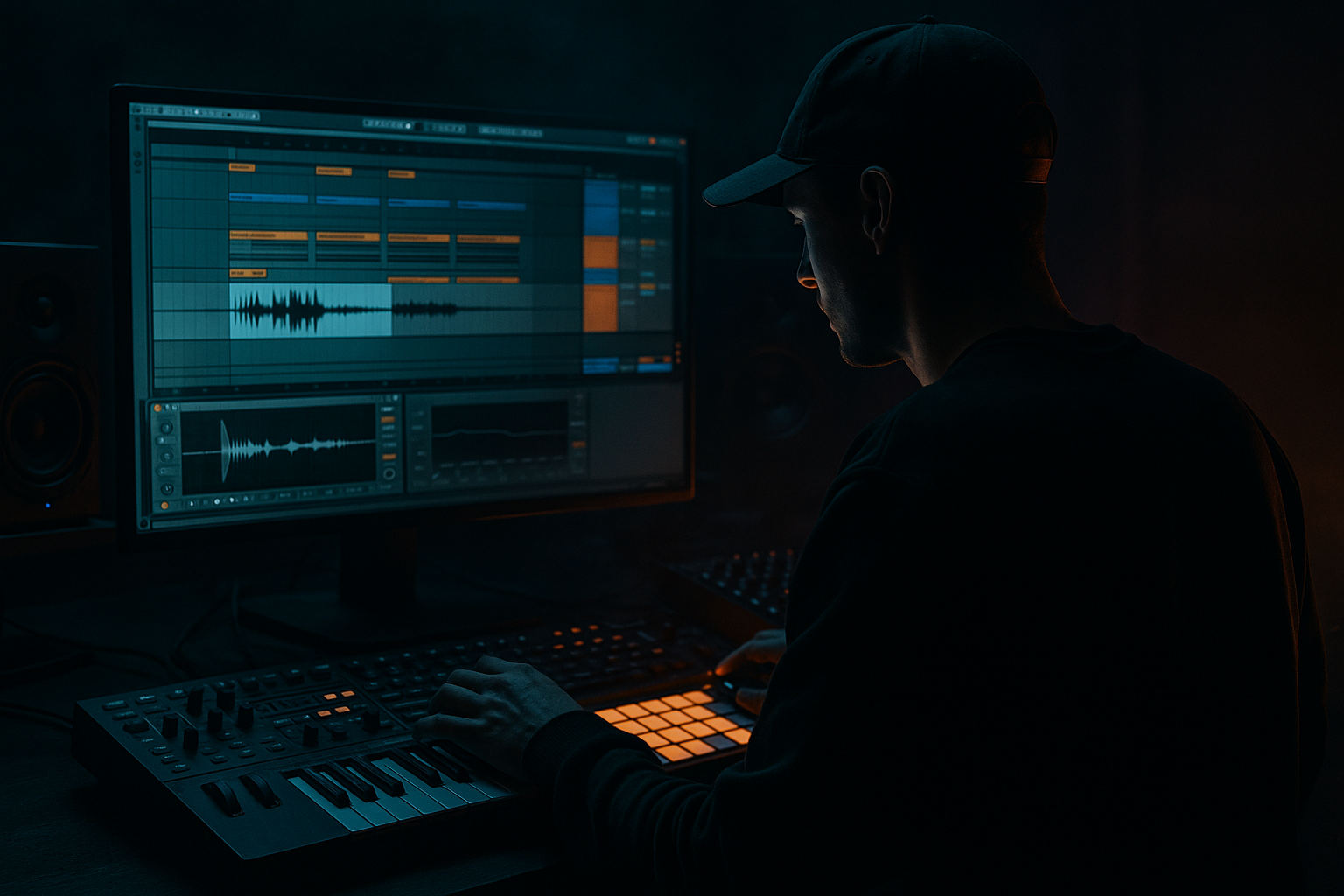
Main tutorial
```markdown
Creating Eerie Drops with Filtered Thunder (DnB FX in Ableton Live) ⚡🌧️
1. Lesson overview
In rolling drum & bass, the drop doesn’t just “arrive”—it materializes. One of the cleanest ways to do that is by using thunder as an evolving, filtered impact layer that:
- builds tension in the last 4–16 bars,
- hits with the drop,
- and then ducks out of the way so the drums and bass stay dominant.
- return tracks, sidechain routing, automation,
- EQ + dynamics,
- gain staging and phase awareness.
- Filtered thunder riser (HP→LP sweeps + resonance)
- Pre-drop “vacuum” moment (band-pass + stereo narrowing)
- Drop impact reinforced by low-end controlled rumble
- Clean mix integration using sidechain ducking and mid/side EQ
- One dedicated Thunder Audio track
- One Thunder Verb return (optional but powerful)
- Automation lanes that make it feel alive in a 16-bar build
- HP filter: 24 dB/oct at 25–35 Hz (remove unusable sub)
- Notch: if needed around 200–400 Hz (mud zone)
- High shelf: -2 to -6 dB above 8–10 kHz if hissy
- Cutoff start (build): ~ 250–600 Hz
- Cutoff end (drop): 2–6 kHz (depends how bright you want the hit)
- Resonance: 20–40% (don’t over-whistle)
- Drive: +2 to +6 dB
- Envelope: Off (we want manual automation)
- Bars 1–8: slowly open from ~300 Hz → 1.2 kHz
- Bars 9–16: open faster to ~3–5 kHz
- Last 1/2 bar before drop: slam it down briefly (see Step 3)
- Mode: Soft Clip
- Drive: +3 to +8 dB
- Output: adjust to keep level consistent
- Attack: 3 ms
- Release: Auto
- Ratio: 4:1
- Threshold: aim 2–5 dB gain reduction on the strike
- Soft Clip: On (subtle)
- Width: automate between 60–120%
- Consider Bass Mono: (Utility → “Bass Mono” if available in your version; otherwise use low-band mono via EQ/Utility workflow)
- Build: wider (100–120%)
- Drop impact moment: narrower (60–90%) so it hits forward.
- Ceiling: -1.0 dB
- Just catch random peaks.
- Mode: Convolution or Hybrid
- Size/Decay: 4–8 s
- Pre-delay: 20–40 ms
- Low Cut: 250–500 Hz
- High Cut: 6–10 kHz
- Mix: 100% (because it’s a return)
- HP 24 dB at 250–400 Hz
- Gentle dip 1–2 dB around 2–4 kHz if it masks snares later
- Add Compressor on the return
- Sidechain input: your Drum Buss or Kick track
- Ratio: 4:1
- Attack: 0.3–1 ms
- Release: 120–250 ms
- Threshold: duck 4–8 dB on hits
- Build: -12 to -6 dB send
- Drop: automate down a bit if needed
- Switch briefly to Band-Pass (BP12 or BP24) (you can automate filter type with device presets / duplication method)
- Frequency: 700 Hz – 1.5 kHz
- Resonance: 35–55%
- Drive: 0–3 dB
- Turn BP filter ON
- Pull Utility Width down to 0–40% (mono narrow)
- Drop the track volume by 1–3 dB right before the drop
- Duplicate the clip.
- On the duplicate, crop to the sharpest crack (20–200 ms region).
- Nudge earlier by 10–30 ms (listen with your kick/snare).
- `Thunder - Crack` (short, early, punchy)
- `Thunder - Tail` (long, filtered, eerie)
- More HP (e.g. 80–150 Hz) so it doesn’t fight sub
- Slight Saturator for presence
- Keep it quieter than you think: -18 to -10 dB relative, depending on mix
- Ratio: 6:1
- Attack: 1–3 ms
- Release: 80–160 ms
- Threshold: aim 3–7 dB GR during kick hits
- Thunder LP cutoff slowly opening (300 Hz → 1.2 kHz)
- Reverb send rising slightly
- Width gradually widening
- Faster opening (1.2 kHz → 4 kHz)
- Add subtle extra distortion (Saturator drive +1–2 dB)
- Introduce small gaps (mute thunder for 1/8 note here and there)
- Half-bar before drop: Vacuum moment (BP + mono + volume dip)
- Final 1/8 note: hard cut to silence (or super short tail)
- Thunder crack hits with kick
- Tail tucked behind with ducking + HP control
- Mid/Side control with EQ Eight:
- Rumble that doesn’t fight sub:
- Texture with Corpus (secret weapon):
- Gate the tail rhythmically (jungle energy):
- Print to audio and commit:
- Thunder becomes a DnB weapon when you filter + automate it like a living riser. ⚡
- Use LP filtering for build, then a BP “vacuum” moment right before the drop.
- Split into crack + tail, time-align the crack, and duck the tail against kick/snare.
- Control space with a ducked reverb return, and keep stereo/low-end disciplined.
This lesson is advanced and assumes you’re comfortable with:
We’ll do this 100% in Ableton Live using mostly stock devices. ✅
---
2. What you will build
A thunder FX chain that behaves like a cinematic, eerie “weather front” leading into a DnB drop:
You’ll end up with:
---
3. Step-by-step walkthrough
Step 0 — Source the thunder (and prep it)
1. Drag a high-quality thunder recording onto an Audio Track named: `FX - Thunder`.
- Pick something with clear transient crack + long tail.
2. Warp OFF (usually best for natural thunder).
- Clip view → Warp: Off
3. Consolidate a region that contains one main strike + tail:
- Select region → `Cmd/Ctrl + J`
4. Gain-stage:
- Aim the clip so peaks hit around -12 to -6 dB (pre-FX).
> DnB context: you’re making an “impact narrative” like classic techstep intros—tension → void → slam.
---
Step 1 — Build the main thunder device chain (stock)
On `FX - Thunder`, add this chain:
#### Device Chain
1) EQ Eight
2) Auto Filter
3) Saturator
4) Glue Compressor
5) Utility
6) Limiter (safety)
---
#### 1) EQ Eight (pre-clean + shaping)
Tip: If your thunder has harsh crack, try a narrow dip around 2.5–4.5 kHz.
---
#### 2) Auto Filter (the “eerie” movement) 🎛️
Set Filter Type to LP24.
Automation idea (16-bar build):
This gives that “storm front approaching” vibe without adding extra synth risers.
---
#### 3) Saturator (weight + grit)
Thunder often needs harmonic help to read on smaller systems—Saturator makes the tail feel thicker in DnB mixes.
---
#### 4) Glue Compressor (control + punch)
---
#### 5) Utility (stereo discipline)
Thunder can be wide and phasey. For the drop, your bass usually owns the center.
Rule of thumb:
---
#### 6) Limiter (safety, not loudness)
---
Step 2 — Create a “Thunder Verb” return for space (optional but huge) 🌫️
Create Return Track A named: `A - Thunder Verb`.
Add:
1) Hybrid Reverb (or Reverb)
2) EQ Eight
3) Compressor (sidechained)
#### Hybrid Reverb settings (starting point)
#### EQ Eight after reverb (clean the cloud)
#### Sidechain the reverb tail (so it doesn’t wreck the drop)
Send the thunder track to this return:
---
Step 3 — The “pre-drop vacuum” trick (DnB tension move) 😶🌫️
In the last 1/2 bar or 1 bar before the drop, we’ll make the thunder feel like it’s being “sucked away,” so the drop hits harder.
On the thunder track, automate Auto Filter like this:
Simpler method: duplicate Auto Filter:
- Auto Filter 1 = LP24 (main)
- Auto Filter 2 = BP12 (vacuum), turned off until needed
BP filter settings (vacuum moment):
Automation for last 1/2 bar:
Result: your ears focus on the mid “whoosh,” then—bam—the drop feels wider and heavier.
---
Step 4 — Make it hit with the drop (layering + timing)
Thunder alone can feel late because its transient is soft.
Timing trick:
Now you have:
For the crack layer:
---
Step 5 — Keep bass clean: sidechain duck the thunder
Add Compressor on the thunder track (or use Glue), sidechained to Kick (or a “Ghost Kick” MIDI trigger).
Suggested settings:
If your snare needs space too (common in jungle-style 2&4), also duck from snare—or use a combined drum bus.
---
Step 6 — Arrangement: where this works best in rolling DnB
Try this 16-bar pre-drop structure:
Bars 1–8:
Bars 9–15:
Bar 16 (last bar):
Drop (bar 1):
This is very in line with darker neuro/techy rollers: controlled chaos.
---
4. Common mistakes
1. Too much low end in the thunder
It’ll smear your sub and kill punch. HP it and control the tail.
2. Over-wide thunder during the drop
Wide low-mids = phase soup. Narrow it on impact or mono below ~150 Hz.
3. No timing correction
Thunder transients can be late. Micro-nudge the crack layer earlier.
4. Reverb not ducked
Big verb tails will mask snares and ride energy. Sidechain the return.
5. Resonance whistle
Auto Filter resonance can scream at 1–3 kHz. Automate resonance down as the cutoff opens.
---
5. Pro tips for darker/heavier DnB 🖤
Put EQ Eight after reverb and reduce Sides around 200–600 Hz so the drop stays focused.
Create a separate low rumble layer from thunder using:
- EQ Eight (band around 50–90 Hz) → Saturator → Compressor → Utility (mono)
Keep it very quiet; duck it heavily from kick.
On the thunder tail, try Corpus subtly:
- Preset: start from “Tube”
- Tune: around 50–120 Hz
- Mix: 5–15%
It can add metallic dread—great for techstep vibes.
Use Gate keyed from a ghost 1/8 pattern to “chop” the thunder tail into motion.
Resample your thunder FX to a new audio track once it’s moving right. Then you can:
- reverse bits,
- add micro-cuts,
- stretch tails without CPU drama.
---
6. Mini practice exercise (15 minutes) ⏱️
1. Pick one thunder sample and create:
- a crack clip (≤200 ms)
- a tail clip (2–6 seconds)
2. Build the main chain (EQ → Auto Filter → Saturator → Glue → Utility).
3. Automate:
- LP cutoff opening over 8 bars
- Vacuum moment in last 1/2 bar (BP + width down)
4. Add a reverb return and duck it from the kick.
5. Drop it into a 174 BPM project with a rolling drum loop and sub-bass.
6. Bounce a 16-bar build + 8-bar drop and check:
- does the snare still snap?
- does the sub stay clean?
- does the drop feel “bigger” after the vacuum?
---
7. Recap
If you want, tell me your sub style (clean sine, reese, foghorn, neuro) and I’ll suggest exact cutoff/ducking ranges that fit your drop mix.
```

