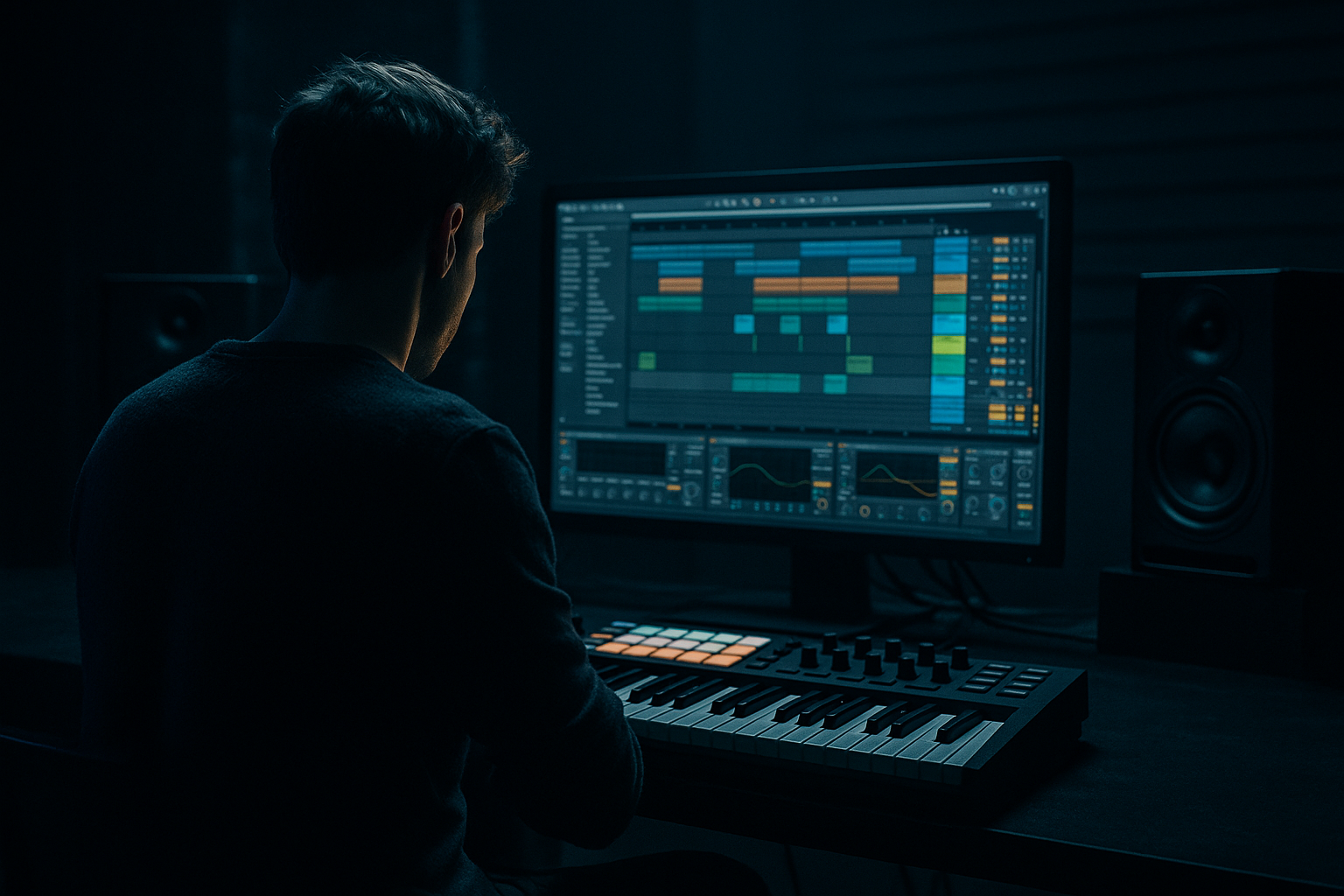
Main tutorial
Creating Forward Motion in Drum & Bass (Ableton Live) 🚀
Beginner • Groove • Practical workflow for rolling DnB / jungle energy
---
1. Lesson overview 🎛️
Forward motion is that feeling that the track is pulling you into the next bar. In drum & bass, it’s created less by “complexity” and more by micro-timing, call-and-response, syncopation, tension/release, and automation.
In this lesson you’ll build a simple but effective DnB groove (drums + bass + ear candy) and learn the exact Ableton Live moves that make it roll: swing, ghost notes, offbeats, fills, risers, and subtle variations.
---
2. What you will build 🧱
By the end you’ll have a 16-bar loop that feels like a real DnB groove:
- A 2-step drum pattern with ghost snares, hats, and micro-variation
- A rolling bass rhythm that locks to the kick/snare but “pushes” forward
- Simple ear candy (rides, shakers, impacts, reverses) to guide the listener
- A basic arrangement plan so the loop evolves over 16 bars
- Grid: 1/16
- Kick: `1.1.1` and `1.3.1` (classic 2-step)
- Snare: `1.2.1` and `1.4.1`
- On the Drum track, add:
- Add quiet snare/rim hits:
- Velocities: `15–40` (keep them subtle)
- Nudge ghost hits slightly early:
- Put a ride/open hat on:
- Bars 1–4: minimal hats
- Bars 5–8: add ride/offbeat hat
- Bars 9–12: add small variations (extra 1/16 hat occasionally)
- Bars 13–16: add a mini fill (see Step 7)
- Auto Filter
- Saturator
- Option A: Wavetable
- Option B: Operator (great for sub)
- Make the bass “answer” the drums.
- Start with notes on:
- Add Compressor on Bass
- Enable Sidechain
- Audio From: Drum track → choose Kick chain (or Pre-FX)
- Settings starter:
- Change one hat velocity every 2 bars
- Add a single extra 1/16 hat at the end of bar 4/8/12/16
- Swap one ghost snare to a different sample
- Add a short muted bass note before a snare (very quiet)
- In bar 4 and 8 (end of phrase):
- On hats or drum bus, automate:
- Bars 1–4: Kick/snare + closed hats (intro of the groove)
- Bars 5–8: Add ride/offbeat hat + slightly louder ghosts
- Bars 9–12: Bass adds 1 extra syncopated note every 2 bars
- Bars 13–16: Add a mini fill + reverse into bar 17 (drop/next section)
- Make the drums feel “ahead,” bass feel “behind”
- Parallel smash your drum bus (stock method):
- Use distortion with control
- Tension automation
- Ghosts with character
- Start with a clean 2-step anchor
- Add hat movement using velocity shaping + Groove Pool swing
- Use ghost notes (quiet + slightly early) for roll
- Write bass rhythms with space, and sidechain for breathing
- Add phrase-based variations every 4/8/16 bars
- Use fills, reverse FX, and automation to pull into the next section
Target vibe: rolling / jungle-leaning DnB at 172–176 BPM.
---
3. Step-by-step walkthrough ✅
Step 0 — Set up your session (2 minutes)
1. Set tempo: `174 BPM`
2. Warp mode: leave defaults (fine for now).
3. Create tracks:
- MIDI Track: Drums
- MIDI Track: Bass
- Audio Track: Ear Candy / FX
4. Set loop brace to 16 bars.
---
Step 1 — Build a solid 2-step foundation 🥁
Goal: strong anchors + space for motion elements.
On the Drum MIDI track:
1. Load Drum Rack (Browser → Instruments → Drum Rack).
2. Pick samples (Ableton packs if you have them, otherwise any clean kick/snare):
- Kick: short, punchy
- Snare: sharp with some body (classic DnB crack)
- Closed hat
- Ride or open hat
- Optional: rim/ghost snare, perc
Program a 1-bar loop:
Now duplicate that to fill 16 bars.
Make it hit harder (stock devices):
1. Drum Buss
- Drive: `5–15%` (taste)
- Boom: `15–35%` (tune to kick fundamental if needed)
- Damp: adjust so it doesn’t get muddy
2. EQ Eight
- Cut rumble: HP at `25–35 Hz` (gentle)
- If snare is boxy: small dip around `250–450 Hz`
✅ At this point it’s steady but probably “static.” Now we add motion.
---
Step 2 — Add hats that pull the groove forward 🎩
DnB forward motion often comes from consistent high-frequency movement.
Closed hats (simple but effective):
1. Add closed hats on every 1/8 note:
`1.1.1, 1.1.3, 1.2.1, 1.2.3, ...`
2. Velocity shaping (this matters!):
- Downbeats louder, offbeats softer
Example: `95, 70, 90, 65, 95, 70...`
Add swing (Groove Pool):
1. Open Groove Pool (click the wave icon / or View → Groove Pool).
2. Drag in a groove like:
- Swing 16-XX (start with something mild)
3. Apply to the hat clip:
- Timing: `20–35`
- Random: `5–10`
- Velocity: `5–15`
4. Hit Commit only after you’re happy (optional).
✅ You should feel it start to “shuffle” instead of marching.
---
Step 3 — Ghost notes: the secret sauce for roll 👻
Ghost notes create momentum by implying extra hits without stealing focus.
Ghost snare (very DnB):
- Just before the main snare: `1.1.4` (1/16 before 2)
- And/or: `1.3.4` (1/16 before 4)
Micro-timing for push:
- Select ghost note → move -5 to -15 ms
- In Live: turn off grid (Cmd/Ctrl+4) and nudge or use the Note Position controls.
✅ This creates “leaning forward” energy—super common in rolling DnB.
---
Step 4 — Offbeat energy: rides, opens, and “air” 🌬️
Add a ride or open hat that helps transitions and bar energy.
Pattern idea (classic):
- `1.1.3` and `1.3.3` (offbeats), or
- a 1/4 pulse during higher energy sections
Make it evolve across 16 bars:
Processing (simple chain):
- HP mode, cutoff around `200–600 Hz` to keep hats clean
- Drive `1–4 dB` for presence
---
Step 5 — Bass rhythm that locks but rolls 🧬
Forward motion isn’t just drums—DnB bass rhythm is everything.
Create a simple bass (stock instrument options):
Beginner-friendly bass patch (Operator):
1. Load Operator
2. Oscillator A: Sine
3. Add Saturator after it:
- Drive `3–6 dB`
- Soft Clip ON (if needed)
4. Add EQ Eight:
- Low-pass around `120–200 Hz` if you want pure sub
- Or leave more harmonics if it’s your main bass
Write a rolling rhythm (1 bar idea):
- `1.1.1` (with kick)
- `1.1.3` (offbeat push)
- `1.2.3` (after snare)
- `1.3.1` (with kick)
- `1.3.3` (offbeat push)
- `1.4.3` (after snare)
Key concept: avoid holding notes too long.
Try lengths around 1/8 or 1/16, with occasional ties.
Sidechain to the kick (stock device):
- Ratio: `4:1`
- Attack: `1–5 ms`
- Release: `60–120 ms` (match groove)
- Threshold: adjust for ~`3–6 dB` gain reduction
✅ You’ll hear the bass “breathe,” which adds movement instantly.
---
Step 6 — Use tiny variations (without breaking the loop) 🔁
A loop feels static because it repeats exactly. In DnB, pros keep the core steady but add micro-variation.
Variation ideas (choose 2–3):
Ableton workflow tip:
Duplicate your 1-bar drum clip to a 4-bar clip, then edit only the last bar. Repeat for 16 bars.
---
Step 7 — Create “pull” into the next phrase (fills + risers) 🧨
Forward motion lives in transitions.
Micro-fill (DnB classic):
- Add 1/16 snare ticks: `... 1.4.3, 1.4.4`
- Or a tiny kick pick-up at `1.4.4` (very quiet)
Reverse cymbal into snare (simple FX):
1. Drop a cymbal sample into Audio track.
2. Right-click → Reverse
3. Place it so it rises into the snare at `1.2.1` or `1.4.1`.
4. Add Reverb (small-to-medium):
- Decay: `1.2–2.5 s`
- Dry/Wet: `15–30%`
5. EQ Eight: high-pass at `200–400 Hz`
Automation that creates motion:
- Auto Filter cutoff slightly rising over 4–8 bars
- Reverb send increasing into bar 8/16 then cutting back
✅ This creates “where are we going?” energy—essential in DnB.
---
Step 8 — Arrangement idea: 16 bars that feel like a real section 🧭
Here’s a super usable beginner arrangement for forward motion:
If you’re building a full track, this 16-bar loop can be your main drop A.
---
4. Common mistakes ⚠️
1. Overcrowding the snare area
Too many loud ghosts makes the backbeat weak. Keep ghosts quiet and/or filtered.
2. No velocity shaping
Hats at the same velocity sound like a typewriter. Use accents.
3. Too much swing on everything
Swing hats/percs first. Keep kick/snare mostly tight unless you really know why you’re shifting them.
4. Bass notes too long
Long sustained bass often kills the roll. Use shorter notes and rhythmic gaps.
5. Random variation without phrase logic
Put changes at bar 4/8/16 boundaries so the listener feels structure.
---
5. Pro tips for darker/heavier DnB 🖤
Nudge hats/ghosts slightly early, let the sub sit slightly late (tiny offsets). This creates weight + urgency.
1. Create a Return track “DRUM CRUSH”
2. Add Compressor (or Glue Compressor if you have it)
- Ratio `10:1`, fast attack, medium release, heavy gain reduction
3. Add Saturator (Drive `5–10 dB`)
4. Send drums lightly (Return send around `-18 to -10 dB`)
Put Overdrive or Saturator on reese/top bass, then EQ Eight after to tame harshness around `2–6 kHz`.
Automate a subtle Auto Filter low-pass closing slightly during bars 13–16, then snap open at bar 17.
Use a rimshot or foley-like tick for ghosts instead of another full snare. It keeps the groove sharp, not cluttered.
---
6. Mini practice exercise 🧪
Set a timer for 20 minutes:
1. Build a 1-bar 2-step loop (kick/snare + hats).
2. Add 2 ghost snares (one before each main snare).
3. Add swing to hats only (Timing 25–35).
4. Duplicate to 8 bars.
5. Make exactly 3 variations:
- One hat velocity change
- One tiny fill at bar 8
- One bass rhythm change at bar 6 or 7
6. Export audio and listen away from the screen:
Ask: Does bar 8 feel like it wants to loop again? If yes, you’ve created forward motion.
---
7. Recap 🔥
To create forward motion in DnB inside Ableton Live:
If you want, tell me what substyle you’re aiming for (liquid, rollers, jump-up, jungle, neuro) and I’ll give you a specific 16-bar MIDI pattern (drums + bass) tailored to it.

