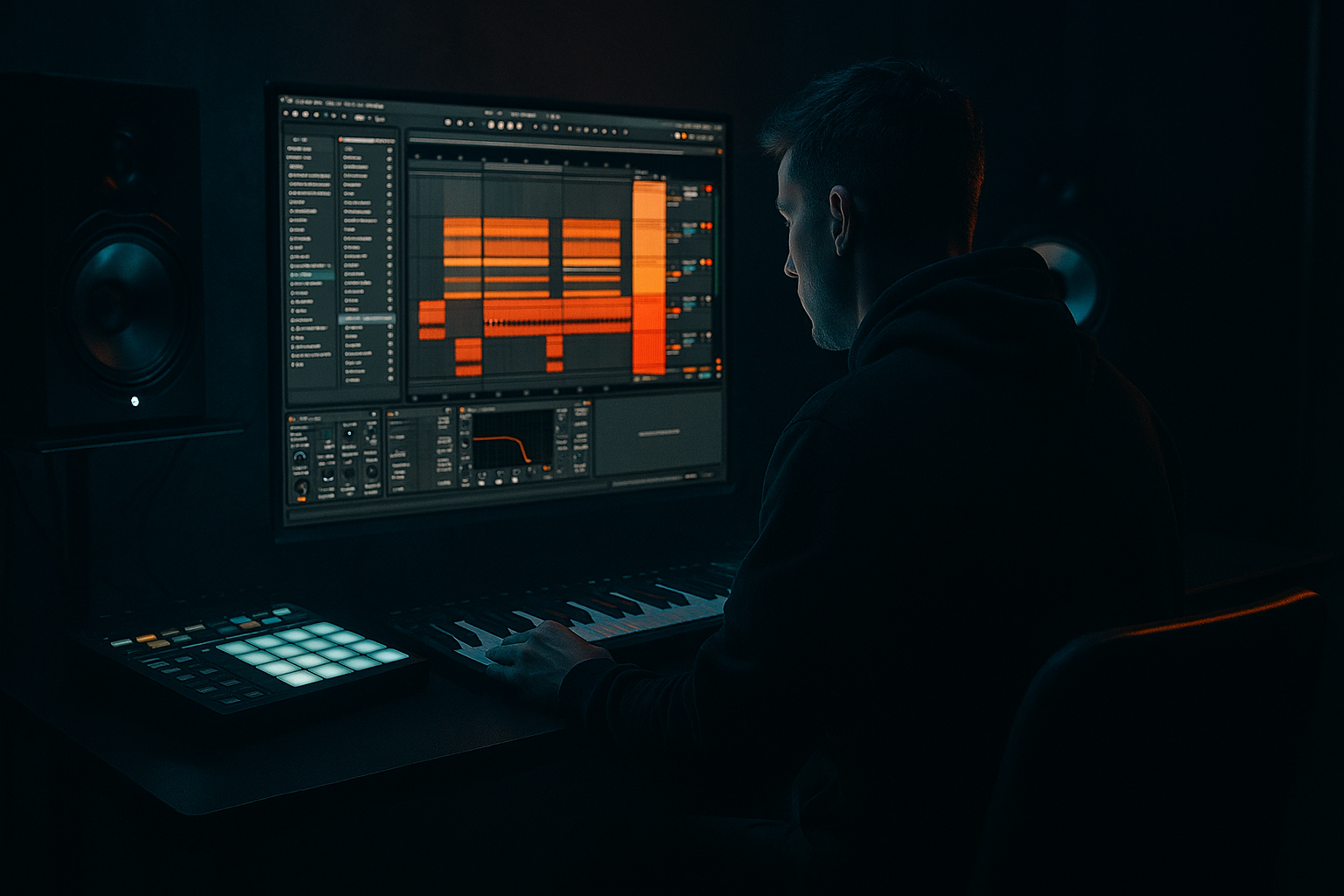
Main tutorial
Creating Forward Motion with Simple Racks (DnB in Ableton Live) 🚄🥁
1) Lesson overview
Forward motion in drum & bass isn’t just “more drums” — it’s controlled movement: tiny changes in tone, rhythm, space, and energy that make a loop feel like it’s going somewhere even when the pattern stays simple.
In this lesson you’ll build a few easy Ableton Instrument/Drum Effect Racks that create motion automatically:
- Velocity → tone/brightness
- Timing → push/pull swing
- Space → micro-ambience that breathes
- Variation → subtle fills and “ghost” movement
- Kick: 1.1, 1.3 (or add a ghost kick at 1.4.3)
- Snare: 1.2 and 1.4 (DnB backbeat)
- Closed hat: 1/8ths or 1/16ths (keep it consistent)
- Map to Drum Buss Drive (5% → 25%)
- Map to Glue Makeup (0 dB → +2 dB) (optional)
- Map to Drum Buss Boom (0% → 10%)
- Map to Glue Attack (3 ms → 0.3 ms)
- Map to Auto Filter Frequency (10 kHz → 20 kHz)
- Add Compressor after Glue (stock Compressor)
- Enable Sidechain, input: your Kick (or a “ghost kick” channel if you use one)
- Settings:
- Map Macro 4 to Compressor Threshold (light → stronger)
- Auto Filter: High-pass or Band-pass
- If High-pass:
- Use this to “thin” or “bite” the hats.
- Saturator:
- Utility:
- Reverb:
- Hat Tone slowly opening across 8 or 16 bars
- Micro Room slightly up in fills (end of 8s/16s)
- Width a touch wider in the second half of the phrase
- EQ Eight
- Saturator
- Auto Filter (optional for subtle talking movement)
- Compressor (sidechain from kick)
- EQ Eight:
- Saturator:
- Auto Filter:
- Compressor sidechain from Kick
- Map macro to Threshold for groove pocket.
- Drums: lighter
- Hats: Hat Tone slightly closed, Micro Room minimal
- Bass: harmonics low, sidechain moderate
- Gradually automate:
- Add 1-bar break edit at bar 16 (even just mute kick on last beat)
- Push:
- Keep hats bright and wide, but don’t drown the snare
- Pull back then re-hit:
- Add a simple fill: snare flam or break chop at bar 32
- Controlled distortion layers:
- Add “air grit” with Redux (tiny):
- Break movement:
- Dark space:
- Forward motion in DnB comes from small, intentional changes repeated over phrases.
- Simple racks let you control:
- The winning workflow:
All using stock Ableton devices so you can do this in any Live setup. ✅
---
2) What you will build
You’ll end up with three simple racks you can drop onto any DnB project:
1. Rolling Drum Movement Rack (Drum Rack macro rack)
Adds “push,” ghost presence, and high-end evolution to your break/kit.
2. Hat Motion Rack (Audio Effect Rack)
Auto-shapes hats with dynamic filtering, width, and micro-room for constant flow.
3. Bass Pocket Motion Rack (Audio Effect Rack)
Sidechain + subtle saturation/chorus movement to keep the bassline rolling but controlled.
You’ll also apply them in a 16–32 bar DnB arrangement (intro → drop → variation) so it feels like real music, not a loop.
---
3) Step-by-step walkthrough
Step 0 — Project setup (fast + clean) ⚙️
1. Set tempo to 174 BPM (classic DnB range: 170–176).
2. Create groups:
- DRUMS (Drum Rack inside)
- BASS
- MUSIC/FX
3. On your Master, keep it simple for now:
- Limiter (Ceiling -0.3 dB, just safety)
---
Step 1 — Start with a minimal rolling groove (the “boring” loop)
Goal: Make something plain, then use racks to create motion.
1. Create a Drum Rack track named `DRUM RACK`.
2. Load basic DnB elements (samples can be anything decent):
- Kick (punchy)
- Snare (crack)
- Closed hat
- Ride/openhats
- A break slice (optional but very DnB)
Simple 1-bar pattern (starter):
Loop 4 bars.
Now let’s make it move without rewriting the pattern.
---
Step 2 — Build Rack #1: “Rolling Drum Movement Rack” (macros that create motion) 🎛️
We’ll build a macro layer on top of your drum rack.
#### 2A) Add a Drum Buss + movement chain on the DRUMS group
1. Put your Drum Rack inside a Group (`Cmd/Ctrl + G`) called `DRUMS BUS`.
2. On `DRUMS BUS`, add:
- Drum Buss
- Drive: 5–15%
- Boom: 0–10% (keep controlled for DnB)
- Crunch: 5–20%
- Glue Compressor
- Attack: 3 ms
- Release: Auto
- Ratio: 2:1
- Soft Clip: On
- Aim for 1–3 dB gain reduction on peaks
- Auto Filter (for energy sweeps later)
- Filter: Low-pass
- Frequency: ~18 kHz (start open)
- Resonance: ~0.7
Now select those three devices → Cmd/Ctrl+G to create an Audio Effect Rack named:
`DRUMS - Motion Rack`
#### 2B) Map 4 macros (simple but powerful)
Inside the rack, map:
Macro 1: “Drive”
Macro 2: “Tightness”
Tighter = faster attack, clamps down slightly.
Macro 3: “Air”
This becomes your “open the top end” energy control.
Macro 4: “Pump”
- Ratio: 4:1
- Attack: 1–3 ms
- Release: 60–120 ms (adjust to groove)
- Threshold: lower until you get 1–4 dB ducking
✅ This rack gives you macro-level motion (energy and groove) without changing the MIDI.
---
Step 3 — Build Rack #2: “Hat Motion Rack” (forward motion = micro-variation) 🎩✨
Hats are the engine of rolling DnB. We’ll make a rack that evolves hats over time.
1. On your hat track (or the hat chain inside Drum Rack if you prefer), add:
- Auto Filter
- Saturator
- Utility
- Reverb (tiny room)
2. Select them → Cmd/Ctrl+G to make an Audio Effect Rack:
`HATS - Motion Rack`
#### Map macros like this:
Macro 1: “Hat Tone”
- Frequency: 200 Hz → 1.2 kHz
- Resonance: 0.4 → 1.0
Macro 2: “Grit”
- Mode: Analog Clip
- Drive: 0 dB → +6 dB
- Soft Clip: On
- Output: adjust so level stays consistent
Macro 3: “Width”
- Width: 80% → 140%
- (Optional) Bass Mono: On, set around 200 Hz
Macro 4: “Micro Room”
- Size: 10–20%
- Decay Time: 0.3–0.7 s
- Pre-Delay: 0–10 ms
- High Cut: 6–10 kHz
- Dry/Wet: 3% → 12%
This adds air movement without washing out the groove.
#### Add motion with automation (this is the magic)
In Arrangement View, automate:
Small moves = big perceived motion in DnB.
---
Step 4 — Build Rack #3: “Bass Pocket Motion Rack” (movement without losing weight) 🧱🔊
DnB bass needs to feel alive but not messy. This rack adds controlled motion + space for drums.
On your BASS track, add and rack:
Select → Cmd/Ctrl+G → `BASS - Pocket Motion`
#### Macro mapping:
Macro 1: “Sub Control”
- Add low shelf around 80–120 Hz
- Map Gain -2 dB → +2 dB
- (Optional) Add a narrow cut at 200–350 Hz to reduce mud
Macro 2: “Harmonics”
- Drive: 0 dB → +8 dB
- Soft Clip: On
- Keep it subtle — rolling bass likes controlled harmonic density.
Macro 3: “Wobble (tiny)” (optional but fun)
- Low-pass around 200 Hz → 2 kHz
- Add LFO:
- Amount: small (5–15)
- Rate: 1/8 or 1/4 (sync)
- Map macro to LFO Amount or Filter Frequency
Keep this barely moving for rollers, more for neuro-ish flavors.
Macro 4: “Sidechain”
- Ratio: 4:1
- Attack: 0.5–3 ms
- Release: 70–140 ms
---
Step 5 — Arrangement idea: 32 bars of forward motion (with only automation) 🧭
Here’s a practical DnB structure using your macros:
Bars 1–8 (Intro / tease):
- DRUMS Motion Rack: Drive low, Air slightly down
Bars 9–16 (Build):
- DRUMS “Air” opening
- HATS “Width” + “Micro Room” up slightly
Bars 17–24 (Drop):
- DRUMS “Drive” up
- BASS “Harmonics” up a touch
Bars 25–32 (Variation):
- Bar 25–28: reduce Air slightly, change hat tone
- Bar 29–32: increase Pump/Sidechain for extra roll
Forward motion often comes from automation and contrast, not constant complexity.
---
4) Common mistakes
1. Over-automating everything
If every macro is moving constantly, nothing feels intentional. Choose 1–2 main movements per section.
2. Too much reverb on hats/snare
Jungle/DnB needs speed and clarity. Keep reverb short and filtered.
3. Sidechain release too slow
If release is long, the groove “sags.” For rollers, try 70–120 ms and adjust by feel.
4. Driving the drum bus until the snare loses crack
If your snare dulls, reduce saturation/comp or add a small presence boost around 2–5 kHz (EQ Eight).
5. Width on low end
Don’t widen sub. Use Utility to keep lows mono (below ~120–200 Hz).
---
5) Pro tips for darker/heavier DnB 🖤
Duplicate bass: keep one channel clean sub, one channel distorted mids. Use EQ Eight to split (sub <120 Hz, mids >120 Hz).
On hats or breaks, try Redux with very subtle downsample for crunch (mix low).
Use Beat Repeat very lightly on a break channel:
- Interval: 1 bar
- Grid: 1/16
- Chance: 5–12%
- Mix: 5–15%
Use Echo instead of big reverbs:
- Time: 1/8 or 1/16
- Feedback: 10–25%
- Filter it dark (low-pass ~4–8 kHz)
---
6) Mini practice exercise (15–20 minutes) ⏱️
1. Make a 4-bar loop with kick/snare/hats/bass (simple roller).
2. Add the HATS Motion Rack and automate:
- Hat Tone opens from bars 1–4
- Micro Room spikes only on bar 4
3. Add the DRUMS Motion Rack and automate:
- Air opens gradually across 8 bars
- Pump increases slightly in the last 2 bars
4. Bounce/export a quick audio and listen:
Does it feel like it’s “arriving” at bar 8 even without new notes?
If not, reduce the amount of movement and make the changes more section-based.
---
7) Recap ✅
- Energy (Air/Drive)
- Groove pocket (Pump/Sidechain)
- Texture (Grit/Tone)
- Space (Micro Room/Width)
Build a plain loop → add racks → automate macros over 8/16-bar phrases → add 1–2 fills for punctuation.
If you tell me what sub-genre you’re aiming for (liquid, jungle, neuro, jump-up, rollers), I can suggest macro ranges and a matching 32-bar automation plan.

