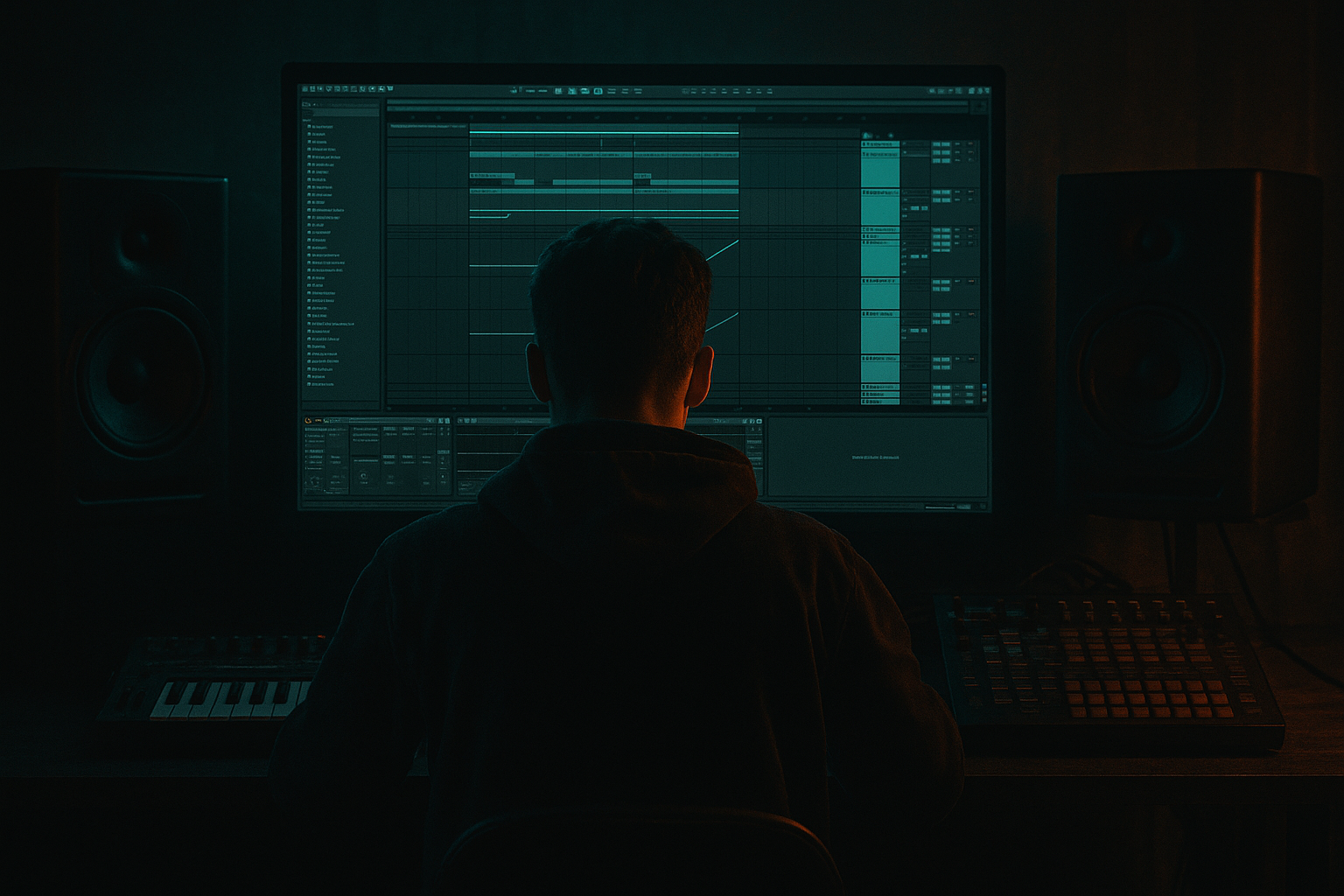
Main tutorial
1. Lesson overview
------------------
Goal: Advanced techniques for building tension with tonal risers in drum & bass (170–175 BPM). You'll learn how to design layered, musical risers that feel like they’re “pulling” the energy up into the drop — not just noisy sweeps. This lesson is Ableton-centric and focused on practical device chains, automation, resampling, and arrangement ideas tailored to DnB/jungle/rolling bass music. Expect concrete settings, routings, and macro mappings you can drop into your session. Let’s get the energy rising! 🚀🥁
2. What you will build
----------------------
A 3-layer tonal riser (long tonal pitch riser + mid harmonic/formant riser + short high/noise riser) processed into a single resampled audio riser with additional processing (reverb/delay/sidechain) and mapped macros for easy reuse. The riser will be designed to work with 8–16 bar build sections common in DnB, and to cut neatly into a heavy drop.
What each layer does:
- Layer A (foundation): long, musically pitched oscillator stack that slowly slides up (adds perceived energy and harmonic lift).
- Layer B (character): spectral / formant sweep or grain-pitched harmonic motion — adds body and harmonic interest.
- Layer C (transients/noise): white noise sweep, short reversed hits and impact hits — gives the “whoosh” and transient attack for the drop.
- Set tempo to 174 BPM (common DnB sweet spot). Use Ableton Live 11+ features if available (Spectral devices, Sampler). All steps include alternatives for Standard vs Suite where needed.
- Create a new Return Track (R1) with Glue Compressor and shallow Reverb (Hall/Plate) for send ambience.
- Osc A: Saw, level 0 dB
- Osc B: Saw, Detune +8 cents, level -3 dB
- Osc C: Saw Octave, Unison 2, level -6 dB
- Pitch Bend: +1200 cents over 16 bars (curve)
- Auto Filter: LP -> Cutoff 800 Hz → 6kHz automation, Res 3.5
- Saturator: Drive 2–4 dB, Soft clip
- Long build: Use Layer A to perform a slow +12 semitone climb over 16 bars; Layer B kicks in around bar 9 and morphs dramatically in the last 4 bars; Layer C performs short 1/4–1/8 bar sweeps and reversed hits every bar, with last two quarter bars opening fully.
- Quick hype into a drop: a 4-bar condensed riser where pitch jumps +5 → +12 semitones rapidly and noise opens in the last bar (use exponential automation).
- Rolling pre-drop: For a rolling DnB feel, sync an LFO-controlled filter or Auto Pan to 1/16 or 1/32 rates and automate the macro to increase intensity while the bass groove keeps rolling underneath.
- Riser steals sub/fundamental energy: Always HP the riser (120–300 Hz) or sidechain it to the kick/sub so the drop’s low-end stays tight.
- Linear automation that feels predictable: Linear pitch automations sound mechanical. Use curves that ease-in and then accelerate (exponential), or create breakpoints that speed-up in the final bars.
- Over-processing that removes pitch clarity: Too much bitcrush/distortion can kill the harmonic motion. Put distortion after pitch processing and dial it in subtly.
- Not resampling: Leaving many real-time chains active makes edits and CPU hit awkward. Resample and then sculpt.
- Too many competing risers: Layering is good — clutter is not. When you layer, carve space for each (low/mid/high) with EQ.
- Ignoring stereo phase: If you widen everything with chorus or stereo wideners, mono-compatibility can suffer. Check in mono, use utility for controlled stereo width.
- Lower the starting pitch: Start your pitch sweep from a lower register (-12 to -24 semitones) so the riser sweeps through darker harmonics and ends in the higher register — gives a “looming” feeling.
- Add inharmonic metallics: Use Corpus or Spectral Resonator with inharmonic settings (low Q, complex mode) to create metallic clangs that feel unsettling.
- Use heavy distortion selectively: Put Saturator + Overdrive on Layer B and drive lightly (4–6 dB). Post-saturator, low-pass around 6–8 kHz to keep it thick.
- Make the midrange raw: Create a band-pass around 400–900 Hz and automate a narrow resonance sweep to create that aggressive body bite common in heavier DnB.
- Granular pitch chaos: Use longer grain sizes and negative spray in Grain Delay to generate unpredictable artifacts. Automate feedback so the grain becomes more prominent towards the climax.
- Sub drop technique: On the last 1/4 bar of the riser, briefly cut the sub frequencies (HP filter up to 150–300 Hz) so the drop hits with a sudden sub-return — creates impact.
- Layer low-end rumble: An LFO-modulated sine sub (~40–80 Hz) with slow pitch wobble (±5–10 cents) underneath the riser adds subterranean tension without conflicting with drop sub if you HP the main riser.
- Use spectral gating: Automate a narrow band boost in EQ Eight plus a gate to let gritty midrange slap through rhythmically in the last bars.
- Tonal risers in DnB should be layered: long tonal pitch + mid harmonic/formant + high/noise/transients.
- Use pitch bend or device transpose automation for smooth musical rises; avoid linear motion — prefer curves and staged acceleration.
- Use spectral/granular tools (Spectral Resonator, Grain Delay, Corpus) to add harmonic character. Resample early, then sculpt with EQ, delay, and reverb.
- Always manage low-end: HP filtering and sidechain to preserve drop impact.
- Map macros for instant global control and build tension dynamically in arrangement.
- For darker/heavier vibes, favor lower starting pitches, inharmonic metallics, band-pass mid resonance, heavy but tasteful distortion, and a brief sub-cut before the drop.
3. Step-by-step walkthrough
---------------------------
Preliminaries
Layer A — Long Tonal Pitch Riser (MIDI synth approach)
1. Create a MIDI track. Insert Operator (stock synth) or Simpler in Classic mode loaded with a saw stack.
- Operator: Use 3 oscillators: A (saw), B (saw detuned -7 cents), C (square/saw octave). Detune B by +/-6–12 cents and set unison on C to 2. Level mix so fundamental is strong but not overpowering.
- Envelope: Give a long amp with slow attack 10–30 ms and long release 300–600 ms.
2. Pitch automation:
- Option A (MIDI Pitch Bend): Create a 16-bar MIDI clip, switch to the Pitch Bend lane. Draw a smooth curve going from 0 to +1200 cents (+12 semitones) over the clip. For more drama, accelerate: 0→+6 semitones over first 12 bars, then +6→+12 in last 4 bars.
- Option B (Device Transpose): Use the Simpler/Operator Transpose parameter and automate it in clip/arrangement view for a similar effect. Draw a curved automation (ease-in) rather than linear — exponential upward motion sells tension.
3. Filters & movement:
- Add Auto Filter (band-pass or low-pass with resonance). Start cutoff ~800 Hz and automate to ~6–8 kHz at the peak. Auto Filter LFO off; we are automating cutoff manually for a sweep.
- Add Saturator (Soft Clip) -> Glue Compressor (fast attack, medium release) on the track for glue.
4. Routing: Send to Return R1 at 15–30% for long reverb tail.
Settings summary (Operator):
Layer B — Mid harmonic / Formant riser (spectral/granular)
1. Create an audio or MIDI track. Two approaches:
- Spectral approach: Use a short vocal-ish sample (e.g., “ah” or sine chord) -> feed into Spectral Resonator (Live 11 Suite) or Corpus.
- Granular approach (no Suite): Use Simpler/Sampler or resample and use Grain Delay.
2. Spectral Resonator chain:
- Put an instrument chain: Sample (vowel) -> EQ Eight (HP at 50 Hz) -> Spectral Resonator.
- Spectral Resonator settings: Mode = Harmonic, Frequency = 440 Hz (or root note of your track), Detune +0 to +200 cents automation across build, Feedback 20%. Use Preset as starting point “Tonal Resonator.”
- Automation: Automate the Resonator’s “Pitch” (or Frequency) from root to +6–+18 semitones over 4–8 bars. Also automate the Dry/Wet to increase toward the peak.
3. Granular alternative (if no Spectral device):
- Load a sustained chord into Simpler in Slice or Classic mode, then use Grain Delay after it:
- Grain Delay: Delay Time 1–15 ms, Spray 0–30%, Pitch convert: vary Pitch from 0 → +1200 cents using automation or macro.
- Feedback 20–40% for thickening.
4. Add movement: Insert Chorus/Ensemble (small depth) and a small amount of Chorus to widen.
5. Route to R1 (reverb) + small delay (Ping Pong) set to dotted 1/8 with low feedback.
Layer C — High / Noise sweep + reverses (transients)
1. Create an audio track. Use Noise sample or create white noise:
- If you don’t have a noise sample, create Operator with only noise oscillator or use an instance of Simpler with a recorded sweep.
2. Chain:
- EQ Eight: HP filter 400–800 Hz (depending on bite), Band boost near 2–5 kHz for air.
- Auto Filter (LP to open): Set initial cutoff low ~1 kHz, resonance 4.5. Automate cutoff to open very quickly in the final 1–2 bars to ~12 kHz.
- Utility: Stereo width 0.9 → starts narrower and automated to full width at the peak.
3. Processing:
- Use Corpus or Resonators to add a pitched harmonic to a portion of the noise (gives “ring”).
- Add Redux (light bitcrush) at end for gritty texture.
4. Reverse hits:
- Use a short cymbal or plate hit, reverse it, and automate the clip start to push into the drop. Layer a few reversed transient hits, some at 1/4, 1/8 bars before the drop.
Layer stacking & macro control
1. Put all three tracks in an Instrument/Audio group Rack (or create a return bus called “RISER BUS”). Group their tracks into a Rack (select -> Group Tracks).
2. In the group, create macros and map:
- Macro 1: Global Pitch Amount — map to each layer’s pitch transpose or Spectral Resonator pitch (range -0 → +12 semitones).
- Macro 2: Brightness — map to Filter cutoff on Layer A, Auto Filter on Layer C, and Dry/Wet of Spectral Resonator.
- Macro 3: Width — map to Utility Width and Chorus Dry/Wet.
- Macro 4: Reverb Send — map to send to R1.
3. Automate the group macro(s) in Arrangement for fast global control. This lets you shape everything with a single lane.
Resampling & Final polish
1. Arm a new audio track for resampling (Input: “Resampling” or route group to “Sends Only” then record).
2. Record the whole riser performance once you like automation. Bounce/Freeze-Resample if needed.
3. On the resampled audio:
- Warp Mode: Use “Complex Pro” to preserve tonal content if you need to change tempo. For heavy artifacts, try “Texture” mode with a large grain size to glue grain motion into a more interesting texture.
- Add Delay (Echo) set to ping-pong dotted 1/8, feedback 20–25%, Dry/Wet 15%.
- Add Reverb (Verb) big tail but automate Dry/Wet to increase just before drop so the riser sends a wash into the drop.
- High-pass the resample at around 120–300 Hz (depending on mix) so it won't clash with kick/sub. Use EQ Eight with gentle slope.
- Sidechain the resampled riser to the kick/lead elements with Glue Compressor or Compressor in sidechain mode (Ratio 3:1, Attack 1–5 ms, Release 50–120 ms).
- Add transient emphasis using Saturator (Drive 1–3 dB), then glue with Glue Compressor (fast attack, medium release).
Arrangement ideas (DnB-specific)
4. Common mistakes
-------------------
5. Pro tips for darker/heavier DnB
----------------------------------
6. Mini practice exercise
-------------------------
Objective: Build a 16-bar DnB riser that climbs +12 semitones and ends with a clean sub-cut before the drop.
Step-by-step (20–40 minutes):
1. Create the three layers as described above (A = Operator long pitch, B = Spectral Resonator vocal chord, C = Noise with Auto Filter).
2. Tempo: 174 BPM. Make an Arrangement clip 16 bars long.
3. Layer A: automate pitch bend 0 → +12 semitones over 16 bars; Auto Filter cutoff 800 Hz → 6 kHz (progressive).
4. Layer B: start at bar 9. Automate Spectral Resonator freq +0 → +9 semitones over bars 9–16. Increase Dry/Wet from 0 → 45% at bar 12.
5. Layer C: in last 2 bars, quick Auto Filter open (1 bar), reverse cymbal hits on the last bar, noise sweep from 2 kHz → 12 kHz in last bar.
6. Group and create macros: Macro 1 = Global Pitch (maps to Layer A transpose + Layer B freq), Macro 2 = Brightness (maps to cutoffs), Macro 3 = Reverb Send.
7. Resample the full 16 bars. On the final resample:
- HP @ 150 Hz
- Compressor (sidechain to kick) Ratio 3:1, Attack 2 ms, Release 80 ms
- Reverb Dry/Wet automate 0 → 25% in last bar
8. Final tweak: At the very last 1/8 note before the drop, automate HP to 300 Hz (cut sub) and automate a short volume drop (fade to -3 dB) and then instant return at downbeat — this creates tactile impact.
7. Recap
--------
Go build: create multiple presets of your “Riser Rack” with different ranges (+6, +12, +24 semitones), different textures (clean, metallic, crushed) and you’ll have a DnB-ready toolkit for any tension moment in your track. If you want, send me your project or a riser stem and I’ll give specific tweaks for punch and clarity. 🔊🔥
Would you like a downloadable Ableton Rack preset text for the three-layer riser (macro map suggestions included)?

