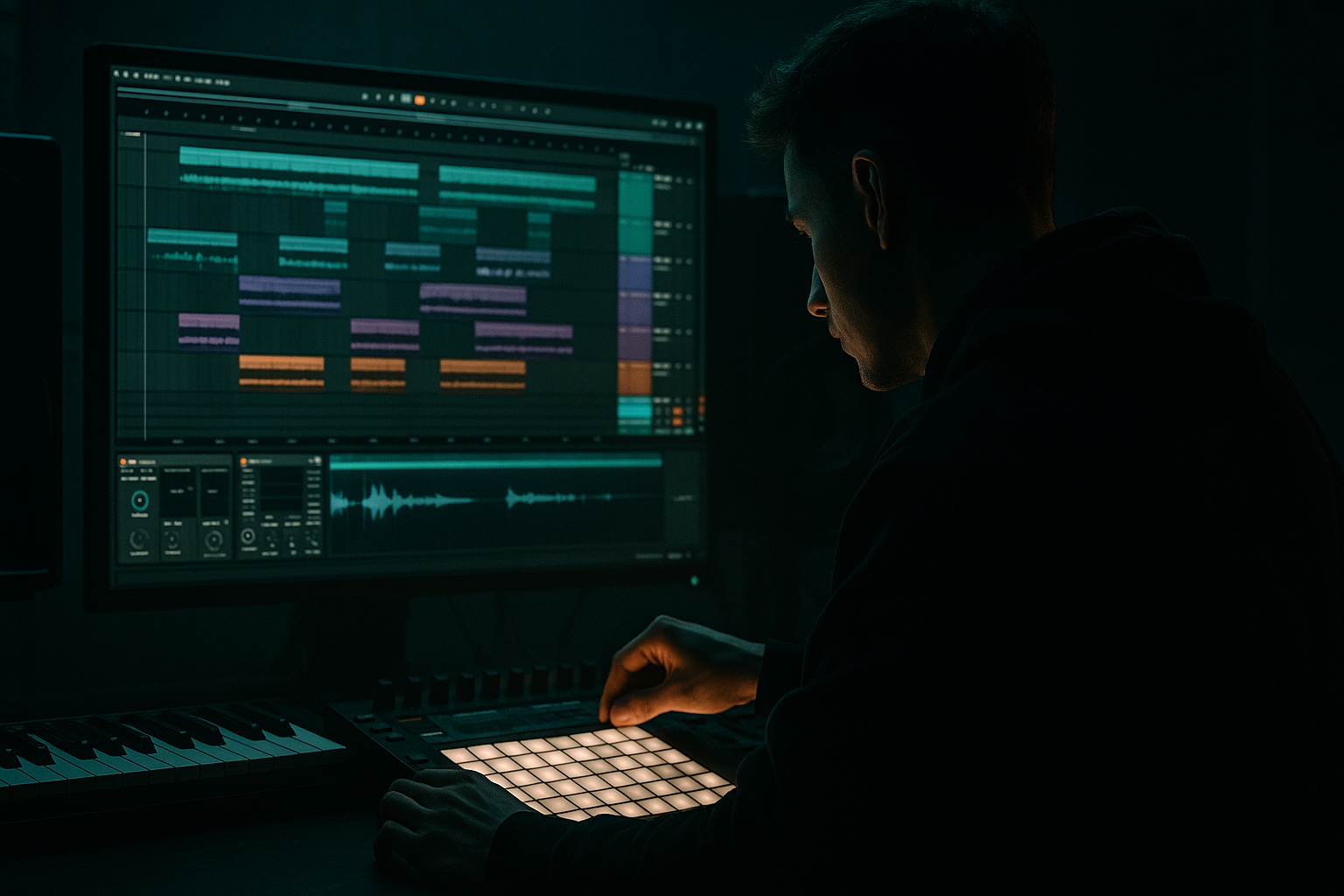
Main tutorial
Dark Mix Translation on Small Speakers (Ableton Live 12 Stock) 🔊🌑
Intermediate | Mixing | Drum & Bass / Jungle / Rollers
---
1. Lesson overview
A “dark” DnB mix is all about weight, menace, and density—but if it only sounds good on big monitors or headphones, it’s not finished. Small speakers (phones, laptops, Bluetooth boxes) won’t reproduce deep sub, and they exaggerate harsh upper mids. That’s where dark mixes often fall apart.
In this lesson, you’ll learn a from-scratch workflow in Ableton Live 12 using stock devices + stock packs to make a dark, heavy DnB mix that still reads on small speakers: kick/snare punch, bass presence without losing sub, and controlled darkness without “blanket over the mix.”
---
2. What you will build
You’ll build a mini DnB mix template with:
- A rolling drum bus that stays punchy on small speakers
- A two-layer bass system:
- A translation-check chain (small speaker simulation, mono checks, spectral sanity)
- A dark-but-readable tonal balance using stock EQ, saturation, and dynamics
- No devices, or just Spectrum at the end.
- Utility
- EQ Eight
- EQ Eight
- Compressor
- SUB (clean sine/triangle)
- MID BASS (distorted/resampled layer)
- Osc 1: Sine (or Triangle if you want more harmonics)
- Voices: 1
- Glide: optional for slides (DnB fun), keep subtle
- Filter: often off for pure sine
- Keep snare crack present (2–4 kHz)
- Keep vocal chops / reese edges controlled but not absent (3–6 kHz)
- Reduce wide-band hiss (8–12 kHz) on hats/breaks with gentle shelves
- Avoid stacking tons of energy at 200–500 Hz (mud zone)
- On hats/shakers:
- On pads/atmos:
- Hybrid Reverb (Convolution “Room” or “Plate”)
- Decay: 0.8–1.6 s (DnB: shorter usually works)
- Pre-delay: 10–25 ms
- High Cut: 4–7 kHz (dark reverb!)
- Low Cut: 200–400 Hz (keep low clean)
- Pre-drop bass “hint”: bring in MID BASS quietly 1–2 bars before the drop.
- Drop clarity: first 4–8 bars keep elements limited:
- Mid-bass call/response: alternate reese phrase vs bass stab every 2 bars—phones will catch the rhythmic contrast.
- Controlled crashes/risers: too much white noise makes “dark” turn into “hissy.”
- Make darkness with harmonics, not just EQ cuts:
- “Invisible” bass audibility trick:
- Mono discipline:
- Snare is your lighthouse:
- Breaks = perceived loudness:
- Small speakers kill sub, so design a mid-bass translator layer.
- Use a master A/B translation rack: Full / Mono Mid / Small Speaker Sim.
- Keep sub clean + mono, and sidechain it correctly to the kick.
- Make “dark” by controlling harshness and hiss, not deleting all top end.
- Prioritize snare clarity and drum bounce—that’s DnB credibility.
- Sub (mono, clean, felt on big systems)
- Mid-bass “audible” layer (translates on phones)
Everything will be Ableton Live 12 stock: EQ Eight, Roar, Saturator, Compressor, Glue Compressor, Drum Buss, Multiband Dynamics, Utility, Limiter, Spectrum, and Hybrid Reverb.
---
3. Step-by-step walkthrough
Step 0 — Session setup (so you don’t fight your mix)
1. Tempo: 172–176 BPM (classic DnB pocket).
2. Master headroom: keep peaks around -6 dBFS while mixing.
3. Reference: drop a dark DnB reference track onto an audio track and:
- Turn Warp OFF
- Set its gain so it matches your rough level (don’t get tricked by loudness)
4. Put your master at 0 dB (don’t pre-limit yet).
Goal: Mix decisions with room to breathe; no “loudness lies.”
---
Step 1 — Build a “small speaker check” rack (master A/B) 🎧➡️📱
Create an Audio Effect Rack on the Master called TRANSLATION CHECK.
We’ll set up 3 chains you can toggle:
#### Chain A: FULL (normal monitoring)
#### Chain B: MONO MID CHECK (does it read without width?)
- Width: 0%
- Bass Mono: On, Frequency: 120 Hz
- HP filter: 90 Hz, 24 dB/oct (removes sub like small speakers do)
- Gentle tilt: +1 to +2 dB around 1.5–3 kHz if you want to “stress test” harshness (optional)
#### Chain C: SMALL SPEAKER SIM (brutal reality check)
- HP: 140 Hz, 24 dB/oct
- Small bump: 700 Hz +2 dB, Q ~0.7 (mimics boxy speakers)
- Small dip: 250 Hz -2 dB, Q ~1 (reduces false warmth)
- Ratio 2:1
- Attack 10 ms
- Release 80 ms
- Aim for 1–3 dB GR (simulates limited dynamics on consumer playback)
Workflow: Mix mostly on FULL. Every 5–10 minutes, flip to MONO MID and SMALL SPEAKER SIM.
If your track becomes “kick + hats only” on SMALL SPEAKER SIM, your bass mids are missing.
---
Step 2 — Drum foundation that stays dark but punchy 🥁
Use a Drum Rack or audio clips from stock packs (e.g., Core Library, Breakbeats, Drum Essentials, any included Live packs you have installed).
Aim for: tight kick, loud snare, controlled hats, and a break layer for grit.
#### 2A) Kick channel (clean + weight)
Device chain (Kick track):
1. EQ Eight
- HP at 25–30 Hz (24 dB/oct)
- Dip 250–400 Hz by -2 to -4 dB if boxy
- Optional: small presence bump 2–4 kHz +1–2 dB (for click on phones)
2. Saturator
- Mode: Soft Sine or Analog Clip
- Drive: 2–5 dB
- Output: compensate so level matches bypass
3. Compressor
- Ratio 4:1
- Attack 15–30 ms (let transient through)
- Release 60–120 ms
- GR: 2–5 dB
#### 2B) Snare channel (your translation anchor)
Your snare is the small speaker hero in DnB.
Device chain (Snare track):
1. EQ Eight
- HP 90–120 Hz
- Body: 180–220 Hz +1–3 dB if thin
- Crack: 2–3.5 kHz +2–4 dB
- Air control: if harsh, dip 6–9 kHz -1–3 dB
2. Roar (for dark aggression without fizz)
- Style: start with Warm or Crunch
- Drive: low-moderate (aim for vibe, not distortion)
- Tone/Filter: roll a little top if it turns fizzy
3. Transient shaping (stock way): Drum Buss
- Drive: 2–6
- Crunch: 0–10%
- Transients: +5 to +20 (if needed)
- Boom: OFF or very subtle (DnB snares can get tubby fast)
#### 2C) Break layer (texture + darkness)
Add an Amen-style or tight roller break from stock packs.
Break track chain:
1. EQ Eight
- HP 120–180 Hz (keep low end for kick/sub clean)
- Dip 3–5 kHz if it fights snare crack
2. Glue Compressor
- Attack 3 ms
- Release Auto
- Ratio 2:1
- GR 1–3 dB
3. Hybrid Reverb (very subtle room, dark)
- Algo or Convolution “Room”
- Decay: 0.3–0.6 s
- High Cut: 5–8 kHz
- Mix: 5–12%
#### 2D) Drum Bus (glue + translation)
Group drums into DRUM BUS and add:
1. EQ Eight
- Gentle shelf down 10 kHz: -1 to -2 dB (dark vibe, avoid hiss)
- Tiny presence bump 1.5–2.5 kHz +0.5–1.5 dB if drums disappear on phones
2. Glue Compressor
- Ratio 2:1
- Attack 10 ms
- Release Auto
- GR 1–2 dB (subtle!)
3. Drum Buss
- Drive 2–5
- Crunch 5–15%
- Damp: adjust to keep top controlled
- Keep it tight, don’t squash
Checkpoint: Flip to SMALL SPEAKER SIM. You should clearly hear kick pulse + snare dominance + break movement.
---
Step 3 — Bass that’s dark AND audible (sub + mid layer) 🐍
This is the core of small speaker translation: sub won’t play, so you must design a mid-bass “shadow” that communicates the bassline rhythm and tone.
Create a group BASS BUS with two tracks:
#### 3A) SUB track (mono, clean, consistent)
Instrument: Wavetable (stock)
SUB chain:
1. EQ Eight
- HP 20–25 Hz
- LP around 80–100 Hz if your sub patch leaks mids
2. Compressor (sidechain from Kick)
- Sidechain: Kick
- Ratio 4:1
- Attack 0.5–3 ms
- Release 80–140 ms (set to groove; at 174 BPM, often ~100 ms feels right)
- GR: 2–6 dB depending on kick length
3. Utility
- Width: 0%
- Bass Mono: On (freq 120 Hz)
Key idea: Sub should be felt, not “heard” on phones. Don’t waste time trying.
#### 3B) MID BASS track (the “phone translator”)
Instrument: Wavetable or Operator
Start with a richer wave: saw/square, or FM in Operator.
MID BASS chain (proven stock chain):
1. EQ Eight
- HP 90–120 Hz (leave room for sub)
2. Roar (main harmonic generator)
- Drive to taste (start around 10–25% depending on mode)
- Use its filter to keep top end controlled (dark ≠ dull)
3. Saturator (tightens harmonics)
- Drive 2–6 dB
- Soft Clip: On
4. EQ Eight (post-distortion cleanup)
- Control harshness: dip 2.5–4.5 kHz if nasal
- Control fizz: shelf down 8–12 kHz by -2 to -6 dB
- Add “audibility”: gentle bump 200–400 Hz if it vanishes on phones
5. Compressor (sidechain from Kick, lighter than sub)
- Ratio 2:1
- Attack 5–15 ms
- Release 80–140 ms
- GR 1–3 dB
Checkpoint with SMALL SPEAKER SIM:
You should still perceive the bassline rhythm and note movement even with HP at 140 Hz. If not, increase MID BASS harmonics (Roar/Saturator) or shift energy into 180–400 Hz a bit.
---
Step 4 — Keep the mix dark without losing intelligibility 🌘
Dark mixes often fail because producers remove too much top end globally. Instead, control where brightness lives.
#### Strategy: “Bright in small areas, dark overall”
Use these stock tools:
A) Frequency prioritization (EQ Eight)
- HP 300–600 Hz
- Gentle shelf down 10–12 kHz if too shiny
- HP 150–250 Hz
- LP 8–12 kHz for darkness + space
B) Dark space (Hybrid Reverb)
Create a REVERB SEND:
Send snare a touch, breaks a touch, atmos more. Keep kick/sub mostly dry.
---
Step 5 — Mixbus sanity (don’t crush the life out of rollers)
On the Master (before your TRANSLATION CHECK rack if you prefer), keep it minimal while mixing:
1. EQ Eight (optional)
- HP 20 Hz (gentle)
2. Glue Compressor (optional)
- Ratio 2:1
- Attack 30 ms
- Release Auto
- GR: 0–1 dB (barely kissing)
3. Limiter (only for safety while sketching)
- Ceiling: -1.0 dB
- Keep it doing <2 dB most of the time
Important: If you’re mixing into heavy limiting, your small-speaker checks will lie.
---
Step 6 — Arrangement moves that help translation (DnB-specific) 🧠
Small speakers don’t deliver sub drops well, so use arrangement to sell impact:
- Kick + snare + bass + minimal hats
---
4. Common mistakes
1. All sub, no mid-bass → sounds huge on headphones, disappears on phones.
2. Over-darkening with master low-pass → kills snare crack and groove definition.
3. Too much 200–500 Hz buildup → “blanket” mix; small speakers sound muddy.
4. Wide low end (stereo bass) → phase loss in mono and weak translation.
5. Over-compressing the drum bus → rollers lose bounce; kick/snare stop feeling like DnB.
6. Hats too bright to compensate → turns dark mix into harsh mix.
---
5. Pro tips for darker/heavier DnB 🧪⚙️
Use Roar/Saturator to generate controlled mid harmonics, then trim fizz with EQ.
Add a subtle mid layer that emphasizes 2nd/3rd harmonics (around 120–300 Hz) so the bassline is readable without sounding “bassy” on big systems.
Keep everything below 120 Hz mono (Utility Bass Mono).
If the snare is clear and consistent across devices, the track feels “finished.”
A well-controlled break layer can make the drop feel louder on phones without actual LUFS pushing.
---
6. Mini practice exercise (20–30 minutes) ⏱️
1. Load or program:
- Kick + snare pattern (basic 2-step)
- One break loop layer (HP filtered)
- Simple 1-bar rolling bassline (Wavetable)
2. Build:
- SUB track: sine, sidechain to kick
- MID BASS track: distort with Roar + Saturator, HP at 100 Hz
3. Turn on SMALL SPEAKER SIM chain:
- Adjust MID BASS until you can follow the bass rhythm clearly
4. Toggle to MONO MID CHECK:
- Ensure kick + snare + bass still hit and don’t hollow out
5. Print a 16-bar loop and listen on:
- Laptop speakers or phone speaker (real-world test)
- Take one note: “What disappears first?”
Win condition: On a phone, you can still “hear the drop” as a groove, not just hats.
---
7. Recap ✅
If you want, tell me what sub/bass style you’re aiming for (deep minimal roller vs neuro-ish reese vs jungle ragga), and I’ll tailor a stock-only bass rack and sidechain timing to that vibe.

