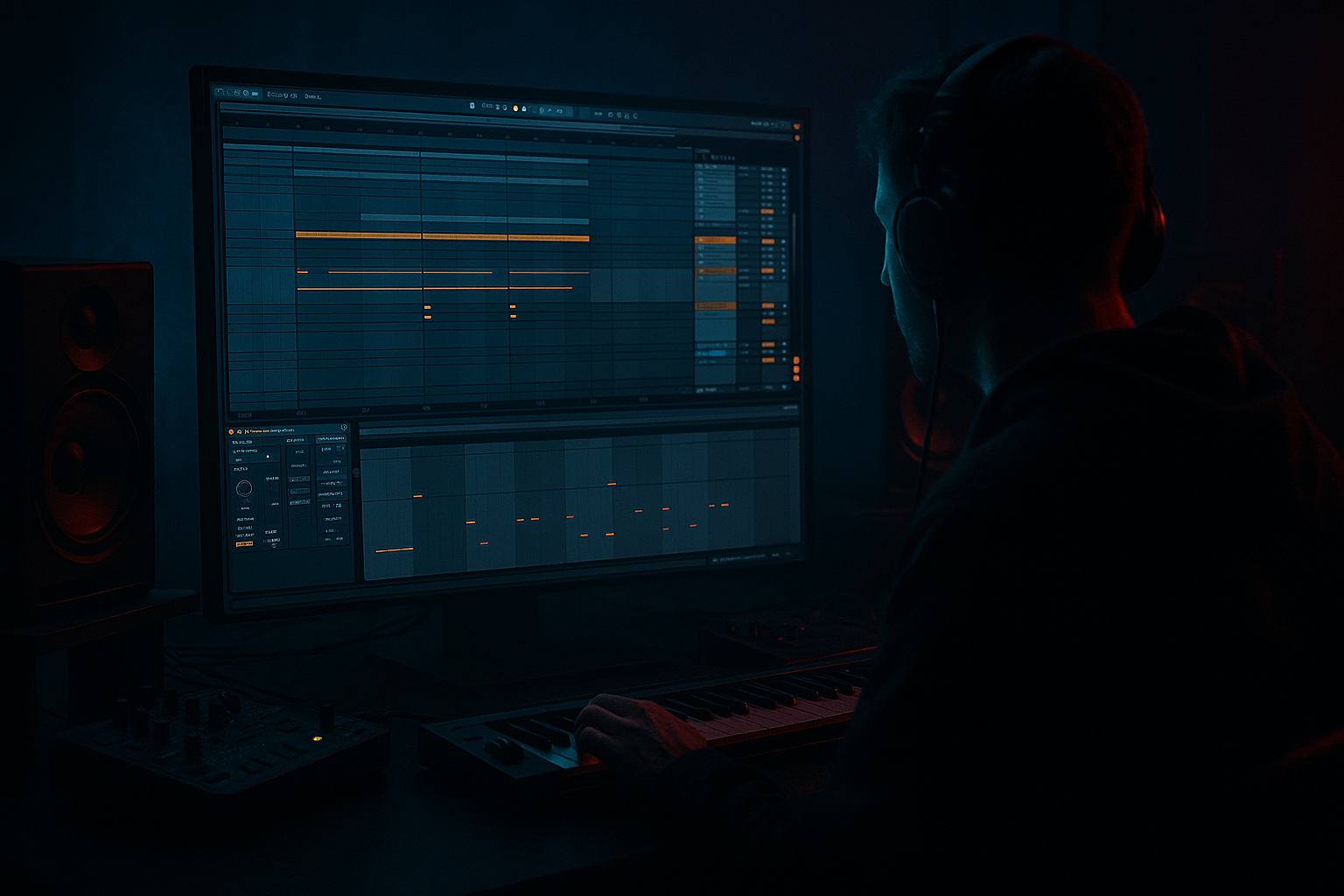
Main tutorial
```markdown
Darkside Ableton Live 12 Amen Variation Playbook (Deep Jungle Atmosphere) 🌒🥁
Skill level: Advanced
Category: Mastering (via “master-minded” break control: tone, dynamics, translation)
---
1. Lesson overview
This lesson is a playbook for turning a plain Amen (or any classic jungle break) into a darkside, deep-atmo, rolling jungle weapon in Ableton Live 12—with variations that stay coherent, mix-ready, and master-friendly.
You’ll work like a pro:
- Slice → sculpt → control dynamics → create variations → print stems → master translation checks
- Using mostly stock devices so the workflow is fast and reliable.
- A Break Rack (Drum Rack with slices) that outputs:
- A Variation System:
- A Master-ready break bus:
- A short 16–32 bar deep jungle loop with atmosphere and bass.
- Add EQ Eight:
- In the Drum Rack, click Show/Hide Chain List.
- Create 3 Return Chains inside Drum Rack (yes, Drum Rack supports returns):
- LOW: subtle (you mainly want kick-thump transients)
- BODY: main
- AIR: moderate-high
- In the MIDI clip driving the rack:
- Velocity targets:
- Mode: Comp
- Drive: small (to reduce extreme spikes)
- Random: 5–15 (humanization)
- Pick 3–6 “fill” notes near bar ends (like 1.4.3–1.4.4)
- Set Chance per note:
- Use Groove Pool:
- Apply lightly:
- Transpose -1 to -3 semitones for weight
- Or +1 to +2 on tiny hat slices for tension
- Open the pad → Transpose in Simpler/Sampler (created by slicing).
- Duplicate just the AIR return output:
- Add Reverb (stock) on the reversed audio:
- Drop some kick slices
- Keep hats rolling
- Let sub and atmosphere carry
- Sub track: simple sine/triangle (Operator or Wavetable)
- Sidechain the break from the sub? Usually no.
- Sidechain the sub from the kick element (if you have a separate kick or clear transient).
- Or use sidechain on the bass from the BREAK BUS very lightly:
- Create an `ATMOS` audio track:
- Process:
- Atmos + filtered break (AIR only or LP at 3–6 kHz)
- Tease ghost notes
- Full break A (rolling)
- Sub enters
- Minimal fills
- Probability fills increase
- Add reverse-air swells
- 2-bar half-time threat (bars 21–22)
- One big fill at bar 28 end
- Strip to hats/air for 1 bar, then slam back in
- Use “negative space”: darkside feels heavier when some hits don’t happen. Strategic dropouts hit harder than constant edits.
- Tune the snare body: pitch one snare slice down -2 semitones and blend it quietly under the main for a deeper smack.
- Transient discipline:
- Print and re-edit: resample your Break Bus, then do 2–4 “hero edits” (reverse, stutter, tape stop style) instead of endless MIDI micro-edits.
- Master translation check:
- You built a Darkside Amen system that’s variation-friendly and master-safe.
- The key is band control + smart dynamics:
- Variations come from probability, ghost notes, micro-timing, selective pitching, and resampled reverse swells—not from wrecking the core groove.
- Your break now supports deep jungle: sub stays solid, atmosphere breathes, master stays stable. ✅
Core philosophy: Your Amen shouldn’t “sound sick” only in solo. It should sit, punch, and breathe under a sub + atmosphere while staying loud and controlled on the master. 🎚️
---
2. What you will build
You’ll end up with:
- Sub break (low thump / controlled)
- Body break (weight + glue)
- Air/top break (snap + hiss)
- Ghost layer (movement + swing)
- “A” (rolling) / “B” (busier) / “C” (dark fill) scenes or arrangement blocks
- Probability + velocity logic that feels human but stays mix-safe
- consistent peak control
- stable stereo image
- controlled harshness (2–6 kHz)
- optional tape-ish weight
---
3. Step-by-step walkthrough
Step 0 — Session setup (so your break translates)
1. Tempo: 160–170 BPM (pick 165 as a sweet spot).
2. Warp mode (audio clips):
- For breaks: usually Complex Pro OFF.
- Start with Beats mode, Transient Loop and adjust as needed.
3. Master headroom:
- Put a Utility on the Master and set Gain = -6 dB while building.
- You’ll earn loudness later.
---
Step 1 — Choose and prep the Amen (clean but not sterile)
1. Drop your Amen into an audio track.
2. Warp it tightly:
- Right-click → Warp on.
- Set 1.1.1 to the first true transient.
- Ensure bar length is correct (usually 1 bar or 2 bars).
3. Clip gain staging: Aim the break at around -12 to -9 dB RMS-ish feel (no need to meter perfectly—just avoid slamming devices).
Micro-clean:
- HP at 25–35 Hz (24 dB/oct)
- Optional gentle dip: 300–500 Hz if it’s boxy
- If harsh: dynamic-ish cut later (we’ll do it properly on the bus)
---
Step 2 — Slice to Drum Rack (your variation engine)
1. Right-click the Amen clip → Slice to New MIDI Track…
2. Settings:
- Slice by: Transients
- Create one slice per: Transient
- Preset: Built-in (then we’ll replace chain)
Now you have a Drum Rack with slices mapped across pads.
Workflow tip: Rename the track: `AMEN RACK (Darkside)`.
---
Step 3 — Build the “3-band Amen” inside the Drum Rack (master-friendly control)
You want independent control of low/body/top to avoid over-compressing everything.
#### 3.1 Create 3 parallel chains (inside the rack)
- Return A: `LOW`
- Return B: `BODY`
- Return C: `AIR`
On each slice pad, set Sends so the signal feeds the returns:
If you prefer simpler routing: duplicate the rack into 3 tracks and band-split with EQ. But the Drum Rack returns keep it tidy.
#### 3.2 Process each band (stock chain suggestions)
Return A: LOW (tight, mono, punch)
1. EQ Eight
- LP at 140–180 Hz (24 dB/oct)
- HP at 25–35 Hz
2. Drum Buss
- Drive: 5–15% (careful)
- Boom: Off or Freq ~55–65 Hz at 5–10% if you need weight
- Damp: 5–20%
3. Utility
- Width: 0% (mono low = stable master)
Return B: BODY (glue + attitude)
1. EQ Eight
- HP at 90–120 Hz (so it doesn’t fight the low chain)
- Gentle dip 250–450 Hz if wooly
2. Glue Compressor
- Attack: 3 ms
- Release: Auto or 0.1–0.3 s
- Ratio: 2:1
- Aim: 1–3 dB GR on peaks
3. Roar (for dark texture)
- Mode: start with Tube or Warm
- Drive: low (2–6 dB)
- Tone: tilt darker (pull highs slightly down)
- Mix: 10–30%
Return C: AIR (snap, hiss, controlled pain)
1. EQ Eight
- HP at 2–4 kHz (depending on break)
- Optional shelf boost around 8–12 kHz (small)
2. Saturator
- Mode: Soft Sine or Analog Clip
- Drive: 2–6 dB
- Soft Clip: On
3. De-essing / harsh control (stock method):
- Use Multiband Dynamics:
- Solo the high band while tuning
- Set high band threshold so it grabs harsh snare crack 2–6 kHz only when it spikes
- Keep it subtle: 1–3 dB reduction
---
Step 4 — Create variations (the Darkside Playbook) 🎛️
You’re going to create controlled chaos: fills, drops, edits, reverses, ghosts—without destroying groove.
#### Variation 1: “Ghost-note engine” (roll without clutter)
- Duplicate your main pattern.
- Add quiet 1/16 or 1/32 ghost hits on hat-ish and snare-tail slices.
- Ghosts: 15–45
- Main hits: 70–110
Add MIDI Velocity device before the rack:
#### Variation 2: Probability fills (Live 12 MIDI chance) 🎲
- subtle: 15–35%
- more animated: 40–60%
Keep the kick/snare anchors at 100% so the tune doesn’t fall apart.
#### Variation 3: Micro-timing swing (dark shuffle)
- Try MPC-style or shuffled break grooves.
- Timing: 10–25%
- Velocity: 5–15%
- Random: 2–8%
Then Commit only if you want to print and further edit.
#### Variation 4: Slice pitching for menace 👹
On selected snare/kick slices:
Do this per pad:
Keep it minimal: pitching too many slices kills the Amen identity.
#### Variation 5: Darkside “air-reverse” swells
- Resample a bar of AIR only (print to audio).
- Reverse small sections before snares (1/8–1/4 bar).
- Decay: 1.5–3.5 s
- Size: medium
- HP filter: 600–1.5 kHz
- Wet: 15–35%
Then gate/trim so it sucks back into the hit instead of washing the mix.
#### Variation 6: The “half-time threat” switch (arrangement weapon)
For a 2-bar moment:
This creates contrast without changing BPM.
---
Step 5 — Break Bus (where mastering thinking begins) 🔥
Route the Drum Rack output into a group: `BREAK BUS`.
Suggested BREAK BUS chain (in order):
1. EQ Eight
- HP at 25–30 Hz
- Gentle wide dip 200–400 Hz if the break masks bass
- If harsh: small bell dip 3–5 kHz (Q ~1–2)
2. Glue Compressor
- Attack: 10 ms (let transients through)
- Release: Auto
- Ratio: 2:1
- GR: 1–2 dB average
3. Drum Buss (optional, subtle)
- Drive: 2–8%
- Crunch: 0–10%
- Damp: adjust if cymbals get spicy
4. Limiter (only as safety while producing)
- Ceiling: -1.0 dB
- Aim: barely working; if it’s slamming, fix upstream
Key mastering concept:
If your break only feels loud by crushing it on the bus, you’ll get a small, fatiguing master. Build loudness by clean transient design + controlled bands, not by forcing 6–10 dB limiting on the break.
---
Step 6 — Make it “deep jungle atmosphere”
Add two support layers:
#### 6.1 Sub + bass relationship (don’t let Amen steal the sub)
Instead:
- Compressor sidechain from BREAK BUS
- GR: 1–3 dB max
- Fast attack, medium release
This creates “breathing” without pumping.
#### 6.2 Atmosphere bed (darkside glue) 🌫️
- vinyl noise, distant rave pad, field recording, thunder, etc.
- Auto Filter (LP around 6–10 kHz, slight res)
- Hybrid Reverb (dark plate/room)
- Utility to widen slightly (120–160%) but keep low end mono (use EQ HP first)
---
Step 7 — Arrangement: 32-bar template (pro jungle pacing)
Bars 1–8: Intro
Bars 9–16: Drop A
Bars 17–24: Drop B (variation + threat)
Bars 25–32: Drop C (dark fill + strip-back)
Print (resample) the break bus at the end for final polish options.
---
4. Common mistakes
1. Over-warping the Amen
If it sounds “phasey” or smeared, your warp markers are fighting the groove. Use fewer markers and let it breathe.
2. Too much saturation on AIR
You’ll get brittle cymbals and painful 3–6 kHz that kills loud masters.
3. Wide low end
Stereo lows = unstable limiter behavior and weak club translation. Mono below ~120–160 Hz.
4. Randomness everywhere
Chance on the main anchors makes the groove feel broken. Randomize ornaments, not structure.
5. Compressing the break to compete with the sub
If the bass disappears, you’ll crank the break, then the master limiter collapses. EQ and band-control instead.
---
5. Pro tips for darker/heavier DnB 🖤
- Let attack through (10 ms-ish on Glue).
- Control sustain with Drum Buss Damp / subtle gating on noisy tails.
- Toggle a Utility on the Master: Width 0% briefly (mono check).
- If snare vanishes or cymbals get weird, fix stereo processing in AIR chain.
---
6. Mini practice exercise (20–30 minutes) ⏱️
1. Slice an Amen to Drum Rack.
2. Build the LOW/BODY/AIR returns with the exact chain outlines above.
3. Create a 16-bar loop:
- Bars 1–8: Variation A (steady roll)
- Bars 9–16: Variation B (chance fills + reverse-air swell before bar 9 and bar 16)
4. Constraints:
- Break Bus Glue GR must stay around 1–2 dB average
- Master limiter should do almost nothing (safety only)
5. Export two bounces:
- Full mix loop
- Break bus only
Compare: does the break still feel dark and punchy inside the mix, not just solo?
---
7. Recap
- LOW = mono, tight, punch
- BODY = glue + texture
- AIR = crisp but de-harsh
If you want, tell me your target vibe (e.g., 94-style darkside, Photek-clean, or modern deep rollers) and your BPM, and I’ll suggest a specific Amen edit pattern + exact EQ points for your break sample.
```

