Main tutorial
Lesson Overview
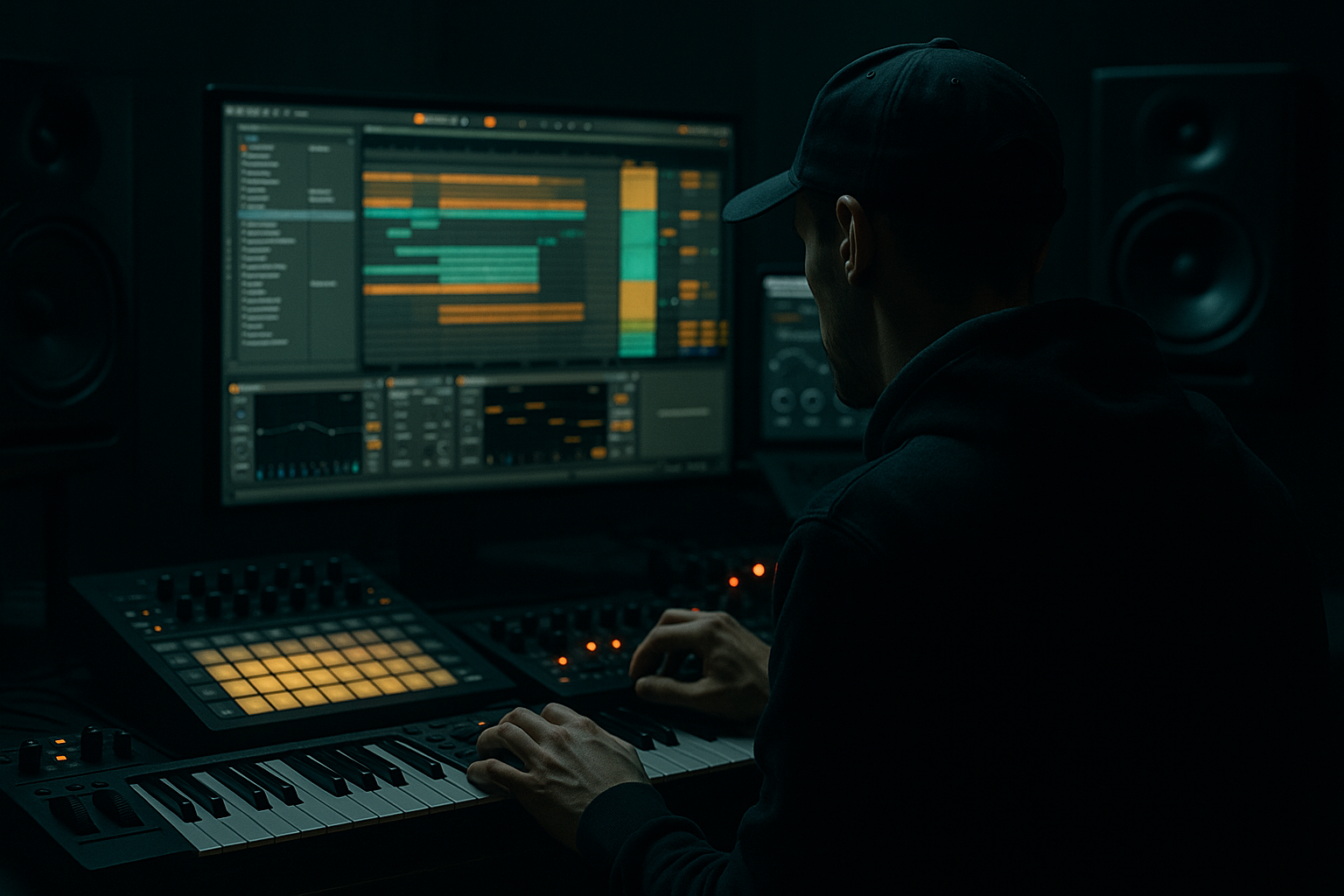
This lesson shows you how to build a darkside bassline arrangement in Ableton Live 12 that feels emotional and atmospheric for a sunrise set, while still keeping the weight, swing, and tension of oldskool jungle / DnB. The focus is not just on making a bass sound — it’s on arranging that bass so it breathes with the drums, leaves space for the break, and creates that late-night-to-daybreak mood 🌅
In DnB, the bassline is usually the emotional engine under the drums. For sunrise vibes, you want a balance of:
- sub weight for physical impact
- reese-style movement for tension and darkness
- space in the phrasing so the break and atmosphere can shine
- call-and-response arrangement so the track feels like it evolves over time
- a clean mono sub layer
- a mid reese layer with movement
- a simple note pattern with space and repeats
- a call-and-response phrase that works with a jungle break
- automation on filter and distortion to create energy shifts
- an arrangement that can be dropped into a full DnB section with intro, first drop, switch-up, and sunrise breakdown
- a dark, emotional bassline sitting under chopped breaks
- oldskool jungle energy with modern clarity
- a bass movement that sounds like it’s waking up into sunrise
- a structure that leaves room for FX, atmospheres, and drum edits
- Track 1: SUB
- Track 2: REESE
- one audio track for a breakbeat or chopped amen
- one return track for reverb
- one return track for delay if you want more space later
- Bars 1–4: intro energy / lighter bass activity
- Bars 5–8: drop starts
- Bars 9–12: variation
- Bars 13–16: switch-up or sunrise lift
- Oscillator A: Sine
- Turn off other oscillators
- Octave: -1 or -2 depending on note range
- Turn on Mono in the MIDI track settings if needed
- Add Utility after Operator and set Width to 0% for mono bass
- Bar 1: root note on beat 1, then a short answer note on beat 3
- Bar 2: repeat with one note shifted higher or lower for variation
- Bar 3–4: leave more space
- Amp envelope attack: 0–5 ms
- Release: 80–180 ms
- Keep velocity consistent at first
- Oscillator 1: Basic Shapes or saw-type waveform
- Oscillator 2: another saw or similar waveform
- Slight detune between oscillators
- Unison: 2 voices to start, not too wide
- Filter: Low-pass 12 dB or 24 dB
- Saturator
- Auto Filter
- EQ Eight
- optional Drum Buss very lightly
- Saturator Drive: 2–6 dB
- Auto Filter cutoff: around 150–400 Hz depending on brightness
- EQ Eight: cut some low end below 100–140 Hz so the sub has its own space
- use the same root note as the sub on the first beat
- answer with a higher note on beat 3 or the “and” after beat 2
- leave rests between phrases
- Phrase A: F → F → D# → pause
- Phrase B: F → G# → F → pause
- bar 1: main idea
- bar 2: repeat with one extra note
- bar 3: less notes
- bar 4: turnaround or pickup note into the next phrase
- use Warp carefully if needed
- try Chop or Slice to New MIDI Track if you want to edit hits
- keep the break’s mids and highs energetic, but avoid muddy low end
- try an oldskool swing groove lightly
- start with 10–20% groove amount
- keep timing human, not sloppy
- In bars 1–4, keep bass notes sparse so the break and atmospherics can establish mood
- In bars 5–8, let the reese answer the snare gaps
- In bars 9–12, increase note density slightly
- In bars 13–16, introduce a short lift or turnaround note before the next section
- cutoff slowly opening over 8 or 16 bars
- resonance just a little higher on key notes
- optional filter envelope movement if you want more bite
- bars 1–4: cutoff around 200–400 Hz
- bars 5–8: open to 600–1.2 kHz
- bars 9–12: close slightly to create tension
- bars 13–16: open again for a lift into the next section
- Saturator Drive up slightly in the drop
- Reverb send on a short note or tail note
- Utility Gain to create a tiny level lift before a drop
- DJ-friendly intro
- drop with drums first
- bass entering after the drums have established the pocket
- switch-up every 8 or 16 bars
- breakdown or atmospheric reset
- return with more energy
- Bars 1–8: intro / filtered drums / hint of bass
- Bars 9–16: full first drop
- Bars 17–24: variation with bass phrase change
- Bars 25–32: breakdown or sunrise lift, reduce sub and let atmosphere breathe
- do not run the exact same bass phrase for more than 8 bars without a change
- change either the note pattern, filter, or drum density every 8 bars
- remove one bass note
- add a pickup note before bar 9
- mute the bass for half a bar before a transition
- add a small riser or reverse cymbal into the next section
- Utility width at 0%
- avoid heavy effects
- keep the level stable
- EQ Eight: high-pass around 80–140 Hz
- gentle cut if there’s harshness around 2–5 kHz
- Saturator before EQ if you want extra harmonic energy
- Drum Buss lightly for punch
- a small amount of Drive
- a touch of Transient if needed, but don’t crush the break
- aim to leave at least -6 dB or so peak headroom while building
- avoid making the bass too loud just because it sounds exciting in solo
- Use two layers of automation: one slow filter open over 16 bars, and one small 1–2 bar movement for tension.
- Duplicate the reese clip and make one version with slightly different note endings for a drop switch-up.
- Add short silence before a bass answer note. In dark DnB, space can hit harder than extra notes.
- Use Resonators very lightly on atmospheric sections if you want eerie top texture, but keep it subtle.
- Try Drum Buss on the reese with low Drive settings to thicken the midrange.
- For extra underground character, resample your bass phrase to audio and cut tiny gaps or reverse small tails for a rougher jungle feel.
- Keep checking in mono with Utility. If the bass disappears, your stereo processing is too wide.
- If the bassline feels too clean, add a touch of Saturator or mild Overdrive on the reese for grit, but protect the sub.
- 1 sub layer
- 1 reese layer
- 1 drum break
- 1 automation move
- Does the sub feel stable?
- Does the reese leave space for the break?
- Does the filter movement feel like sunrise energy?
- Does the loop feel like it could continue into a full arrangement?
- Build sub and reese separately in Ableton Live for clean DnB bass control.
- Keep the sub simple and mono.
- Use the reese for movement, emotion, and tension.
- Arrange the bass in 4-bar and 8-bar phrases so it evolves naturally.
- Let the bass answer the breakbeat instead of fighting it.
- Use filter automation, saturation, and space to create sunrise emotion with dark jungle energy.
- Always check the groove, mono compatibility, and drum/bass balance before calling it done.
Why this matters: a beginner can often make a big bass sound, but the track still feels flat if the bass is constant from start to finish. In DnB, especially jungle and darkside styles, the arrangement of bass notes, rests, and automation is what turns a loop into a proper track. This lesson will help you build a bassline that works in a DJ-friendly intro, rolling drop, and a sunrise emotional section without overcomplicating the process.
What You Will Build
You’ll build a 16-bar bassline system in Ableton Live 12 that includes:
The finished result should feel like:
Step-by-Step Walkthrough
1. Set up your working section and reference the vibe
Open a new Ableton Live set and set the tempo to something in the DnB zone, like 170–174 BPM. For this lesson, use 172 BPM because it sits nicely between jungle swing and modern rolling DnB.
Create two MIDI tracks:
Also create:
For arrangement, start with a 16-bar loop. In DnB, 16 bars is enough to shape a proper bass phrase without getting lost. Use the Arrangement View from the start, not just Session View, because this lesson is about how the bassline evolves over time.
Arrangement mindset:
Why this works in DnB: DnB listeners respond strongly to phrase changes every 4 or 8 bars. That means the bassline should not just repeat blindly — it should “answer itself” in sections.
2. Build the sub layer first with simplicity and mono control
On the SUB track, load Ableton’s Operator. This is ideal for a pure sub because it is simple and clean.
Use these settings:
Write a very simple MIDI pattern first. Keep it to notes around F, G, A, or D# if you want a dark tonal center. Use short notes with occasional held notes.
Example pattern idea:
Good beginner sub settings:
Do not overwrite the sub line with lots of notes. A sunrise DnB bassline often feels emotional because the sub is confident and restrained.
3. Create the reese layer using wavetable or a simple detuned source
On the REESE track, load Wavetable or Analog. If you want a very beginner-friendly approach, use Wavetable:
Suggested patch starting point:
Add these devices after the synth:
Basic starting settings:
Important: keep the reese layer off the deepest sub range. Let the SUB track handle that job. The reese should provide texture, growl, and tension — not compete with the kick.
This is a classic DnB separation move: sub in one lane, character in another.
4. Write a bass phrase with call-and-response
Now create a MIDI clip on the REESE track that follows the sub line but adds movement. Keep the phrase simple and musical.
A beginner-friendly method:
For example, if your base key is F minor:
Try placing notes in a 1-bar loop first, then duplicate it to 4 bars and make small changes:
This is where the oldskool jungle feel comes in. Jungle bass often works because it talks back to the drums. If the break is busy, the bass should leave space. If the break drops out, the bass can become more active.
5. Shape the groove so the bass locks with the breakbeat
Now bring in your drum loop or chopped break. If you’re using an amen or similar break, place it so the groove sits naturally against the bassline.
On the drum track:
Use Ableton’s Groove Pool if you want more swing:
Make sure the bass hits are not always landing on top of the kick and snare. In DnB, a powerful bassline often feels better when it answers the drum accents rather than stepping directly on them every time.
Arrangement tip:
Why this works in DnB: the breakbeat already contains motion. If the bassline mirrors every drum hit, the track becomes crowded. If the bassline plays around the drums, the rhythm feels bigger and more professional.
6. Add automation for sunrise emotion
This is where the “sunrise set” feeling really appears. Automation turns a loop into a journey.
Use Auto Filter on the REESE track and automate:
Suggested automation ideas:
You can also automate:
For sunrise emotion, the trick is often not huge effects, but gradual change. A bassline that slowly opens up over a phrase can feel like daylight arriving without sounding cheesy.
7. Use arrangement to create a proper DnB section
Now think like a producer arranging for a DJ mix.
A strong DnB arrangement often has:
For this lesson:
Beginner-friendly arrangement rule:
Use clip duplication in Arrangement View and make small edits:
8. Glue the bass and drums with simple mix control
Before moving on, keep the mix clean. DnB bass can get messy fast.
On the SUB track:
On the REESE track:
On the drum bus, you can use:
Check the master with headroom in mind:
If your bassline sounds good only when soloed, it is probably too busy or too bright. In DnB, the best basslines are often felt more than heard in detail.
Common Mistakes
1. Making the sub too active
- Fix: keep the sub simple and let the reese do the movement.
2. Putting too much low end in the reese
- Fix: high-pass the reese and leave the deepest frequencies to the sub.
3. Looping the same phrase for too long
- Fix: make a change every 4 or 8 bars, even if it’s just one note or a filter move.
4. Forgetting the drums
- Fix: always test the bassline with the breakbeat. DnB bass must lock to the groove.
5. Using too much stereo width on the bass
- Fix: keep sub mono and only allow width in the upper bass / texture layer.
6. Overusing distortion
- Fix: add saturation gradually. Too much distortion can make the bass lose punch and turn muddy fast.
Pro Tips for Darker / Heavier DnB
Mini Practice Exercise
Spend 10–20 minutes building a sunrise-style dark DnB bass phrase.
Exercise goal:
Create an 8-bar bass arrangement with:
Steps:
1. Set your tempo to 172 BPM.
2. Load Operator for the sub and write a 2-note pattern.
3. Load Wavetable for the reese and copy the sub rhythm, then add 1–2 answer notes.
4. Add Saturator and Auto Filter on the reese.
5. Automate the filter cutoff to open slowly over 8 bars.
6. Place a chopped breakbeat underneath.
7. Make one variation at bar 5 or bar 7 by removing one note or changing one ending note.
8. Export or bounce the 8-bar loop and listen back in mono.

