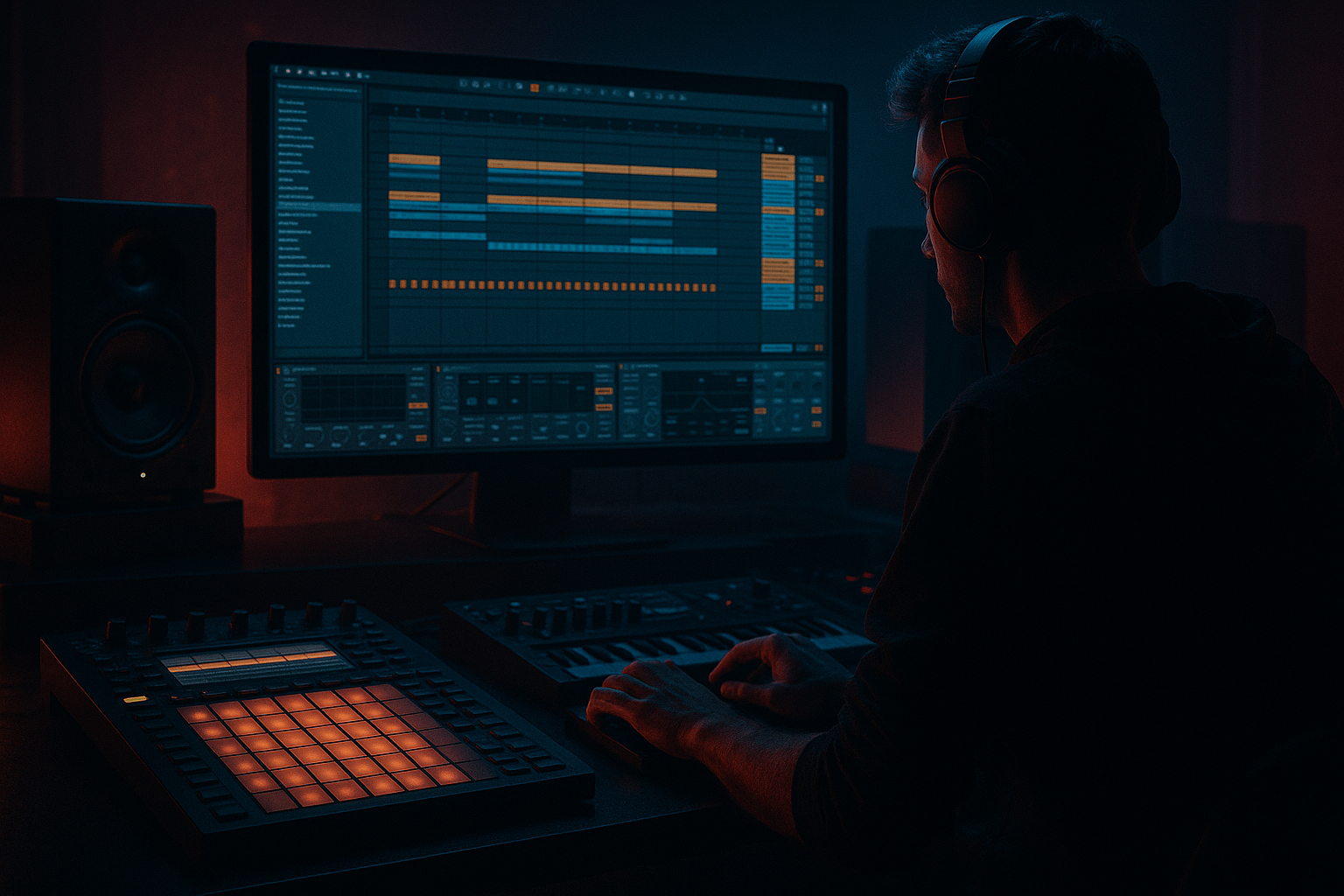
Main tutorial
Darkside Break Roll Drive Lab (Ableton Live 12)
Using Macro Controls creatively for jungle / oldskool DnB drive 🥁⚙️🌑
---
1. Lesson overview
In this workflow lesson you’ll build a performance-ready break “roll + drive” rack in Ableton Live 12 that can take a classic jungle break from clean and bouncy to darkside, snarling, rolling chaos—using Macro Controls to keep it playable and musical.
You’ll focus on:
- Macro-driven break rolls (stutters, gates, repeats)
- Darkside drive (saturation, bit reduction, clip-style crunch)
- Weight + movement (transient control, resonant filtering, parallel smash)
- Arrangement-ready automation for fills, drops, and tension
- Parallel chains: Clean / Roll / Smash / Air
- Macro controls for:
- Gate
- Auto Pan
- Beat Repeat
- Set Width: 80–100% (we’ll macro later)
- Optional: Bass Mono ON at 120 Hz (keeps rolls from smearing the low end)
- Saturator
- Drum Buss
- HP: 30 Hz
- Add a controlled “anger” peak:
- If harsh, dip 7–10 kHz a little
- Ratio: 4:1
- Attack: 1–3 ms
- Release: 0.1–0.3 s
- Soft Clip: ON
- Aim 3–6 dB GR (parallel style)
- Filter Type: High-Pass 12 dB
- Frequency: 2–6 kHz
- Resonance: 0.7–1.2
- Envelope: small amount if you want it to react (+5 to +15)
- Algorithm: Plate or Room
- Decay: 0.8–1.8 s
- Pre-delay: 10–25 ms
- EQ: roll lows to keep it airy
- Mix: 10–25% (this is parallel so it can be wetter)
- Downsample: 2–8
- Bit Reduction: 0–3 (subtle)
- Auto Pan Rate (ROLL): range 1/8 ↔ 1/32
- Beat Repeat Grid (ROLL): range 1/16 ↔ 1/32
- (Optional) Gate Hold: 25 ms ↔ 10 ms (faster = tighter)
- ROLL chain Volume: -inf ↔ -6 dB
- Beat Repeat Gate: 40% ↔ 75%
- Auto Pan Amount: 60% ↔ 100%
- Saturator Drive (SMASH): +4 dB ↔ +14 dB
- Drum Buss Drive (SMASH): 10% ↔ 35%
- Glue Compressor Threshold (SMASH): set so macro increases GR slightly (careful!)
- Auto Filter Frequency (AIR HP): 6 kHz ↔ 2 kHz (invert if you want)
- EQ Eight high shelf on SMASH: -2 dB ↔ +2 dB around 8–10 kHz
- (Optional) Saturator Color/Drive tiny range for perceived brightness
- Redux Downsample (AIR): 1 ↔ 6
- Drum Buss Crunch (SMASH): 0% ↔ 25%
- (Optional) Saturator Soft Clip ON is not mappable; instead map Output trim slightly
- Drum Buss Transients (SMASH): -5 ↔ +20
- Glue Compressor Attack (CLEAN): 10 ms ↔ 3 ms (more punch as it gets faster)
- Gate Release (ROLL): 80 ms ↔ 40 ms (tightens)
- Utility Width (CLEAN): 110% ↔ 85%
- Utility Width (ROLL): 100% ↔ 70%
- Utility Bass Mono Frequency (where used): 80 Hz ↔ 150 Hz (careful)
- Hybrid Reverb Mix (AIR): 10% ↔ 40%
- Hybrid Reverb Decay (AIR): 0.8 s ↔ 2.2 s
- Auto Filter Resonance (AIR): 0.7 ↔ 1.3
- Bars 1–8 (Groove established):
- Bars 9–12 (Tension):
- Bars 13–16 (Fill + Drop setup):
- Resample your macro performance 🎚️➡️🎧
- Add subtle pitch drift for horror vibe
- Use Roar (Live 12) if you want modern filth
- Mid/side EQ for controlled aggression
- Sidechain the break to the kick (subtle)
- Keeps a clean groove while adding rollable stutters
- Uses parallel smash for heavy jungle grit
- Adds air + dark reverb tail for phrase endings
- Turns complex processing into 8 playable macros 🎛️
Skill level: Intermediate (you know racks, routing, and basic processing).
---
2. What you will build
A single Audio Effect Rack called:
“Darkside Break Roll Drive” 🎛️
It will include:
- Roll Rate (note division feel)
- Roll Amount (how hard the stutter hits)
- Drive (saturation + clipping intensity)
- Tone (filter sweep for dark-to-bright)
- Crunch (Redux + noise texture)
- Punch (transient shaping / envelope feel)
- Width (mid/side control)
- Reverb Tail (dark space for fills)
You’ll be able to perform it like an instrument and automate it in arrangement.
---
3. Step-by-step walkthrough
Step 0 — Prep your source break (the right starting point)
1. Start a new Live set at 170–174 BPM (jungle/DnB sweet spot).
2. Drag in a break (Amen, Think, Hot Pants, etc.) as an audio clip.
3. In Clip View:
- Warp: ON
- Warp Mode: Beats
- Preserve: 1/16 (good default for break slicing feel)
- Transients: set so the kick/snare are crisp (move markers if needed)
Workflow tip: Consolidate to a clean 1–2 bar loop:
Select → Cmd/Ctrl + J.
---
Step 1 — Create the rack container
1. On the break track, add:
- Audio Effect Rack
2. Click the rack’s Chain List and create 4 chains:
- `CLEAN`
- `ROLL`
- `SMASH`
- `AIR`
You’ll blend these with macros for controlled chaos.
---
Step 2 — CLEAN chain (keep the groove intact)
On CLEAN chain, add:
1. EQ Eight
- HP filter: 24 dB/oct @ 25–35 Hz
- Optional small dip: -2 to -4 dB around 250–400 Hz if boxy
2. Glue Compressor
- Attack: 3 ms
- Release: Auto
- Ratio: 2:1
- Soft Clip: ON
- Aim for 1–2 dB gain reduction
This chain is your anchor—when you go darkside, you still keep the roll.
---
Step 3 — ROLL chain (the stutter engine)
The goal: create a repeat/roll layer that you can fade in for fills and pressure.
On ROLL chain, add:
#### A) Gate (for tight rhythmic chopping)
- Threshold: start around -25 dB
- Return: -inf
- Attack: 0.10 ms
- Hold: 15–25 ms
- Release: 40–80 ms
We’ll macro this so the rolls tighten/loosen.
#### B) Auto Pan (for tempo-synced gating = classic trick)
- Amount: 100%
- Rate: 1/8 to start
- Phase: 0° (hard gate)
- Shape: Square (or close)
- Offset: adjust until it “grabs” the groove right
This becomes your “roll rate” driver.
#### C) Beat Repeat (controlled glitch, not random mess)
- Interval: 1 Bar (so it triggers musically)
- Grid: start 1/16
- Chance: 0% (we’ll keep it deterministic)
- Mode: Insert
- Gate: 40–70%
- Variation: 0
- Pitch: 0 (keep it classic)
#### D) Utility
Important: Keep ROLL chain level lower than CLEAN initially (e.g., -8 dB). Rolls should be an effect, not the whole break.
---
Step 4 — SMASH chain (parallel darkside drive)
This is your “Metalheadz alleyway” chain 🌑
On SMASH chain, add:
#### A) Saturator (main grit)
- Mode: Analog Clip or Warmth
- Drive: +6 to +12 dB
- Soft Clip: ON
- Output: reduce to match level (avoid fooling your ears)
#### B) Drum Buss (weight + knock)
- Drive: 10–30%
- Crunch: 5–20%
- Boom: 0–15%
- Boom Freq: 45–60 Hz (watch your sub!)
- Damp: 5–20%
- Transients: +5 to +20 for snap (or negative if too pokey)
#### C) EQ Eight (darkside sculpt)
- Bell +2 to +4 dB around 1.8–3.5 kHz (find the bite)
#### D) Glue Compressor (the clamp)
Set SMASH chain volume down (e.g., -10 to -14 dB) and blend in via macro later.
---
Step 5 — AIR chain (space + top texture for fills)
On AIR chain, add:
#### A) Auto Filter (movement)
#### B) Hybrid Reverb (dark plate/room)
#### C) Redux (optional “dust”)
Keep AIR chain quiet. It’s the “tail” you automate into fills.
---
Step 6 — Build Macro Controls (the fun part) 🎛️
Open the rack’s Macro Mappings and create these 8 macros. Map multiple parameters to each macro so one knob feels like a “producer move”.
Macro 1: ROLL RATE
Map:
Why it works: faster rate = classic jungle “machine gun” pressure.
---
Macro 2: ROLL AMOUNT
Map:
Use: fade rolls in like fills, not constant clutter.
---
Macro 3: DRIVE
Map:
Goal: one knob that “leans into the wall” without instantly clipping your master.
---
Macro 4: TONE (DARK ↔ BRIGHT)
Map:
DnB use: roll off brightness in verses, open it into drops.
---
Macro 5: CRUNCH
Map:
Tip: Crunch is best used momentarily (fills, switch-ups).
---
Macro 6: PUNCH
Map:
Result: macro tightens the front edge and increases urgency.
---
Macro 7: WIDTH / MONO
Map:
DnB rule: keep low end stable; widen the tops.
---
Macro 8: DARK TAIL
Map:
Use: “ghost reverb” before drops or at the end of 8-bar phrases.
---
Step 7 — Make it arrangement-ready (oldskool rollouts)
Now use macros like arrangement “moves”:
A) 16-bar loop plan (classic jungle phrasing)
- ROLL AMOUNT low (0–15%)
- DRIVE moderate (20–40%)
- TONE darker
- Slowly increase DRIVE
- Add slight DARK TAIL at the end of bar 12
- Push ROLL AMOUNT up for bar 15–16
- Increase ROLL RATE toward 1/32 in last half bar
- Quick CRUNCH spike for 1/4 bar
- Snap back to cleaner right at the drop
B) Record macro performance
1. Arm automation recording.
2. Hit Session Record (or arrangement record) and perform the macros live.
3. Edit automation lanes after:
- Keep big moves on bar boundaries
- Use quick “flicks” (1/8–1/4 bar) for CRUNCH and ROLL RATE
This is how you get that human DJ-style energy in arrangement. 🔥
---
4. Common mistakes
1. Rolls overpower the original break
If ROLL chain volume is too high, you lose the groove. Keep rolls as a layer.
2. Overdriving without level compensation
Always match perceived loudness when pushing DRIVE, or you’ll choose “louder” not “better”.
3. Too much stereo in the low mids
Wide breaks can smear the bass relationship. Use Utility and keep low end stable.
4. Beat Repeat randomness that wrecks phrasing
Keep Chance at 0% until you intentionally want chaos.
5. Reverb on the whole break, all the time
DARK TAIL should be an automation moment, not permanent wash.
---
5. Pro tips for darker/heavier DnB
Freeze/Flatten or resample to audio, then chop the best 1–2 bar “weapon” fills into a new track.
After the rack, try Shifter (very subtle) or automation on clip Transpose (±1 semitone for quick drops).
Swap/augment Saturator with Roar:
- Start with a gentle drive mode
- Keep low band cleaner, distort mids/highs more
- Macro-map Drive + Tone for nasty “darkside opens up” moments
- EQ Eight in M/S mode:
- Cut some harshness on the Sides
- Keep mid punch intact for snare/kick
If you run a heavy kick + sub, use Compressor sidechain on the break track:
- Ratio 2:1, fast attack, short release
- Only 1–2 dB ducking for headroom
---
6. Mini practice exercise (15 minutes)
1. Pick a break and loop 8 bars.
2. Build the rack with the 4 chains.
3. Record one pass of automation:
- Bars 1–4: mostly CLEAN, small DRIVE
- Bar 5: increase ROLL AMOUNT slightly
- Bar 7: add DARK TAIL on last beat
- Bar 8: ROLL RATE spike to fastest + CRUNCH flick
4. Resample the output to a new audio track.
5. Chop the best last 1 bar and place it before a drop.
Goal: create one signature darkside fill you can reuse.
---
7. Recap
You built a Darkside Break Roll Drive rack that:
…and you learned how to perform + automate it for authentic oldskool DnB arrangement energy.
If you want, tell me what break you’re using (Amen/Think/etc.) and whether your track leans more Metalheadz dark, 94 rave, or modern neuro-jungle, and I’ll suggest tighter macro ranges and a matching bass workflow.

