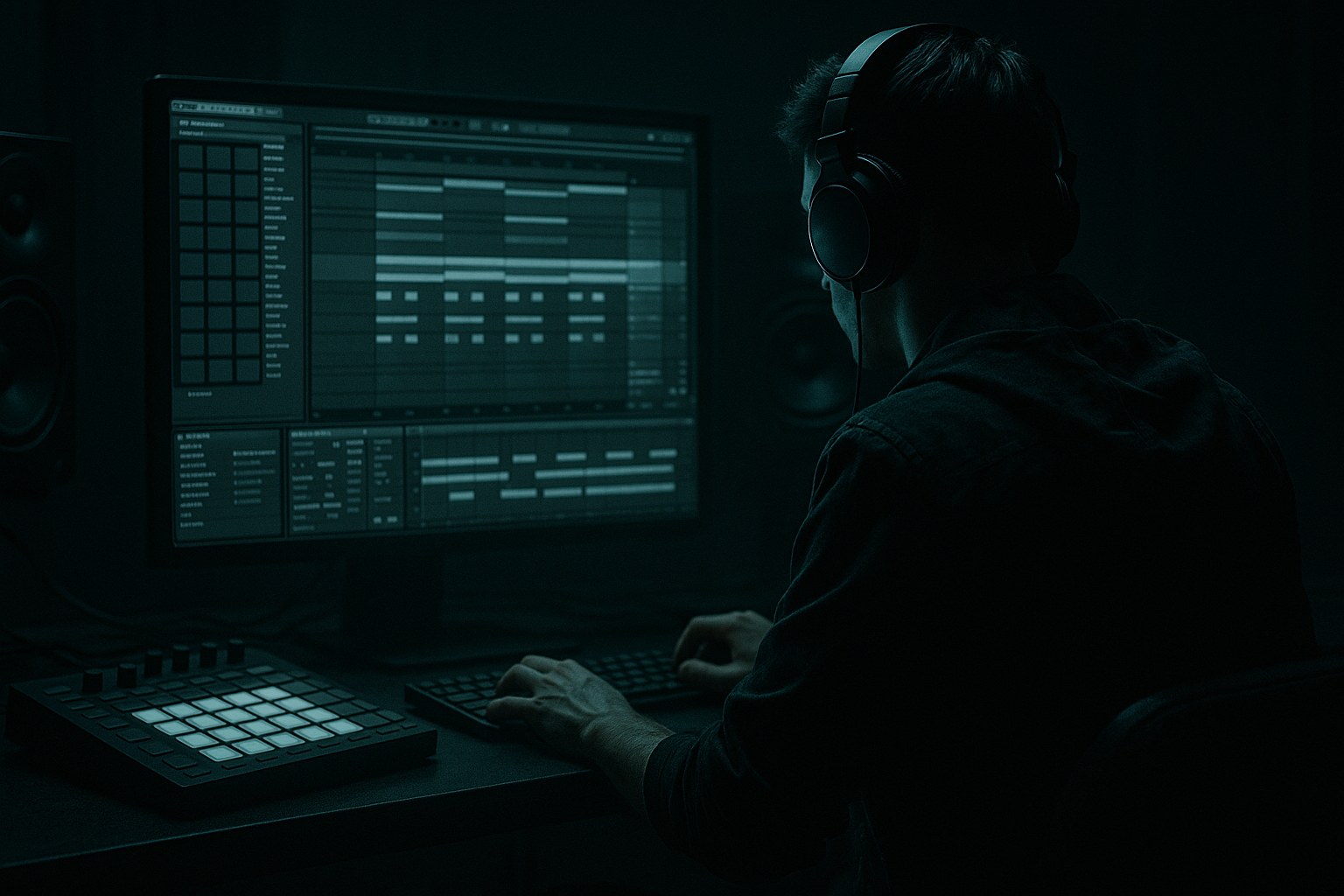
Main tutorial
Darkside Breakbeat Layer Deep Dive (with Macro Controls) — Ableton Live 12 (Beginner, Edits)
1. Lesson overview
In darkside DnB/jungle, the break is the identity: gritty mids, tight transients, and movement that feels “alive.” In this lesson you’ll build a two-layer breakbeat stack (clean punch + dark texture), then create Macro controls that let you perform edits like a producer: filtering, reverb throws, distortion pushes, and glitchy fills — all from a few knobs 🎛️
You’ll do this using Ableton Live 12 stock devices (plus Drum Rack + Macros).
---
2. What you will build
You’ll end up with a single “Darkside Break Stack” track that includes:
- Layer A (Punch): tight kick/snare transients, stable groove
- Layer B (Dark Texture): resampled grit, pitch/warp artifacts, distortion, stereo haze
- Macro controls that perform like an instrument:
- Warp mode: Beats
- Add devices (in this order):
- Change Warp mode to Complex (or Complex Pro)
- Add devices:
- `Break - Punch` → Drum Buss Transients: +5 to +35
- `Break - Texture` → Auto Filter Cutoff (LP): 2 kHz to 10 kHz (inverted mapping if you want tighter = darker)
- Optional: `Break - Texture` → Reverb Dry/Wet: 6% to 16% (looser = wetter)
- Group (or texture track) Auto Filter Cutoff: 400 Hz → 9 kHz
- Map Resonance: 5% → 25%
- Texture Overdrive Drive: 15% → 55%
- Texture Redux Dry/Wet: 0% → 35%
- Punch Drum Buss Drive: 3% → 18%
- Texture Reverb Dry/Wet: 8% → 35%
- Texture Reverb Decay Time: 0.8 s → 2.5 s
- Optional: Texture Auto Filter Cutoff: 8 kHz → 3 kHz (so throw gets darker as it gets bigger)
- Interval: 1 Bar
- Grid: 1/8
- Variations: 0–20
- Chance: 0% (we’ll macro it)
- Gate: ~50%
- Mix: 10–35%
- Beat Repeat Chance: 0% → 35%
- Beat Repeat Mix: 0% → 35%
- Utility Width: 100% → 160%
- Group Auto Filter (if you have one) or Texture Filter Cutoff: 9 kHz → 1.5 kHz
- Room Throw macro (or Reverb Wet): 10% → 30%
- Bars 1–4:
- Bars 5–8:
- Bars 9–12 (second phrase):
- Bars 13–16 (pre-drop energy):
- Warping wrong = weak groove
- Too much low end in the break
- Over-distorting the punch layer
- Wet reverb all the time
- Macros mapping too wide
- Parallel dirt without losing transients
- Mid/Side control for evil width
- Use pitch as a “fear” tool
- Make fills with silence
- Resample your macro performance
- You built a darkside break stack using Punch + Texture layers.
- You used Ableton Live 12 stock devices (EQ Eight, Drum Buss, Glue, Auto Filter, Overdrive/Redux, Reverb, Beat Repeat, Utility).
- You created Macros that turn a static loop into a playable performance tool 🎛️
- You applied arrangement edits + automation to make it feel like real DnB/jungle production.
- Tightness (transient shaping + gate feel)
- Dark Filter (LP/HP sweep for tension)
- Grit (Saturator/Overdrive drive + tone)
- Room Throw (reverb send-style macro)
- Stutter (Beat Repeat performance)
- Crash Zoom (big build filter + reverb + widen)
All arranged into a 16-bar DnB loop with edits every 4/8 bars.
---
3. Step-by-step walkthrough
Step 0 — Project setup (DnB-ready) ⚡
1. Set tempo to 170–174 BPM (try 172).
2. Create a Drum Group in the mixer:
- `Break Stack` (we’ll build this)
- `Kick (optional)`
- `Sub Bass`
- `Music/Vox`
- `Drum Bus` (group later if you want glue)
> Beginner tip: Use Arrangement View for edits. It’s easier to see what’s happening.
---
Step 1 — Choose a break and prep it (Warp correctly)
1. Drag a classic style break into an audio track (any break works: think Amen-ish, Think, Funky Drummer, etc.).
2. In the clip view:
- Enable Warp
- Set Seg. BPM correctly (Live often guesses wrong)
- Warp Mode:
- For clean transients: Beats
- Preserve: Transients
- Envelope: ~20–40
- For darker smear/texture later: we’ll use Complex/Pro on the texture layer.
3. Consolidate a clean 1 or 2-bar loop:
- Select 1–2 bars → `Cmd/Ctrl + J`
---
Step 2 — Create two layers (Punch + Dark Texture)
1. Duplicate the break track:
- `Break - Punch`
- `Break - Texture`
#### On Break - Punch (clean + punchy)
1. EQ Eight
- HP filter around 25–35 Hz (remove rumble)
- Gentle dip 250–400 Hz if boxy (–2 to –4 dB, Q ~1.2)
- Slight presence boost 3–6 kHz (+1 to +3 dB) if needed
2. Drum Buss
- Drive: 5–15%
- Crunch: 0–10%
- Boom: OFF (usually avoid boom on breaks in DnB)
- Transients: +10 to +30 (for snap)
3. Glue Compressor
- Attack: 3 ms
- Release: Auto
- Ratio: 2:1
- Aim for 1–3 dB gain reduction on peaks
#### On Break - Texture (darkside grime)
- Complex Pro Formants: 0 to -20 (experiment)
1. Auto Filter
- Mode: LP24
- Start cutoff around 3–8 kHz (we’ll macro this)
- Add a touch of Resonance: 10–20%
2. Overdrive
- Drive: 20–45%
- Tone: 4–7 kHz
- Dry/Wet: 20–50%
3. Redux (optional but very “darkside”)
- Downsample: 1.5–4
- Bit Reduction: 6–10 bits
- Dry/Wet: 10–30%
4. Reverb
- Size: 20–40
- Decay: 0.8–1.8 s
- Predelay: 10–25 ms
- High Cut: 4–7 kHz (keep it dark)
- Dry/Wet: 8–18%
> The goal: Punch layer = clean rhythm definition. Texture layer = haunted atmosphere + dirt.
---
Step 3 — Group them and create Macro controls 🎛️
1. Select both break tracks → `Cmd/Ctrl + G` to Group them. Name it: Darkside Break Stack.
2. Show Macro controls (in the group).
3. Click Map and assign these (practical starter set):
#### Macro 1 — Tightness
Map:
Use it like: Low = tight/forward, High = smeary/washed (or invert to taste).
#### Macro 2 — Dark Filter
Map:
Use it for tension sweeps into drops and fills.
#### Macro 3 — Grit
Map:
This is your “push it over the edge” knob 😈
#### Macro 4 — Room Throw
Instead of drowning the whole break constantly, you’ll “throw” reverb on edits.
Map:
#### Macro 5 — Stutter
Add Beat Repeat to the Group (after everything) or only to the texture track.
Suggested Beat Repeat settings:
Map:
Now you can “tap in” glitch fills by automating this macro for a beat or two.
#### Macro 6 — Crash Zoom (Build)
This is a classic darkside trick: filter down + widen + smear.
Add Utility on the group (end of chain).
Map:
Use it at the end of 8/16 bars to create that “sucked into the void” vibe 🕳️
---
Step 4 — Make it a proper “edit”: slice + micro-rearrange (beginner-friendly)
You’ve got movement macros, now let’s add DnB edits.
#### Option A (fast): Arrangement chops
1. Consolidate each break layer to the same length (e.g., 2 bars).
2. In Arrangement:
- Duplicate your 2-bar loop to 16 bars
- Add edits:
- Bar 4: remove the last 1/8 kick tail (hard cut)
- Bar 8: repeat last 1/16 snare hit (copy/paste)
- Bar 12: mute the first 1/4 for a “stumble”
- Bar 16: big reverb throw + filter sweep
#### Option B (more “producer”): Slice to Drum Rack
1. Right-click break clip → Slice to New MIDI Track
2. Choose:
- Slicing preset: Built-in
- Slice by: Transient
3. Now you can program jungle-style re-trigs in MIDI:
- Put snare slices on offbeats
- Add a quick 1/32 roll right before bar 9
> You can still keep your two-layer concept by slicing one layer and leaving the other as a straight loop.
---
Step 5 — Automation plan (make it feel like darkside DnB)
In Arrangement View, automate your macros like a DJ performing the break:
Example 16-bar automation idea (rolling + sinister):
- Tightness: low-mid (clean groove)
- Grit: low
- Dark Filter slowly down from ~7 kHz → 3 kHz
- Small Stutter blips on bar 8 last beat
- Grit up slightly (+10–20%)
- Room Throw on snare hits only (quick automation spikes)
- Crash Zoom ramps up over 2 bars
- Final bar: Stutter on last 1/2 bar, then hard cut
This is how you get that “edited break” vibe without needing 50 tracks.
---
4. Common mistakes
If the break feels late/early, re-check warp markers and clip start. DnB is unforgiving here.
Break lows fight your sub. High-pass the break (often 25–60 Hz depending on material).
Keep punch relatively clean; let texture be nasty.
Darkside uses space, but the rhythm must stay readable. Use throws, not constant wash.
If a macro goes from “fine” to “destroyed” too quickly, tighten the mapping ranges.
---
5. Pro tips for darker/heavier DnB
Put distortion on the texture layer, and keep punch layer transient-focused (Drum Buss + Glue).
Use EQ Eight in M/S mode on the texture layer:
- Cut some 2–5 kHz on the Sides if it gets harsh
- Boost subtle 300–900 Hz on Sides for “room growl”
Duplicate texture layer, pitch it -3 to -7 semitones, low-pass it, blend quietly.
Muting the first 1/8 of a bar before a snare is often heavier than any plugin.
Once it slaps, resample the group to audio and do one more round of slicing for true jungle chaos 🔥
---
6. Mini practice exercise (10–15 minutes) 🧪
1. Build the two-layer stack and map at least 4 macros (Tightness, Dark Filter, Grit, Room Throw).
2. Create a 16-bar loop and add:
- One stutter fill at bar 8
- One reverb throw on a snare at bar 12
- One Crash Zoom ramp in bars 15–16
3. Export a quick bounce and listen on low volume:
- Can you still clearly hear the kick/snare pattern?
- Does the texture feel dark without masking the groove?
---
7. Recap
If you want, tell me what kind of break you’re using (clean Amen, crunchy old funk, modern break pack, etc.) and your target vibe (deep roller vs. full darkside terror), and I’ll suggest specific macro ranges and an 8-bar edit blueprint tailored to it.

