Main tutorial
Darkside “Impact Ghost” for Rewind‑Worthy Drops (Ableton Live 12) 🥁🌑
Advanced composition technique for jungle / oldskool DnB vibes
---
1) Lesson overview
The Impact Ghost is a darkside trick: you preview the impact of the drop (the weight, sub bloom, transient smack, room slam) before it happens, but in a ghosted way—filtered, reversed, gated, or sidechained—so the listener feels the drop coming and instinctively wants the rewind.
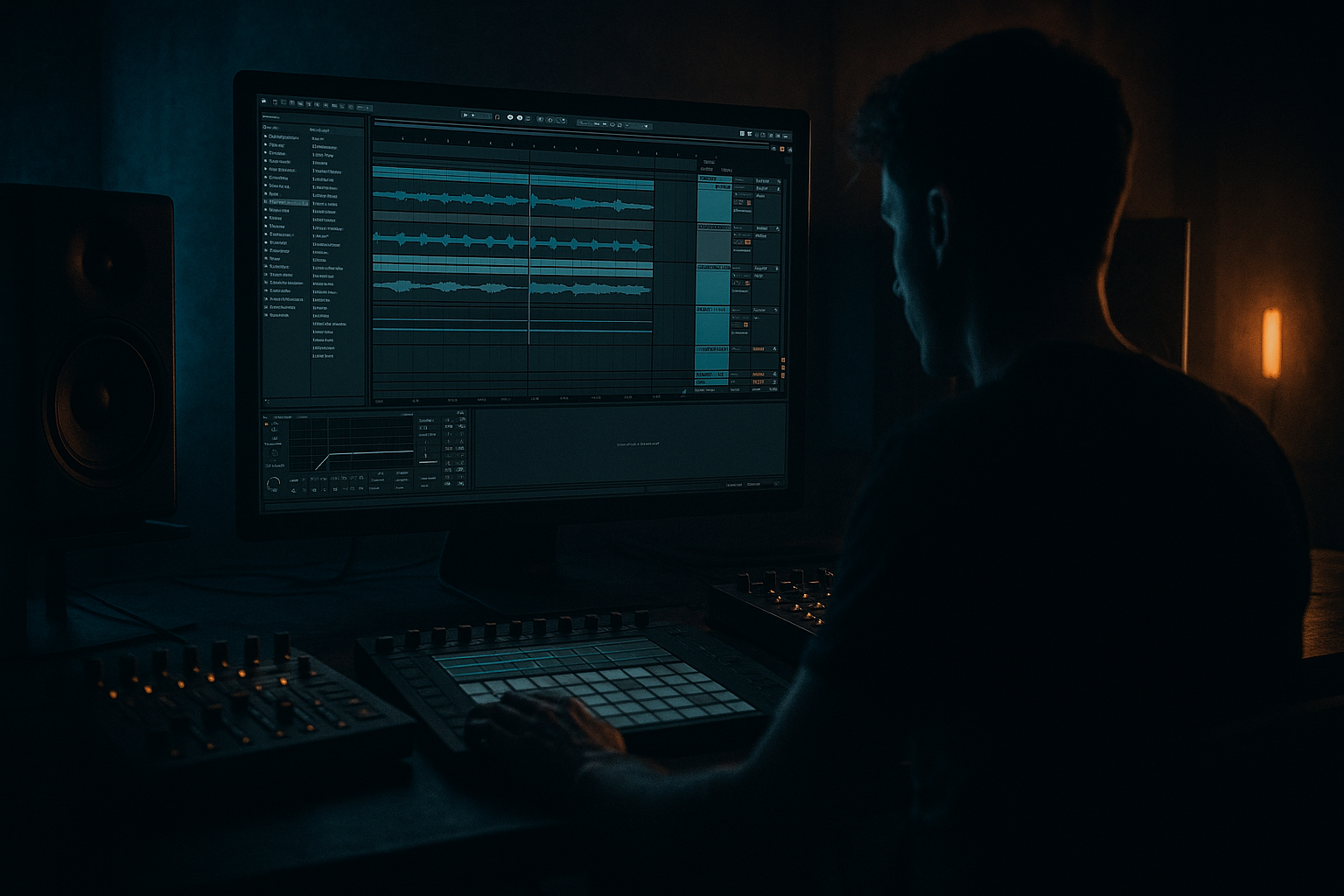
In Ableton Live 12, we’ll build a pre-drop “ghost impact” layer using resampling, reverse envelopes, macro-controlled racks, and arrangement-level call-and-response that feels very jungle / metalheadz / early techstep energy.
---
2) What you will build
You’ll create a pre-drop system that:
- Takes the first hit of the drop (kick+snare+sub+crash) and turns it into a ghost impact riser
- Builds tension with reverse tail, filtered transient, gated noise, and room slam
- Lands the actual drop harder because the ear already “knows” it’s about to get hit
- Is easy to automate using Audio Effect Rack macros 🎛️
- Tempo: 165–172 BPM (try 168 BPM)
- Groove: use a classic swing:
- Drop target: make sure your drop has a clear first downbeat impact (kick+snare or snare+sub hit)
- Last 1/2 bar before drop:
- Last 1/8 or 1/4 before drop:
- Drop:
- Use track automation for:
- Add a single snare flam right before silence (optional, very oldskool)
- Place the ghost impact 1 bar earlier than expected.
- Let it land into a half-time empty bar or break-only bar.
- Then do the real drop 1 bar later.
- Slice your ghost clip into 1/8 segments (Cmd/Ctrl+E)
- Nudge a couple slices slightly early/late
- Fade clips quickly to avoid clicks
- Add Beat Repeat (subtle) on Chain B:
- Ghost is too loud → It stops being a tease and becomes a spoiler. Keep it behind the breakdown.
- Too much sub in the ghost → You lose headroom before the drop, and the drop feels smaller. Filter + sidechain.
- No silence before the drop → If everything is constantly loud, nothing feels like impact. Use micro-stops.
- Reverb not EQ’d → Reverb low end turns into mush fast at 170 BPM. High-pass your verb return.
- Over-widening → Wide low end kills punch and mono compatibility. Keep lows mono.
- Print the ghost through saturation: Resample your ghost once you like it. Committing makes you arrange faster.
- Use drum room “slap” not wash: In Hybrid Reverb, keep decay moderate (1–2s), darker tone, and predelay 15–25ms for clarity.
- Add a “distant scream” layer (quiet):
- Contrast equals heaviness: Make the 1 bar before drop narrower, darker, quieter; then drop is bright/wide/punchy.
- Group automation: Put all breakdown FX (ghost, risers, atmos) into a group and automate one Utility Gain for clean tension curves.
- You printed the first drop impact, reversed it, and built an Impact Ghost Rack with Sub Shadow, Transient Whisper, and Room Slam chains.
- You macro-mapped key controls so the ghost becomes a compositional tool, not a one-off trick.
- You used silence, misdirection, and sidechain discipline to make the real drop hit harder—proper darkside jungle psychology.
End result: a pre-drop moment like:
> “…whoosh—thump (ghost)—silence—DROP (real)!”
---
3) Step-by-step walkthrough
Step 0 — Session setup (for authentic oldskool weight)
- Groove Pool → try MPC 16 Swing 54–58
- Apply lightly to breaks (Amount 20–35%)
---
Step 1 — Build a “Drop Impact Print” (the source for your ghost)
1. Create a new Audio Track: `DROP IMPACT PRINT`
2. Solo the core drop elements for the first hit only:
- Kick / snare stack
- Sub / bass stab
- Crash / ride hit
- Any reese stab or main chord stab (optional but tasty)
3. Resample the first 1/2 bar of the drop impact:
- Set global record to Resampling
- Record 1/2 bar or 1 bar starting exactly at the drop downbeat
4. Consolidate: Cmd/Ctrl + J so it’s one clean clip.
Goal: a single audio clip that contains the “drop’s punch signature.”
---
Step 2 — Turn that impact into a ghost (reverse + envelope control) 👻
1. Duplicate the clip onto a new audio track: `IMPACT GHOST`
2. In the clip view:
- Reverse the audio (toggle Reverse)
- Warp Mode: Beats (Preserve: Transient, try 1/16)
3. Drag the reversed clip so it ends right before the drop (e.g., last 1/2 bar of the breakdown)
Now it “sucks into” the drop—classic tension.
---
Step 3 — Create an “Impact Ghost Rack” (stock devices, macro-ready)
On `IMPACT GHOST`, add an Audio Effect Rack with 3 chains:
#### Chain A: “Sub Shadow” (felt, not heard)
Devices (in order):
1. EQ Eight
- HP at 30 Hz (gentle)
- Low shelf around 70–90 Hz: +2 to +4 dB (optional)
- LP around 120–180 Hz (steep-ish)
2. Saturator
- Mode: Soft Sine or Analog Clip
- Drive: 2–6 dB
- Output: compensate
3. Compressor (as control)
- Ratio: 3:1
- Attack: 20–30 ms
- Release: 80–140 ms
- Aim: 2–4 dB GR
Why: a controlled low “bloom” that hints at incoming weight.
---
#### Chain B: “Transient Whisper” (the click/edge, but ghosted)
Devices:
1. Auto Filter
- Mode: Band-Pass
- Freq: start ~2–4 kHz
- Resonance: 0.7–1.2
- Drive: 2–4
2. Gate
- Threshold: set so it ticks rhythmically (usually -30 to -20 dB, depends on clip)
- Return: 0
- Floor: -inf
- Attack: 1–3 ms
- Hold: 10–30 ms
- Release: 40–90 ms
3. Redux (subtle grit)
- Downsample: 2–6
- Bit Reduction: keep mild (or off)
Why: you get that jungle “air-rattle” without giving away the full hit.
---
#### Chain C: “Room Slam” (dark space before the drop)
Devices:
1. Hybrid Reverb
- Algorithm: Convolution + Algorithm blend
- Convolution: choose a darker room/warehouse style
- Predelay: 10–25 ms
- Decay: 1.2–2.5 s
- Color / damping: darker (roll highs)
2. EQ Eight after reverb
- HP at 150–250 Hz
- Gentle dip around 2–4 kHz if harsh
3. Utility
- Width: 120–160% (keep lows mono via EQ, not width)
- Gain: trim to sit behind the mix
Why: a “warehouse inhale” right before the drop.
---
Step 4 — Macro map it like a weapon 🎛️
Map these to macros (Audio Effect Rack → Map):
1. Ghost Length (clip gain automation is fine, but device macro is cleaner)
- Map Auto Filter freq (Chain B) + Reverb Dry/Wet (Chain C)
2. Darkness
- Map EQ Eight LP freq (Chain A) + Hybrid Reverb damping
3. Grit
- Map Saturator Drive (Chain A) + Redux Downsample (Chain B)
4. Gate Pulse
- Map Gate Threshold (Chain B) + Release
5. Stereo Threat
- Map Utility Width (Chain C) (keep it tasteful)
Workflow tip: Save this rack as “Impact Ghost – Darkside” so you can drop it into any project.
---
Step 5 — Make it “rewind-worthy” with arrangement psychology 🔥
This isn’t just sound design—the composition move is the rewind trigger.
#### A) The “Ghost → Stop → Drop” move (classic)
- Let the ghost swell in
- Hard mute main drums + bass (a micro-stop)
- Keep only a tiny tail of the ghost (or none)
- Full impact, no apology
Ableton execution:
- `IMPACT GHOST` volume up into the drop
- Master or drum group mute for 1/8 (or automate Utility gain to -inf on groups)
#### B) The “Fake Drop” variant (extra evil 😈)
This is pure dancefloor mischief if your groove is strong.
---
Step 6 — Glue it to the drop with sidechain + frequency discipline
You want the ghost to tease the impact, not steal the sub/headroom.
1. On `IMPACT GHOST`, add Compressor at the end (or on each chain)
2. Sidechain input: your Kick+Snare bus (or a “Drop Trigger” track)
3. Settings:
- Ratio: 4:1
- Attack: 0.3–3 ms
- Release: 80–160 ms
- Gain reduction: 3–8 dB during the strongest moment
Extra: Put an EQ Eight last with a gentle LP at 8–12 kHz if the ghost is too revealing.
---
Step 7 — Optional: “Ghost Chop” for jungle authenticity (micro-edits) ✂️
Oldskool energy loves edits.
- Interval: 1/8
- Grid: 1/16
- Chance: 10–20%
- Filter: On, keep it bright but low volume
This gives that “tape/splice panic” vibe without cluttering.
---
4) Common mistakes
---
5) Pro tips for darker/heavier DnB 🌑⚙️
- Use a short vocal stab or noise hit
- Reverse it into the drop
- Band-pass 800 Hz–3 kHz, then saturate lightly
---
6) Mini practice exercise (15 minutes) ⏱️
1. Pick a classic break (Amen-style or any crunchy oldskool break) and a reese/sub.
2. Build an 8-bar phrase:
- Bars 1–6: breakdown (pads/atmo, sparse break)
- Bar 7: introduce Impact Ghost (1/2 bar reverse)
- Last 1/8: full stop
- Bar 9: drop (full drums + bass)
3. Deliverables:
- Export a 16-bar loop
- Create two versions:
- Version A: subtle ghost (more filtered)
- Version B: aggressive ghost (more transient chain + grit)
Listen: which one makes you instinctively want to pull it back?
---
7) Recap ✅
If you want, share what style your drop is (break-heavy 94 jungle vs techstep vs modern rollers) and I’ll suggest a specific ghost timing pattern and macro ranges for that vibe.

