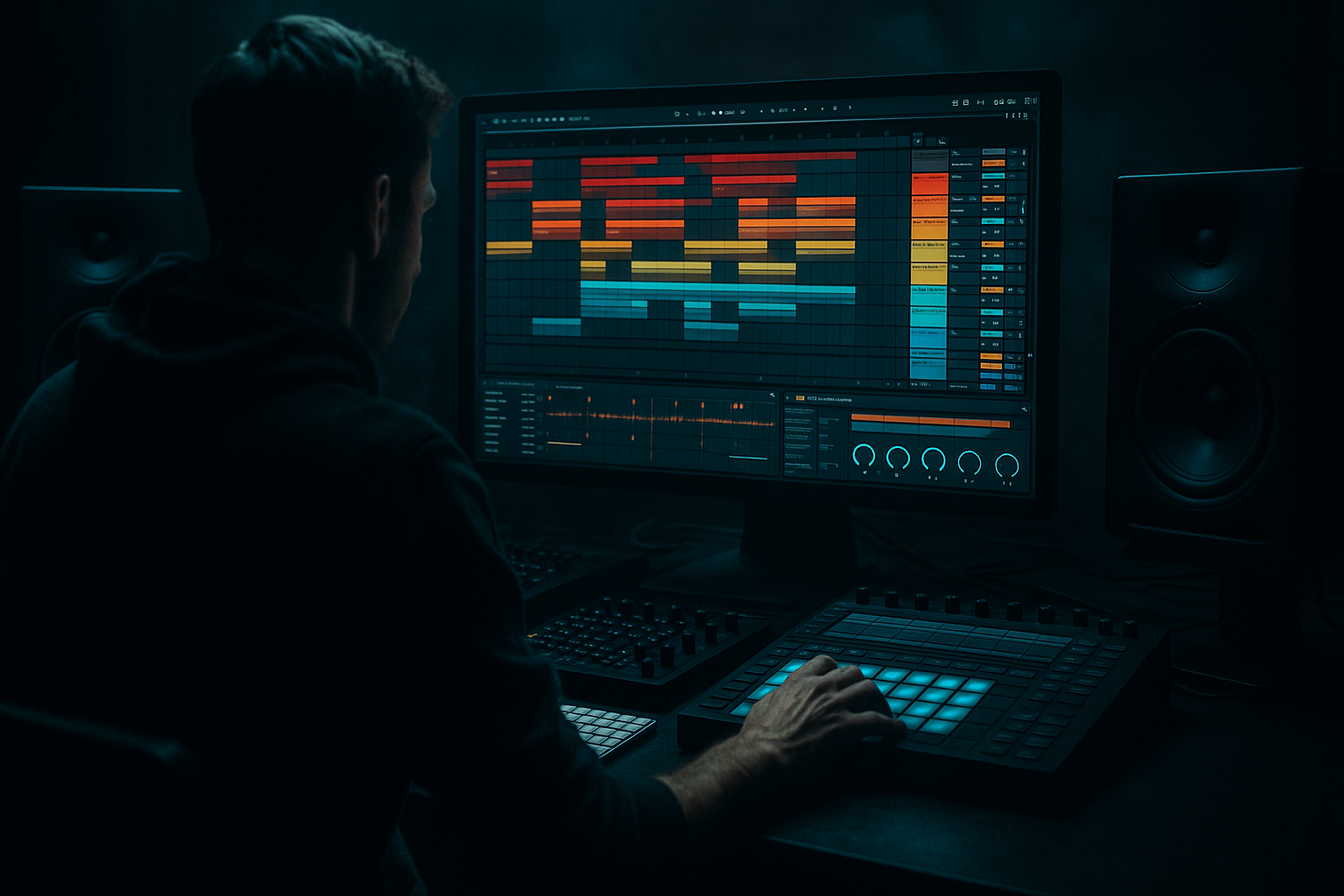
Main tutorial
Darkside Jungle Sub: Flip and Arrange in Ableton Live 12 (Resampling)
1) Lesson overview
In this lesson you’ll take a basic jungle-style sub/bass tone, flip it into a darkside weapon, and then arrange it like a proper rolling DnB tune using resampling inside Ableton Live 12. We’re focusing on advanced workflow: committing audio, creating variation fast, and building an arrangement that breathes with the drums. 🖤🔊
You’ll use mostly stock Ableton devices: Wavetable / Operator, Saturator, Auto Filter, Echo, Roar (if you have it), EQ Eight, Glue Compressor, Drum Buss, Limiter, and Resampling.
---
2) What you will build
By the end you’ll have:
- A darkside jungle sub that feels physical (solid fundamentals, controlled harmonics).
- A resampled “flip pack”: multiple audio variations (clean, driven, filtered, reese-ish, ghosted).
- A tight 32–64 bar arrangement: intro tease → drop → switch → breakdown → 2nd drop.
- A bass that locks to a classic jungle/drum & bass drum pattern (think rolling 2-step with edits). 🥁
- Color code: Sub (blue) / Mid bass (purple) / Drums (orange) / FX (green).
- Create groups now: BASS BUS, DRUM BUS.
- Operator
- Saturator
- EQ Eight
- Utility
- Wavetable
- 1-bar loop with syncopation (notes on 1, the “&” of 2, and 4)
- Add a short ghost note before a kick for push/pull.
- Long notes = weight
- Short notes = more rhythmic roll
- Use legato occasionally for glide (if you choose)
- SUB – Clean (Mono)
- BASS – Character (Resample Target)
- EQ Eight
- Utility
- Auto Filter
- Saturator (or Roar if you want heavier movement)
- Echo
- EQ Eight
- Glue Compressor
- Auto Filter Cutoff sweeping from ~300 Hz → 1.5 kHz
- Saturator Drive increasing in certain phrases (e.g., last 2 bars before a drop)
- Echo Mix momentarily up on fill hits
- Add LFO (from Auto Filter or Wavetable) for slight wobble
- Bars 1–2: tighter, filtered
- Bars 3–4: more open, dirtier
- Pass 1: “Clean-ish”
- Pass 2: “Overdriven”
- Pass 3: “Filtered + echo moments”
- Re-sequence slices into new patterns
- Create “call and response” by alternating slice groups
- Trigger a one-shot stab slice like an old-school sampler vibe
- In clip view, add tiny fades (1–5 ms) to prevent clicks.
- Duplicate the audio clip or slice, Reverse key hits (not everything)
- Use as pre-hit suck-ins before kicks/snares
- Take a slice → in Clip View:
- Add Auto Filter with envelope for stab shape
- On a duplicate, add:
- Keep it quiet under the main bass, just to widen the darkness.
- Resample again with:
- Print as 1–2 bar risers and tails.
- Drums: hats/shakers first, then add breaks
- Bass: tease a filtered version (high-passed or very low level)
- Use HP filter automation on the bass bus to keep the intro clean
- Full drums + sub
- Use 2–4 bar bass phrases
- Every 8 bars, do a flip: reverse hit, pitch stab, or a slice change
- Pull the sub out for 1–2 beats (impact!)
- Use a resampled tail or echo throw
- Bring back bass with a different slice pattern (instant “switch”)
- Same drums, bass pattern evolves:
- Add a call/response between two slice sets
- Strip to drums + minimal bass hits
- Keep sub simpler, avoid too many fills (DJ usable)
- On SUB – Clean, add Compressor
- Temporarily mono the master (Utility on Master, Width 0%)
- Nudge layers or adjust filtering to avoid cancellation.
- Resampling the sub with heavy effects and losing fundamental control. Keep sub mostly clean/mono.
- Too much distortion below 120 Hz → turns to mush, steals headroom.
- Over-automating tiny movements that don’t translate once drums are in.
- No phrase structure: a sick loop but no 4/8/16 bar story.
- Slicing without fades → clicks everywhere.
- Sidechain too slow: bass smears over the kick and kills the roll.
- Commit early: resample the bass bus and work in audio. Jungle is born in the chop. ✂️
- Use “contrast bars”: every 8 bars, do something obvious (filter open, reverse, stop, pitch stab).
- Midrange focus = perceived aggression: keep sub clean; get dirt from 200 Hz–2 kHz.
- Roar trick (if available): drive mids hard, then high-pass the result so sub stays stable.
- Drum Buss on character (not sub):
- Print transition FX from your bass: resample a 1-bar echo tail and use it as a riser/downlifter.
- Use gates rhythmically: put a Gate after Echo to create chopped tails that follow the groove.
- You built a clean mono sub plus a character layer designed for movement.
- You resampled multiple automation passes to commit ideas quickly.
- You sliced the resample into a playable kit and created flips: reverse, pitch, texture.
- You arranged in DnB phrasing (4/8/16 bar structure) with switches and impact moments.
- You glued it to drums with sidechain and kept the sub phase-safe. ✅
---
3) Step-by-step walkthrough
Step 0 — Project setup (fast, DJ-ready)
1. Tempo: 165–174 BPM (try 170 BPM).
2. Key: Pick something dark and sub-friendly: F, F#, G are common.
3. Warp mode defaults: For bass audio, you’ll often want Complex OFF. Use Beats (Transient/1/16) or Tones depending on the material later.
Session hygiene:
---
Step 1 — Build a solid jungle sub source (MIDI)
Create a MIDI track: “SUB – Source”.
#### Option A: Operator (fast + clean)
- Osc A: Sine
- Envelope: A=0 ms, D=150–300 ms, S= -inf (or low), R=80–120 ms
(Shorter for stabs, longer for notes.)
- Pitch Env: OFF (keep it stable unless you want a little thump)
Add:
- Mode: Analog Clip
- Drive: 2–6 dB
- Soft Clip: ON
- HP filter OFF (don’t cut your sub yet)
- Gentle dip around 200–350 Hz if it muddies later
- Bass Mono: ON (or Width 0% below 120 Hz using Utility + EQ split later)
#### Option B: Wavetable (if you want a slightly “alive” sub)
- OSC1: Basic Shapes → Sine
- Slight FM Amount (tiny!) or a hint of Warp for texture
- Keep it subtle: you’re building a sub foundation, not a lead.
Write a bassline:
Use a jungle/DnB rhythm like:
Important: Keep MIDI lengths intentional:
---
Step 2 — Split the bass into “Sub” and “Character” lanes (advanced control)
Duplicate the track twice:
#### SUB – Clean chain
- Low-pass around 90–120 Hz (24 dB/oct)
- OPTIONAL: tiny wide bell boost at 50–60 Hz if needed (don’t overdo)
- Width: 0%
- Gain: match levels
This track’s job: stable, phase-safe, mono sub.
#### BASS – Character chain (where the darkside lives)
Start with:
- Mode: LP24
- Cutoff: 200–600 Hz (we’ll automate)
- Drive: a little (2–8%)
- Saturator Drive: 5–12 dB (watch low-end)
- Time: 1/8 or 1/16
- Feedback: 10–25%
- Filter: HP around 200–400 Hz, LP around 2–6 kHz
- Mix: 5–15% (just smear, don’t wash)
Then:
- High-pass around 120–180 Hz (this prevents sub conflict)
- Ratio 2:1
- Attack 10–30 ms
- Release Auto
- Just 1–3 dB GR
Now you’ve got a proper split: SUB does weight, Character does vibe.
---
Step 3 — Add “flip” movement (macro automation that resamples well)
This is where we design for resampling: big, readable moves.
On BASS – Character, automate these across 8–16 bars:
- Rate: 1/8 or 1/16
- Amount: very small (we want menace, not wobble bass)
DnB phrasing tip:
Make a 4-bar question/answer:
---
Step 4 — Resample: commit audio, then slice like jungle 🧪
Now we turn that moving bass into audio you can chop, reverse, and re-arrange.
#### Method: Resampling internally
1. Create a new audio track: “BASS – RESAMPLED”
2. Set its Input to Resampling
3. Arm the track
4. Solo SUB – Clean and BASS – Character (or route them to a BASS BUS and record that)
5. Record 16 bars of performance/automation into audio
Pro workflow:
Record multiple passes:
This becomes your flip library.
---
Step 5 — Chop the resample into a playable jungle bass kit
Open the recorded audio and do this:
1. Consolidate (Cmd/Ctrl+J) a clean 8 or 16 bar region.
2. Right-click → Slice to New MIDI Track
- Slicing preset: Transient (or 1/8 if it’s very steady)
- This creates a Drum Rack with slices.
Now you can:
Tighten with fades:
---
Step 6 — Make darkside flips (reverse, pitch, texture)
Duplicate the sliced track a few times for variations:
#### Flip A: Reverse menace 👹
#### Flip B: Pitch-drop stabs
- Transpose: -3 to -7 semitones
- Warp: OFF or Tones
#### Flip C: “Reese shadow” layer (mid-only)
- Chorus-Ensemble (small amount)
- Saturator (drive)
- EQ Eight: HP at 200 Hz
#### Flip D: Texture prints (for transitions)
- Echo higher mix
- Reverb (short, dark)
- Filter sweeps
---
Step 7 — Arrange like a rolling jungle / DnB tune (32–64 bar plan)
Here’s a practical arrangement skeleton (works great at 170 BPM):
#### 0–16 bars: Intro (DJ-friendly)
#### 17–33 bars: Drop 1 (main groove)
#### 33–41 bars: Micro breakdown / switch
#### 41–57 bars: Drop 2 (heavier variation)
- More open filter
- Dirtier drive
- Higher mid layer (reese shadow)
#### 57–64 bars: Outro / mix-out
---
Step 8 — Glue it to the drums (sidechain + phase sanity)
Sidechain approach (clean, controlled):
- Sidechain from Kick (or a “ghost kick” MIDI track)
- Ratio: 4:1
- Attack: 1–5 ms
- Release: 40–120 ms (tune to groove)
- Gain reduction: usually 2–6 dB for DnB
Optional: add a tiny sidechain on Character too, but less.
Phase check tip:
If sub feels weak:
---
4) Common mistakes
---
5) Pro tips for darker/heavier DnB
- Drive 5–15%
- Boom OFF (or very low)
- Crunch to taste
---
6) Mini practice exercise (20 minutes)
1. Create a 1-bar sub MIDI pattern (Operator sine).
2. Duplicate to make SUB clean + Character split.
3. Automate Character over 8 bars:
- Filter cutoff movement
- Saturator drive pushes on bars 7–8
4. Resample 8 bars into audio.
5. Slice to Drum Rack and create:
- Pattern A: original vibe (bars 1–4)
- Pattern B: flipped vibe (bars 5–8) using at least:
- one reverse slice
- one pitched-down stab
6. Arrange into 16 bars: 8-bar build → 8-bar drop.
Deliverable: bounce a quick render and listen on small speakers—does the bass still speak without sub? 🎚️
---
7) Recap
If you want, tell me your target vibe (1994 darkside, modern roller, techy halftime-jungle hybrid) and I’ll suggest a specific bass rhythm + automation map and an 8/16/32 bar arrangement template to match.

