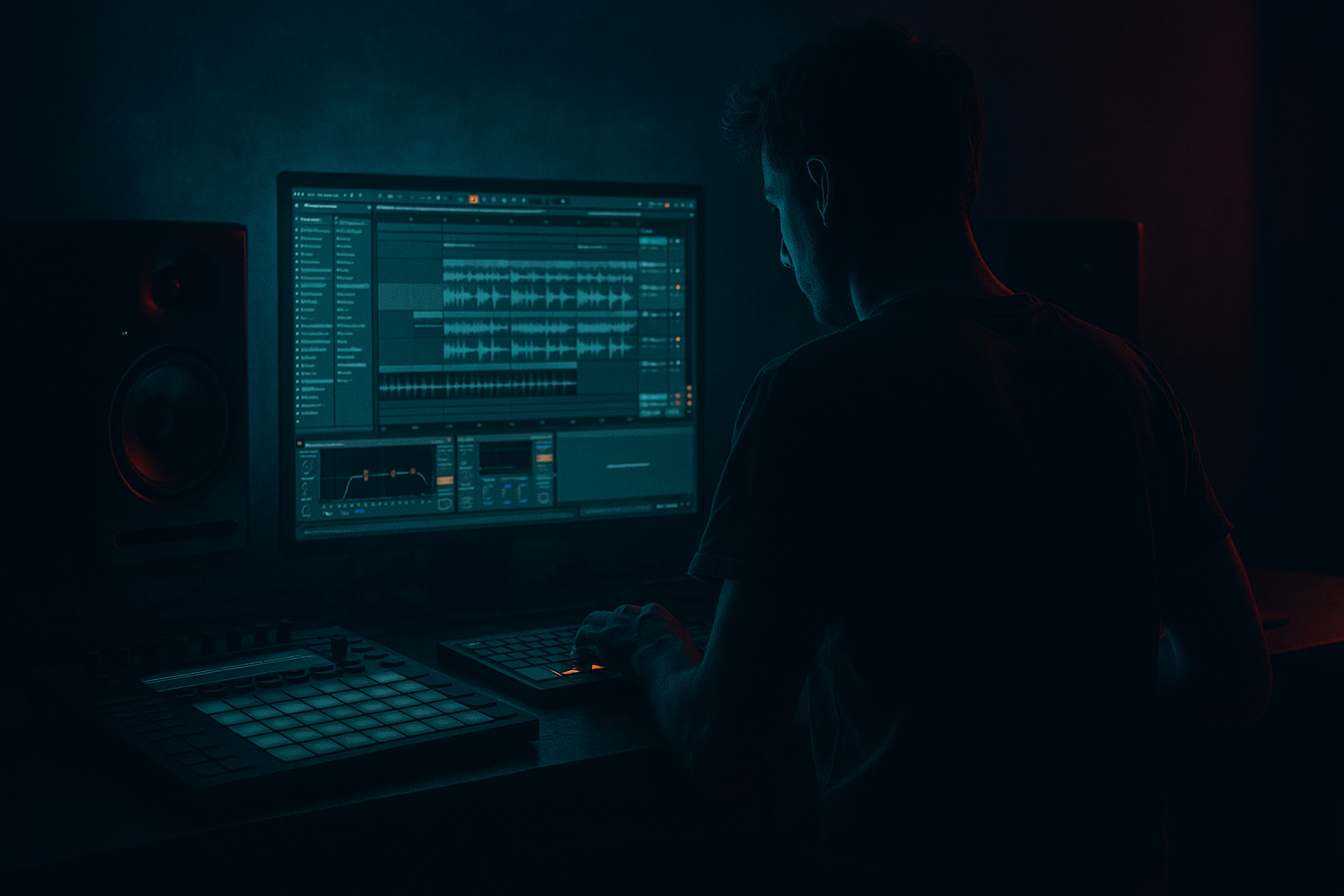
Main tutorial
Darkside Jungle Vocal Texture: Transform & Arrange in Ableton Live 12 (Beginner / Composition)
1) Lesson overview
In this lesson you’ll take a plain vocal (a spoken phrase, ad‑lib, or rap one‑liner) and turn it into a darkside jungle texture—the kind of eerie, mangled, rhythmic vocal atmosphere that sits perfectly over 170–175 BPM drums. You’ll learn how to:
- Warp and slice vocals for jungle-style rhythm 🎛️
- Build texture layers (main phrase + ghost chops + reverb tail resample)
- Use Ableton stock devices to get dark, gritty character
- Arrange the vocal into an 8/16/32-bar DnB structure so it evolves and doesn’t annoy the listener
- Lead vocal hook (intelligible, punchy, rhythmically placed)
- Chop layer (stuttered/sliced one-shots for call-and-response)
- Haunted wash layer (reverb tail resampled → filtered → sidechained)
- Transition FX (reverse reverb pulls, pitch drops, tape-stop vibes)
- Put one clear slice on beat 1
- Add two quick chops on 1.3 and 1.4 (16ths)
- Add a response slice on beat 3
- Sprinkle 1–2 ghost chops just before snare hits (common DnB trick)
- Start with Vox Wash only (filtered + distant)
- Add a single reversed vocal hit every 4 bars
- Keep lead vocal OFF until later
- Bring in Vox Chops quietly (call-and-response)
- Automate Return A (reverb send) up slightly toward the drop
- Add a high-pass sweep on the wash (Auto Filter cutoff rising)
- Full drums + bass
- Use Lead Vox phrase every 4 or 8 bars (not constantly)
- Use chops in the gaps (especially after snare hits)
- Reduce wash during busiest drum moments to keep punch
- Strip drums
- Bring wash forward (less sidechain)
- Add pitch automation (clip transposition down 2–5 semitones)
- New chop pattern
- Different reverb/delay send automation
- Maybe pitch the lead vocal +7 semitones for one bar as a “shock” moment
- In clip view, automate Transpose from 0 down to -12 over the last 1/2 bar.
- Add a touch of Saturator after for weight.
- Too much reverb on the lead → your hook loses impact. Keep reverb mostly on returns and automate it.
- No high-pass filtering → wash layer fights the bass and kick (mud city).
- Chops everywhere → jungle chops are spice, not the whole meal. Leave gaps.
- Ignoring timing feel → don’t hard-quantize everything; tiny offsets can feel more “real.”
- Over-distorting sibilance (“S” sounds) → if it hurts, tame with EQ Eight dips around 6–9 kHz or reduce saturation.
- Make the vocal sit “behind” the snare: sidechain the wash, and sometimes even sidechain the chops lightly.
- Use band-pass a lot: Darkside is often mid-focused (e.g., 300 Hz – 4 kHz) with controlled top.
- Automate sends instead of adding more layers: One vocal can feel like 10 with smart send moves.
- Try Texture warp mode on a duplicate vocal for creepy grain:
- DnB call-and-response rule: If bass is busy, make vocals simpler. If bass is simple, vocals can get more active.
- Warped and cleaned a vocal for DnB tempo ✅
- Sliced it into jungle chops using Slice to MIDI + Simpler ✅
- Built a haunted wash by return reverb + resampling + sidechain ✅
- Arranged it into a believable intro/build/drop structure ✅
- Added dark transitions like reverse reverb pulls and pitch drops ✅
---
2) What you will build
By the end, you’ll have a vocal section that feels like classic dark jungle / rolling DnB:
All inside Ableton Live 12 using mostly stock devices ✅
---
3) Step-by-step walkthrough
Step 0 — Project setup (DnB-friendly)
1. Set tempo to 174 BPM.
2. Create tracks:
- Audio Track: `Vox Source`
- Audio Track: `Vox Lead`
- MIDI Track: `Vox Chops (Simpler)`
- Audio Track: `Vox Wash (Resample)`
- Return tracks:
- A: Dark Verb
- B: Delay Dirt
Why returns? You’ll keep your main vocal controlled, then “send” into darkness as needed 😈
---
Step 1 — Import and Warp the vocal cleanly
1. Drop your vocal clip onto `Vox Source`.
2. Double-click the clip → enable Warp.
3. Set Warp Mode (pick based on the material):
- Complex Pro for full phrases (best for natural voice)
- Tones for smoother sustained bits
- Texture for glitchy/airy stretching (great for darkside)
4. Set the clip’s Seg. BPM if needed (right-click → “Warp From Here (Straight)” can help).
Beginner tip: Don’t force perfect timing yet—dark jungle vocals can be slightly “off” and still feel sick.
---
Step 2 — Create a tight “Lead Vox” phrase
1. Duplicate the clip from `Vox Source` to `Vox Lead`.
2. Trim to just the best phrase (usually 1–2 bars).
3. Add these devices on `Vox Lead` (in this order):
#### Device chain: Lead Vox (dark but clear)
1. EQ Eight
- High-pass: 100–150 Hz (remove rumble)
- Dip harshness: 2.5–5 kHz by -2 to -4 dB if needed
2. Saturator
- Mode: Analog Clip
- Drive: 2–6 dB
- Turn on Soft Clip
3. Compressor
- Ratio: 3:1
- Attack: 10–30 ms
- Release: 60–120 ms
- Aim for 3–6 dB gain reduction
4. Utility
- Gain to taste, and if it’s too wide/phasey: set Width 80–100%
✅ Now you have a vocal that can sit over drums without disappearing.
---
Step 3 — Slice the vocal into jungle chops (Simpler)
This is the “shredded” rhythmic layer that gives jungle that manic energy 🔪
1. Right-click the vocal clip → Slice to New MIDI Track.
2. In the dialog:
- Slicing preset: Built-in (or Transients)
- Slice by: Transients
3. Ableton will create a MIDI track with Simpler containing slices.
#### Make it punchy:
On `Vox Chops (Simpler)`:
1. Open Simpler:
- Mode: One-Shot
- Turn on Warp inside Simpler if needed
2. Set Filter:
- Type: LP24
- Frequency: start around 6–10 kHz
- Drive: 2–6
3. Shape the amplitude:
- Attack: 0–5 ms
- Decay: 150–350 ms
- Sustain: 0
- Release: 50–120 ms
#### Program a jungle rhythm:
Create a 1-bar MIDI clip at 174 BPM, then:
DnB feel tip: Let chops “answer” the snare, not fight it.
---
Step 4 — Build the “haunted wash” layer (reverb resample)
This is the atmosphere behind the vocal—classic darkside vibe 🕯️
#### Create Return A: Dark Verb
On Return A, add:
1. Hybrid Reverb
- Algorithm: Hall (or Shimmer OFF for darker)
- Decay: 4–8 s
- Pre-delay: 15–35 ms
- High cut: 4–7 kHz
2. EQ Eight after the reverb
- High-pass: 200–400 Hz
- Low-pass: 3–6 kHz (darkens tail)
3. Glue Compressor
- Light control, 1–2 dB GR
Send `Vox Lead` and/or `Vox Chops` into Return A (start at -18 to -12 dB send).
#### Resample the wash
1. Create `Vox Wash (Resample)` audio track.
2. Set its input to Resampling (or “Return A” if you prefer targeted).
3. Arm and record 4–8 bars while the vocal plays.
4. Now you have a printable “atmo” audio clip.
#### Make it breathe with the drums (sidechain)
On `Vox Wash (Resample)` add:
1. Compressor
- Sidechain: from your Kick (or full drums group)
- Ratio: 4:1
- Attack: 1–5 ms
- Release: 80–150 ms
- Aim for 3–8 dB GR
This makes the wash pump around drums—instant DnB glue 💥
---
Step 5 — Add delay dirt (Return B)
On Return B add:
1. Echo
- Time: 1/8 dotted or 1/4
- Feedback: 25–45%
- Filter: HP 200 Hz, LP 4–6 kHz
2. Redux (subtle!)
- Bit reduction: 10–12 (gentle)
- Downsample: small amount
3. Auto Filter
- Type: BP (band-pass)
- Map cutoff to a macro (we’ll automate it)
Send the lead vocal into this return for dubby, unsettling repeats 👂
---
Step 6 — Arrange it like a real DnB track (8/16/32-bar thinking)
#### Suggested arrangement blueprint (simple + effective)
0–16 bars: Intro
16–32 bars: Build
32–64 bars: Drop
64–80 bars: Breakdown
80+: Second drop / variation
---
Step 7 — Dark transitions (quick FX you can actually do)
#### A) Reverse reverb pull (classic)
1. Duplicate the lead vocal phrase.
2. Consolidate (`Cmd/Ctrl + J`).
3. Add reverb (Hybrid Reverb 100% wet).
4. Freeze + Flatten or resample.
5. Reverse the printed audio (`R` in clip view).
6. Place it just before the vocal starts.
#### B) Pitch drop at the end of a phrase
---
4) Common mistakes
---
5) Pro tips for darker/heavier DnB
- Warp Mode: Texture
- Grain Size: 20–60 ms
- Flux: low for stable, higher for chaos
---
6) Mini practice exercise (15–25 minutes)
1. Pick one vocal phrase (1–2 seconds is enough).
2. Create:
- `Vox Lead` (clean-ish)
- `Vox Chops (Simpler)` (transient slicing)
- `Vox Wash (Resample)` (reverb printed + sidechained)
3. Arrange an 8-bar loop:
- Bars 1–4: wash + a couple chops
- Bars 5–8: introduce lead vocal on bar 7, beat 1
4. Automate one thing:
- Reverb send up into bar 7, then snap down at bar 8.
Export the 8 bars and listen on repeat—if the vocal stays interesting for 1 minute, you nailed it.
---
7) Recap
If you tell me what kind of vocal you’re using (spoken, rap, female vocal, movie quote) and your target vibe (classic jungle, techstep, modern rollers), I can suggest a tighter device chain and a 32-bar arrangement template for that exact style.

