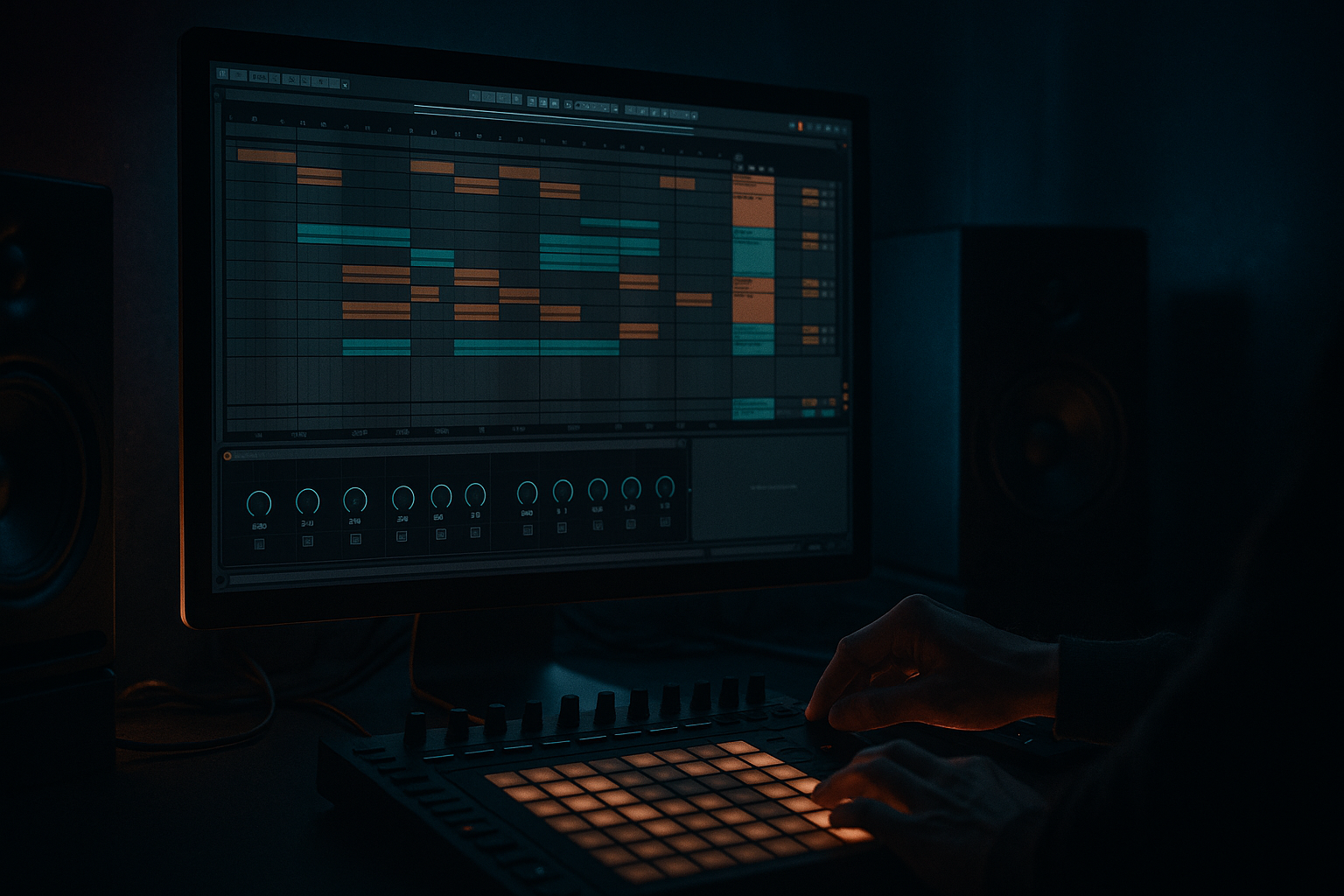
Main tutorial
Deconstructing Bounce from Classic Jungle (Ableton Live) 🥁⚡
Skill level: Advanced
Category: Groove
---
1. Lesson overview
Classic jungle bounce isn’t just “swing.” It’s the interaction between:
- Microtiming (tiny pushes/pulls on specific hits)
- Ghost notes (low-level hits that imply momentum)
- Velocity shape (accents that steer the groove)
- Layered break behavior (multiple breaks doing different rhythmic jobs)
- Tight-but-not-quantized editing (human feel with intentional constraints)
- A primary break layer (e.g., Amen-style)
- A tight punch layer (clean kick/snare reinforcement)
- A ghost/percussion layer (hats, rides, shuffles)
- A groove template + microtiming system you can reuse
- Double-click clip → enable Warp
- Set Warp Mode: Beats
- Preserve: Transients
- Transient Loop Mode: Off (usually cleaner)
- Start with Transient Envelope ~ 15–35 (less = tighter slices, more = smoother)
- Slicing preset: Transient
- Create: Drum Rack
- (If asked) choose Built-in slicing preset
- Kick around 1.1
- Snare on 2.1 and 4.1 (backbeats)
- Extra kick or ghost kick around 3.3–3.4 depending on vibe
- Shuffle energy from hats/ghost snares between beats
- Some late hats
- Some early ghost notes
- Some dragged snares (tiny)
- Some retrigger funk (tiny slices repeated)
- Timing: 35–55%
- Random: 3–8%
- Velocity: 10–25%
- Base: usually 1/16 (try 1/8 if it over-shuffles)
- Main snare (2 and 4):
- Ghost snare before 2 or 4:
- Hats/shuffles:
- Extra kick (around 3):
- Early ghosts = urgency
- Late hats = swagger
- Slight late snare = heaviness
- Backbeat snare: 110–127
- Kick(s): 95–120 depending on layer
- Ghost snares: 20–55
- Little fill hits: 45–80 (varied)
- Hats: 35–90 with accents on periodic anchors
- Kick: 1.1
- Snare: 2 and 4
- HP at 300–600 Hz
- Auto Filter (HP, slight resonance) for moving “air”
- Redux (very subtle) for old-school grit
- Bars 1–4: main groove (establish)
- Bars 5–8: swap 1–2 slices (tiny fill), remove one kick
- Bars 9–12: add a hat pattern or ride, introduce a quick snare retrigger (1/32 or 1/24 feel via manual spacing)
- Bars 13–16: “answer” phrase—extra ghost notes + micro-drop (remove main snare for half a beat then slam back)
- Use clip duplication (Cmd/Ctrl + D)
- Make A/B versions of the same clip and alternate them in Arrangement View.
- Make snares heavier by dragging, not just by EQ
- Parallel distortion for break menace (stock-only)
- Dark roll = controlled top end
- Sub-bass and break relationship
- Add “room” like old records
- Jungle bounce comes from microtiming + dynamics + layering roles, not generic swing.
- Use Slice to Drum Rack so you can compose bounce, not just loop it.
- Groove Pool is helpful, but the real magic is selective push/pull:
- Reinforce anchors with clean hits, but preserve break funk as the engine.
- Arrange with call-and-response across 16 bars to keep the roll hypnotic.
In this lesson you’ll rebuild that bounce inside Ableton Live, using stock tools (plus your ears), and you’ll end with a rollable 2-step jungle/DnB groove that feels alive—not stiff or over-shuffled.
---
2. What you will build
You’ll create a 16-bar classic jungle groove built from:
End result: a pattern that bounces at 170–174 BPM, with the “lurch” and forward-roll associated with classic jungle.
---
3. Step-by-step walkthrough
Step 0 — Session setup (important for feel) 🎛️
1. Set tempo to 172 BPM (classic sweet spot).
2. Set Global Quantization = 1 Bar (top-left in Live).
3. Create 3 audio tracks and 2 MIDI tracks:
- A1 – Break (Main)
- A2 – Break (Tops/Texture)
- A3 – Room/Trash Layer (optional but very jungle)
- M1 – Kick/Snare Reinforcement
- M2 – Hats/perc (Ghosts)
---
Step 1 — Choose and prep a break the “jungle” way 🔥
On A1 (Break Main), drop in a break sample you like (Amen, Think, Hot Pants style, etc.).
Warping (crucial):
Pro move: If your break loses punch in Beats mode, try Complex Pro only for long breaks, but classic jungle editing usually prefers Beats because it preserves transient snap.
---
Step 2 — Slice to a Drum Rack for controllable bounce ✂️
Right-click the break clip → Slice to New MIDI Track:
Now you have a Drum Rack with each hit on a pad and a MIDI clip driving it.
Why this matters: Bounce lives in re-ordering, ghosting, and micro-offsetting individual hits—not just moving the whole loop.
---
Step 3 — Build the “classic jungle skeleton” (2-step core) 🧱
Open the MIDI clip created by slicing.
At 172 BPM, classic DnB/jungle skeleton often implies:
Action:
1. Identify the clean snare slice (usually the Amen snare).
2. Place snares firmly at:
- Bar 1: 1.2.1 (beat 2)
- Bar 1: 1.4.1 (beat 4)
3. Identify a kick slice and place it at:
- 1.1.1
- Optional: 1.3.3 (or 1.3.2) for push
Keep this first pass tight (close to grid). Bounce comes next.
---
Step 4 — Extract swing the right way (Groove Pool) 🕺
Classic jungle swing is rarely a single “MPC 16 swing 54%.” It’s usually:
#### 4A) Create a groove template from audio
If you have a break loop that already bounces:
1. Put it on an audio track.
2. In the clip view, click Groove → choose Extract Groove.
3. Open Groove Pool (hotkey: click the wave icon, or View → Groove Pool).
Now apply that groove to your sliced MIDI clip.
#### 4B) Groove Pool settings (advanced jungle-friendly starting point)
On the groove in Groove Pool:
Click Commit only after you like it. Until then, keep it “live” so you can adjust.
---
Step 5 — Microtiming: the “push-pull” map (this is the bounce) 🎯
This is where advanced producers separate from presets.
Turn on Grid: 1/16, then disable snap temporarily (Cmd/Ctrl + 4 toggles grid; you can also hold Cmd/Ctrl while dragging for fine moves).
Use micro offsets in milliseconds feel, not huge rhythmic moves.
#### Suggested microtiming offsets (starting point)
In the MIDI clip (or audio slices if you’re editing audio), try:
- Keep on-grid or +3 to +8 ms late (slight drag = weight)
- Place at 1.1.4 / 1.3.4 and nudge -5 to -15 ms early (creates “pull into snare”)
- Offbeats (the “and”): +5 to +15 ms late (laid-back roll)
- Often -3 to -10 ms early (push forward)
Rule of thumb:
---
Step 6 — Velocity shaping (bounce is dynamic, not flat) 📈
Open Velocity lane in the MIDI editor.
Do this systematically:
If everything is loud, nothing bounces. Classic jungle grooves breathe.
---
Step 7 — Layering for punch while keeping break funk 🧩
Now reinforce without killing the break’s feel.
#### M1 – Kick/Snare Reinforcement (Drum Rack)
Create a Drum Rack with a clean kick + snare (short, punchy).
Program only the main anchors (don’t copy the whole break).
Device chain (stock):
1. Drum Rack
2. Saturator
- Drive: 2–6 dB
- Soft Clip: On
3. EQ Eight
- HP at 25–35 Hz
- Small dip around 200–350 Hz if boxy
4. Glue Compressor (light)
- Attack: 3 ms
- Release: Auto
- Ratio: 2:1
- GR: 1–2 dB max
#### A1 – Break Main processing (keep it alive)
Device chain (stock):
1. EQ Eight
- HP at 25–35 Hz (don’t fight sub bass)
- Gentle shelf -1 to -3 dB above 10 kHz if harsh
2. Drum Buss
- Drive: 5–20% (taste)
- Crunch: 0–10
- Boom: Off or very low (often unnecessary in DnB)
3. Transient Shaper (if you have Live Suite: use Drum Buss transient via Drive/Transient; or careful with Saturator)
4. Utility
- Width: 90–120% depending on break (don’t overdo)
Key: Your reinforcement gives punch, the break gives bounce.
---
Step 8 — Create the “jungle air” layer (tops/texture) 🌪️
On A2 (Break Tops/Texture): duplicate the break, then make it mostly high-end.
EQ Eight:
Optional:
Then nudge this layer slightly late (like +5 to +12 ms).
This creates a psychoacoustic “lift” without muddying the main transient.
---
Step 9 — Arrangement: bounce needs call-and-response 🧠
Classic jungle is arrangement groove as much as it’s bar groove.
Build a 16-bar loop with variation:
Ableton workflow tip:
---
4. Common mistakes 🚫
1. Over-quantizing everything
- If all hits are perfectly grid-locked, you kill the push-pull conversation.
2. Using one Groove Pool preset as a magic fix
- Jungle bounce is selective timing, not global shuffle.
3. Too many loud ghost notes
- Ghosts should be felt more than heard.
4. Layering full kick/snare on every break hit
- Reinforce anchors only, or your drums become a flat wall.
5. Warping artifacts and transient smearing
- Check Warp Mode and transient markers—bad warp = dead bounce.
---
5. Pro tips for darker/heavier DnB 🕶️🔊
- Try +5 ms on the main snare for “weight.”
- Create a return track: Saturator (Drive 8–15 dB, Soft Clip On) → EQ Eight (HP 200 Hz) → Compressor.
- Send break to it at -15 to -8 dB.
- If your hats are too bright, the groove feels “fast” instead of “heavy.”
- Use EQ Eight or Auto Filter to tame 8–12 kHz slightly.
- Sidechain the bass to the reinforcement kick, not the break.
- Use Compressor sidechain with fast attack, release timed to groove (e.g., 80–140 ms).
- Tiny Convolution Reverb room on snare (very short) or Reverb:
- Decay: 0.3–0.6 s
- Pre-delay: 10–25 ms
- HP filter in reverb: 400–800 Hz
- Keep it subtle—just enough to suggest space.
---
6. Mini practice exercise 🎯
Goal: Make a 4-bar loop bounce harder without adding any new samples.
1. Start with your current 2-step jungle loop.
2. Add exactly 3 ghost notes (snare/kick fragments) in bar 1.
3. Apply these constraints:
- One ghost is early (-10 ms)
- One ghost is late (+10 ms)
- One ghost stays on-grid
4. Change velocity so the three ghosts are 35 / 45 / 55.
5. Record yourself toggling between “before” and “after.”
6. If it doesn’t bounce more, remove one ghost and instead move the hat timing (+8 ms on offbeats).
You’re training “groove causality”: knowing exactly which change creates the motion.
---
7. Recap ✅
- Early ghosts → pull
- Late hats → swagger
- Slight late snare → weight
If you want, tell me what break you’re using and your target vibe (94-style ragga jungle vs. techstep vs. modern rollers), and I’ll suggest a specific microtiming map + layering plan for that direction.

