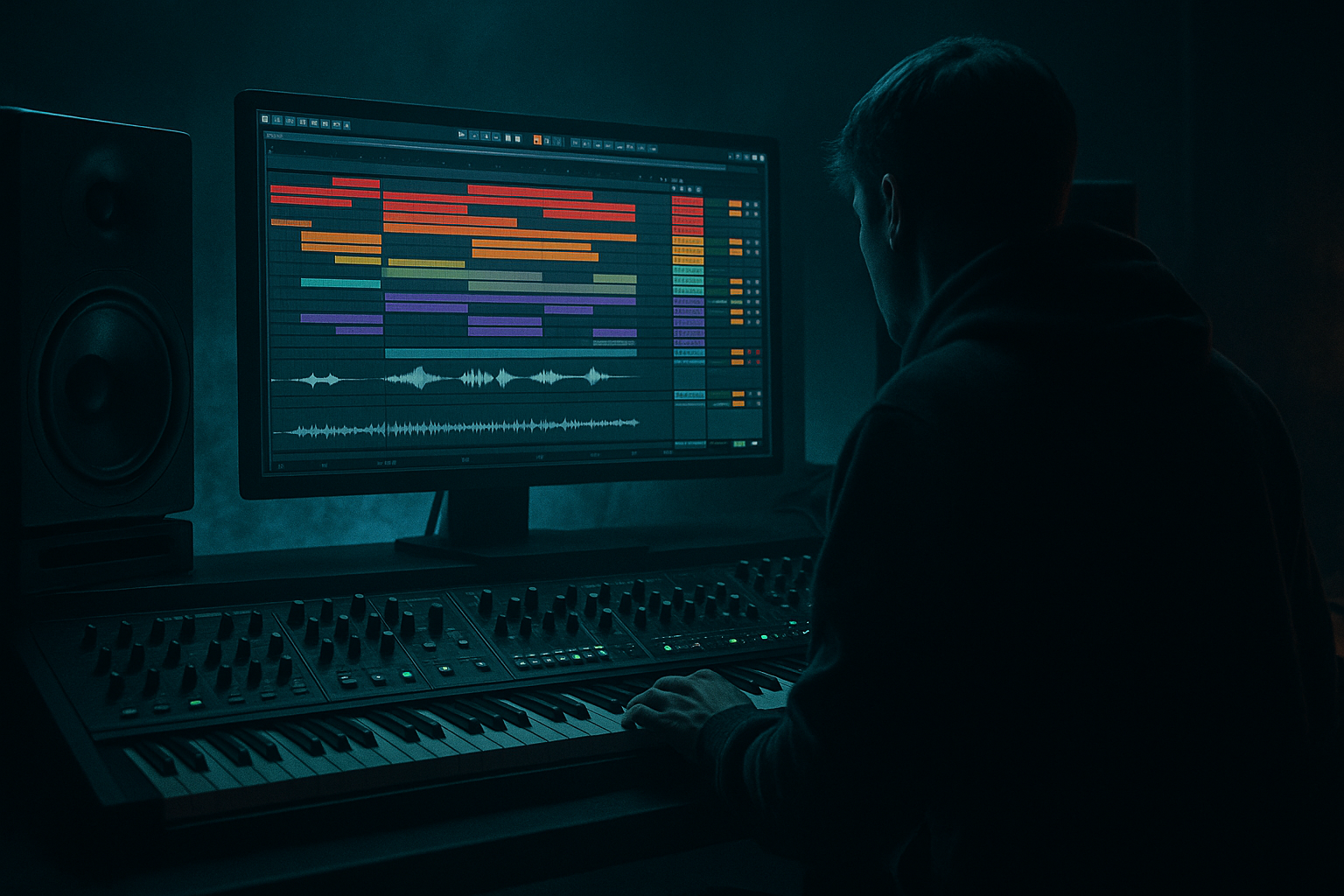
Main tutorial
Delay Throws on Vocal Chops in Arrangement View (Ableton Live) — Advanced DnB Automation 🎛️
1) Lesson overview
Delay throws are those momentary bursts of echo you hear on a single word/chop—classic in rolling DnB, jungle edits, and darker halftime. In this lesson, you’ll build tight, mix-safe delay throws on vocal chops using Arrangement View automation, with a workflow that stays fast even in dense 174 BPM sessions. ⚡
We’ll focus on:
- Send/Return delay throws (clean, mix-controlled)
- Dry/Wet + feedback “punch” automation (more aggressive)
- Printing/resampling throws for precision and creative mangling
- Plays mostly dry and upfront
- Hits selected chops with tempo-synced delay throws
- Ducks the delay tails under the drums/bass
- Has optional filtered / distorted / reverb-washed echoes for heavy DnB atmosphere 🌑
- Return A: Throw Delay (Echo-based)
- Sidechain-controlled tails via Gate/Compressor
- Arrangement automation that targets specific chops cleanly
- Keep most chops short and dry; throw delay on the last chop of a 2-bar phrase to lead into the next bar.
- Mode: Sync
- Time: start with 1/4 (classic)
- Feedback: 35–55% (we’ll adjust)
- Dry/Wet: 100% (since it’s a return)
- Noise: Off (usually cleaner for DnB)
- Character: Mid (or Clean if you want surgical)
- Stereo: 80–120% (careful: too wide can smear mono clubs)
- Filter Type: LP24
- Cutoff: 6–12 kHz (tame harsh echoes)
- Resonance: 0.2–0.5
- Optional: automate cutoff later for “closing” tails.
- Sidechain: On
- Audio From: your DRUM BUS (or Kick+Snare group)
- Ratio: 4:1
- Attack: 1–5 ms
- Release: 80–180 ms (time to groove)
- Threshold: set for 3–8 dB gain reduction on drum hits
- Bass Mono: On, set around 120 Hz
- Gain: trim so returns don’t surprise you later
- Keep baseline Send A near -inf (off).
- For a throw, draw a quick ramp:
- Small throw: peak at -12 to -6 dB
- Big phrase throw: peak at -3 to 0 dB
- Keep it short: the return device handles the tail.
- Place the “on” point right on the chop start
- Turn it off by the next 16th to avoid doubling syllables unintentionally
- Automate Echo → Feedback
- Use short automation “bumps” only on phrase ends.
- On Auto Filter cutoff, draw:
- Creates that descending, smoky tail that sits behind a reese.
- Automate Echo Stereo from ~80% → 120% on key throws
- Keep Utility Bass Mono on so the club doesn’t turn to soup.
- Saturator
- Redux (sparingly for techy/jungle edge)
- Triplet throws for jungle tension: set Echo time to 1/8T for a few strategic moments—great before fills.
- Band-pass “radio” throws: Auto Filter BP12, cutoff ~1.5–3 kHz, resonance ~0.7. Makes a vocal feel like it’s shouting through the mix.
- Pre-drop blackout: automate Return A Utility Gain down right before the drop, then slam it back on with one big throw on the last word.
- Distorted tail only, clean vocal upfront: keep distortion only on the return so the vocal stays intelligible.
- Reese-aware EQ: if your reese lives at 200–800 Hz, high-pass the delay return (Auto Filter HP12) around 150–250 Hz to avoid mud.
- Use Return-based throws for clean, mix-safe control.
- Automate Send A in Arrangement: quick on/off bursts per chop.
- Shape the vibe by automating Echo feedback and filter cutoff on the return.
- Keep throws tight with sidechain ducking from the drum bus.
- For maximum control, print/resample throws and edit like audio.
---
2) What you will build
A vocal chop lane that:
You’ll end up with:
---
3) Step-by-step walkthrough
Step 0 — Prep your vocal chops for DnB timing
1. Put your vocal chop audio on a track named: VOCAL CHOPS.
2. Ensure it’s tight:
- Warp Mode: Complex Pro (if it’s tonal/wordy) or Tones (if it’s short/stabby).
- Set Seg. BPM correctly if needed.
3. In Arrangement, place chops rhythmically—think call/response around snare:
- Common: chops answering on beat 3.2–3.4 or between snares in a 2-step.
DnB arrangement idea:
---
Step 1 — Build a dedicated Delay Throw Return (recommended workflow)
Using a Return is clean because you can automate Send amount, keep the vocal’s dry level stable, and control the throw’s mix globally.
#### 1A) Create Return A: “THROW DELAY”
On Return A, add:
1) Echo (stock)
Alternatives:
- 1/8 dotted for more skippy jungle vibe
- 1/2 for big space at phrase ends
2) Auto Filter
3) Compressor (duck the tail under drums) 🥁
4) Utility
Why this chain works in DnB: Echo tails can fight hats, snares, and reese mids—ducking keeps it energetic without washing the groove.
---
Step 2 — Automate delay throws in Arrangement View (the core technique)
#### 2A) Show Send automation
1. Select the VOCAL CHOPS track.
2. Press A to show automation lanes.
3. In the automation chooser, select:
- Mixer → Send A (or “A Send”)
#### 2B) Draw throws on specific chops
- Jump to -6 dB to 0 dB right at the chop transient
- Drop back to -inf shortly after (usually 1/16–1/8 note later)
Practical values:
Timing tip (174 BPM):
---
Step 3 — Make throws musical: automate Return parameters (advanced)
Instead of changing the send shape a ton, you can keep send consistent and automate the Return’s Echo for different throw flavors.
#### 3A) Automate Echo Feedback for “one-shot” vs “runaway”
On Return A:
- Normal: 35–45%
- Big moment: 55–70% (careful—can blow up fast)
#### 3B) Automate Echo Filter / Auto Filter cutoff for movement
- Start brighter (e.g., 10–12 kHz) then close down to 2–5 kHz across the tail
#### 3C) Add a “throw widen” moment (but keep lows mono)
---
Step 4 — Create “freeze-frame” throws by printing/resampling (arrangement power move) 🧊
When you want absolute control (and easy editing):
1. Create a new audio track called THROWS PRINT.
2. Set its input to Resampling (or “Return A” via routing).
3. Record only the sections with throws.
4. Now you can:
- Slice tails
- Reverse a tail into a drop
- Stretch one echo into an atmosphere
- Re-pitch tails for jungle spice
DnB arrangement idea: print the throw that happens at the end of bar 8, reverse it, and fade it into bar 9 to “pull” the drop.
---
Step 5 — Optional: Add grit for heavier DnB (still stock)
On Return A, after Auto Filter (or after Echo depending on taste):
- Mode: Analog Clip
- Drive: 2–6 dB
- Soft Clip: On
- This makes throws audible on smaller speakers.
- Bit Reduction: 10–14
- Downsample: x2–x4
- Automate it only on one throw per phrase.
---
4) Common mistakes
1. Leaving the send up too long
Result: repeated syllables + messy phrasing. Keep the send “on” very short.
2. Too much feedback in a busy drop
In rolling DnB, tails pile up fast. If your groove loses punch, reduce feedback or increase sidechain ducking.
3. No ducking = smeared drums
Delay returns often mask hats/snare crack. Sidechain your delay return from the drum bus.
4. Wide low-end in the delay return
Stereo delays can introduce low-end phase weirdness. Use Utility Bass Mono or filter lows out.
5. Throwing every chop
Throws are impact tools. If everything throws, nothing feels special.
---
5) Pro tips for darker/heavier DnB 🌑
---
6) Mini practice exercise 🧪
At 174 BPM, build a 4-bar loop:
1. Place 6–10 vocal chops around the snare (leave space on beat 2 and 4).
2. Create Return A with the chain above.
3. Add delay throws on:
- The last chop of bar 2
- The last chop of bar 4
4. Make bar 4’s throw “special”:
- Feedback bump to 65% for just that throw
- Filter cutoff sweep from 10 kHz → 3 kHz over the tail
5. Print the return tail of bar 4 and reverse it into bar 1.
Deliverable: a loop that feels like it breathes—dry chops + two signature throw moments.
---
7) Recap ✅
If you tell me your typical vocal style (ragga one-shots, spoken phrases, airy female hooks, etc.) and whether your drums are more 2-step or breaky jungle, I can suggest exact delay timings and throw placements that match your groove.

