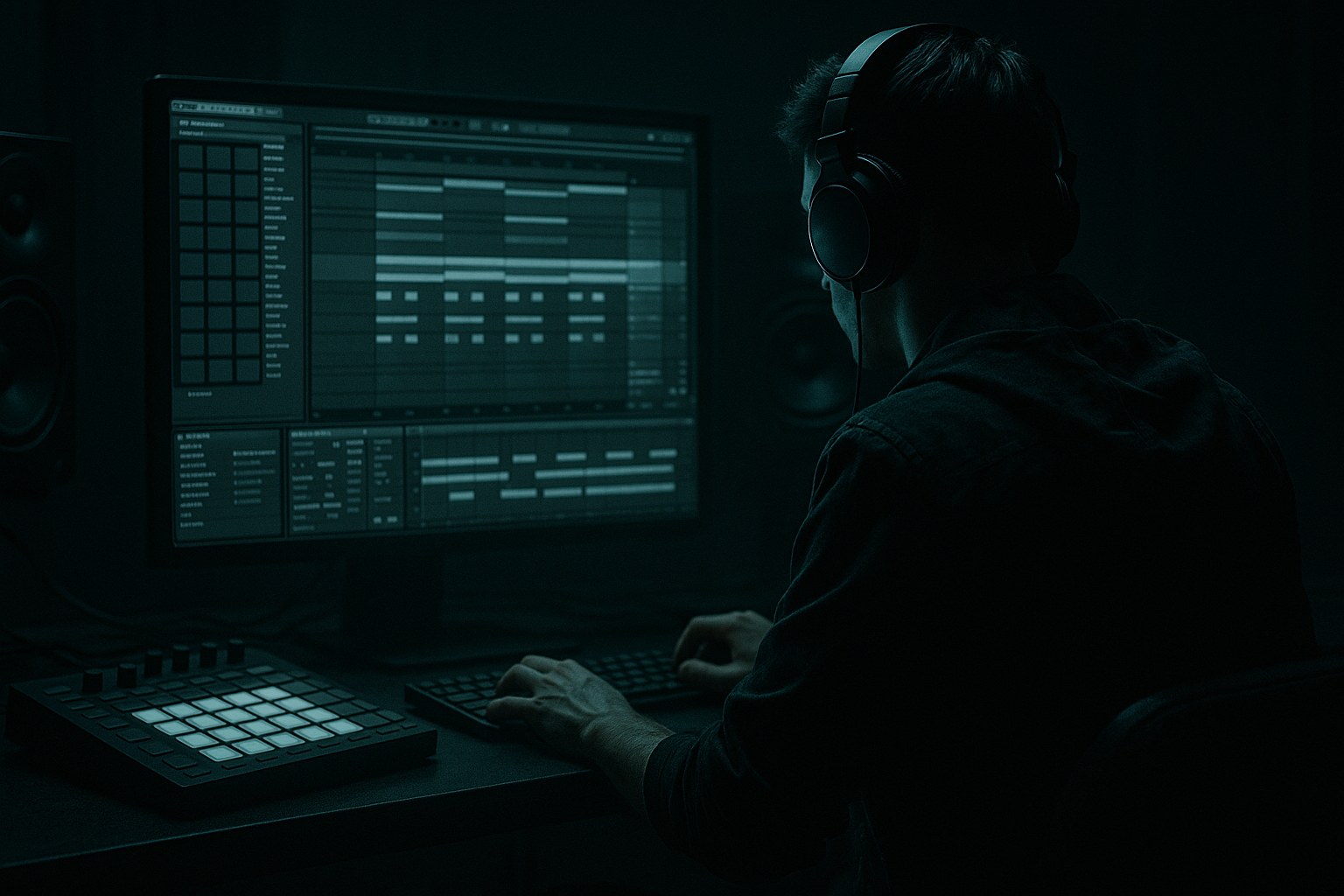
Main tutorial
Lesson Overview
An Amen break is one of the most iconic rhythmic foundations in Drum & Bass, but the raw loop alone rarely creates that deep jungle atmosphere on its own. In this lesson, you’ll learn how to design an Amen-style variation in Ableton Live 12 that feels like it belongs in a moody, dubby, late-night jungle roller: chopped, reshaped, ghosted, and merged with atmosphere so it doesn’t sound like a stock loop pasted on top of a track.
This matters because in deeper jungle and darker DnB, the drum break is not just “the drums” — it’s part groove, part texture, part arrangement device. A strong Amen variation gives you movement across 8 or 16 bars, creates lift into a drop, and keeps the track alive without overcrowding the mix. For mastering-minded production, the real goal is to make the break punch through while leaving enough headroom and spectral space for sub, reese bass, and FX.
We’ll build this in Ableton Live 12 using stock tools only: slicing, warping, drum racks, transient shaping, saturation, automation, and resampling. The result should feel like a deep jungle edit you could use in an intro, a main drop variation, or a switch-up before the second drop.
What You Will Build
By the end, you’ll have:
- A 1–2 bar Amen-style drum pattern with edited kick, snare, ghost hits, and shuffle
- A layered break sound that keeps the character of the original Amen while sounding tighter and more modern
- Atmospheric detail using filtered noise, vinyl-style texture, reverse tails, and reverb throws
- Controlled low-end and transient balance so the drums sit properly against a sub-heavy DnB bassline
- A variation that can move between four distinct feels: intro tension, first drop impact, mid-drop movement, and breakdown suspense
- A 1-bar sub pulse or sustained sub note
- A simple reese or mid-bass layer playing off the drums
- One atmospheric pad or field-recording texture
- A return track with long reverb for throws
- Add a MIDI track for bass and keep it muted at first.
- Add an audio track for your Amen break.
- Drop in a reference loop from a deep jungle or darker roller track if you’re working on a commercial-style arrangement.
- Keep your master peaking conservatively; target around -6 dB headroom while building. That gives you space for mastering decisions later.
- Warp mode: Beats
- Preserve: 1/16 or 1/8 depending on how chopped the break is
- Transients: 25–50 for sharper hits
- Loop length: start with 1 bar, then duplicate to 2 bars
- Option A: Slice to New MIDI Track by transients
- Option B: Keep it as audio and edit warp markers manually
- Strong kick on beat 1
- Snare on beat 2
- Extra snare or rim accent around the “and” of 2 or late 2
- Ghost kick before beat 3
- Snare on beat 4
- A few 16th-note hat fragments and tiny break tails between main hits
- In Drum Rack, group your kick-type slices, snare slices, and hats into color-coded zones.
- Use velocity to control emphasis, not just note placement.
- Keep ghost hits around velocity 20–60.
- Let the main snare hits sit around 90–127 for strong contrast.
- Drum Buss
- EQ Eight
- Saturator
- Utility
- Drive: 5–15%
- Crunch: 0–10% for subtle grit
- Boom: usually off or very low here, since the sub should live elsewhere
- Transients: +5 to +20 for more attack
- Damp: adjust carefully if the top end gets spiky
- High-pass very gently around 25–35 Hz only if needed
- Cut any boxy build-up around 250–450 Hz by 1.5–3 dB
- Add a narrow dip around 6–8 kHz if the break gets splashy or harsh
- If the hats feel dull, a tiny shelf around 10–12 kHz can help, but keep it subtle
- Mode: Analog Clip or Soft Sine
- Drive: 1–4 dB
- Output trim so the level stays controlled
- Width: 100% or less on the break itself if the mix feels too wide
- Bass Mono: not needed here if your sub is separate, but do check overall mono compatibility later
- Vocoder or Erosion for texture movement
- Auto Filter
- Echo
- Reverb
- Utility
- Use a noise sample, vinyl crackle, rain ambience, or a field recording.
- High-pass it aggressively with Auto Filter around 200–500 Hz.
- Automate the cutoff so it breathes across 4 or 8 bars.
- Add Echo with short feedback and a filtered repeat to create depth.
- Put Reverb after Echo for a smeared, ghostly space.
- Auto Filter cutoff: 300–1,500 Hz depending on the texture
- Reverb decay: 2.5–6 seconds
- Reverb pre-delay: 10–30 ms
- Echo feedback: 15–35%
- Echo filter: roll off lows heavily, tame highs if needed
- Create a resample track set to “Resampling”
- Record 4 bars of your edited break with texture layers active
- Consolidate the best 1–2 bars
- Warp and cut the resampled audio again
- Reverse a tiny tail before the snare
- Slice a kick tail and place it just ahead of the snare
- Remove one hat hit to create negative space
- Add a reverb throw to one fill hit only
- Bar 1: more open, fewer ghost notes
- Bar 2: denser, with an extra kick pickup
- Bar 3–4: remove the main snare once for tension
- Bar 5–8: add a fill or half-bar switch before the drop
- a clean sub note
- a reese with movement in the mids
- a short stab bass answering the drums
- Group all drums into a Drum Bus
- Keep sub on its own mono track
- Keep mid-bass on a separate bus
- Sidechain the bass lightly to the kick or the main drum bus using Compressor
- Ratio: 2:1 to 4:1
- Attack: 1–10 ms
- Release: 60–150 ms, tuned to tempo
- Gain reduction: usually 1–4 dB for subtle movement
- Width: 0%
- Keep the fundamental mono
- Check that the sub doesn’t overlap too heavily with the kick if your break has a strong low transient
- Auto Filter cutoff on the atmosphere track opening into the drop
- Drum Buss Drive rising slightly into a fill
- Reverb send increasing on the last snare before a section change
- Echo feedback jumping briefly on one hit for a transition
- Utility width narrowing just before the drop, then opening again
- Bars 1–4: filtered intro with ghosted break elements
- Bars 5–8: full break comes in, bass stays restrained
- Bars 9–12: more ghost notes and a snare pickup
- Bars 13–16: breakdown fill, reverse tail, then drop reset
- Overfilling the break with too many ghost hits
- Making the break too bright
- Letting the break fight the sub
- Quantizing everything perfectly hard
- Using too much reverb on the main snare
- Forgetting arrangement context
- Use subtle distortion on the break bus, not just the bass. A little Drum Buss Drive or Saturator can make the whole rhythm feel more aggressive without adding clutter.
- Layer a very quiet, high-passed metal hit or foley tick on selected snares for underground character. Keep it around 2–6 kHz and barely audible.
- Try a tiny pre-delay on the main atmospheric reverb so the snare stays forward while the space blooms behind it.
- Use short reverse edits before key snare hits to increase tension. In jungle, that “pull” into the hit is huge.
- If the break feels too static, automate velocity or sample volume on alternating ghost notes to simulate a live drummer’s dynamics.
- For a heavier roller feel, reduce some of the high-frequency break fragments and let the midrange snare speak more. Weight often comes from restraint.
- Check mono constantly. Darker DnB often uses width cleverly, but the core kick/snare and sub must remain solid.
- If the mix feels crowded, high-pass the atmosphere harder than you think. You want dread and space, not mud.
- Keep the drum break punchy, ghosted, and evolving
- Protect the sub with clean low-end separation
- Use atmosphere and automation to create jungle depth
- Make every change serve arrangement energy and mix clarity
Musically, this will feel like a dark jungle roller at around 170–174 BPM, with a break that can work under a sustained sub note, a rolling reese, or call-and-response bass stabs. Think: DJ-friendly, hypnotic, and slightly haunted — not over-polished, but definitely precise.
Step-by-Step Walkthrough
1. Set the arrangement context first
Before editing the break, build the space it will live in. Set your project tempo to 172 BPM as a strong middle ground for deep jungle and rollers. Create a basic arrangement reference with:
Why this matters: the Amen variation should be shaped in context, not in isolation. In DnB, the drum edit has to leave room for the bass movement and still read clearly on small speakers. If you design the break without the bass, you’ll often overcompensate with too much top end or too much transient.
Practical Ableton move:
2. Choose or record an Amen source and warp it cleanly
Drag your Amen sample into an audio track. If it’s a clean break loop, switch Warp on and try Beats mode first.
Suggested settings:
If the source has a loose feel and you want more of a classic jungle drift, try Complex Pro very lightly, but for most Amen work, Beats mode gives you the strongest transient identity.
Now do one of two advanced workflows:
For advanced jungle editing, I recommend slicing to Drum Rack if you want flexibility. It lets you individually shape kick, snare, hats, and ghost hits without flattening the groove.
Why this works in DnB: Amen breaks live and die by micro-timing and transient shape. Ableton’s slice workflow preserves the attack while letting you reposition hits against the grid, which is crucial when you’re matching the break to sub and bass phrasing.
3. Build the core Amen pattern in Drum Rack
If you sliced to MIDI, you now have individual break hits mapped across pads. Program a 1-bar groove that is clearly Amen-inspired but not a copy-paste loop.
Try this structure:
You want 3 layers of rhythm:
1. Main anchor hits: kick/snare backbone
2. Ghost notes: low-velocity micro hits
3. Motion layer: hats, chopped tails, and tiny syncopations
Ableton workflow:
Advanced tip: duplicate the one-bar idea into a second bar, then vary it slightly. In dark DnB, a two-bar phrase with one altered snare or kick makes the groove feel like it’s breathing rather than looping mechanically.
4. Tighten the transient balance with stock devices
Now shape the edited break so it punches without getting brittle.
On the Drum Rack track, add:
Suggested Drum Buss settings:
Suggested EQ Eight moves:
Suggested Saturator:
Then use Utility:
Why this works in DnB: the drum break needs midrange punch and transient clarity to compete with aggressive bass design. Drum Buss and light saturation help the break cut through without relying on raw volume, which is essential for mastering headroom.
5. Add deep jungle atmosphere with texture layers
A deep jungle Amen variation rarely sounds finished without atmosphere. Add a second audio track and create a texture bed that sits under or around the break.
Good stock-device chain:
Workflow idea:
Parameter starting points:
Musical context example: if your bassline is a rolling two-note sub pattern, let the atmosphere swell on the off-beats or during the last half of bar 2. That creates a call-and-response relationship between drum detail and ambient space, which is a classic jungle tension move.
6. Create the “amen variation” by resampling and re-cutting
This is where the track becomes yours. Resample your edited break into a new audio track.
Ableton workflow:
Now make variation edits:
This creates a break that feels performed, not programmed.
Advanced variation idea:
Keep the variation musical. Don’t randomize the break — shape it to create momentum.
7. Glue the drums and bass together with routing and sidechain discipline
Now bring in the bass and make sure the break variation supports it, not fights it.
For a deep jungle track, the bass may be:
Suggested routing:
Suggested compressor settings for bass sidechain:
Use Utility on the sub:
Mastering-minded note: the cleaner your drum/bass separation is here, the easier your eventual master will be. You’re not “fixing” the break later — you’re designing it to be mix-ready.
8. Automate for arrangement energy
A true Amen-style jungle variation is an arrangement tool as much as a groove. Automate changes so the pattern evolves over 8 or 16 bars.
Great automation moves:
Structure suggestion:
This keeps the listener locked in and gives DJs clear phrases to mix with.
Common Mistakes
Fix: remove 10–20% of the extra detail. In DnB, negative space is part of the rhythm.
Fix: use EQ Eight to tame 6–10 kHz before boosting anything. Harsh top end becomes tiring fast, especially in dark jungle.
Fix: keep the sub mono, reduce overlapping low transients, and clean up the break below about 80–120 Hz if needed.
Fix: nudge selected hits slightly late or use groove intentionally. A little drag gives jungle its human pressure.
Fix: send selectively, or automate short throws instead of washing the whole pattern.
Fix: always audition the break with bass and atmospheres. Soloed drums can lie to you.
Pro Tips for Darker / Heavier DnB
Mini Practice Exercise
Spend 15 minutes making a two-bar Amen variation:
1. Load one Amen break and slice it to Drum Rack.
2. Program a 1-bar groove with at least one main snare, one ghost snare, one kick pickup, and one hat fragment.
3. Duplicate it to 2 bars and alter exactly 3 hits in bar 2.
4. Add Drum Buss and EQ Eight to tighten the break.
5. Add one atmosphere track with Auto Filter and Reverb.
6. Resample 4 bars and re-edit one fill with a reverse tail.
7. Bounce between solo drums and full mix to check if the break still feels strong against a simple sub note.
Goal: make the variation feel intentional, dark, and DJ-friendly — not busy.
Recap
The key idea is simple: don’t treat the Amen as a loop; treat it as a living drum instrument. Build the variation in context with bass and atmosphere, shape the transients with stock Ableton devices, and use resampling plus small edits to create motion.
Remember these priorities:
If the break feels alive, moody, and controlled, you’ve nailed the deep jungle atmosphere.

