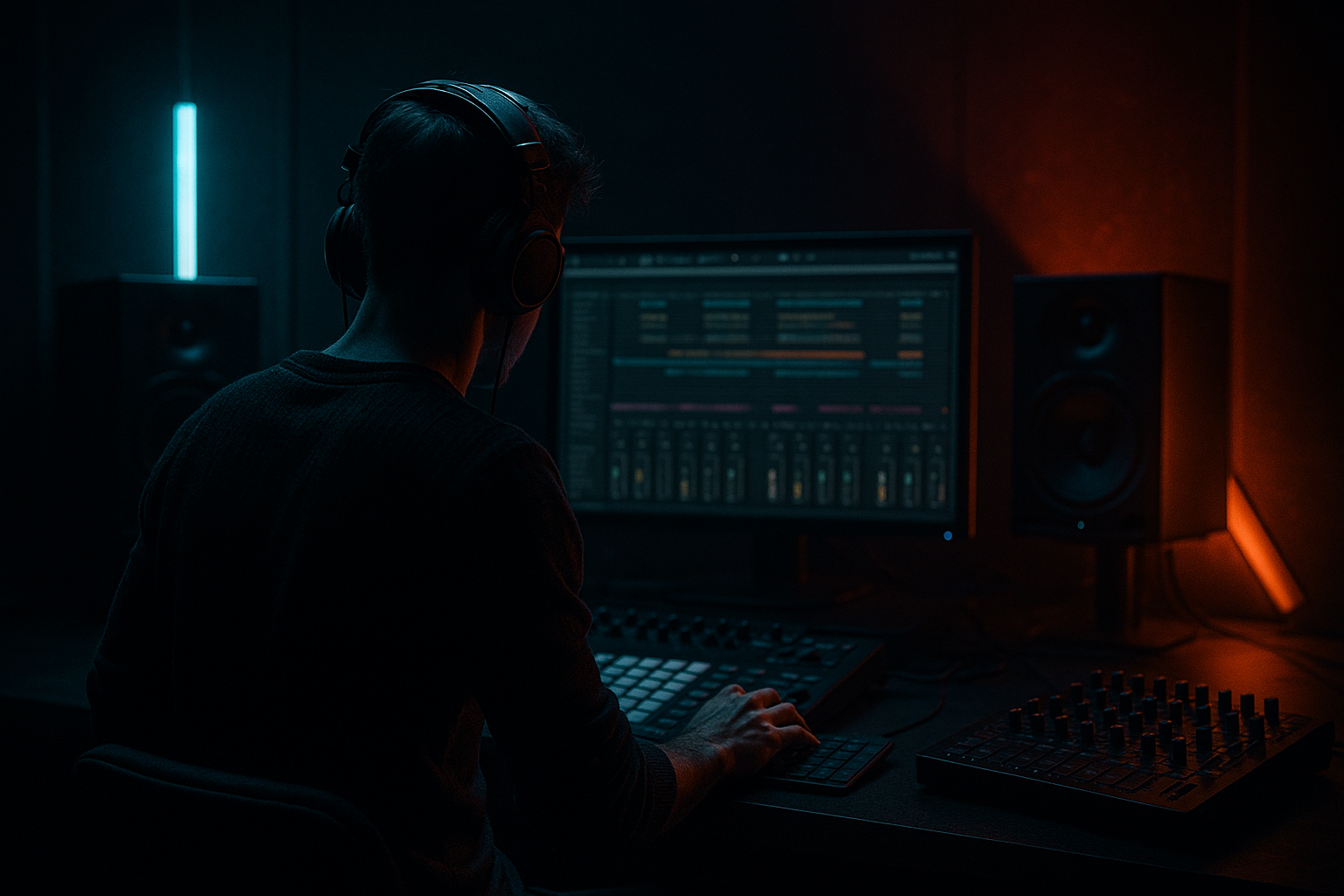
Main tutorial
Designing Crowd Noise Risers (DnB FX) — Ableton Live Advanced Tutorial 🎛️🔊
1. Lesson overview
Crowd-noise risers are one of the most effective “big-room” tension tools in drum & bass: they glue transitions, exaggerate drops, and make minimal sections feel alive. In rolling DnB/jungle, they also help bridge long 16–32 bar phrases without adding melodic clutter.
In this lesson you’ll design crowd-based risers that feel authentic, controlled, and heavy—using Ableton stock devices and a few pro workflows for movement, stereo, and tension shaping.
---
2. What you will build
You’ll create three crowd riser types, all suited to DnB arrangements:
1. Classic Uplifter (8–16 bars): brightening + widening + accelerating energy
2. Tension Suck + Slam (1–2 bars into drop): filtered “vacuum” + impact-ready tail
3. Dark Roller Riser (16–32 bars): gritty, mid-focused, reese-friendly buildup without washing the low end
Each will be built from:
- a crowd/room noise sample (or synthesized noise + impulse space)
- a macro-controlled FX chain
- automation that follows DnB phrasing (8/16/32 bar structure)
- A clean “crowd loop” (festival ambience, crowd cheer, room tone)
- Jungle-friendly alternative: vinyl noise + room impulse (if you want a more “rave tape” vibe)
- HP filter around 120–250 Hz (24 dB/oct)
- Optional dip: 2–4 kHz -2 to -4 dB if harsh
- Optional high shelf: +1 to +3 dB above 8–10 kHz (later you’ll automate brightness with filter)
- Filter type: Lowpass (LP24) for classic uplifter or Bandpass (BP12) for darker
- Resonance: `0.60–1.20` (enough to “speak”)
- Drive: `2–8 dB` (subtle harmonic lift)
- Map Frequency for automation (we’ll automate from low to high)
- Mode: Analog Clip
- Drive: `2–6 dB`
- Soft Clip: ON
- Optional: Color ON, set around `1.5–3.5 kHz` for bite
- Preset-style: start with Tube or Beam
- Dry/Wet: `5–20%`
- Tune/Res: lightly emphasize a band that complements your key (or ignore musical tuning and treat it as texture)
- Algorithm: stock Reverb
- Decay Time: `2.5–8.0 s` (automate longer into the peak)
- Pre-Delay: `10–25 ms` (keeps definition)
- High Cut: `6–10 kHz` (prevents fizzy smear)
- Low Cut: `250–600 Hz` (keeps lows out of the verb)
- Dry/Wet: `10–35%` (automate)
- Start Width: `80–120%`
- Map Width for automation (widen into peak, narrow at drop)
- Default is fine; aim for no more than 1–3 dB reduction
- Double the filter ramp steepness
- Increase Resonance slightly (don’t exceed ~1.4 unless you want a whistle)
- Bars 1–16 (Breakdown / pre-drop): Classic Uplifter slowly building
- Bars 15–16: Add rhythmic gate acceleration + “suck” layer
- Last 1 beat: hard volume dip (or quick mute)
- Drop: crowd instantly disappears or returns very quietly as room tone
- Use shorter 4-bar crowd lifts before an Amen edit or bass switch.
- Combine with a tape stop (not required, but fun) on the master or drum bus—keep crowd separate so you can control the chaos.
- Leaving low end in the crowd: it masks your sub and makes the drop feel weaker. HP aggressively.
- Too much reverb width: crowd becomes a white-noise cloud that fights hats/shakers. Control width with Utility.
- No gain staging: risers creep up and clip. Put a Limiter and automate volume intentionally.
- Linear automation: DnB tension usually needs curved ramps—slow early, steep late.
- Over-resonant filter whistle: resonance too high + bright source = painful peak. Keep it musical.
- Sidechain the crowd to the kick/snare (subtle):
- Make space for the snare:
- Parallel “grit” return:
- Mono the very end (tiny moment):
- Use BP instead of LP for minimal rollers:
- Crowd risers in DnB work best when they’re filtered, automated, and gain-staged—not just “loud noise.”
- Use Auto Filter + Reverb + Utility as your main tension trio.
- Add realism and urgency with gating/sidechain, and use HP/BP approaches for darker rollers.
- Arrange with intention: build over 16 bars, intensify over the last 2, and create a vacuum right before impact.
---
3. Step-by-step walkthrough
A) Source: choose / prep your crowd noise 🎤
Best sources
In Ableton
1. Create an Audio Track: `Crowd Riser`.
2. Drop in a crowd sample (ideally 10–30 seconds, steady texture).
3. In Clip View:
- Warp: ON
- Mode: `Complex Pro` (keeps texture stable when stretching)
- Set Seg. BPM to match your project (DnB typically 170–176).
- If the sample is too “peaky,” reduce Gain by `-6 to -12 dB`.
Goal: a consistent bed of human noise you can sculpt—avoid samples with loud claps/screams unless you want those as accents.
---
B) Build the core device chain (stock) 🔧
On the `Crowd Riser` track, add:
1. EQ Eight
2. Auto Filter
3. Saturator
4. Corpus (optional but powerful)
5. Reverb
6. Utility
7. Limiter (safety)
#### Suggested starting settings
1) EQ Eight (cleanup + focus)
- If your mix is very sub-heavy: push to 300–400 Hz
2) Auto Filter (the “riser” engine)
3) Saturator (energy + density)
Keep it controlled—crowd noise gets nasty fast.
4) Corpus (optional: “arena” character)
This adds a “hollow stadium” tone that reads huge in a club.
5) Reverb (space + lift)
6) Utility (width control)
7) Limiter (just in case)
---
C) Make it move like DnB: automation shape (16-bar example) 🏁
DnB transitions often land every 16 bars, with extra pressure in the last 2 bars and last 1/2 bar.
#### Automation lanes to write (Arrangement View)
1. Auto Filter Frequency:
- Start low: ~`300–800 Hz`
- End high: `12–18 kHz`
- Use a curved ramp (slow rise first 8 bars, faster last 8)
2. Reverb Dry/Wet:
- Start `10–15%`, end `25–40%`
3. Reverb Decay:
- Start `2.5–4s`, end `6–10s`
4. Utility Width:
- Start `80–100%`, end `130–170%`
5. Track Volume:
- Gentle gain staging: rise `+2 to +6 dB` into the peak
- BUT: pull down quickly right before drop to leave headroom for the hit
DnB trick: In the last 1 bar, add a tiny “panic rise”:
---
D) Add “tension acceleration” with rhythmic gating 🧠⚙️
Crowd risers feel more “drop-ready” when they start pulsing.
Method 1: Auto Pan as a gate (stock, fast)
1. Add Auto Pan after Reverb (or before—try both).
2. Set:
- Amount: `100%`
- Shape: Square (or close)
- Phase: `0°` (acts like tremolo/gate)
- Rate: automate from `1/4` → `1/8` → `1/16` in last 4 bars
3. Optional: switch to 1/32 for last 1/2 bar for “machine-gun” tension.
Method 2: Gate with sidechain (more surgical)
1. Add Gate (after Reverb).
2. Enable Sidechain, feed from a ghost MIDI kick or hat pulse track.
3. Set:
- Threshold: so it opens only on hits
- Return: `50–150 ms` to avoid clicks
This locks the riser groove to your roll, like proper modern rollers.
---
E) Create the “suck” (pre-drop vacuum) 🌪️
This is the 1–2 bar moment where the room feels like it’s inhaling.
1. Duplicate your crowd track → `Crowd Suck`.
2. On `Crowd Suck`, use:
- Auto Filter: Highpass (HP24)
- Automate Frequency up aggressively (e.g., `200 Hz → 6–10 kHz`)
- Add Resonance `0.9–1.3`
- Reverb: higher decay, lower dry (more “wash”)
- Utility: narrow width slightly near the end (creates claustrophobia)
Key move: In the last 1/4 bar, automate track volume down sharply (or mute) so the drop hit feels massive.
---
F) Make it darker for rolling DnB (mid-forward, low-safe) 🌑
For deeper rollers, bright crowd noise can fight your hats and reese.
Use Bandpass + distortion emphasis:
1. Auto Filter: BP12
- Start center around `600–1.2 kHz`
- End around `2–4 kHz`
- Resonance `0.7–1.1`
2. Saturator: increase Drive `4–8 dB` (watch harshness)
3. Add Overdrive (optional):
- Freq: `1–2.5 kHz`
- Drive: `10–25%`
- Dry/Wet: `5–15%`
4. EQ Eight:
- Hard HP at `250–450 Hz` (protects sub and kick)
This gives a “warehouse crowd” texture that sits behind the drums instead of sizzling over them.
---
G) Arrangement ideas (DnB phrasing) 🧱
Classic roller structure
Jungle switch-ups
---
4. Common mistakes
---
5. Pro tips for darker/heavier DnB 🧨
Use Compressor sidechain, `Ratio 2:1`, `Attack 5–15 ms`, `Release 80–160 ms`, `1–3 dB` GR. Keeps drums punchy.
On EQ Eight, automate a small dip around your snare crack (often 180–220 Hz body and/or 2–4 kHz crack depending on your snare).
Send crowd to a Return Track with Saturator + EQ + Reverb, then blend. This keeps the main riser controlled while adding aggression.
Automate Utility Width down to `0–30%` right before the drop, then kill the crowd. This makes the drop feel wider by contrast.
Bandpass movement reads as “tension” without adding top-end fizz.
---
6. Mini practice exercise 📝
Goal: Build a 16-bar crowd riser into a 2-bar suck, ready for a 174 BPM roller drop.
1. Pick a crowd sample and loop it to 18 bars total.
2. Build the chain: `EQ Eight → Auto Filter → Saturator → Reverb → Utility → Limiter`.
3. Write automation:
- Bars 1–16: LP frequency `600 Hz → 16 kHz` (curved)
- Bars 13–16: Utility Width `90% → 160%`
- Bars 15–16: Auto Pan gate rate `1/8 → 1/16`
4. Duplicate as “suck” layer for bars 17–18:
- HP `200 Hz → 8 kHz`, more reverb, volume dips to silence right before drop
5. Bounce the riser to audio and check:
- Does it avoid sub buildup?
- Does the last 1 bar feel like acceleration?
- Does the drop hit harder because the riser clears space?
---
7. Recap ✅
If you want, tell me your sub/bass style (liquid, neuro, jump-up, jungle) and your typical drop phrasing, and I’ll suggest a tailored automation curve + chain variant for that lane.

