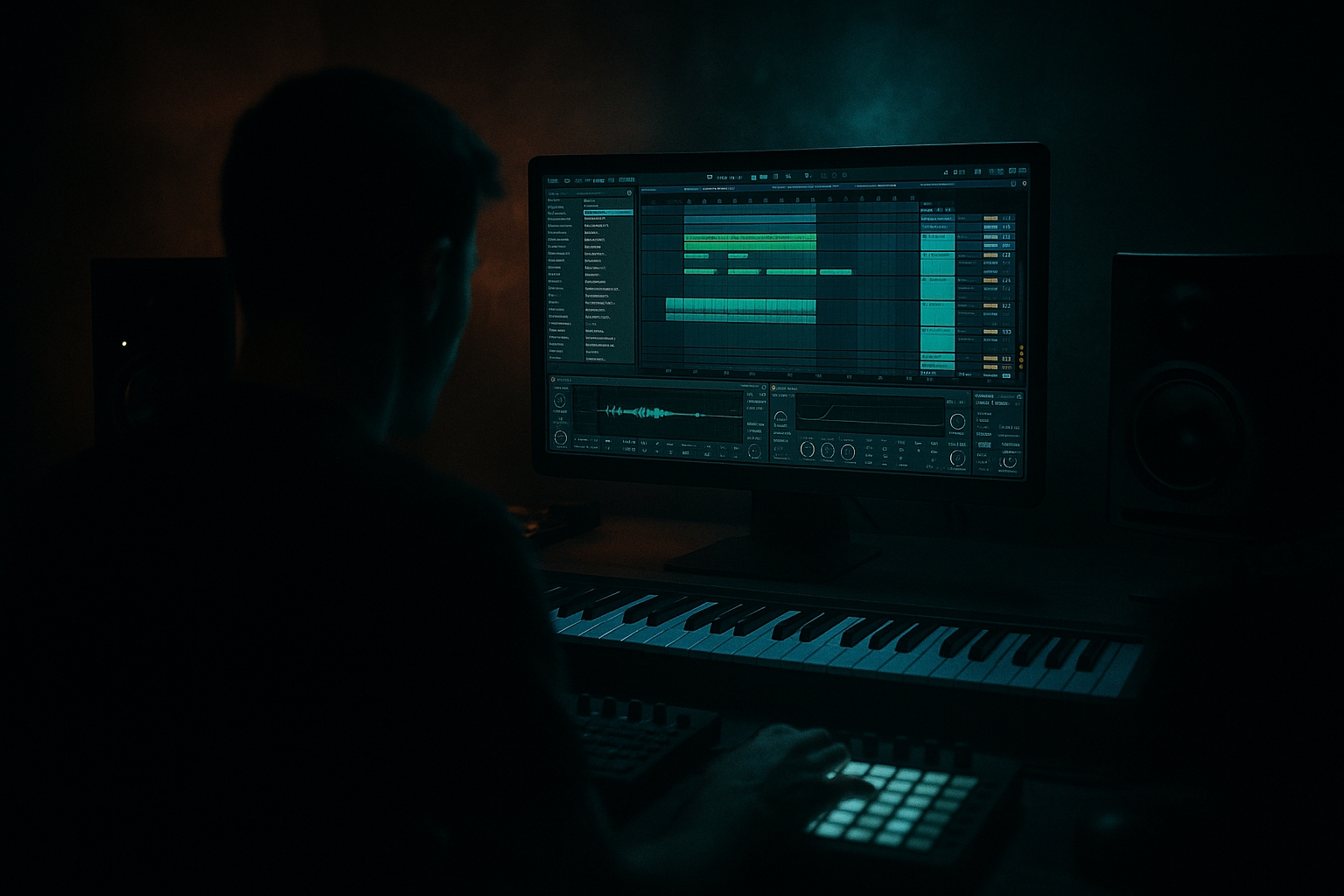
Main tutorial
```markdown
Designing Dusty Shaker Layers (DnB in Ableton Live) 🥁✨
1. Lesson overview
Dusty shaker layers are one of the fastest ways to make a drum & bass groove feel human, rolling, and “lived-in”—especially in jungle-leaning or minimal roller styles. In this lesson you’ll build a 2–3 layer shaker stack that sits behind the drums, adds motion, and stays out of the way of the hats/snare.
You’ll do this using Ableton Live stock devices, with a workflow that’s quick enough to repeat every session.
---
2. What you will build
A DnB-ready dusty shaker bus with:
- Core shaker (tight + steady, provides pulse)
- Dust layer (noisy/lo-fi texture, provides grit)
- Ghost/Flam layer (tiny timing offsets for roll + swing)
- Filtering + transient control
- Saturation for “paper/dust”
- Subtle chorus/width (optional)
- Roomy ambience that doesn’t wash out your break/snare
- Shaker Core
- Shaker Dust
- Shaker Ghost
- Core: -14 dB
- Dust: -20 dB
- Ghost: -18 dB
- Mode: One-Shot
- Warp: Off
- Filter: On
- Pitch: try +2 to +5 st if it feels dull
- Drive: 5–12%
- Crunch: 5–15
- Damp: 6–10 kHz
- Boom: Off (you don’t want low-end inflation here)
- Create a 1-bar MIDI clip.
- Use 1/16 notes, but remove a few to create pockets:
- Velocity:
- Type: BP12 (Bandpass is perfect for “dust”)
- Freq: 2.5–6 kHz
- Res: 0.60–0.90
- Drive (filter drive): 2–5 dB if needed
- Downsample: 2.0–6.0
- Bit Reduction: 0–2 (keep this low; downsample does most of the “dust”)
- Dry/Wet: 15–35%
- Mode: Soft Sine or Analog Clip
- Drive: 2–6 dB
- Soft Clip: On
- Output: trim to match
- Type: BP12
- Freq: ~4 kHz
- LFO: On
- Make a 1-bar clip with 1/32 notes but only in short bursts:
- Add Groove Pool groove:
- Apply to Ghost only, Amount: 30–60%
- Then manually nudge the entire Ghost track +5 to +15 ms late (Track Delay)
- High-pass: 200–500 Hz (steeper if needed)
- Dip harshness if required:
- If it fights vocal air / ride:
- Drive: 5–15%
- Crunch: 10–25
- Transients: -5 to -15 (slightly softer = dustier)
- Damp: 7–10 kHz
- Boom: Off
- Ratio: 2:1
- Attack: 10–30 ms (let the tick through)
- Release: 60–120 ms
- Gain Reduction: 1–3 dB on peaks
- Pre-delay: 0–10 ms
- Decay: 0.3–0.7 s
- High Cut: 6–9 kHz
- Low Cut: 500 Hz+
- Dry/Wet: 6–12%
- Width: 110–140% (only if it’s not clashing)
- If your mix is busy: keep width 100% and instead do movement with subtle level automation.
- Sidechain input: Snare track (or Drum Group Snare chain)
- Ratio: 2:1 to 4:1
- Attack: 1–5 ms
- Release: 60–140 ms
- Aim for 1–4 dB duck on snare hits
- Intro: more dust + more reverb (Dust layer up 1–2 dB)
- Drop: reduce reverb + tighten transient (Transients slightly more positive or reduce Wet)
- Filter open +5% on Dust
- Ghost layer mutes for 2 beats then returns
- Tiny autopan on Dust only (rate 1/8, amount 10–20%)
- Notching 7–9 kHz
- Lowering Core velocities during ride phrases
- Too bright = instant amateur. If shakers are louder than hats, they’ll feel like spray cans. Roll off top and reduce velocity.
- No pocket. Fully quantized 16ths with identical velocity reads as MIDI. Use groove, track delay, and velocity shaping.
- Layering without filtering. If Core + Dust both occupy 6–12 kHz heavily, you’ll get harshness and smear.
- Reverb too long. Long tail reverb turns fast DnB into a fizzy cloud and kills snare definition.
- Over-saturation. Dust is subtle—if it sounds like distortion, you’ve lost the “paper” and gained “fizz.”
- Bandpass the Dust lower (1.8–4.5 kHz) so it feels like grit inside the groove, not airy sparkle.
- Add Corpus very subtly on Dust for metallic/wood resonances:
- Use Erosion (very low) to add controlled digital sand:
- For neuro/tech rollers: transient-tight Core, but keep Dust moving:
- Want that “tape-ish” darkness?
- Core shaker = pulse
- Dust layer = texture (bandpassed + downsampled + saturated)
- Ghost layer = pocket (swing + micro-delay)
- Bus processing = glue + space + mix control
- Sidechain to snare = keeps DnB punch intact
And a bus chain that makes it cohesive:
Target vibe: rolling, slightly crunchy, late-90s tape-ish, but controlled for modern mixdowns.
---
3. Step-by-step walkthrough
Step 0 — Session prep (DnB context)
1. Set tempo to 172–176 BPM.
2. Have a basic drum context playing:
- Kick on 1 and 3 (or your usual pattern)
- Snare on 2 and 4
- Optional: a simple ride/hat pattern so you can hear conflicts
Why: Shakers are supporting actors—design them in-context.
---
Step 1 — Create a 3-track shaker group
Create three MIDI tracks:
Select them → Cmd/Ctrl + G to group → name the group SHAKERS BUS.
Set initial levels:
(You’ll adjust later—these are just safe starting points.)
---
Step 2 — Build the “Core” shaker (tight + controlled)
On Shaker Core, load Simpler (one-shot mode):
1. Drag in a shaker sample (or hat-like shaker). If you don’t have one:
- Use a tight closed-hat sample and treat it like a shaker (works fine in DnB).
Simpler settings (suggested):
- Type: HP24
- Freq: 250–450 Hz (keep lows out)
- Res: 0.20–0.35
Add Drum Buss (stock) after Simpler:
Sequence idea (DnB roller-friendly):
- Start with all 16ths
- Delete steps 4, 8, 12 (classic “breathing” pattern)
- Accents on 1, 5, 9, 13
- Everything else lower (target range: 45–85)
✅ This creates a steady shaker that feels like a hand moving, not a machine.
---
Step 3 — Make it dusty (noise + lo-fi texture layer)
On Shaker Dust, you’ll build a “fuzzed air” layer that’s mostly upper mids, not harsh top.
Option A (fast): Use sample + processing
1. Add Simpler with a noisy shaker, vinyl hat, brushed hat, or even foley (keys, sand, paper).
2. Filter hard so it becomes texture rather than a second hat.
Simpler filter:
Add Redux (stock) after Simpler:
Add Saturator (stock):
Add Auto Filter (optional) for movement:
- Rate: 1/8 or 1/16
- Amount: very subtle (5–12%)
- Phase: 180° (often helps keep it moving without being obvious)
🎯 Goal: you should feel this layer when muted/unmuted, but not “hear a second shaker.”
---
Step 4 — Add the Ghost layer (micro-timing + swing)
On Shaker Ghost, we’re creating the rolling “ch-ch-ch” behind the groove—classic in jungle and liquid rollers.
1. Use Simpler with a similar shaker (or duplicate Core but change pitch).
2. Pitch it slightly:
- -2 to -5 st (often makes it feel woodier and less “hat”)
Sequence:
- Put 1/32 hits leading into snare hits (e.g., last 2–4 hits before beat 2 and 4)
- Example: place hits at 1.4.3–1.4.4 (last 1/16 subdivided into 1/32s) and similarly before beat 4.
Groove & timing:
- Try MPC 16 Swing 55–58 or SP1200 swing style grooves if you have them
- In Live: track’s Delay field (bottom of mixer in Session view / or in arrangement mixer)
✅ Late ghost shakers = instant pocket.
---
Step 5 — Glue it on the SHAKERS BUS (the “dusty layer” sound)
On the SHAKERS BUS group, use this chain:
#### 1) EQ Eight (cleanup)
- 6–9 kHz: -1 to -3 dB (Q ~2)
- Dip 10–12 kHz slightly
#### 2) Drum Buss (glue + dirt)
#### 3) Compressor (tight control)
Use Ableton Compressor:
#### 4) Reverb (tiny room, not a wash) 🌫️
Use Reverb or Hybrid Reverb (Room):
DnB tip: keep shaker reverb shorter than snare reverb. Shakers should “sit”, not “float.”
#### 5) Utility (width management)
---
Step 6 — Sidechain the shaker bus to the snare (space + punch)
Add Compressor on SHAKERS BUS:
This preserves the crack of the snare and stops the shaker layer masking transient detail.
---
Step 7 — Arrangement ideas (make it feel like a record) 🎛️
A) Drop vs. intro contrast
B) 16-bar evolution
Every 16 bars, do one subtle change:
C) Call-and-response with rides
If you have rides on offbeats, thin shakers by:
---
4. Common mistakes
---
5. Pro tips for darker/heavier DnB 🖤
- Mode: Tube or Beam
- Dry/Wet: 3–10%
- Tune: match key-ish (or just by ear until it “locks”)
- Mode: Wide Noise
- Amount: 0.2–1.5
- Frequency: 4–8 kHz
- Core: less groove, more consistent
- Dust: LFO filter movement + subtle autopan
- Saturator (Soft Sine) + EQ Eight high shelf -1 to -3 dB at 10 kHz
---
6. Mini practice exercise (15 minutes) ⏱️
1. Build the 3-layer shaker group as described.
2. Make two versions:
- Version A (Jungle Dust):
- More Dust layer (+2 dB)
- More swing on Ghost (55–60%)
- Slightly darker EQ (dip 10–12 kHz)
- Version B (Modern Roller):
- Tighter Core (less groove, more consistent velocity)
- More sidechain to snare (3–5 dB duck)
- Shorter reverb (0.3–0.5 s)
3. A/B them in the drop with your bass playing:
- Pick the one that keeps the snare loud and the bass clear.
---
7. Recap
You designed a DnB shaker layer system that’s dusty, controlled, and groove-driven:
If you want, tell me your subgenre (jungle, liquid, minimal roller, neuro) and what your main drums are (breaks vs. one-shots), and I’ll tailor a shaker chain + MIDI pattern that fits your exact groove.
```

