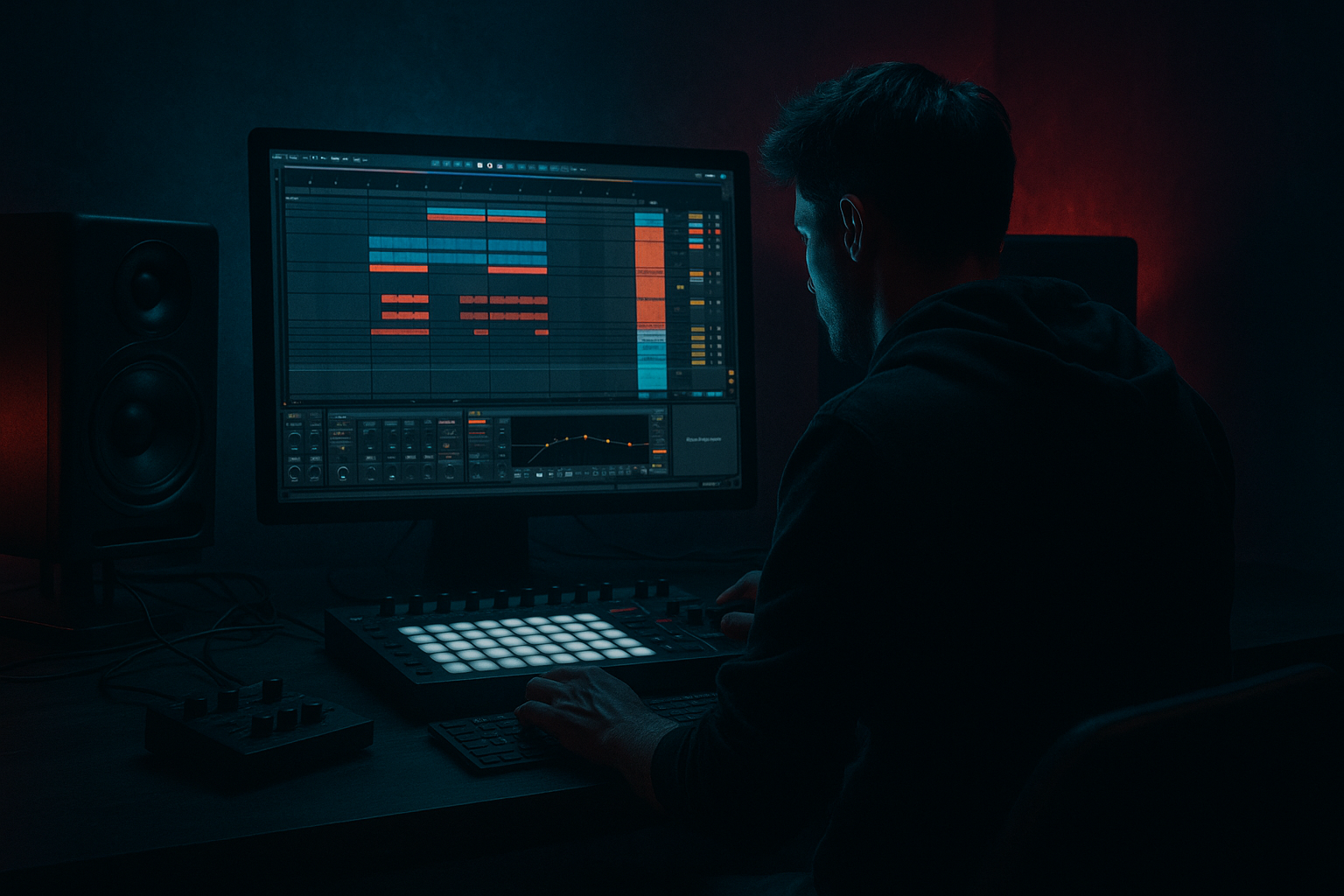
Main tutorial
Designing Memorable Answer Phrases (DnB in Ableton Live) 🔁⚡
1) Lesson overview
In drum & bass, the call-and-response between a main hook (“call”) and a secondary motif (“answer”) is what makes a drop feel conversational rather than repetitive. The answer phrase is the part that replies to your main riff—usually in bars 3–4 (or 7–8) of an 8-bar loop—adding identity, tension, and variation without stealing the spotlight.
In this advanced lesson, you’ll design answer phrases that:
- Feel inevitable (they belong to the hook)
- Add contrast (rhythm, register, timbre, or space)
- Improve arrangement momentum (turn loops into sections)
- Stay mix-safe (don’t sabotage the sub or drums)
- A main bass hook (call) that repeats every 2 bars
- A designed answer phrase that hits in bars 3–4 and evolves again in bars 7–8
- A supporting answer layer (FX/atmo or stab) for extra memorability
- Arrangement automation that makes the answer feel like a “moment” 🎯
- Bass Group: Call chain + Answer chain (shared sub management)
- Answer Bus processing: glue + movement + space control
- A clean arrangement template you can reuse
- Use Wavetable or Operator for the mid bass.
- Keep sub separate.
- 2-bar MIDI, mostly 1/8 notes with a few 1/16 pushes.
- Leave a little space near the end of bar 2 so the answer can land.
- Operator sine (or Wavetable sine), low-pass, mono
- Keep it stable; let the answer happen mostly in the mids/highs.
- Call is steady 1/8 → answer becomes syncopated 1/16, triplet touch, or a short burst.
- Call is mid → answer jumps up an octave (or drops to a reese-ish lower mid).
- Call is smooth → answer is metallic, formanty, noisy, or resampled.
- Call is dry/forward → answer blooms with a controlled verb/delay tail.
- Place after Saturator
- Preset: start from “Pipe” or “Tube”
- Tune to the track key (or near root)
- Dry/Wet: 10–30% (don’t overdo)
- Mode: Ring Mod or Shift (experiment)
- Fine: 5–30 Hz for subtle movement
- Dry/Wet: 10–25%
- Automate Fine slightly during the answer phrase
- Amp: Clean/Blues, Gain modest
- Cabinet: 4x12, Mic off-axis if harsh
- Great for making the answer “speak”
- EQ Eight: carve 250–500 Hz mud, control 2–4 kHz bite
- Utility: Bass Mono ON below ~120 Hz (or keep answer high-passed)
- Slice it, reverse micro bits, and time-stretch for personality.
- Remove MIDI unpredictability and lock the hook.
- Try Complex Pro for tonal stuff (Formants 0–40)
- Try Beats for gritty rhythmic bass (Transient loop, Preserve 30–60)
- Drop hats for 1/2 beat right before the answer (space = impact)
- Add a snare flam or quick jungle ghost fill into the answer
- Add a short ride switch (if call is tight hats, answer gets ride texture)
- Auto Filter: open slightly (e.g., 1.2 kHz → 3–6 kHz) over the bar
- Utility Gain: +0.5 to +1.5 dB only on the answer (tiny, but effective)
- Reverb send: increase on the final note only (use automation)
- Hybrid Reverb (Convolution short room or plate)
- Pre-delay: 10–25 ms
- High-pass in reverb (EQ after): cut below 200–400 Hz
- Keep it subtle; DnB needs punch 🥊
- Use Simpler with a short rave stab / chord hit (or synth it with Wavetable).
- Write it to mirror the answer rhythm but leave space.
- A reverse cymbal into the answer
- A vocal “hey/yeah” micro chop
- A single pitch bend down at the end
- Pitch variation: answer jumps up +3 or +5 semitones briefly
- Rhythm variation: add 1 extra 1/16 at the end (like a stutter)
- Texture variation: introduce noise layer only in bar 7–8
- Wavetable noise osc or Operator noise
- Band-pass with Auto Filter around 2–6 kHz
- Sidechain it hard to the snare for groove
- Sub stays consistent: avoid pitch chaos below ~80–100 Hz.
- Answer mid bass: high-pass around 120–180 Hz if sub is separate.
- Use Spectrum (or EQ Eight visual) to check build-up at 200–400 Hz.
- If answer has reverb/delay, filter the return aggressively.
- Use dissonance tastefully: a minor 2nd or tritone in the answer can sound nasty (in a good way) if it’s brief and rhythmically tight.
- Parallel distortion on the answer only:
- Movement via subtle modulation, not chaos:
- Mono discipline:
- Drum-bass interlock:
- A strong answer phrase is a designed reply, not extra decoration.
- Choose 1–2 contrast axes (rhythm/timbre/register/space).
- Use Ableton stock power tools: Wavetable/Operator, Saturator, Auto Filter, Corpus, Frequency Shifter, Echo, Hybrid Reverb, EQ Eight, Utility.
- Make it memorable with phrasing: space before entry, short motif, repeatable tag, and a bar 7–8 upgrade.
- Keep the low end disciplined and let the answer live where it can shine.
All examples are rooted in rolling / jungle / neuro-ish DnB, inside Ableton Live using stock tools.
---
2) What you will build
You’ll create a 16-bar drop loop with:
Deliverable:
---
3) Step-by-step walkthrough
Step 0 — Set the grid and the “conversation” slots
1. Set tempo: 172–175 BPM (start at 174).
2. In Arrangement View, create a 16-bar loop.
3. Mark these slots with locators:
- Bars 1–2: Call (hook statement)
- Bars 3–4: Answer (reply)
- Bars 5–6: Call (repeat with tiny change)
- Bars 7–8: Answer (bigger variation / payoff)
- Bars 9–16: repeat with arrangement tweaks (drum fills, automation, etc.)
DnB rule of thumb: the answer often feels best as a one-bar idea that “tags” the end of a 2-bar call.
---
Step 1 — Build the call (quick, but solid)
You likely already have a hook. If not, create a simple rolling bass hook:
Instrument (stock-friendly)
Basic call idea
Suggested call chain (Mid Bass track)
1. Wavetable
- Osc 1: Basic Shapes (saw-ish), Unison 2–4, slight detune
2. Saturator
- Drive: 2–6 dB, Soft Clip ON
3. Auto Filter
- 24 dB LP, Envelope amount small for movement
4. EQ Eight
- High-pass around 120–180 Hz (mid bass only)
5. Compressor
- Sidechain from Kick (and/or ghost kick), 2–5 dB GR
Sub track (separate!)
---
Step 2 — Decide what kind of answer you want (choose 1–2 “contrast axes”)
A memorable answer changes one or two of these, not all at once:
A) Rhythm contrast
B) Register contrast
C) Timbre contrast
D) Space contrast
Pick: Rhythm + Timbre (classic rolling DnB move).
---
Step 3 — Design the answer bass (fast method: resample and weaponize)
The best answers often sound like they’re from the same “world” as the call but mutated.
#### 3.1 Duplicate the call sound as your starting DNA
1. Duplicate the mid bass track → rename: MID BASS – ANSWER.
2. In MIDI, write an answer motif in bar 3 (and maybe bar 4).
Keep it short and hooky:
- A “question mark” rhythm: 1/8 + 1/16 + 1/16 + rest
- Or a 1-beat stab repeated with a tiny pitch turn.
Tip: Start the answer on the “and” of 2 or beat 4 to feel like a reply, not a restart.
#### 3.2 Make it noticeably different with a focused chain tweak
Add one of these devices (pick one main “character” device):
Option 1: Corpus (metallic knock / talking edge)
Option 2: Frequency Shifter (neuro grit / movement)
Option 3: Amp + Cabinet (bite and bark)
Then tighten with:
#### 3.3 Resample for “one-shot” memorability (highly recommended) 🎛️
1. Create an Audio Track named `RESAMPLE_ANSWER`.
2. Set its input to Resampling.
3. Record 4–8 bars while you tweak the character device.
4. Pick the best 1-bar chunk → consolidate (Cmd/Ctrl+J).
Now you can:
Warp settings
---
Step 4 — Build “answer phrasing” with arrangement, not just sound
A memorable answer isn’t only a synth patch—it’s how it enters and exits.
#### 4.1 Create a micro “spotlight” in the drums
In bars 3–4 (answer area), do one of these:
Ableton stock tip:
Use Drum Buss on your drum group; automate Drive + Boom slightly up during the answer.
#### 4.2 Automate 2–3 parameters to “frame” the answer
On the Answer Bus (group the answer layers):
Reverb (Return track)
---
Step 5 — Add a second “answer layer” (ear candy that locks the hook)
The most memorable answers often have a non-bass identifier: a stab, vocal chop, or fx shot.
#### 5.1 Create a stab that answers the bass
Stab chain (stock)
1. EQ Eight: high-pass 250–500 Hz
2. Redux (very light): Downsample 2–6, Dry/Wet 5–15%
3. Echo
- Time: 1/8 or dotted 1/8
- Feedback: 15–30%
- Filter: keep lows out
4. Auto Pan (optional)
- Amount 15–30%, Rate 1/2 or 1 bar for gentle movement
Place it only in bars 3–4 and 7–8. This creates anticipation when it disappears.
#### 5.2 Make the answer “signature” with a repeatable tag
Add a tiny recurring detail:
Keep the tag consistent every 8 bars so listeners learn it.
---
Step 6 — Make the answer evolve (bar 7–8 upgrade)
Now we add a “bigger answer” the second time.
Pick one:
Noise layer (stock)
This keeps the hook familiar but rewards attention.
---
Step 7 — Mix discipline: keep the answer big but not messy
Answer phrases can wreck your low end if you’re not careful.
Checklist
A/B quickly:
Toggle Answer Bus ON/OFF. If the drop loses identity when off, it’s a great answer. If the drop becomes cleaner and louder when off, your answer is probably overdesigned.
---
4) Common mistakes
1. Answer is just “more notes”
More density ≠ more memorable. Use contrast and phrasing.
2. Answer fights the sub
If your answer adds low-end movement, it often causes muddiness. Keep sub stable and let the answer live in mids/highs.
3. Too many new sounds at once
If you add a new bass + new stab + new drum fill simultaneously, the ear can’t latch onto the motif.
4. No space before the answer
In DnB, a tiny dropout (even 1/4 beat) makes the answer hit harder than +3 dB ever will.
5. Over-wet effects
Reverb tails can smear drums at 174 BPM. Filter returns and keep them short.
---
5) Pro tips for darker/heavier DnB 🖤
Create a return with Saturator → Overdrive → EQ Eight (high-pass 300 Hz) and send the answer into it. Keeps weight without ruining sub.
Automate Frequency Shifter Fine by tiny amounts (±5–15 Hz) during the answer for unsettling motion.
Use Utility to keep low mids centered if the answer gets wide. Wide reese + wide reverb can collapse the drop.
Make the answer rhythm answer the snare. A classic trick is to place the answer’s main hit right after the snare (or just before it) to create “push-pull.”
---
6) Mini practice exercise (20 minutes) ⏱️
1. Take an 8-bar rolling DnB loop you already have.
2. Create three different answer phrases in bar 3–4:
- Answer A: rhythm contrast only (same sound)
- Answer B: timbre contrast only (Corpus or Frequency Shifter)
- Answer C: space contrast only (Echo + filtered reverb tail)
3. For each answer, do one drum arrangement trick:
- 1/2-beat hat dropout
- Snare ghost fill
- Ride swap
4. Export three quick bounces and listen away from the DAW.
5. Pick the one you can hum or tap back most easily. That’s your keeper.
---
7) Recap
If you share a screenshot of your 8-bar MIDI/audio loop (or describe your call riff), I can suggest 2–3 specific answer rhythms and a device chain tailored to your sub/bass setup.

