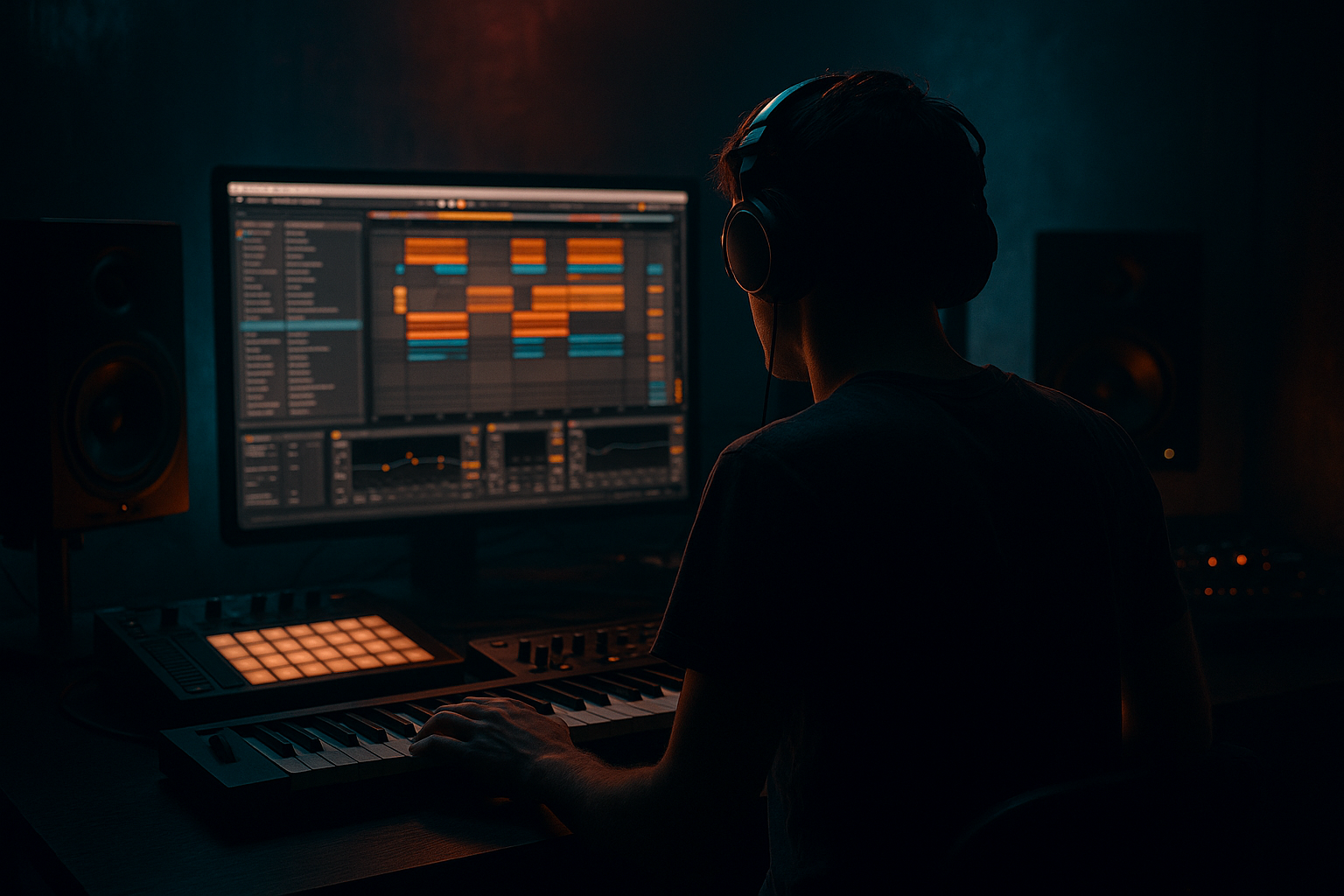
Main tutorial
Designing Synthetic Jungle Claps (Ableton Live) 🥁✨
Skill level: Intermediate • Category: Sound Design • Context: Drum & Bass / Jungle (rolling, punchy, club-ready)
---
1. Lesson overview
Jungle claps aren’t just “a clap sample.” In proper DnB/jungle, the clap often acts like a snare layer—it adds width, brightness, and that classic “hands in a warehouse” snap that cuts through fast breaks.
In this lesson you’ll design synthetic jungle claps from scratch inside Ableton Live using stock devices, then shape them so they sit correctly with breaks and modern DnB drums.
---
2. What you will build
By the end, you’ll have:
- A synthetic jungle clap made from noise + transient + resonant body
- Two variations:
- A ready-to-use Ableton device chain you can save as an Audio Effect Rack 🎛️
- Arrangement-ready tips for placing claps in rolling DnB patterns (2&4, ghost claps, pre-snare push)
- Transient “tick” (for punch)
- Noise “hands” (the main clap texture)
- Body/resonance (to help it feel real + audible on small speakers)
- Add Chorus-Ensemble after Echo or instead of it
- Oscillator A waveform: Sine or Triangle
- Pitch: 2–4 kHz region (either by ear or transpose up several octaves)
- Amp Env:
- Add Saturator:
- HP filter: 150–250 Hz (depends on how much body you added)
- Presence boost: +2 to +4 dB around 3–6 kHz (Q ~0.7–1.2)
- Air shelf: +1 to +3 dB at 9–12 kHz if you want that crisp top ✨
- If harsh: notch 7–8.5 kHz slightly
- Attack: 3 ms
- Release: Auto or 0.1–0.3 s
- Ratio: 2:1
- Aim for 1–3 dB gain reduction on the loudest hits
- Makeup as needed
- Drive: 2–6
- Crunch: 0–10 (tiny amounts go far)
- Transient: +5 to +15 if it needs bite
- Boom: usually OFF for claps, unless you’re doing a very specific effect
- Noise Filter Freq (2–5 kHz range)
- Noise Decay (60–140 ms)
- Echo Time (1/64 ↔ 1/48)
- Echo Amount (Dry/Wet 5–20%)
- Transient Level (Tick chain volume)
- Reverb Amount
- “Darkness” macro: EQ Eight high shelf down / low-pass down
- More Echo (12–18% wet)
- Slight air boost 10–12 kHz
- Reverb short + bright-ish
- Less Echo (5–10% wet)
- Low-pass around 8–10 kHz
- More saturation + slightly shorter decay
- Optional: tiny bit of Redux (very subtle) for grit
- Too long decay/reverb: smears the groove at 170+ BPM and masks hats.
- All top-end, no body: sounds great solo, vanishes in the mix.
- Over-widening: huge stereo can collapse badly in mono; keep an eye on Utility.
- Clap fighting the snare: if both peak in 3–6 kHz, you’ll get harshness—carve space with EQ.
- Echo too loud: turns into audible flam/delay rather than “multi-hand” texture.
- Mid-focused claps hit harder in dark mixes: low-pass around 9 kHz and push 2–4.5 kHz instead.
- Parallel distortion:
- Transient control with Drum Buss: use Transient + for smack, but if it gets clicky, reduce Tick layer instead.
- Stereo discipline: use Utility after the rack:
- Sidechain against the kick (subtle): a touch of compression keyed by the kick can keep the backbeat clean without lowering overall level.
- You built a jungle clap using noise + transient + body, not just “a sample.”
- You used Operator for synthesis, Echo for multi-hand feel, EQ Eight/Glue/Drum Buss for mix power, and short reverb for space.
- You created macro controls to quickly move between classic jungle and modern heavy DnB clap behavior.
- You learned placement tricks (ghost claps, layering with snares) that keep the groove rolling at 170+ BPM.
1) Classic bright jungle clap (wide, crisp, 90s vibe)
2) Modern heavier clap (shorter, darker, more aggressive)
---
3. Step-by-step walkthrough
A) Setup: make a “Clap Synth” track
1. Create a MIDI Track
2. Drop Operator (stock) on it
3. Set tempo to something realistic: 170–174 BPM
4. Create a MIDI clip with hits on beats 2 and 4 (classic DnB backbeat)
We’ll build the clap in three layers inside one rack:
---
B) Build the clap core with Operator (Noise layer)
Goal: a tight burst of filtered noise shaped like hands clapping.
1. In Operator, click Oscillator A
2. Change waveform to Noise White (or a noise type available in your Live version)
3. Turn Filter on:
- Type: BP (Band-Pass) or HP + LP combo if preferred
- If Band-Pass is available:
- Freq: ~ 2.2 kHz
- Res: 0.70 (enough bite, not whistly)
4. Shape the amplitude envelope (Amp Env):
- Attack: 0.5–2 ms
- Decay: 70–120 ms
- Sustain: -inf (0)
- Release: 20–50 ms
This is your “clap hands” burst.
DnB context tip: At 172 BPM, claps must be shorter than you think or they smear across the groove—especially if you’re layering with a snare.
---
C) Add the “multi-hand” illusion (Discrete repeats)
A jungle clap often feels like several hands landing slightly offset.
Option 1: Echo (easy + controllable)
1. Add Echo after Operator
2. Turn Sync ON
3. Settings:
- Time: 1/64 or 1/48 (1/48 adds that shuffle-y human spacing)
- Feedback: 10–18%
- Dry/Wet: 8–15%
- Filter: HP around 800 Hz, LP around 7–9 kHz
4. Keep it subtle—you want “multiple hands,” not an audible delay.
Option 2: Chorus-Ensemble (classic width)
- Amount: 10–25%
- Rate: low (0.2–0.6 Hz)
- Keep it gentle to avoid phasey mono collapse.
---
D) Create a transient “tick” layer (adds punch)
We’ll add a sharp transient so the clap reads clearly over breaks.
1. Create an Audio Effect Rack and put your Operator chain in Chain 1: Noise
2. Duplicate chain → Chain 2: Tick
3. In Chain 2, add a second Operator (or keep same Operator but different settings)
Tick Operator settings:
- Attack: 0 ms
- Decay: 10–25 ms
- Sustain: 0
- Release: 5–20 ms
- Drive: 3–8 dB
- Soft Clip: ON
Mix: Keep Tick chain low. You should miss it when muted, but not “hear a click.”
---
E) Add “body” (resonant smack) so it translates
A clap that’s only noise can disappear on smaller speakers or in dense mixes.
Method: Resonator or short “boxy” tone
1. Add Resonator on the Noise chain (or a 3rd chain called “Body”)
2. Settings (starting point):
- Mode: I or II
- Dry/Wet: 8–18%
- Frequency: 180–260 Hz (lower = weight; higher = papery)
- Decay: 0.2–0.6 s (keep short)
3. Follow with EQ Eight:
- High-pass at 120–160 Hz (24 dB/oct) to avoid sub build-up
- Gentle dip if it gets honky around 400–700 Hz
DnB note: If your snare already has a big 200 Hz body, keep clap-body subtle or push it higher (250–400 Hz) to avoid “cardboard stack.”
---
F) Shape with EQ + compression (make it sit like jungle)
Now we’ll make it mix-ready.
1) EQ Eight (post-rack or inside each chain)
2) Glue Compressor (classic drum buss vibe)
3) Drum Buss (optional, but very DnB-friendly)
---
G) Add space without washing the groove (short reverb trick) 🌌
Jungle claps often have a short, bright space that feels like a room—not a long tail.
1. Add Reverb (or Hybrid Reverb if you like) at the end
2. Starting settings:
- Decay Time: 0.25–0.6 s
- Pre-Delay: 5–18 ms (helps keep the transient punch)
- High Cut: 7–10 kHz (tames fizz)
- Low Cut: 500–900 Hz (keep low-end clean)
- Dry/Wet: 6–14%
3. For extra jungle flavor: add Saturator before reverb (light drive) to “excite” the space.
Alternative (cleaner): Put reverb on a Return track so you can EQ it aggressively and keep control.
---
H) Make two usable clap variants (quick macros)
Turn your rack into something you can tweak fast during a session.
Map these to Macros:
Variant 1: Classic bright jungle clap
Variant 2: Modern heavier clap
---
I) Arrangement ideas (where claps actually work in rolling DnB) 🏃♂️
Try these placements at 172 BPM:
1. Layer with snare on 2 and 4
- Clap adds width + snap, snare adds body + crack.
2. Ghost clap before the snare (push)
- Put a quieter clap at 1/16 before beat 2 (and/or 4)
- Velocity down: 30–50% of the main clap
3. Call/response with breaks
- If you’re using an Amen or thinkbreak, place the clap to reinforce the backbeat while the break fills the in-between.
4. Drop impact
- First bar of the drop: slightly louder clap (or brighter macro) then settle back.
---
4. Common mistakes
---
5. Pro tips for darker/heavier DnB 🖤
- Duplicate the clap track → distort copy with Saturator / Overdrive
- Low-pass distorted copy to 5–7 kHz
- Blend quietly for thickness.
- Try Width 80–110%
- If your mix is heavy, consider keeping the clap slightly narrower than hats.
---
6. Mini practice exercise 🎯
Goal: Create a clap that works with a rolling break + modern kick/snare.
1. Program a 2-step DnB pattern:
- Kick on 1 and the “and” before 3 (typical 2-step vibe)
- Snare on 2 and 4
2. Add a break loop (Amen/think-style) quietly underneath.
3. Build your synthetic clap using this lesson.
4. Make two versions:
- Version A: brighter, wider (classic jungle)
- Version B: darker, tighter (modern)
5. A/B test in the mix at the same loudness:
- Mute/unmute clap
- Check if the backbeat loses energy without it
- Check harshness around 6–10 kHz
Deliverable: Save your rack as “Jungle Clap – Synthetic.adg”.
---
7. Recap
If you tell me what style you’re aiming for (90s jungle, modern neuro-roller, jump-up, etc.) and whether your snare is bright or dark, I can suggest a tailored macro range + EQ targets for your exact mix.

