Main tutorial
1. Lesson Overview
This lesson teaches an intermediate Ableton Live 12 workflow focused on the exact topic: "Digital sub bassline: tighten and arrange in Ableton Live 12 for pirate-radio energy". You will turn a digital low-end patch into a razor-tight, DJ‑style subline that punches through a Drum & Bass mix, then arrange looped stabs, cutouts and lo‑fi moments to evoke pirate‑radio grit. The walkthrough uses Live stock devices (Wavetable/Operator, EQ Eight, Utility, Compressor/Glue, Saturator, Multiband Dynamics, Beat Repeat, Aut Filter, Gate, Limiter) and practical routing tricks so you can reproduce it in your sessions.
2. What You Will Build
- A two-part digital sub bassline (clean mono sub + distorted tonal layer) that sits solidly on the kick.
- Tightening chain to remove muddiness, lock phase and add punch without killing low-end purity.
- An arrangement sketch (16–32 bars) with pirate‑radio energy: tight loops, sudden cutouts, gating, filtered stabs and a short lo‑fi grit transition.
- Template-ready routing: grouped bass with sidechain and macro controls for quick DJ-style automation.
- Over-saturating the sub oscillator: applying full Saturator on the sub chain will create unpredictable resonances and phase issues. Keep saturation on the tone chain only.
- Leaving low frequencies stereo: not using Utility mono below ~120 Hz causes phase cancellation on club systems.
- Excessive sidechain depth: too aggressive ducking kills energy; aim for 3–6 dB gain reduction on sub compressor.
- Using bitcrush on sub: Redux or bit reduction should be on the tone/harmonic layers, never on the clean sub sine.
- Forgetting phase alignment: stacking oscillators without phase control creates inconsistent low-end. Lock phase or use single-voice.
- Not resampling before destructive edits: once you automate destructive effects (heavy Beat Repeat, resampling), keep a clean backup track.
- Mono below 120 Hz: map a Utility Macro to cut stereo width, and automate it to 0% width for club moments.
- Two-track low-end routing: keep the pure sub as audio-only and the tone as an instrument; this makes final mastering and resampling safer.
- Fast transient shaping without plugins: use Compressor with very fast attack and short release to tighten initial sub transient, then parallel blend back more natural sustain.
- Use Group Macros as performance controls: assign Sub Volume, Tone Cutoff, and Tone Distortion to 3 macros for quick pirate‑radio stabs.
- Resample and chop: resample your final bass loop then edit audio to create micro-gated stabs and one-shot edits that are more "radio-scrappy".
- Reference club playback: test on earbuds, small monitors and a sub or car system. Pirate radio energy often fails without a real sub check.
- Split sub (clean mono) and tone (harmonic) for precise control.
- Tighten via envelopes, phase control, fast compression and careful timing/quantization.
- Use sidechain ducking that respects groove (3–6 dB typical on sub).
- Preserve sub purity: saturate harmonics, not the sine.
- Arrange pirate‑radio energy through abrupt cuts, beat-repeat stutters, filter automation and macros for hands-on control.
- Always check mono low end and resample problematic CPU-heavy sections.
3. Step-by-Step Walkthrough
Note: keep the exact topic phrase in mind as you follow: "Digital sub bassline: tighten and arrange in Ableton Live 12 for pirate-radio energy".
A. Setup and sound selection (MIDI track)
1. Create a MIDI track called "Bass - Wavetable" and load Wavetable (or Operator if you prefer pure sine).
- For a digital sub: start with a pure sine (Operator sine or Wavetable with Sine/Morph wavetable) on oscillator 1.
- Set MIDI note range to C1–C2 for sub pitches. Use 32 or 48 sample rate-safe wavetable settings.
2. Add a second MIDI track called "Bass - Tone" and load Wavetable with a slightly brighter waveform (square/triangle/metal wavetable) at low volume for harmonic content. Detune slightly and use single-voice or 2-voice unison but keep stereo spread off.
B. Basic voicing & envelope (tightness)
3. In both instruments, tighten the amplitude envelope:
- Attack: 0–6 ms (near zero for immediate feel).
- Decay: minimal — let MIDI note length handle sustain.
- Sustain: full for continuous sublines but lower for plucked sublines.
- Release: very short (10–30 ms) to prevent bleed after note-offs.
4. Tune oscillator phase for consistency (Operator has Phase knobs). For sub, set consistent start phase or zero to avoid phase jitter against kick.
C. Routing and splitting sub/mid (separation = control)
5. Route both tracks into a Group called "BASS GROUP". Duplicate the Wavetable track (or create return routing) to split low and high content if not using separate tone track.
6. On a return inside the group: set up two chains using Group’s Chain Selector (or simpler: keep two tracks):
- "Sub Chain": Use EQ Eight low-pass (24 dB/oct slope) at ~200 Hz to remove harmonics. Insert Utility and set Width to 0% for mono below.
- "Tone Chain": Use EQ Eight high-pass at ~120 Hz to remove sub energy, then saturate.
D. Tightening chain (stock devices)
7. Sub Chain processing (order matters):
- EQ Eight: low-pass 200 Hz (adjust per patch). Add small bell cut at any boom frequency (e.g., 60–80 Hz) if needed.
- Multiband Dynamics (optional): compress mid/high bands only; keep low band uncompressed or lightly compressed.
- Compressor (for transient control): Ratio 2:1, Attack 0–5 ms, Release ~50–120 ms. Use a slow attack only if you want more transient.
- Utility: Width 0%, make sure phase invert is off.
- Limiter at the end to prevent overs.
8. Tone Chain processing:
- EQ Eight: HP at 120 Hz.
- Saturator: Drive 2–6 dB, choose "Analog Clip" or "Soft Sine" for pleasant harmonics.
- Glue Compressor (or Compressor): Fast attack ~1–5 ms, release 50–150 ms, 2–4 dB gain reduction to glue tone with sub.
- Auto Filter on low resonance with LFO/clip automation for movement. You’ll automate cutoff during arrangement for pirate-radio sweeps.
E. Sidechain & Kick interaction (punch)
9. Create a Kick reference: route the main kick audio to a dedicated track or use the kick sample track as Compressor sidechain source.
10. On the Sub Chain, insert a Compressor with Sidechain enabled:
- Ratio 3:1–6:1, Attack 0–10 ms, Release 80–200 ms. Adjust threshold so the sub ducks clearly on each kick.
- Use the Tone Chain compressor sidechain less aggressively (lower ratio) so tonal harmonics breathe but still yield space.
11. Consider a two-stage ducking: fast compressor on the sub and a slower, gentler duck on the combined group to preserve groove.
F. Tighten with timing and quantization
12. MIDI/Timing:
- Quantize the MIDI sub notes to grid (1/16 or 1/32) to tighten timing — but keep a little human micro-timing if desired.
- Use Groove Pool: apply a DnB swing/groove with small timing strength (10–25%) to match drums.
13. Ghosting & micro-shifts:
- Duplicate the sub MIDI track, nudge the duplicate by 10–20 ms earlier with very low volume to add attack (experiment cautiously to avoid phase issues) or use a sample-based transient.
G. Creative pirate-radio arrangement moves
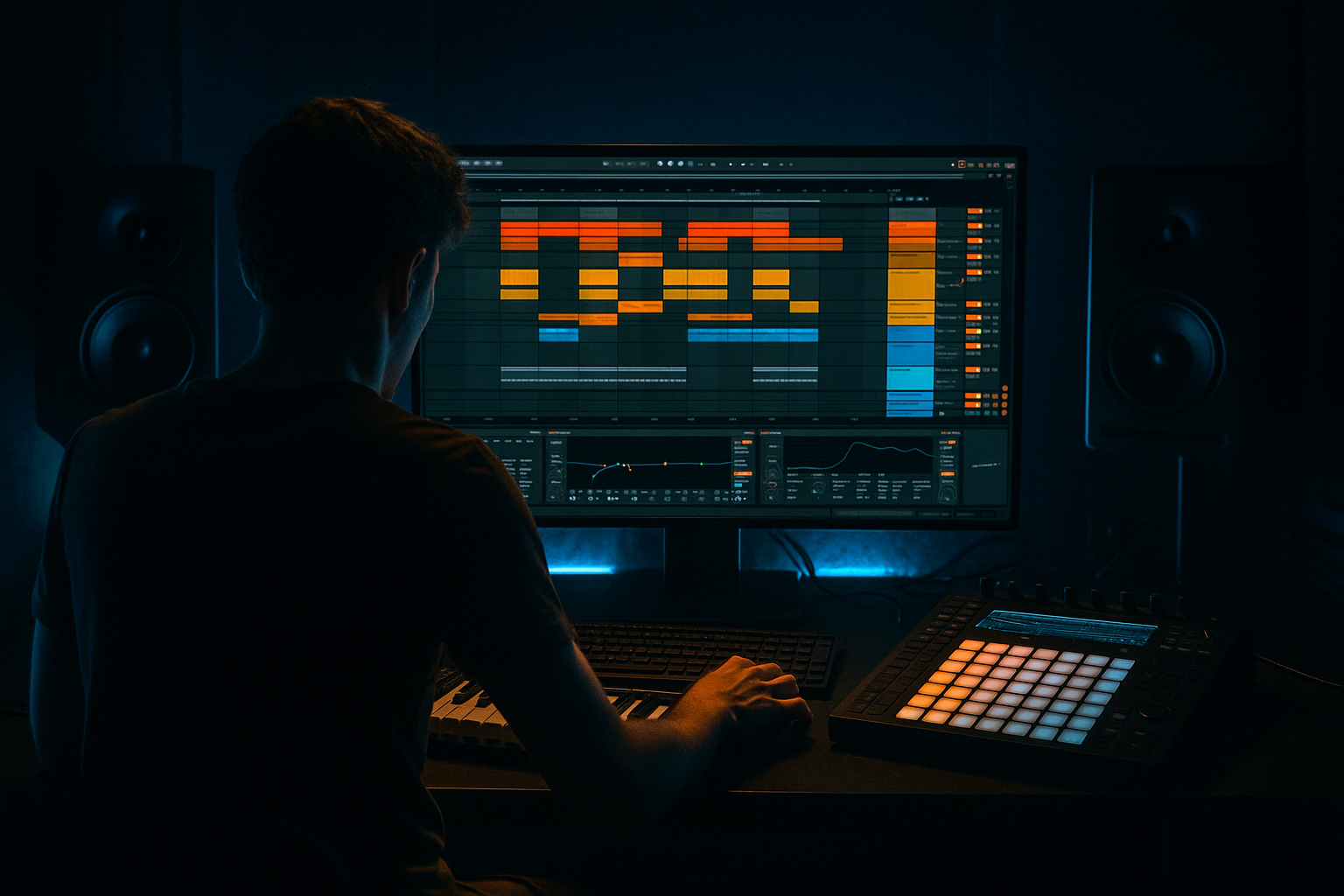
14. Create a 16-bar loop structure in Arrangement View:
- Bars 1–8: Lead loop — sub + tone full, sidechained to kick.
- Bar 9: Half-bar cutout — automate Group Track Volume to -inf with Instant automation (simulate pirate-radio drop).
- Bars 9–12: Introduce a Filtered stutter: duplicate the tone chain and place Beat Repeat on it (Interval 1/16, Grid 1/64, Repeat chance 30–50%) to create lo-fi fragments.
- Bar 13: Tape stop effect via automating Pitch on a resampled clip or use Frequency Shifter and Utility for a pitch-modulated stop (short, 1–2 bars).
- Bars 14–16: Return full bass with an aggressive high-cut bypass (open Auto Filter cutoff) and heavy saturation for energy.
15. Use automation lanes:
- Map Group Macro 1 to Auto Filter cutoff (tone), Macro 2 to Saturator drive (tone), Macro 3 to Sub level (utility gain). Automate macros in arrangement for quick DJ-style moves.
16. Pirate‑radio grit:
- Occasionally apply Redux or subtle Bit Reduction on the tone chain during a four-bar phrase only — keep sub pure.
- Use a low‑pass on the master for a brief period and then snap back to create raggedness.
- Add vinyl noise/short AM‑style EQ wobble (Auto Filter LFO or clip automation) for authenticity.
H. Bounce & finalize
17. Freeze/Flatten group if CPU-heavy; resample a few candidate sections to audio for manual edit/warping.
18. Final low-end check: set Master Limiter to -0.3 dB; use Spectrum and Utility to ensure mono below 120 Hz. Compare with a reference DnB track.
4. Common Mistakes
5. Pro Tips
6. Mini Practice Exercise
Goal: Build a 16-bar sketch that demonstrates a tightened digital subline and a pirate‑radio cut at bar 9.
Steps:
1. Create MIDI Bass - Wavetable. Program a 1-bar loop of C1–F#1 (two-note DnB motif).
2. Duplicate to Bass - Tone (Wavetable with square-ish wavetable). High-pass tone at 120 Hz.
3. On Sub track: EQ Eight LP @200 Hz -> Compressor (sidechain to a kick track) with Ratio 4:1, Attack 3 ms, Release 120 ms -> Utility width 0%.
4. On Tone track: Saturator Drive 3 dB -> Glue Compressor 2 dB gain reduction -> Auto Filter with cutoff macro-mapped.
5. Group them. Map Macro 1 = Sub Volume, Macro 2 = Tone Cutoff, Macro 3 = Tone Drive.
6. Arrange bars 1–8 normal. At bar 9, automate Macro 1 to -inf for an instant cut. Bars 9–12: enable Beat Repeat on Tone (short interval). Bars 13–16: snap macros back and increase Saturator for extra energy.
7. Bounce the 16-bar loop to audio and compare with a reference breakbeat loop. Listen on headphones and a monitor with sub if possible.
7. Recap
You’ve followed a focused Ableton Live 12 workflow addressing "Digital sub bassline: tighten and arrange in Ableton Live 12 for pirate-radio energy". The key takeaways:
Apply the mini exercise until you can produce a tight 16-bar sketch quickly; map three macros and you’ll be able to perform pirate‑radio style drops live or automate them across your arrangement.

