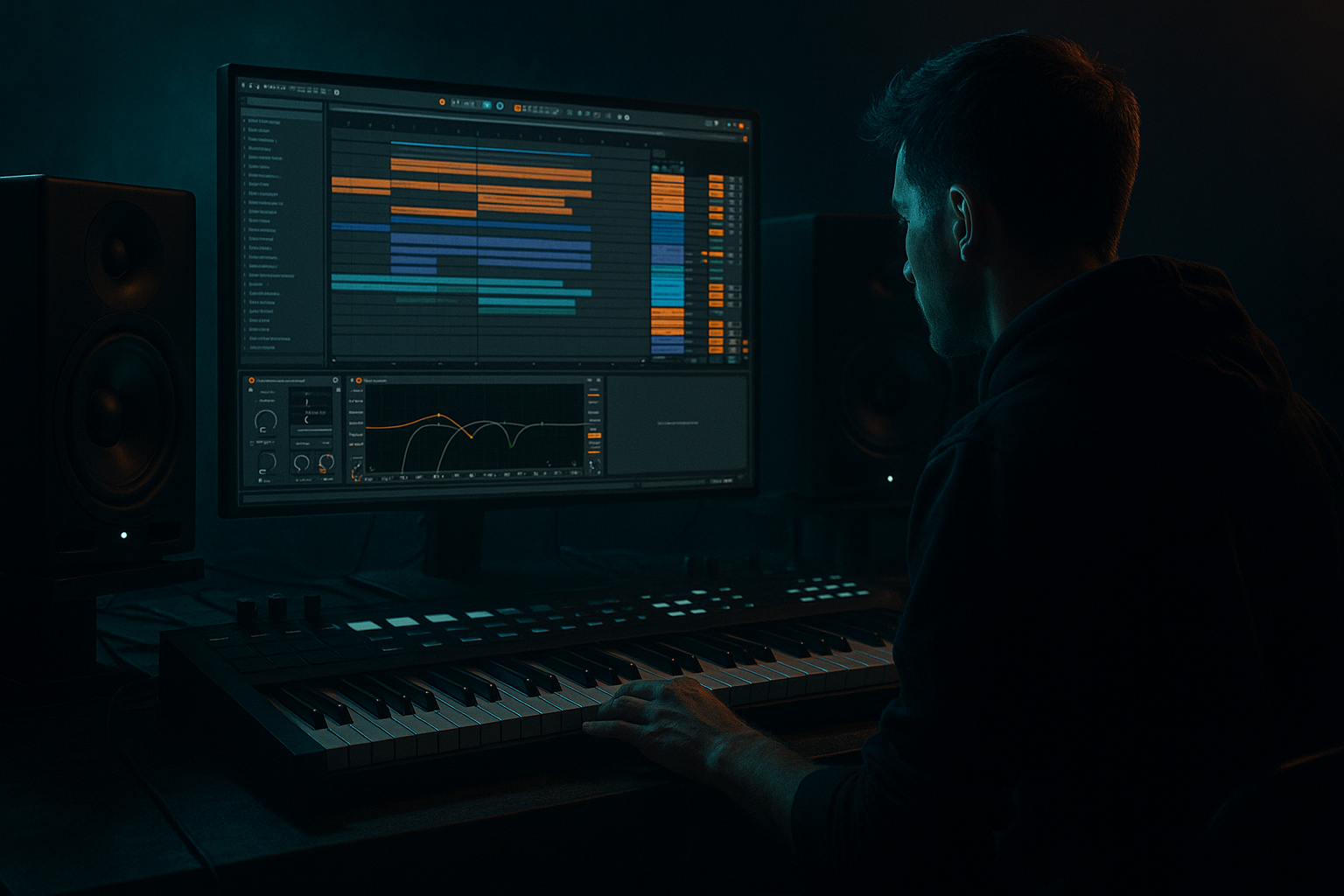
Main tutorial
Lesson Overview
In this lesson, you’ll learn how to take a simple top loop and turn it into a gritty, DJ-friendly riser section that feels right at home in jungle, oldskool DnB, rollers, or darker bass music. The focus is not just on “making it distorted” — it’s on shaping tension in a way that helps the track move forward like a proper DnB arrangement.
A top loop in DnB usually carries hats, shakers, cymbals, and upper percussion. When you distort and automate that loop carefully, it can become a transition tool: a build into the drop, a switch-up before the second eight, or a tension layer that keeps the listener engaged during a breakdown. This matters because DnB arrangement is all about momentum. Even simple loops can become powerful when they evolve with automation, filtering, saturation, and DJ-friendly phrasing.
Why this technique matters in DnB:
- It creates energy without adding too many new sounds
- It helps your track feel structured and mix-ready
- It adds oldskool grit and urgency
- It gives your intro, breakdown, or pre-drop section a clear rise in intensity
- It works especially well when paired with breaks, reese basses, and sub drops
- A top loop that begins with light movement and space
- Gradual distortion and saturation to add edge
- Filtering and automation that create a clear rise in tension
- A controlled stereo image so the loop stays punchy and club-safe
- A riser phrase that can lead into a drop, fill, or bass switch-up
- An arrangement-ready section that works in a jungle or oldskool DnB context
- Overdistorting too early
- Leaving too much low end in the loop
- Making the riser too wide and messy
- Using too much Echo feedback
- Forgetting arrangement context
- Pushing volume instead of tension
- Try putting a tiny amount of overdrive before the filter so the loop gets more aggressive as the cutoff opens.
- Use Drum Buss with subtle Crunch for a dirtier, more underground feel without destroying the transients.
- Automate a small EQ Eight high-shelf lift only in the final bar if the riser needs extra urgency.
- Layer a very short snare roll underneath the top loop if you want more classic jungle energy.
- If the track is neuro-influenced, keep the riser more controlled and mechanical; if it’s oldskool jungle, let it feel rougher and more chopped.
- Resample the final bar and edit it by hand for a more human, less predictable transition.
- Keep the sub and kick completely out of the riser section unless you intentionally want a full pre-drop build.
- Use reference tracks: compare your build to a jungle intro or roller breakdown and notice how much space is left before the drop.
- A distorted top loop can become a powerful DnB riser when shaped with EQ, saturation, filtering, and automation.
- Keep it DJ-friendly by building in 4-bar or 8-bar phrases.
- Use Ableton stock devices like EQ Eight, Saturator, Auto Filter, Drum Buss, Echo, and Utility.
- High-pass the loop, automate tension upward, and keep the low end clear for the drop.
- For jungle and oldskool vibes, let the loop feel slightly raw, chopped, and energetic.
- The best risers don’t just get louder — they create a clear sense of movement and release.
We’ll use Ableton Live 12 stock devices only, keeping the workflow beginner-friendly but still authentic to real jungle/DnB production. 🥁
What You Will Build
You’ll build a distorted top-loop riser that starts clean and narrow, then becomes more aggressive, bright, and tense over 4 or 8 bars. The finished sound will feel like a DJ-friendly transition element rather than just a random effect.
Specifically, you’ll create:
Musically, think of this as the kind of tension you’d hear before a breakbeat drop comes back in, or before a bassline re-enters after an 8-bar breakdown. It should feel like the loop is climbing, not just getting louder.
Step-by-Step Walkthrough
1. Start with a strong top loop and place it on the grid
Drag a top loop into an audio track in Ableton Live 12. For this lesson, use a loop that mainly contains hi-hats, ride hits, shakers, or chopped percussion — ideally something around 1 to 2 bars long.
Good starting point:
- A loop with a clear transient pattern
- Not too much kick or sub content
- A loop that already has some swing or break feel
If needed, set the clip warp mode to Complex or Beats depending on the source:
- Beats works well for rhythmic drum loops
- Complex can be better for textured percussion
Make sure the loop is quantized to the bar grid so your riser can fit into a DJ-friendly 4-bar or 8-bar structure. In DnB, clean phrasing matters because transitions need to land hard and predictably.
2. Shape the loop with EQ Eight before adding distortion
Before you distort, clean up the loop so the effect works on the useful parts of the sound.
Add EQ Eight first in the chain and try:
- High-pass filter around 180–300 Hz to remove low-mid clutter
- A gentle dip around 300–600 Hz if the loop feels boxy
- A small boost around 6–10 kHz if the loop needs extra air later
The goal is to keep the riser focused on the top end. In DnB, low-end separation is everything. You do not want your riser fighting the kick and sub when the drop arrives.
Why this works in DnB: top-loop risers should add excitement without muddying the mix. By clearing the low end first, the distortion stays crisp and more musical.
3. Add Saturator for controlled grit
Insert Saturator after EQ Eight. This is your first distortion stage, and it’s a great beginner-friendly way to introduce harmonic bite without wrecking the loop.
Good starting settings:
- Drive: 3 to 8 dB
- Soft Clip: On
- Output: reduce to match levels after adding drive
- Curve Type: Analog Clip or Soft Sine, depending on the tone you want
Automate the Drive over 4 or 8 bars so the loop slowly becomes more aggressive. For example:
- Bar 1: 3 dB
- Bar 2: 5 dB
- Bar 3: 7 dB
- Bar 4: 8 dB or slightly more, depending on taste
If your loop starts sounding harsh too soon, reduce the drive and use automation more gradually. The point is tension, not distortion for its own sake.
4. Add Auto Filter to create a rising motion
Place Auto Filter after Saturator, or before it if you want the filter movement to hit the distortion differently. For a beginner, try Auto Filter after Saturator first.
Use a High-Pass filter and automate the cutoff upward:
- Start around 200–400 Hz
- End around 2–6 kHz
- Resonance: 10% to 25%
- Drive: small amount only if needed
Automating the cutoff gives you a classic riser shape. As the filter opens, the loop gets brighter and thinner in a way that naturally builds tension.
For oldskool jungle vibes, don’t make it too smooth. Let the top loop feel slightly raw and mechanical. The roughness is part of the style.
5. Add Drum Buss for punch and controlled aggression
Now add Drum Buss to give the loop some weight and glue. Even though it’s called Drum Buss, it works really well on top loops and transition elements.
Try these starting settings:
- Drive: 5 to 15%
- Crunch: low, around 5 to 20%
- Transients: +5 to +20 if you want more snap
- Damp: adjust if the top end gets too sharp
- Boom: usually off or very subtle for this lesson
If the loop feels too thin after filtering, Drum Buss can restore impact and make the distortion feel more physical. This is especially useful in DnB where drums need to hit hard even in a transitional section.
Keep an eye on gain staging. If the loop gets too loud, reduce output or use the Utility device later to keep headroom.
6. Automate a DJ-friendly 4-bar or 8-bar structure
This is where the lesson becomes truly useful for arranging.
Create a 4-bar or 8-bar riser phrase and automate these main controls:
- Saturator Drive: steadily up
- Auto Filter Cutoff: steadily up
- Drum Buss Drive or Transients: slightly up
- Volume or Utility Gain: very small lift if needed
A simple beginner-friendly structure:
- Bars 1–2: mostly clean, filter low, mild saturation
- Bars 3–4: more drive, more filter opening, more brightness
- Final beat before the drop: strongest intensity, maybe a tiny pause or fill
In DnB, DJ-friendly structure usually means 4-bar and 8-bar phrasing that’s easy to mix and easy to follow. If you’re building a riser before a drop, make it line up with the phrase so the tension lands exactly where the drums or bass re-enter.
Arrangement example:
- 8 bars of breakdown
- 4-bar riser made from the top loop
- 1-bar drum fill
- drop on the next downbeat
7. Add Echo for movement and space, but keep it tight
Add Echo near the end of the chain if you want the loop to feel wider and more atmospheric before the drop. Use it carefully so it enhances the riser instead of smearing it.
Start with:
- Delay Time: 1/8 or 1/16
- Feedback: 10% to 30%
- Filter inside Echo: high-pass the repeats so they stay out of the low-mids
- Dry/Wet: 5% to 20%
For a darker DnB feel, automate the feedback slightly upward in the last bar. This gives the loop a sense of tail and motion without filling up the whole mix.
If the Echo makes the groove too messy, shorten the feedback and reduce the wet amount. The top loop still needs to feel rhythmically tight enough for a club mix.
8. Make it more “oldskool” by resampling or adding clip-level variation
If you want that jungle-style character, you can resample the processed loop into a new audio clip and make a few simple edits.
Ways to do this in Ableton:
- Freeze and Flatten the track
- Record the processed output onto a new audio track
- Chop the resampled audio into small pieces and rearrange them
This is useful because oldskool DnB often feels more like edited audio than perfectly polished loop playback. You can create a stutter on the last half-beat, mute one hit, or repeat the final two hits for extra tension.
Beginner-friendly edit ideas:
- Duplicate the last hat hit
- Silence one beat before the drop
- Reverse a tiny slice for a suction-like lead-in
- Cut the clip so the last transient lands exactly on the next downbeat
This gives the riser more personality and makes the transition feel produced rather than automated only.
9. Check the mix in mono and balance against the drums and bass
Use Utility on the top loop or on the group to keep stereo under control. A riser can get wide, but it should not destabilize the mix.
Good checks:
- Turn on Mono briefly to hear if the loop still works
- Keep the riser mostly above the low-mid area
- Compare the loudness of the riser against the kick, snare, and bass drop
If the loop gets harsh around 7–10 kHz, use EQ Eight with a gentle dip or lower the filter cutoff end point slightly. If it feels weak, add a touch more Saturator or Drum Buss instead of simply turning it up.
In DnB, clarity during the buildup matters because the drop needs room to hit hard. A clean riser can make your bassline feel bigger by contrast.
10. Add a final transition hit or silence for impact
Before the drop, use one final move to make the phrase land. This could be:
- A short silence on the last 1/8 note
- A reversed hat or cymbal hit
- A snare fill from the break loop
- A short impact layered underneath
For a DJ-friendly DnB arrangement, a tiny gap can be very effective if the next section hits cleanly. Alternatively, a full fill can make the drop feel more explosive. Choose one based on the energy of your track.
The key is contrast: the riser should build, then the drop should snap into place. If everything is loud all the time, the listener stops feeling the rise.
Common Mistakes
Fix: lower Saturator Drive and automate it gradually instead of starting at full intensity.
Fix: high-pass with EQ Eight around 180–300 Hz so the riser doesn’t fight the sub and kick.
Fix: reduce stereo effects, use Utility to tighten width, and check in mono.
Fix: lower feedback to 10–30% and keep the delay subtle.
Fix: build the riser in 4-bar or 8-bar phrases so it supports the drop, not random timing.
Fix: automate filter, saturation, and small movement first; volume should be the last gentle adjustment.
Pro Tips for Darker / Heavier DnB
Mini Practice Exercise
Spend 10–20 minutes building one riser phrase from a top loop.
1. Pick a 1-bar or 2-bar top loop.
2. Add EQ Eight, Saturator, Auto Filter, and Drum Buss.
3. Automate the filter cutoff rising over 4 bars.
4. Increase Saturator Drive from subtle to medium.
5. Add a small Echo tail in the last bar.
6. Duplicate the section and make a second version:
- Version A: cleaner, more oldskool
- Version B: harsher, more distorted
7. Place each version before a drop or drum fill and listen to which one creates better tension.
Goal: finish with two usable risers you can save into your project templates or sample library.

