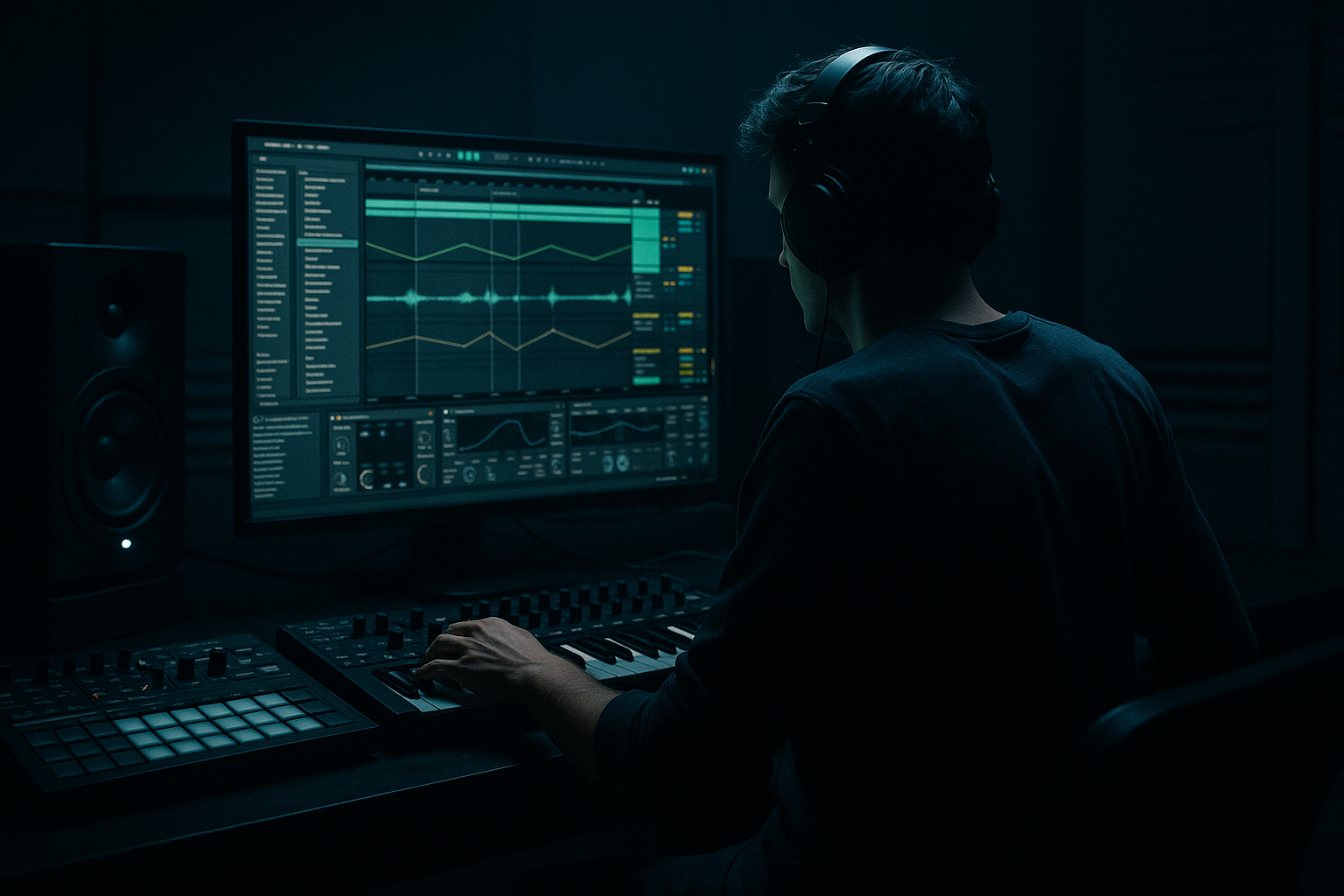
Main tutorial
Distort an Amen-style 808 tail for ragga-infused chaos in Ableton Live 12
1) Lesson overview
In this lesson, you’ll learn how to take the tail of an 808-style kick that sits inside an Amen-break-inspired drum pattern and turn it into a wild, ragga-flavoured automation moment for drum and bass/jungle. The goal is not just “more distortion” — it’s to build a controlled ramp of chaos that adds tension, attitude, and motion without wrecking the drop.
This is a very useful technique for:
- Breakdown-to-drop transitions
- Fill moments before a bar change
- Dubwise ragga call-and-response sections
- Dark roller variations
- Jungle edit energy with a broken-up, saturated low-end tail
- An Amen-style drum loop with an 808 kick tail
- A distortion chain on the tail only, or mostly on the tail
- Automated movement across:
- A short ragga-infused chaos fill that sounds like it’s about to tear open the arrangement
- An Amen break loop
- A separate 808 kick sample or a layered kick with a long tail
- Warp it cleanly if needed
- Set the clip to loop
- Keep the break rhythmic and punchy
- Make sure the kick transient inside the break is not clipping
- Put it on a separate track
- Align the kick so it reinforces a strong beat in the bar, usually beat 1
- Choose an 808 with a long, low tail rather than a short punchy kick
- Amen track peak: around -10 to -6 dB
- 808 kick track peak: around -12 to -8 dB
- Master headroom: keep at least 6 dB free
- Open the sample in the clip view
- Adjust Gain/Volume so the tail is audible
- Use Clip Envelope if needed to extend or shape the tail region
- Activate a high-pass filter at 25–35 Hz
- Cut any muddy buildup around 180–350 Hz if the tail gets boxy
- If the tail needs bite, add a small boost around 700 Hz–1.5 kHz
- If it becomes too harsh, tame 3–6 kHz
- Distortion exaggerates everything
- Cleaning the signal first gives you a more deliberate sound
- The sub stays controlled, which is important in DnB where the kick and bass already fight for space
- Drive: +3 to +8 dB
- Soft Clip: ON
- Output: lower as needed to match level
- Try Analog Clip or Soft Sine curve if you want smoother grit
- Start around +2 dB
- Push to +8 or +12 dB in the last 1/4 bar
- This creates a rising intensity that feels like a dub delay send turning into a speaker-rattling hit
- Drive: 10–35%
- Boom: use carefully; too much will swamp the mix
- Transient: slightly positive if you want the attack to cut
- Crunch: small to medium amount
- Damp: adjust to keep the top end from getting spitty
- Great for aggressive, animated saturation
- Try a parallel-style setup inside Roar if needed
- Automate Amount / Drive / Tone / Feedback for evolving chaos
- Cutoff
- Resonance
- Filter Type: Low-pass, band-pass, or notch
- Low-pass filter with cutoff around 200 Hz to 2 kHz
- Resonance around 0.7 to 1.4
- Automate the cutoff upward for a rising, screaming tail
- Or automate it downward for a collapsing, choking effect
- Try a band-pass sweep over the distorted tail
- This creates a vocal-ish, dubby formant flavour that works well in jungle edits
- Gain: automate a short boost into the tail
- Width: keep low frequencies narrow, but widen the distorted mids/highs if desired
- Mono toggle can be used if you want the tail to collapse into the center for a more brutal finish
- Keep the main low-end tail mostly mono
- Only widen the distorted upper harmonics
- That preserves club translation while still sounding huge
- Decay: 0.8–2.5 s
- Pre-delay: 10–25 ms
- Low Cut: 200 Hz or higher
- High Cut: 5–8 kHz
- Time: 1/8 or dotted 1/8
- Feedback: 15–35%
- Filter: high-pass the repeats a bit
- Add some Modulation for movement
- Bar 1: clean break + subtle 808 support
- Bar 2: slightly more Saturator drive
- Bar 3: increase filter resonance and Drum Buss crunch
- Bar 4: full chaos automation on the final kick tail
- Saturator Drive rises
- Auto Filter Cutoff opens or closes dramatically
- Drum Buss Crunch increases
- Utility Gain rises briefly
- Reverb/Echo send increases on the last hit
- Subtle for 3 beats
- More extreme on the “and” of 4
- Maximum on the final kick tail
- Instantly pulled back before the drop lands, unless you want the whole section to explode
- Clip volume dips and boosts
- Filter cutoff on the clip
- Device parameter automation confined to that clip
- Lets you commit the sound
- Frees CPU
- Makes it easier to chop the tail into new edits
- Gives you a sampled-jungle feel
- Dry path keeps the punch
- Wet path brings the filth
- a short noise burst
- a reversed cymbal
- a sub stab
- a vocal shout sample
- Filter closes quickly
- Distortion rises
- Width collapses to mono
- Reverb spikes at the last moment
- Add Compressor with sidechain from the main kick
- Or use Glue Compressor gently
- Keep the tail powerful, but not permanently masking the groove
- Subtle
- Medium
- Unhinged
- subtle in verse
- medium in build
- unhinged in transition
- Keep the first half clean
- Make the second half more distorted
- End with a sudden mono collapse
- Then slam into a full drop
- Does the automation feel like a phrase?
- Does the tail still hit hard?
- Is the sub controlled?
- Does it sound like jungle/DnB, not just generic distortion?
- Clean the source first with EQ Eight
- Use Saturator, Drum Buss, or Roar to build intensity
- Shape the motion with Auto Filter
- Control space and width with Utility, Reverb, and Echo
- Automate across the last beat or last bar of a phrase
- Resample the result to turn it into new jungle material
- a midi/audio track template for Ableton Live 12
- a rack with macros
- or a version aimed specifically at dark 1994 jungle / modern rollers / ragga tekstep.
We’ll use Ableton Live 12 stock devices and focus on automation as the main creative tool. You’ll learn how to shape the tail so it starts clean, then gets progressively nastier, wider, or more broken up right at the end of a phrase. 🔥
---
2) What you will build
By the end, you’ll create:
- Drive / distortion amount
- Filter cutoff
- Dry/Wet
- Utility gain or width
- Optional reverb throw for atmosphere
The result will be a controlled, musical blow-up — perfect for modern jungle, techstep-leaning DnB, or heavy ragga roller vibes.
---
3) Step-by-step walkthrough
Step 1: Build the drum source
Start with an Audio track or Drum Rack containing:
If you’re using an Amen break:
If you’re layering the 808 kick:
#### Suggested starting levels
You want room to push distortion later.
---
Step 2: Create a tail you can automate
The trick is to isolate or emphasize the tail, not just smash the whole drum loop all the time.
#### Option A: Use an 808 kick with a long decay
If your 808 already has a long tail:
#### Option B: Duplicate the kick and process only the duplicate
This is often cleaner:
1. Duplicate the 808 kick to a new track
2. Name it something like `808 Tail FX`
3. Put a Gate or Auto Filter before distortion if needed
4. Automate the send or volume so the duplicate only appears in the last hit of the phrase
This gives you a dedicated “chaos lane” without affecting the whole groove.
---
Step 3: Build the distortion chain
Here’s a strong stock-device chain for ragga-flavoured DnB chaos:
#### Recommended chain
1. EQ Eight
2. Saturator
3. Drum Buss or Roar
4. Auto Filter
5. Utility
6. Optional Reverb or Echo
Let’s break it down.
---
Step 4: Prep the signal with EQ Eight
Place EQ Eight first to clean up the low-end before you distort.
#### Starter settings
Why this matters:
---
Step 5: Add Saturator for the first layer of dirt
Use Saturator for controlled harmonic thickening.
#### Good starting settings
For ragga-style aggression, automate the drive upward at the end of the phrase:
---
Step 6: Add Drum Buss or Roar for character
#### If you want classic punch and crunch:
Use Drum Buss
#### If you want more modern destruction:
Use Roar
For jungle / ragga chaos, Roar can sound very alive when moved slowly over the last bar.
---
Step 7: Shape the movement with Auto Filter
After distortion, insert Auto Filter to make the tail “speak.”
#### Useful automation targets
#### Practical settings
For ragga-infused chaos:
---
Step 8: Use Utility for width and impact control
Put Utility near the end of the chain.
#### Automation ideas
#### Practical approach
---
Step 9: Add a throw effect for ragga swagger
For extra personality, send the tail into a short, dirty space.
#### Option 1: Reverb
Use Reverb with:
Automate the send so the reverb only blooms at the end of the phrase.
#### Option 2: Echo
Use Echo for a dub/ragga vibe:
A small automated Echo throw can make the distorted 808 tail sound like it’s being shouted into a cavernous sound system. 🎛️
---
Step 10: Automate the tail like a phrase, not just a hit
This is the key lesson: don’t automate randomly. Think in bar language.
#### Example 4-bar arrangement idea
#### What to automate in the final bar
#### Best workflow in Ableton Live 12
1. Press A to show automation
2. Choose the parameter you want
3. Draw a gradual curve into the final hit
4. Use breakpoints to make the automation snap harder
5. Tweak by ear while looping the last 2 bars
A good automation shape often looks like:
---
Step 11: Use clip envelopes for tighter control
If your 808 tail is part of an audio clip, you can automate directly inside the clip using Clip Envelopes.
#### Great uses for clip envelopes
This is useful if you want the distortion chaos to happen only on one specific Amen variation rather than across the whole track.
---
Step 12: Resample the chaos
Once you’ve dialled in the movement, resample it.
#### Why resample?
#### How to do it
1. Create a new audio track
2. Set its input to Resampling
3. Record the bar with your automation
4. Chop the resulting audio into hits or stabs
5. Re-arrange the best parts into fills
This is a very authentic jungle workflow: automate, record, chop, recontextualize.
---
4) Common mistakes
1. Distorting the entire low-end too much
If you slam the full 808 into distortion constantly, you’ll lose punch and mix clarity.
Fix: automate the effect, or use parallel processing.
---
2. Ignoring headroom
Distortion and saturation can cause hidden clipping fast.
Fix: keep levels conservative before the chain, and use Utility or device output controls.
---
3. Making the tail too wide in the sub range
Wide low-end is usually a bad idea in DnB club mixes.
Fix: keep the sub mono, widen only the upper harmonics.
---
4. Over-automating every parameter
Too many moving parts can make the moment feel messy instead of powerful.
Fix: choose 2–4 parameters max for the main automation move.
---
5. Not matching the automation to the phrase
If the chaos happens in a random spot, it won’t feel musical.
Fix: aim the ramp at the last beat of a 2-bar or 4-bar phrase.
---
5) Pro tips for darker/heavier DnB
Use parallel distortion
Instead of fully inserting distortion, create a return track or duplicate track and blend it in.
This is especially effective for dark roller energy.
---
Layer the tail with noise or a sub hit
Add:
Then automate the distortion on the layered signal. This gives the tail a more ragga-jungle identity.
---
Try a “collapse then explode” automation curve
A strong jungle-style move is:
That contrast makes the drop feel heavier.
---
Use sidechain or ducking after distortion
If the tail is stepping on the kick or bassline:
---
Bounce variations
Make 3 versions:
Then choose based on arrangement:
---
6) Mini practice exercise
Exercise: Build a 1-bar chaos fill
Do this in Ableton Live:
1. Load an Amen break
2. Layer an 808 kick tail on the final beat of bar 4
3. Add this chain:
- EQ Eight
- Saturator
- Drum Buss
- Auto Filter
- Utility
4. Automate:
- Saturator Drive from +2 dB to +10 dB
- Auto Filter cutoff from 300 Hz to 2.5 kHz
- Drum Buss Crunch from 10% to 25%
- Utility Gain from 0 dB to +2 dB
5. Add a small Echo send only on the last hit
6. Resample the result
7. Chop the best part and place it before the drop
#### Challenge version
Make the same fill, but this time:
Listen back and ask:
---
7) Recap
You’ve now got a practical Ableton Live 12 workflow for turning an 808 tail in an Amen-style drum context into a ragga-infused chaotic moment.
Key takeaways:
The big idea is simple:
don’t just distort the tail — perform it. 🎚️🔥
If you want, I can also turn this into:

