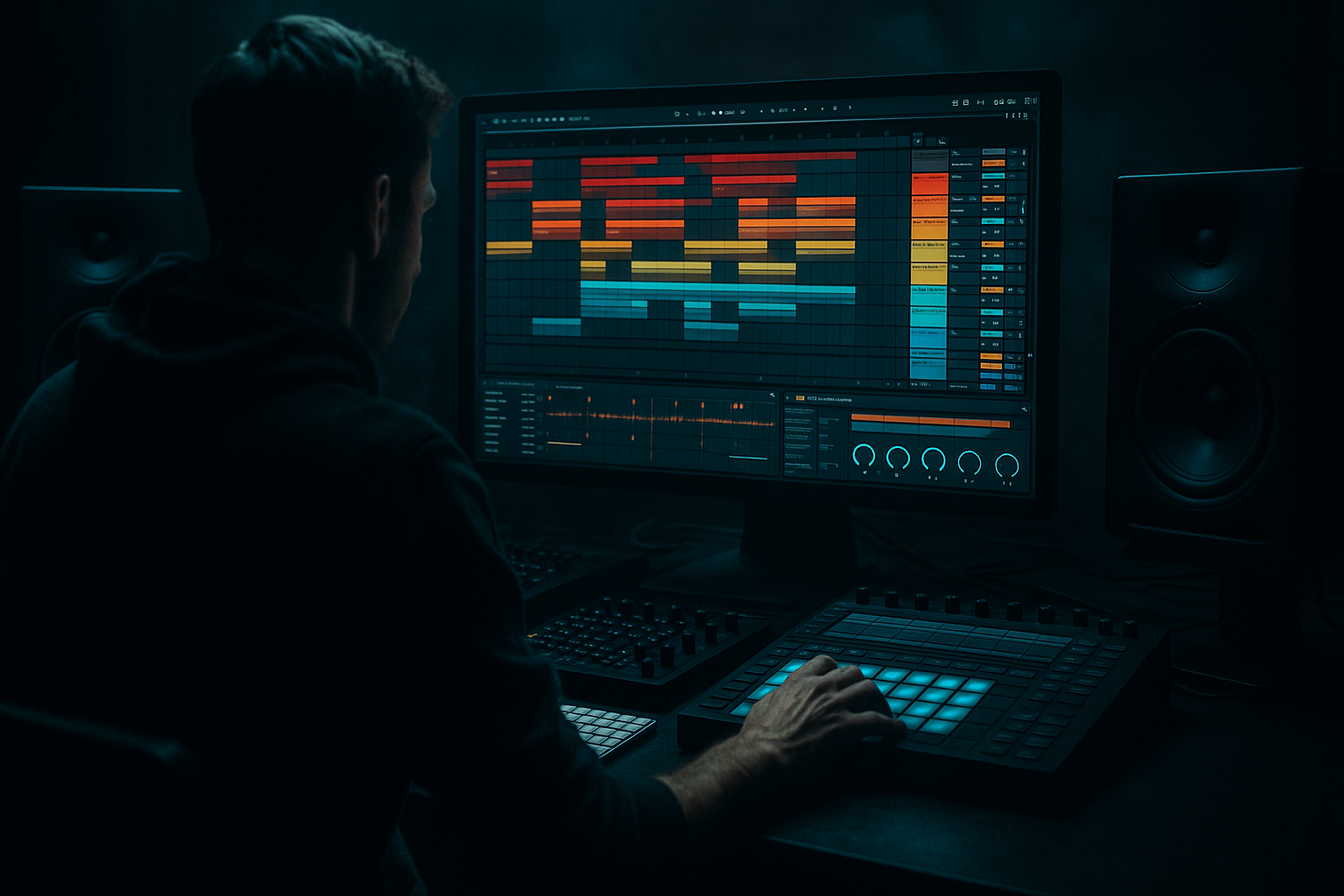
Main tutorial
```markdown
DJ-friendly intro design from scratch (Oldskool DnB vibes) — Ableton Live 🎛️🥁
1. Lesson overview
A DJ-friendly intro isn’t just “some pads and a loop.” In drum & bass (especially oldskool/jungle/rolling styles), the intro is a mix tool: clean phrasing, consistent energy ramp, and useful elements for DJs to cue and blend.
In this lesson you’ll build a 32–64 bar intro that feels authentic—think break teases, dubby chords, sub hints, FX sweeps, and clear 8/16-bar changes that make mixing effortless.
Skill level: Intermediate
Focus: Arrangement + practical sound/processing choices in Ableton Live (stock devices)
---
2. What you will build
A DJ-ready intro with:
- 16 bars “DJ drums” (simple, clean, steady) for beatmatching 🎚️
- 16 bars “tease” (break edits + atmos + chord stabs) 🌫️
- Optional 32-bar extended intro (more story, more tension)
- A clean drop setup with a clear impact + last-bar fill
- Bars 1–16: DJ drums (clean + minimal)
- Bars 17–32: tease + tension (breaks, stabs, risers)
- Bar 33: Drop
- Kick: 1.1 and 1.3 (vary later)
- Snare: 1.2 and 1.4 (beats 2 & 4)
- Hat: 1/8s or 1/16s (light swing)
- Try Swing 16-55 (start subtle)
- Apply at 10–20% to hats/ghosts only (not kick/snare)
- EQ Eight
- Glue Compressor
- Saturator
- Auto Filter high-pass around 300–600 Hz
- Utility: slightly reduce width if too wide (oldskool hats often feel tighter)
- Bars 1–8: kick/snare + hats (steady)
- Bars 9–16: introduce a tiny variation every 4 bars:
- EQ Eight
- Drum Buss
- Transient shaping (stock-ish method):
- Optional: Redux (very subtle) for old sampler edge
- Bars 9–16: introduce the break quietly (like -10 to -14 dB under main drums)
- Bars 17–32: bring break up and start teasing edits:
- Break Volume: ramp up gradually from bars 9 → 24
- Break EQ: automate HP from 150 Hz down to 100 Hz as energy increases (still keep low end clean)
- Echo
- Reverb
- Auto Filter (after reverb/echo if you want sweeps)
- Choose a minor key (e.g., F minor / G minor)
- Use a simple 2-chord vamp:
- Place stabs sparsely:
- Bars 25–28: sub only hits on bar 1 (one long note)
- Bars 29–32: sub hits more frequently (half-bars or quarter notes), but keep it minimal
- Compressor (sidechain from `DRUMS` kick)
- Use a short impact sample (or make one with noise + reverb freeze)
- Place at bar 33 (drop) and optionally a downlifter at bar 32.4
- At bar 32:
- Master/Group high-pass slightly (very gentle), then snap back at drop
- `1: Intro (DJ drums)`
- `17: Break tease`
- `25: Tension + sub hint`
- `33: DROP`
- Changes every 8 bars (or at least every 16)
- Kick/snare remain stable enough for beatmatch
- No huge sub conflicts before the drop (leave headroom)
- Use a “drone note” atmosphere: one root note with texture (vinyl crackle, distant pads).
- Parallel distortion on breaks:
- Minor-key stabs + pitch dives: automate stab pitch down -2 to -5 semitones at the very end of phrases for menace.
- Tension with less, not more: remove kicks in bar 31, let the break + atmos carry, then slam the drop.
- Stereo discipline: keep intro low-end mono.
- 1–16: clean 2-step + hats
- 17–32: break tease + stabs + riser
- 33: drop
- 1–16: DJ drums only
- 17–32: add break low + atmos
- 33–48: add stabs + more edits
- 49–64: sub hint + clear fills into drop
- Locator markers at 1/17/33 (and 49/65 if extended)
- At least one break edit fill
- At least one filter automation ramp
- Sub only introduced in the final 8–16 bars
- A DJ-friendly DnB intro is about clean beatmatching + clear phrasing.
- Start with simple drums, then layer breaks for oldskool character.
- Add dubby stabs + atmos with controlled space (Echo/Reverb with filtering).
- Foreshadow the drop with sub hints, sidechained and restrained.
- Use 8/16-bar signposts and a clear last-bar fill so DJs can feel the drop coming.
Target vibe: oldskool DnB / jungle / rollers at 170–175 BPM.
---
3. Step-by-step walkthrough
Step 0 — Session setup (2 minutes)
1. Tempo: 172 BPM (classic sweet spot)
2. Time signature: 4/4
3. Create groups:
- `DRUMS`
- `BREAKS`
- `MUSIC (CHORDS/ATMOS)`
- `BASS (SUB/RESE)`
- `FX/IMPACTS`
4. In Arrangement View, turn on:
- Automation Mode (A)
- Grid: 1 Bar and 1/4 as needed
Arrangement goal (basic):
> If you want a longer mix-in: duplicate to 64 bars and add more variation every 8/16.
---
Step 1 — Build “DJ drums” (Bars 1–16) 🥁
The DJ needs something consistent to lock onto. Keep it punchy and uncluttered.
#### A) Create a Drum Rack (core kit)
1. Add a MIDI track → load Drum Rack
2. Samples (choose your own, but aim oldskool):
- Kick: punchy, short tail
- Snare: 90s DnB snare (crack + body)
- Closed hat: tight, bright
- Ride/shuffle hat: optional
- Rim/ghost: optional
#### B) Program a simple 2-step
Typical DnB skeleton:
Groove tip: Use Groove Pool with a light shuffle:
#### C) Make it mix-friendly (processing chain)
On the `DRUMS` group:
- HP filter at 25–30 Hz (remove rumble)
- Small dip 250–400 Hz if boxy (1–2 dB)
- Attack 3 ms, Release Auto
- Ratio 2:1
- Aim 1–2 dB gain reduction on peaks
- Mode: Soft Sine or Analog Clip
- Drive 1–3 dB
- Turn on Soft Clip if you want extra density
On hi-hats (optional):
#### D) Arrange Bars 1–16
- add a ghost note
- add a hat open on the “and”
- small snare flam in bar 16 (keep subtle)
Key rule: DJs love predictability. Don’t overfill the first 16.
---
Step 2 — Add an oldskool break layer (Bars 9–32) 🪓
Oldskool vibe = breaks. But for a DJ intro, keep them controlled and not too messy early.
#### A) Break track setup
1. Add an Audio track: `BREAK`
2. Drop in a break (Amen, Think, Funky Drummer-style, or a modern break with that character).
3. Warp settings:
- Warp Mode: Complex Pro (good general)
- Or Beats mode for more “chop”:
- Beats → Preserve: Transients
- Envelope: ~20–40 (tighter slices)
#### B) Break processing chain (classic, controlled)
On the break track:
- HP at 80–120 Hz (leave room for kick + sub)
- Small dip around 300–500 Hz if muddy
- Drive 5–15% (taste)
- Crunch 0–10%
- Boom: OFF or very low (Boom can fight the kick/sub)
- Drum Buss (Transient knob) + Glue can work
- Downsample: 0.98–0.92
- Bit reduction: 0 or 1 (tiny!)
#### C) Intro placement
- mute kick occasionally to let the break speak
- add a 1-bar break fill at bar 32
Automation suggestion:
---
Step 3 — Add atmosphere + dubby chord stabs (Bars 17–32) 🌫️🎹
This is where the “oldskool soul” lives: minor chords, dub space, and hints of the drop.
#### A) Create a stab instrument (stock)
1. New MIDI track: `STABS`
2. Instrument: Wavetable (or Analog)
- Wavetable:
- OSC1: Basic Shapes (Square-ish)
- OSC2: Sine/Triangle low level for body
- Unison: 2–4 voices, Amount 10–20%
3. Filter:
- LP24, cutoff ~1.5–4 kHz (automate)
- Drive a little (2–5)
4. Amp envelope:
- Attack 0–5 ms
- Decay 200–500 ms
- Sustain 0
- Release 80–200 ms
#### B) Dub space chain (the sauce)
On the `STABS` track:
- Time: 1/8 dotted or 1/4
- Feedback: 20–40%
- Filter: HP 300 Hz, LP 6–10 kHz
- Modulation: small amount
- Decay 1.8–3.5 s
- Predelay 10–25 ms
- HP 250–400 Hz
- Automate cutoff to open toward the drop
#### C) Musical content (keep it DJ-friendly)
- Example: i → ♭VII (e.g., Gm → F) or i → iv (Gm → Cm)
- Bars 17–24: 1 stab every 2 bars
- Bars 25–32: 1 stab every bar + automation opening filter
Important: Keep the sub/bass mostly out until close to drop (or just a hint).
---
Step 4 — Sub hint + bass “foreshadow” (Bars 25–32) 🔊
The goal is tension and expectation, not full drop energy.
#### A) Sub instrument (stock)
1. MIDI track: `SUB`
2. Instrument: Operator
- Osc A: Sine
- Envelope: Attack 0, Decay 0, Sustain -inf? (or full sustain), Release 80–150 ms
3. Add Saturator
- Drive 1–4 dB
- Soft Clip ON
4. Add EQ Eight
- Low-pass around 120–180 Hz (keep it pure)
- Optional small notch if resonant
#### B) Arrangement trick
#### C) Sidechain so the intro stays clean
On SUB:
- Ratio 4:1
- Attack 1–5 ms
- Release 80–140 ms
- Gain reduction 3–6 dB
---
Step 5 — FX, risers, and “last 8 bars” structure (Bars 25–32) 🚨
Oldskool intros often use noise sweeps, impacts, and tape-stop-ish moments—tastefully.
#### A) Noise riser (stock)
1. MIDI track: `RISER`
2. Instrument: Operator
- Noise oscillator ON (or use Simpler with noise sample)
3. Add Auto Filter
- Start cutoff ~200 Hz, end ~8–12 kHz
- Resonance 10–25%
4. Add Reverb
- Decay 3–6 s, HP 500 Hz
5. Automate volume up into the drop
#### B) Impact + downlifter
#### C) The “DJ signpost” fills
DJs expect a clear transition:
- 1-beat snare fill OR
- quick break chop (Amen slice) OR
- micro-silence (1/4 beat) before the drop
Classic move: in the last bar, automate:
- Use Auto Filter on the `MUSIC` group (not on the master ideally)
- HP from 0 → 150 Hz over bar 32, then reset at bar 33
---
Step 6 — Make it DJ-proof (phrasing + markers) 🧭
DnB DJs mix in phrases. Your intro should have obvious “chapters.”
Use Locator markers:
Checkpoints:
---
4. Common mistakes ❌
1. Too busy too early
If you start with full breaks + chords + bass, DJs have no clean layer to mix with.
2. No 8/16-bar signposting
Random changes feel cool in the studio but are awkward in a club blend.
3. Sub appears too soon / too loud
DJs often EQ swap low end; if you flood the sub early, it gets messy fast.
4. Over-wet reverb in the intro
Big reverb tails blur transients and make beatmatching harder.
5. Warp artifacts on breaks
Wrong warp mode can make breaks phasey. Test Beats vs Complex Pro.
---
5. Pro tips for darker/heavier DnB 🖤
Stock tool: Granulator III (if available) or Sampler/Simpler + Reverb + Auto Filter.
- Create a return track `BREAK CRUSH`:
- Saturator (Drive 6–10 dB) → EQ Eight (HP 200 Hz, LP 6–8 kHz) → Glue
- Send break to it lightly (5–15%).
- Use Utility on bass: Width 0% under ~150 Hz (or just keep bass mono).
---
6. Mini practice exercise 🎯
Build two versions of the intro using the same drop:
Version A (DJ minimal — 32 bars)
Version B (Oldskool extended — 64 bars)
Deliverable checklist:
---
7. Recap ✅
If you want, tell me your target vibe (more jungle, more techstep, or more liquid-roller) and I’ll suggest a specific 64-bar intro map + device chains tailored to it.
```

