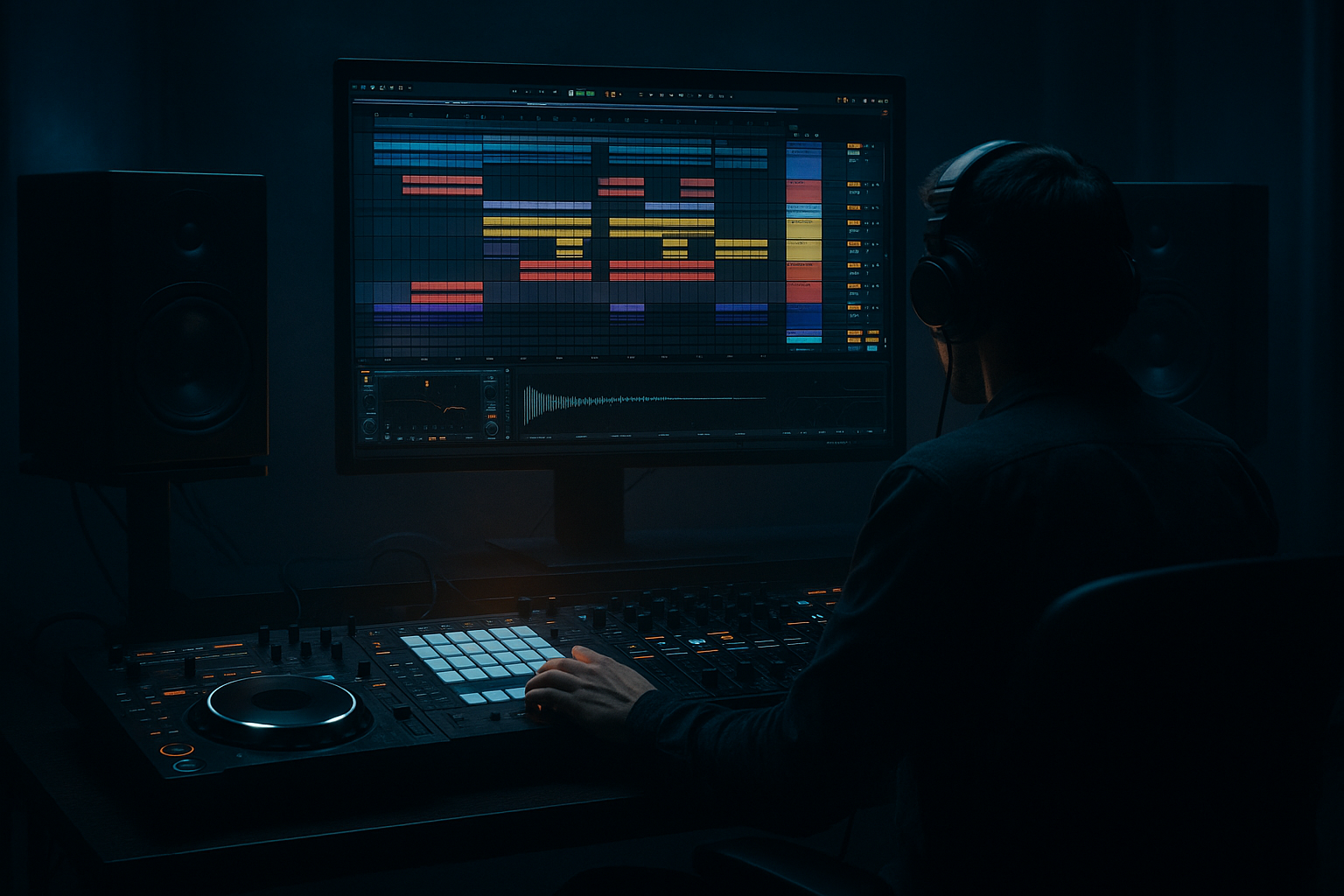
Main tutorial
DJ Intro Design Session: Session View to Arrangement View in Ableton Live 12 for Jungle / Oldskool DnB 🎛️🥁
1. Lesson overview
In this lesson, you’ll build a DJ-friendly intro for a jungle / oldskool drum & bass tune in Ableton Live 12, starting in Session View and then moving into Arrangement View for final structure.
The goal is to create an intro that works for:
- mixing into a DJ set
- building tension before the drop
- introducing your breakbeat, bass, and atmospheres in a controlled way
- setting up an easy blend with other records
- clear
- loopable
- energy-controlled
- easy to cue and mix
- breakbeat drums
- dark subs
- atmospheric pads
- filtered FX
- a strong 16- or 32-bar intro structure
- 8–16 bars of atmospheric lead-in
- filtered drums or ghost percussion
- a rising tension section
- a clean transition into the main groove
- a bass introduction that doesn’t clutter the mix
- an arrangement that makes sense for DJs and listeners
- Bars 1–8: atmospheric intro, no kick/bass
- Bars 9–16: break texture and percussion enter
- Bars 17–24: bass tease / filtered bass hits
- Bars 25–32: full groove or pre-drop tension
- Drop / main section
- Tempo: 160–174 BPM
- Time signature: 4/4
- Warping: enabled for break samples
- Loop length in Session View: 8 bars or 16 bars per scene
- Amen-style breaks
- Think / funky drummer style breaks
- Hip-hop break loops with punch
- Any dusty, chopped break with strong ghost notes
- make sure Warp is on
- set Warp Mode to:
- set transient markers carefully if needed
- one filtered
- one dry
- one with delay
- one with heavy reverb tail
- vinyl noise / tape hiss
- filtered pad
- dark drone
- chopped vocal texture
- distant reverb stab
- jungle rain / city ambience / field recording
- filtered pad
- noise bed
- a tiny vocal hit every 4 or 8 bars
- no bass yet
- full break later
- high-pass filtered break earlier
- single hits / chopped slices before the main loop
- ghost snare or ride pattern to suggest momentum
- clip launch variations
- different scene versions
- clip automation
- Slice to New MIDI Track if you want to chop the break into drum rack hits
- Bars 1–8: no full break, only atmosphere
- Bars 9–12: filtered break loop enters
- Bars 13–16: remove low end filter slightly
- Bars 17–24: add full break or stronger transients
- Drum Buss
- Saturator
- Glue Compressor
- EQ Eight
- Operator or Wavetable
- EQ Eight
- Compressor or Glue Compressor for sidechain
- Utility to keep mono
- Wavetable
- Saturator
- Auto Filter
- Chorus-Ensemble or Phaser-Flanger for movement
- EQ Eight
- filter cutoff opening slowly
- distortion increasing slightly
- volume rising over 8–16 bars
- maybe a high-pass filter on the bass until the transition point
- dry version
- filtered version
- delay version
- reverb-heavy version
- final full-energy version
- Clip A: filtered break
- Clip B: full break
- Clip C: fill variation
- Clip A: pad wash
- Clip B: reversed texture
- Clip C: dark drone
- Clip A: sub teaser
- Clip B: Reese swell
- Clip C: full bass phrase
- Press Record
- Launch your Session clips in the order you want
- Capture the performance into Arrangement View
- Then edit the timeline for precision
- fine-tune timing
- create tension curves
- automate filters and FX
- build a proper DJ intro structure
- clear 16-bar phrase structure
- consistent kickless build-up
- small changes every 4 or 8 bars
- one strong transition before the drop
- Auto Filter cutoff
- Reverb dry/wet
- Echo feedback
- Bass volume
- Noise level
- Drum Buss drive
- Utility width
- Bars 1–8: pad and atmosphere only, slow filter movement
- Bars 9–16: break appears, filter opens slightly
- Bars 17–24: bass tease, tension increases
- Bars 25–32: full break and bass lead-in
- Drop: full impact
- automate reverb up
- cut low end briefly
- add a reverse cymbal or riser
- use a snare fill or break fill
- then hit the drop cleanly
- strong downbeat at the start
- no clutter in the low end
- easy 16- or 32-bar phrasing
- a clean kick/snare pocket for mixing
- enough space for another track to blend
- leave 4 or 8 bars with minimal elements
- keep the intro metrical and predictable
- use a simple drum loop under the atmosphere so DJs can beatmatch
- avoid constant fills before the track is ready
- Is the intro too busy?
- Does the bass arrive too early?
- Is the transition obvious enough?
- Are the low frequencies controlled?
- Does the intro feel mixable?
- EQ Eight for tiny tonal correction
- Limiter only for safety, not loudness abuse
- leave headroom if this is meant for DJ use or later mastering
- full mix
- intro-only version
- DJ edit with extended intro
- instrumental mix
- no kick for 8 bars
- filtered break only
- bass hidden behind a band-pass
- sparse vocal or sci-fi stab
- Saturator
- Drum Buss
- Overdrive
- EQ Eight high-passed
- use Wavetable with saw-based oscillators
- detune slightly
- add Auto Filter automation
- use Chorus-Ensemble lightly
- keep the sub separate
- reversed crash
- pitched-down snare tail
- short metal hit
- filtered noise rise
- echo freeze on a vocal stab
- bit reduction
- filtering
- reversing
- warping
- atmosphere only
- no bass
- no full drums
- introduce filtered break or ghost percussion
- add subtle noise texture
- add bass tease or low rhythmic pulse
- open filter slightly
- bring in full break energy
- add a short fill or FX sweep
- prepare the drop
- 1 break sample
- 1 bass sound
- 1 atmosphere layer
- 2 FX sounds max
- Auto Filter
- EQ Eight
- Reverb
- Echo
- Drum Buss
- Utility
- Saturator
- sketching ideas in Session View
- shaping the final structure in Arrangement View
- using atmospheric tension, breakbeat layering, and bass restraint
- automating filters, space, and energy changes
- keeping the intro mixable and DJ-friendly
- a template Ableton session plan
- a 16-bar intro MIDI/audio layout
- or a step-by-step dark jungle intro using only stock Ableton devices.
This is especially useful for DJ tools, edits, and club-intended DnB because you need the intro to be:
We’ll focus on an oldskool jungle / rolling DnB vibe with:
---
2. What you will build
By the end of this session, you will have a DJ intro that includes:
Typical track layout we’ll aim for
A practical oldskool DnB arrangement could look like this:
This kind of intro gives DJs enough time to mix, while still sounding musical and purposeful.
---
3. Step-by-step walkthrough
Step 1: Set up your project
Open Ableton Live 12 and start with a blank set.
Recommended project settings
- Oldskool jungle often feels great around 162–170 BPM
Organize your tracks early
Create these basic tracks:
1. Drums Break
2. Kick / Snare Layer
3. Sub Bass
4. Reese / Mid Bass
5. Atmos Pad
6. FX / Risers / Vox
7. Noise / Texture
Color-code them if you like. Good organization saves time later. 🎚️
---
Step 2: Build your core breakbeat in Session View
For jungle and oldskool DnB, the breakbeat is the identity. Start with a break sample that has character.
Good break choices
How to work it in Ableton
Drag your break into an audio track, then:
- Beats for drum loops
- try Transient Loop or Repitch if the break needs a raw oldskool feel
Session View tip
Put your break into Scene 1 as a loop, then duplicate the clip into a few scenes and process them differently:
This gives you DJ-intro movement without changing the core identity.
---
Step 3: Design the intro atmosphere
A proper DnB DJ intro usually starts with space and tension, not full drums.
Build an atmosphere layer
Use one or more of the following:
Useful stock Ableton devices
Try this chain on a pad or texture:
Audio Effect Rack / device chain:
1. EQ Eight
- high-pass around 120–250 Hz
- remove muddiness below the bass area
2. Auto Filter
- low-pass around 2–8 kHz
- automate cutoff to open gradually
3. Reverb
- large size
- decay around 4–8 seconds
- low dry/wet if you want the sound to sit behind the drums
4. Echo
- sync delay, often 1/4 or 1/8 dotted
- low feedback for spacious movement
5. Utility
- reduce width if the sound is too wide in the low mids
- keep the sub area mono
Practical intro move
Start with:
This establishes vibe before the rhythm arrives.
---
Step 4: Introduce the breakbeat gradually
For jungle, you often want the intro to tease the break rather than drop it fully immediately.
Good approach
Use the break in layers:
In Ableton Live 12
You can do this in Session View using:
Example breakdown
Processing for oldskool grit
On the break channel, try:
- drive lightly
- boom low, but don’t overdo it
- use soft clip or mild drive
- gentle glue only
- carve mud around 200–400 Hz if needed
---
Step 5: Add bass without destroying the intro
In DnB, bass is king — but in a DJ intro, you often want to delay full bass impact until the arrangement has earned it.
Bass intro strategy
Use one of these methods:
1. No bass for first 8 bars
2. Filtered sub hits only
3. Bass tease with high-pass / band-pass
4. Single note calls before the drop
5. Reese swell entering just before the main groove
Useful stock Ableton devices for bass design
On your bass track, try:
Sub bass chain:
Mid bass / Reese chain:
Practical bass approach
For an intro, automate:
This keeps the intro DJ-friendly and avoids overcrowding the first section.
---
Step 6: Use Session View like a sketchpad
Session View is ideal for experimenting with multiple intro versions fast.
Make several clip variations
For each core element, create:
Example session grid
Track 1: Break
Track 2: Atmos
Track 3: Bass
Why this works
You can audition different combinations quickly, then build the strongest intro sequence before committing to the arrangement.
---
Step 7: Move from Session View to Arrangement View
Once your intro idea is working, record it into Arrangement View.
How to do it
Why this is important
Session View is great for ideas, but Arrangement View is where you:
Arrange your intro carefully
A strong DnB intro often benefits from:
---
Step 8: Shape the intro with automation
This is where the track starts sounding intentional rather than looped.
Automate these elements:
A practical automation plan
Good transition trick
At the final 1 or 2 bars before the drop:
---
Step 9: Add DJ-friendly features
If you’re making this as a DJ tool or mixable intro, think like a selector.
DJ-friendly intro traits
Good tricks
Oldskool vibe tip
A slightly raw intro often feels more authentic than over-polished modern editing. Leave some grit in the breaks and let the atmosphere breathe.
---
Step 10: Final polish in Arrangement View
Now tighten the intro so it feels finished.
Check these points
Helpful final processing
On the master, keep it subtle:
Optional DJ intro/export version
You may want to export:
That’s especially useful if you’re making releases for DJs or promo packs.
---
4. Common mistakes
1. Putting the bass in too early
A lot of producers rush the drop energy. In DnB, the intro needs contrast. If the bass arrives too soon, the drop loses power.
2. Too much reverb on low frequencies
Reverb on subs or heavy low mids can make the intro muddy fast. High-pass reverbs or use return tracks carefully.
3. Breaks that are too clean
Oldskool jungle usually benefits from grit, swing, and character. Perfectly quantized drums can feel sterile.
4. No phrase structure
If elements change randomly, DJs can’t mix confidently. Stick to clear 4, 8, 16, or 32-bar phrasing.
5. Overfilling the intro
Too many FX, fills, and layered elements make the intro hard to use. Remember: DJ tools need space.
6. Ignoring low-end mono
Keep sub frequencies centered. Use Utility to manage width and avoid phase issues.
---
5. Pro tips for darker/heavier DnB
Tip 1: Use tension through subtraction
For darker DnB, the intro often feels heavier when you remove elements rather than add them.
Try:
Tip 2: Parallel distortion on the break
Duplicate the break or use a return track with:
Blend this in subtly for weight.
Tip 3: Reese bass with movement
For dark oldskool vibes:
Tip 4: Tension FX before the drop
Use:
Tip 5: Resample your own intro texture
Record a few bars of your intro, then resample it and process it again:
This can create a more authentic jungle atmosphere. 🔥
---
6. Mini practice exercise
Exercise: Build a 16-bar DJ intro
Create a short intro using this structure:
#### Bars 1–4
#### Bars 5–8
#### Bars 9–12
#### Bars 13–16
Constraints
Use only:
Devices to use
Goal
Make it mixable, dark, and clearly phrased. Then export it and test whether you can cue in another track over the intro.
---
7. Recap
In this lesson, you learned how to design a DJ intro for jungle / oldskool DnB in Ableton Live 12 by:
Key takeaway
A strong DnB intro is not just “the beginning of the song” — it’s a functional mix tool and a vibe setter. Build it with phrasing, contrast, and control, and your track will feel much more powerful on a system and in a DJ set. 🎧
If you want, I can also turn this into:

