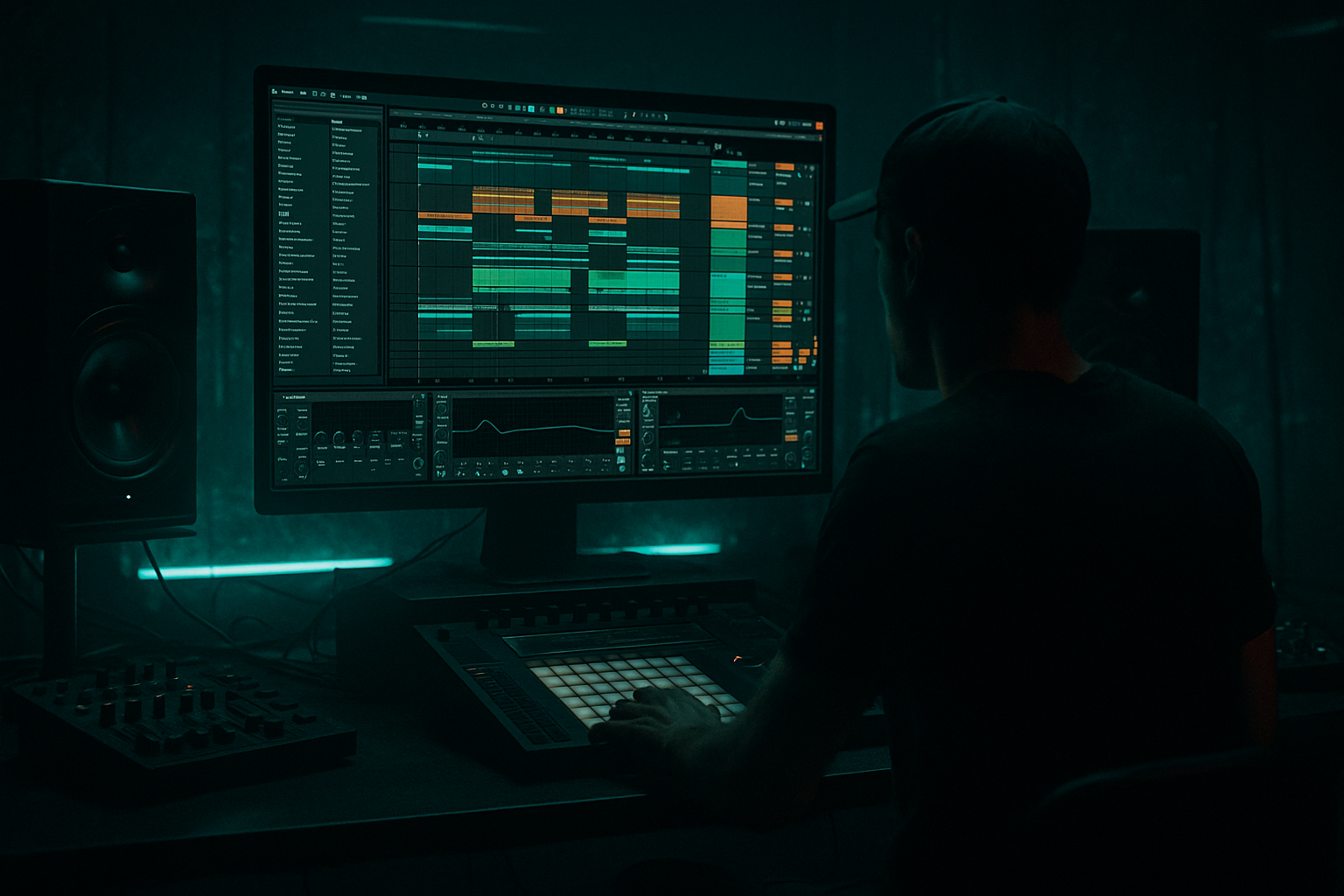
Main tutorial
DJ Intro Flip Approach (Modern Punch + Vintage Soul) in Ableton Live 12
Beginner • Atmospheres • Jungle / Oldskool DnB vibes 🎛️🔥
---
1. Lesson overview
A “DJ intro flip” is a producer-friendly way to make intros that DJs love: clear, mixable, and hype-building—but still musical. You’ll start with a soulful/vintage atmospheric intro, then flip into a modern punchy jungle drop using tight transitions, filtered drums, and classic rave ear-candy.
This lesson focuses on atmospheres (pads, vinyl vibe, chords, vox bits, space) while still giving you practical drum/bass placement so it feels like real DnB.
---
2. What you will build
You’ll create an 8–16 bar DJ-friendly intro with:
- Vintage-soul atmosphere bed (vinyl noise, filtered chords, distant reverb) 🕯️
- Tease elements (amen ghost hits / shuffles, subtle bass movement, FX)
- A clean “flip” moment (tape-stop / filter slam / reverb throw)
- A punchy modern drop-ready handover (tight drums, more mono low-end)
- Hats on offbeats (the “&” counts)
- Add occasional 1/16 hats for momentum
- On the Master or on your Atmos group:
- Add an impact (crash + sub drop) at bar 17.
- At the last chord/vox hit of bar 16:
- Resample a 1-bar atmosphere moment:
- Kick on 1
- Snare on 2 and 4 (or classic DnB snare on 2 and 4 with extra ghost notes)
- A crisp top snare + a body snare (two samples)
- Amen break layer (quiet but adds groove)
- Vinyl + pad/chords
- Very light hats (filtered)
- No heavy bass
- Introduce chopped vocal one-shots (very occasional)
- Automate pad filter opening slightly
- Add a riser or noise sweep (Shifter/Echo automation)
- Short silence or impact
- Reverb throw or filter slam
- Full drums (unfiltered)
- Bass becomes mono/solid
- Atmos layer reduces slightly so drums lead
- Vocal chop (one-shot) → process with Echo + Auto Filter
- Dub siren (simple synth note) → Frequency Shifter + Reverb
- Old rave stab (short chord) → Saturator + EQ Eight (HP at 200 Hz)
- Too much sub in the intro: makes DJ blending messy. High-pass your intro bass/atmos.
- Over-reverb on everything: the drop won’t feel like it “arrives.” Keep intro roomy, drop tighter.
- No real “flip” moment: if nothing changes dramatically at bar 17, it feels flat.
- Clashing stereo low-end: widen pads/noise, but keep anything below ~120 Hz mono (use Utility).
- Drums too loud too early: intros should tease—save full transient smack for the handover.
- Make the atmosphere ominous without adding mud:
- Mono the sub, widen the air:
- Create tension with pitch and dissonance:
- Use gated reverb moments:
- Pre-drop “vacuum”:
- A DJ intro flip is about mixability + vibe: soulful atmosphere first, then a clear switch into modern punch.
- Use filtering, space, and controlled low-end to keep the intro clean.
- The flip needs a moment of drama: impact, silence, reverb throw, or filter slam.
- After the flip, tighten: less reverb, stronger transients, mono low-end.
- Stock Ableton devices that carry this workflow: Auto Filter, EQ Eight, Echo, Hybrid Reverb, Drum Buss, Glue Compressor, Utility, Saturator.
End result: an intro that’s easy to mix, sounds nostalgic, and still hits hard in a modern set.
---
3. Step-by-step walkthrough
Step 0 — Set up your project (tempo, routing, DJ mindset)
1. Set Tempo: `168–174 BPM` (try 172 BPM for jungle).
2. Time signature: 4/4.
3. Arrangement goal:
- Bars 1–8: atmosphere + hints
- Bars 9–16: build + tension
- Bar 17: flip moment (impact/transition)
- Bars 17–33: drop or drop-ready section
DJ-friendly tip: Keep the intro’s low-end minimal so DJs can blend their previous track’s bass.
---
Step 1 — Build the vintage soul atmosphere bed 🎹📼
#### A) Create a “Soul Pad / Chord” layer (stock-first approach)
1. Create a MIDI track → load Wavetable (or Analog for a warmer vibe).
2. Wavetable settings (simple & effective):
- Osc 1: Sine or soft triangle-ish table
- Add Unison: 2–4 (small amount)
- Filter: LP24, cutoff around 500–2kHz (automate later)
- Amp Envelope:
- Attack: 20–60 ms
- Release: 1.5–3.5 s
3. Add Chord MIDI effect (optional) to get instant soulful stacks:
- Chord device: try `+3` and `+7` semitones (minor chord vibe)
4. Add Echo:
- Time: `1/8` or `1/4`
- Feedback: `20–35%`
- Filter in Echo: roll off highs a bit
5. Add Hybrid Reverb (Hall or Plate):
- Decay: `3–7 s`
- High Cut: around `6–10 kHz`
- Mix: `15–35%` (don’t drown it)
Arrangement move: Start the track with this pad fairly filtered, then open it gradually.
---
#### B) Add “vinyl soul” texture (noise + wobble)
1. Create an Audio track called `VINYL`.
2. Drop in a vinyl noise sample (or use any constant noise/room tone).
3. Add Auto Filter:
- HP at 150–300 Hz (remove rumble)
- LP at 8–12 kHz (softens brightness)
4. Add Shifter (subtle pitch drift for tape feel):
- Mode: Fine
- Amount: tiny (start around ±5 to ±15 cents)
- Optional: automate slightly over time
5. Add Utility:
- Width: `70–120%` (keep it wide, low impact)
Goal: you feel the record, but it doesn’t mask drums later.
---
Step 2 — Add a jungle “hint layer” (ghost drums / tops) 🥁
You want movement without making it hard to mix.
#### A) Create a “tops loop” or amen ghosts
1. Create a Drum Rack track.
2. Add:
- Closed hat (short)
- Ride/shaker
- A couple of quiet amen ghost hits (very low level)
3. Program a simple 2-step jungle shuffle:
#### B) Make it DJ-friendly (filter + distance)
Device chain on this drum track:
1. Auto Filter
- HP: start at 300–600 Hz
- (Optional) automate the HP down slightly as you approach the flip
2. Drum Buss
- Drive: `5–15%`
- Crunch: tiny, `0–10%`
- Boom: OFF (keep low-end clean in intro)
3. Hybrid Reverb (short room)
- Decay: `0.6–1.2 s`
- Mix: `10–20%`
Key concept: intro drums should be present but not dominant. Save full transients for the drop.
---
Step 3 — Add a “tease bass” (sub-safe, minimal) 🎚️
A proper DJ intro usually avoids heavy sub. But a mid-bass tease (or filtered sub) feels exciting.
1. Create MIDI track → Operator (great for clean DnB bass).
2. Operator patch:
- Osc A: Sine
- Add slight Saturation: use Saturator after Operator
- Drive: `2–6 dB`
- Soft Clip: ON
3. Add Auto Filter:
- HP around 60–90 Hz (so it doesn’t fight the DJ blend)
- LP around 200–600 Hz (keeps it muted and vibey)
Write a simple pattern: long notes, maybe a 1-bar repeating motif. Keep it subtle until the flip.
---
Step 4 — Create the “flip moment” (the switch from soul to punch) 💥
This is the signature of the approach: the intro “turns over” into the modern jungle section.
#### A) Choose your flip technique (pick one)
Option 1: Filter slam + impact
- Automate Auto Filter cutoff down quickly at bar 16 → then open at 17.
Option 2: Reverb throw
- Automate Hybrid Reverb Mix from `20% → 60–80%` for a moment
- Then cut it back to normal when the drop hits.
Option 3: Tape-stop style (simple beginner method)
1. Select the last bar of the intro → Right-click → Freeze Track → Flatten (or resample to audio)
2. Use Clip Transpose Envelope: dip down quickly (like -12 semitones) at the end of bar 16
3. Add a short silence (1/8–1/4 beat) before the drop for drama
---
Step 5 — Build the modern punchy handover (drop-ready drums) 🧱
Even though this is an atmospheres lesson, the “flip” must land into something credible.
#### A) Classic jungle kick/snare placement (starting point)
In a Drum Rack:
Then layer:
#### B) Punch chain (stock devices)
On your DRUMS group:
1. EQ Eight
- Cut mud: dip around `200–400 Hz` if needed
- Add snap: gentle lift around `3–6 kHz` (snare region)
2. Drum Buss
- Drive `10–25%`
- Transients `+5 to +20` (if it gets too clicky, reduce)
- Boom: optional, but careful for jungle (try `Boom 20–35 Hz` very low amount)
3. Glue Compressor
- Attack: `3–10 ms`
- Release: `Auto`
- Ratio: `2:1`
- Aim for 1–3 dB gain reduction
4. Limiter (light safety, not smashing)
Important: Keep the intro drums filtered/quiet, then remove filtering and increase transient energy at the flip.
---
Step 6 — Arrangement blueprint (copy this)
Here’s a simple 32-bar structure that works in real DJ sets:
Bars 1–8 (Soulful intro bed)
Bars 9–16 (Tension + tease)
Bar 16 → 17 (The flip)
Bars 17–33 (Drop-ready)
---
Step 7 — “Vintage soul” touches that scream jungle 🧡
Add 1–2 of these (don’t do all at once):
Tip: Keep these mostly above 200 Hz in the intro so DJs can mix cleanly.
---
4. Common mistakes
---
5. Pro tips for darker/heavier DnB 🖤
- Use EQ Eight to cut low mids (`250–500 Hz`) on pads if it clouds drums.
- Put Utility on bass: Width `0%` (mono)
- Put Utility on atmos: Width `120–160%` (careful)
- Slight detune or minor 2nd intervals in the pad can feel darker.
- Hybrid Reverb big wash → then Gate after it to chop the tail rhythmically.
- Automate a fast low-pass on the master in the last 1 beat before drop, then snap open.
---
6. Mini practice exercise (15–25 minutes) 📝
1. Set tempo to 172 BPM.
2. Make an 8-bar intro with:
- 1 pad/chord layer (Wavetable or Analog)
- 1 vinyl/noise layer
- 1 filtered hats/ghost layer
3. Automate:
- Pad filter slowly opens from bar 1 → 8
- Hats HP filter slowly lowers from bar 5 → 8 (but still no low end)
4. At bar 9, create a flip using one of:
- Reverb throw
- Filter slam
- Tape-stop resample
5. After the flip, bring in a full drum bar (kick/snare/hats) and make it clearly louder/punchier than the intro.
Export a quick loop of bars 7–10 and listen: Does the transition feel like a real jungle tune entering the dance?
---
7. Recap
If you want, tell me your BPM and whether you prefer Amen-heavy or 2-step roller, and I’ll give you a bar-by-bar intro plan with specific automation lanes to draw in Live 12.

