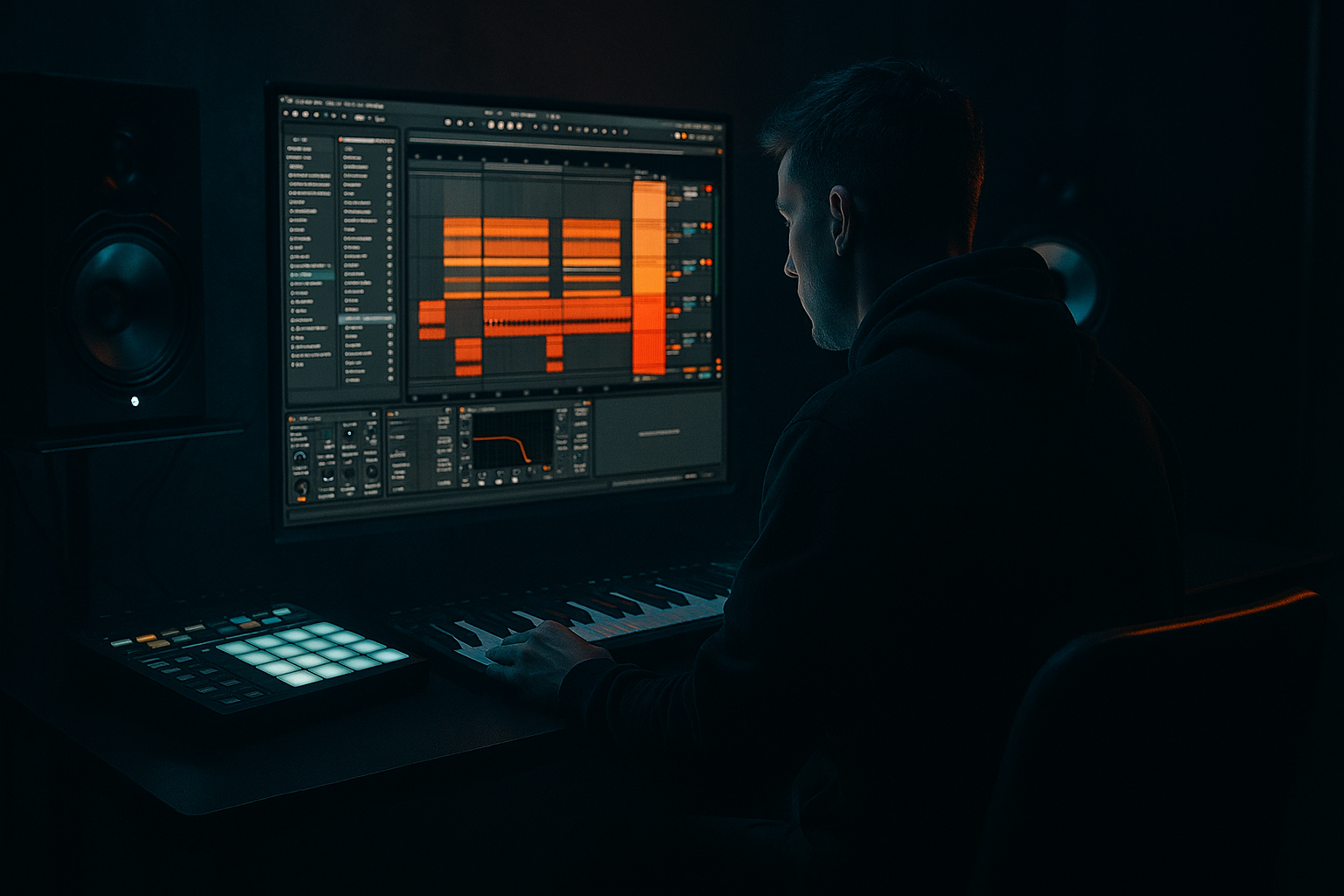
Main tutorial
DJ intro in Ableton Live 12: blend it for ragga‑infused chaos 🔥🔊
Advanced Workflow — Drum & Bass production in Ableton Live 12
---
1. Lesson overview
This lesson is about building a DJ‑friendly intro in Ableton Live 12 that makes your DnB track easy to mix while still sounding like ragga/jungle chaos—toasters, sirens, dub delays, and dirty edits—but structured like a weapon.
You’ll create an intro that:
- Gives DJs clean 16/32‑bar sections and predictable phrasing
- Contains high‑energy ragga flavor without clashing with the outgoing track
- Transitions into the drop with controlled hype (filters, risers, edits, impact)
- Bars 1–16: Minimal “mix bed” (tops + texture + dub FX)
- Bars 17–32: Add groove + ragga callouts + fills (still mixable)
- Last 2–4 bars: Tension ramp + pre‑drop switch (filter, tape stop, snare fill)
- A dedicated “DJ Tools” group: kickless percussion, sub‑safe FX, and “hype” lanes
- Add a Drum Rack (stock) with tight hats.
- Pattern suggestion (DnB roll):
- Groove:
- EQ Eight: HP at 250–400 Hz (steep 24/48 dB)
- Saturator: Soft Clip ON, Drive 1–3 dB
- Auto Filter: HP 12 dB, map cutoff to a macro (“Intro Brightness”)
- Add an audio track with a classic break (Amen / Think / Hot Pants vibe).
- Warp mode: Beats
- Keep it background: filter and tuck.
- EQ Eight: HP at 180–300 Hz
- Drum Buss: Drive 5–15%, Boom OFF (don’t create sub)
- Utility: Width 120–150% (ONLY if it doesn’t smear transients)
- Use Simpler or Drum Rack hits.
- Place percs on offbeats and bar turnarounds (bar 8/16/24/32).
- Attack 3 ms, Release Auto, Ratio 2:1, Threshold for 1–2 dB GR
- Pick 4–8 short phrases: “rewind!” “selecta!” “inna di dance” etc.
- Place them sparsely:
- EQ Eight: HP at 120–200 Hz, dip harshness around 2–5 kHz if needed
- Compressor: Sidechain from INTRO DRUMS (very subtle)
- Delay: Use Echo
- Reverb: Use Hybrid Reverb (Convolution or Algorithmic)
- Return A: Echo (dub throw)
- Instrument: Wavetable or Operator
- Sound: simple reese-ish or square tone, but band-limited
- Bars 1–16: bass ghost only on bar ends (little “bwwap” or reese stab)
- Bars 17–32: add a simple 2‑note motif (still high‑passed)
- Use Operator (simple sine + pitch envelope) or a sample in Simpler.
- Automate pitch bends into bar 16/32.
- Auto Filter: Band-pass sweep (map cutoff to macro “Siren Sweep”)
- Redux (tiny): Downsample a touch (clean chaos)
- Hybrid Reverb: short metallic room or spring vibe
- Use a noise loop, field recording, or Live’s Shaper? (If you’ve got textures—great.)
- Put it behind everything.
- EQ Eight: HP at 300–600 Hz
- Auto Pan: slow rate 0.05–0.15 Hz, Amount 20–40%
- Utility: keep it wide, but quiet
- Slice your filtered break and repeat a 1/8 or 1/16 for 2 beats → then hard stop → then drop.
- Consolidate break → right click Slice to New MIDI Track → use MIDI to trigger repeats.
- Or quick: use Beat Repeat:
- Putting full sub in bar 1. DJs can’t blend—your tune becomes a problem track.
- Too many vocals too early. Ragga works best with space; let phrases hit, then echo into darkness.
- Over-wet reverbs on hats/breaks. Smears transient timing—wrecks the roll.
- No phrasing landmarks. If bar 16 doesn’t feel like 16, DJs miss the mix points.
- Stereo low-end in FX. Wide low frequencies from sirens/noise = messy clubs.
- Endless “tension” with no payoff. Make the last 2–4 bars clearly escalate.
- Use negative space like a weapon: in bars 15–16, briefly drop the hats and let a dub echo hang. The silence amplifies the drop.
- Threatening texture bus: Group FX + Atmos → add Roar (subtle) or Saturator + EQ Eight notch sweeps. Keep it moving, not louder.
- Pre-drop pitch dive: automate a siren or noise down by -7 to -12 semitones in the last bar—classic menace.
- Kick tease (filtered): if you really want kick energy early, introduce a kick that’s HP filtered at 120–180 Hz for 4 bars only, then remove it right before the drop.
- Controlled distortion on the intro bus:
- 32 bars total
- Only Tops + filtered Break + sparse Vox
- No bass until bar 17, and it’s mid-only
- Same structure, but add:
- You built a phrased, DJ-readable intro (16/32 bars) that keeps low-end clean.
- You used stock Ableton devices (Echo, Hybrid Reverb, Auto Filter, Drum Buss, Glue, Utility, Beat Repeat) to create ragga energy with control.
- You designed mix bed → hype lane → pre-drop escalation, so DJs can blend confidently and the crowd still gets the chaos.
---
2. What you will build
A 32‑bar (or 48‑bar) DJ intro for a rolling DnB tune that includes:
You’ll also set up macro controls so you can bounce alternate intro versions quickly.
---
3. Step‑by‑step walkthrough
Step 0 — Set the DJ framework (phrasing first) 🎛️
1. Tempo: Typical modern DnB 174 BPM (or 170–176 depending on style).
2. Arrangement markers:
- Add locators: `Intro 1–16`, `Intro 17–32`, `Pre-drop`, `Drop`.
3. Grid & loop discipline:
- Work in 8‑bar loops then extend to 16/32.
4. DJ‑friendly rule:
- Keep sub + full kick OUT of the first 16 bars (or keep it extremely filtered).
- DJs need space to blend basslines without low-end war.
---
Step 1 — Build a “mix bed” drum layer (no kick, no sub) 🥁
Create a DRUMS – INTRO group with 3 lanes:
#### A) Tops (closed hats / shuffles)
- 1/16 hats with swing variations, occasional 1/32 stutters at bar ends.
- In Live 12, apply a groove like MPC 16 Swing 55–60 (or a subtle shuffle).
- Groove Amount: 20–35% (advanced: keep it lower if your break layer is already swung).
Processing chain (on Tops track):
#### B) Break texture (light, filtered)
- Preserve: 1/16 or 1/8
- Transients: 20–40 (adjust by ear)
Processing chain (Break track):
#### C) Perc FX (rimshots, woodblocks, dub ticks)
Pro workflow tip:
Group these three tracks into INTRO DRUMS and put a Glue Compressor on the group:
This glues without sounding like a finished drop drum bus.
---
Step 2 — Create the ragga “hype lane” (callouts that don’t ruin mixing) 🎙️
Make a group called RAGGA / VOX with two tracks:
#### A) “Callout” track (clean + occasional)
- Bar 4 (1 hit), Bar 8 (1 hit), Bar 12 (1 hit), Bar 16 (slightly bigger), then same in 17–32 but a touch busier.
Processing chain (Vox):
- Time: 1/4 or 1/8 dotted
- Feedback: 20–35%
- Filter inside Echo: HP 250 Hz, LP 6–9 kHz
- Decay: 1.2–2.5 s
- Predelay: 20–40 ms
- HP in reverb: 250 Hz+
#### B) “Dub throw” return (automation-friendly)
Instead of putting huge delay on the vocal track all the time, create a Return track:
- Feedback: 45–70% (careful!)
- Mod: a little (2–6%)
- Noise/Wobble: tiny amount for character
- Freeze (optional, momentary): map a macro to Echo’s Freeze for one‑shot dub holds.
Send only the last word of certain phrases into the return. That’s the ragga magic without constant clutter. ✨
---
Step 3 — Add a “DJ-safe bass suggestion” (mid bass ghost, no sub) 🧱
You want energy, but you still want mix space.
Create BASS – INTRO (MID ONLY):
Device chain:
1. Wavetable
- Osc 1: Saw / Basic shapes
- Unison: 2–4 voices (subtle)
2. Auto Filter (HP)
- 24 dB, Cutoff 120–180 Hz (so no sub)
3. Saturator
- Drive 2–6 dB, Soft Clip ON
4. EQ Eight
- Optional notch around 250–400 Hz if muddy
5. Utility
- Width: 0% below 150 Hz (use Bass Mono mode if you like—otherwise keep it simple)
Arrangement idea:
This gives DJs “something to feel” without wrecking the outgoing sub.
---
Step 4 — FX bed: sirens, air, and tape grime (but controlled) 🚨
Add FX – INTRO group:
#### A) Siren / horn
Processing chain:
#### B) Atmos & vinyl/room
Processing chain:
---
Step 5 — Build the transition: 4-bar “pre-drop chaos” that still reads to DJs 🧨
This is where you turn “mix bed” into “incoming danger.”
#### Bars 29–32 (or last 4 bars of the intro)
1. Filter ramp on INTRO DRUMS group
- Add Auto Filter on the group (if you don’t already)
- Automate: open from ~1.5 kHz to fully open (or reverse: close for tension)
2. Snare fill / edit
- Add a snare build: 1/8 → 1/16 → 1/32 in the final bar.
- Use a Drum Rack snare with Velocity changes for movement.
3. Dub delay throw on a vocal
- Last word → send to Echo return heavily.
4. Impact management
- Add a short “riser” or reverse crash but HP it so it doesn’t eat the drop.
Classic jungle trick:
In the final 1 bar, do a micro “edit”:
Live method:
- Interval: 1 Bar
- Grid: 1/16
- Chance: 0% (manual)
- Trigger: automate Repeat on for the last 1/2 bar.
---
Step 6 — Make it DJ-proof: intro loudness, low-end discipline, and export checks ✅
1. Master low-end sanity
- In intro, ensure no sub content below ~80–100 Hz except intentional moments.
- Use Spectrum on the master during intro and look for uncontrolled lows.
2. Mono compatibility
- Put a Utility on your master (temporarily): Width 0% to check if your intro loses key elements.
3. Leveling
- Intros often need to be a touch quieter than the drop, but not weak.
- Aim: intro peaks ~-8 to -6 dBFS, drop can be higher after mastering—depends on your chain.
4. Export a DJ-friendly version
- Consider printing two versions:
- DJ Intro (32 bars)
- Short Intro (16 bars) for streaming edits
---
4. Common mistakes 🚫
---
5. Pro tips for darker/heavier DnB 🕷️
- Drum Buss on INTRO DRUMS: Drive small, Damp ~5–10 kHz to darken
- Keep it tight: the intro should sound cleaner than the drop, not more destroyed.
---
6. Mini practice exercise 🧪
Create two DJ intro variants for the same track:
Variant A — “Minimal DJ tool” (clean blend)
Variant B — “Ragga chaos” (still mixable)
- Siren swells in bars 9–16
- One Beat Repeat edit in bar 32
- A heavier dub throw on the final vox hit
Checkpoint: Bounce both and drop them into a DJ set (or simulate by placing a reference DnB track before it in Arrangement). Ensure you can mix without low-end fighting.
---
7. Recap 🔁
If you want, tell me your sub/bass style (deep roller, foghorn, jump-up edge, jungle techstep) and I’ll suggest an exact 32-bar intro arrangement map tailored to that vibe.

