Main tutorial
1. Lesson Overview
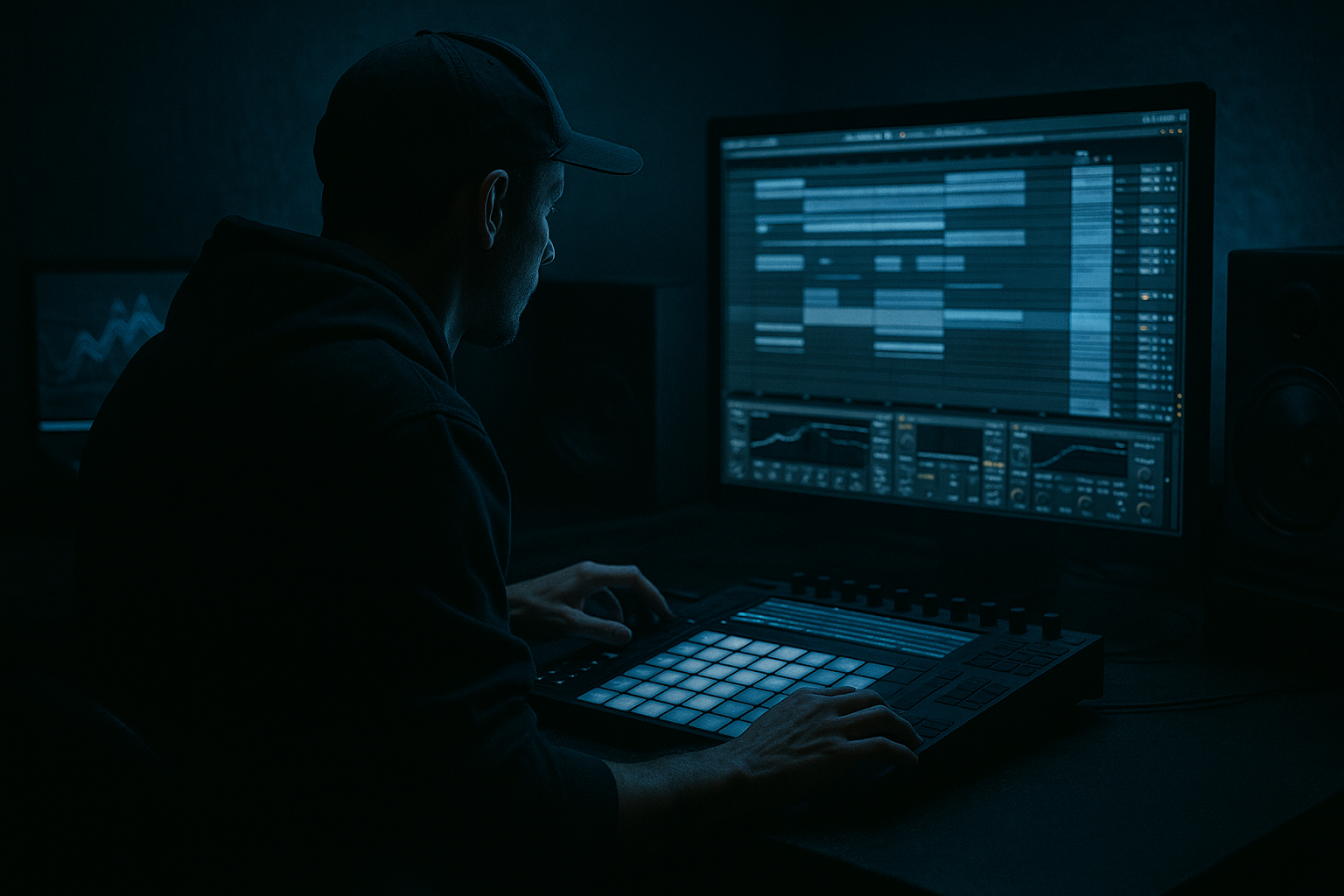
This advanced FX lesson shows how to build a DJ Marky dub siren framework in Ableton Live 12 using Session View to Arrangement View. You’ll create an instrument + FX rack that reproduces the classic pitch-bending, metallic dub-siren character used in Drum & Bass, rig it for live-style clip-driven performance in Session View (Follow Actions, macros, dummy clips), and then record/commit the performance into Arrangement View for final editing and rendering. All examples use Live 12 stock devices and practical Session→Arrangement routing so you can perform, automate, and export a polished dub siren take.
2. What You Will Build
- A compact Wavetable-based dub siren Instrument Rack tuned for DnB.
- An Audio Effect Rack with 2–3 FX chains (clean, filtered/warped, heavy/bit-crushed) switchable via Chain Selector.
- Macro mappings for intuitive live control: Pitch Bend amount, Filter sweep, LFO Rate, Distortion/Drive, Wet/Dry.
- A Session View setup: several MIDI clips (different melodic phrases), Follow Actions to alternate phrases, and dummy automation clips for parameter snapshots.
- A workflow to record the live Session performance into Arrangement View (resampled or via Arrangement record) and finalize the automation.
- Overwide unison: setting Unison detune too high destroys pitch-bend clarity. Keep detune small for a focused siren.
- Mapping too many destinations to one macro without sensible ranges: leads to abrupt, unusable parameter jumps. Set conservative min/max ranges per mapping.
- Not using mono/legato for portamento: sirens need mono mode for smooth pitch slides; using poly mode prevents portamento behavior.
- Forgetting to tempo-sync LFOs: tempo-free LFOs can drift and ruin rhythmic lock with DnB drums.
- Recording without resampling or Arrangement armed: you might lose transient timing of your performance or cannot easily consolidate clips later.
- Overuse of Frequency Shifter or Bit Reduction: too much creates harsh, unmusical artifacts. Tame with EQ and parallel wet/dry.
- Use Chain Selector automation to morph between subtle and brutal FX chains mid-performance—this is faster than toggling multiple devices.
- For DJ Marky-style energy, create short automation "stabs" in dummy clips mapped to Macro 4 (Dirt) to pop the siren into dirty mode for a bar then revert.
- Use two siren racks on separate tracks pitched an octave apart. Triggering them alternately creates call-and-response and fuller sound.
- When mapping LFO Rate to a Macro, map the Rate both to Wavetable LFO and to an overlaid Auto Filter LFO for multi-layered rhythmic motion.
- Record a clean dry resample and a wet resample simultaneously (two audio tracks: one resampling direct, one post-FX) — gives you maximum editing and mix flexibility.
- Freeze + Flatten a take at several points and comp in Arrangement for glitch-free artifacts rather than running lots of heavy FX live.
- Use Utility > Gain automation to duck the siren moments under a kick transient (sidechain compressor if you want pump, Utility gain automation for manual control).
- Create the Wavetable siren with Portamento and map 3 macros: Pitch Bend (Macro1), Filter Sweep (Macro2), Dirt (Macro3).
- Make 3 MIDI clips in Session View: Clip A (1-bar repeating riff), Clip B (2-bar long whoop), Clip C (1/2 bar stab).
- Create one dummy clip that automates Macro3 (a quick dirt burst) and another that ramps Macro2 across 2 bars.
- Use Follow Actions to cycle A -> B -> C and fire the dummy clips during playback.
- Arm an audio track to Resampling and record one take while performing a manual Macro1 pitch-bend with your controller.
- Move to Arrangement View, trim, and apply a short Echo send automation on the final whoop. Export a 16-bit WAV of the siren alone.
3. Step-by-Step Walkthrough
Preparation and Track Setup
1) Create a new MIDI track named "SIREN_RW" and insert Wavetable (stock synth).
- Global: Set Unison to 3 (or 2), Detune low (0.05–0.12) for thickness.
- Osc A: set to a saw/triangle blend (start mostly saw), Osc B off for now.
- Pitch: set coarse transpose to -12 to -7 for sub/octave starting point (experiment for desired register).
- Glide/Portamento: Enable Portamento with Mode = Mono, Glide time around 20–70 ms (adds smooth pitch bends).
- Voices: Mono mode for classic siren behavior.
2) Design the raw siren tone in Wavetable
- Filter: Use Wavetable’s Filter section set to 24dB Lowpass (or Bandpass for more nasal siren). Cutoff around 1–2 kHz.
- LFO1: set to Sync, shape = saw or sine, Rate = 1/8 - 1/16 (tempo-synced). Map LFO1 to Filter Cutoff (positive) and to Pitch (as small amount) for the wobble.
- Envelope 2 (Pitch Envelope): give a short attack (~10–40 ms) and medium decay (~300–700 ms) with some sustain/decay curve. Map Envelope 2 to Osc A Pitch (coarse or semitone) to do pitch-sweep "whoop" moves.
- Add subtle feedback: enable Oscilloscope > Warp or add Osc B with FM for metallic harmonics if you want a more aggressive siren.
3) Add FX devices (chain order matters)
- Audio Effect Rack (call it "SIREN_FX_RACK") — we’ll create chains for performance switching.
- First chain (Global FX, always-on): Auto Filter (Band/Comb or state-variable), Frequency Shifter (subtle for metallic ring; set Amount small and fine control), EQ Eight (to shape), Compressor/Glue for glue.
- Second chain (Dirty): after global, create second chain in same rack with Saturator => Echo => Resonator (if needed) => Redux. This chain will be used for aggressive siren bursts.
- Third chain (Reverse/Noise): chain with Grain Delay or Corpus and Utility to create breathy textures.
4) Map Macros (this is crucial for Session performance)
- Map Macro 1 = Pitch Bend Amount: map to Wavetable Envelope 2 Amount (pitch envelope depth) and/or master Transpose on Wavetable.
- Macro 2 = LFO Rate: map to LFO1 Rate (both Wavetable LFO and the device LFO if using one); set range so low-to-high covers 1/4 → 1/32.
- Macro 3 = Filter Sweep: map to Wavetable Filter Cutoff + Auto Filter Frequency (macro moves both for big sweeps).
- Macro 4 = Dirt: map to Saturator Drive + Redux bit-reduce + Frequency Shifter Amount.
- Macro 5 = FX Mix: map to Audio Effect Rack Chain Selector (or to return send levels) to switch chains or blend returns.
- Macro 6 = Reverb/Delay Wet: map to Echo Dry/Wet and Reverb Dry/Wet.
- Macro 7 = Width: map Utility Width + Stereo Spread in Echo.
- Macro 8 = Global Output Gain or Compressor Threshold.
5) Make the instrument clip-ready
- Create four short MIDI clips in Session View on the SIREN_RW track: Clip A: short repeating pitch riff (1 bar), Clip B: longer "whoop" melodic sweep (2 bars), Clip C: a percussive gated siren stab (1/2 bar), Clip D: a sustained pad-like note for holding presence.
- Each MIDI clip contains only notes that trigger Wavetable; leave velocity variation for expression.
- For clip note positions, use notes across a 2–3 octave range so the pitch envelope and Macro changes are audible.
6) Implement Follow Actions for dynamic variation
- Select Clip A: set Follow Action 1 = Next, Follow Action 2 = Play Again; set time = 1 bar; ratio = 2:1 to prefer switching.
- For Clip B and C set different Follow Actions (Random, Previous) so launching the scene produces unpredictable but musical call-and-response patterns.
- This gives DJ-style unpredictability similar to live siren interplay used by DJ Marky.
7) Add dummy clips for parameter automation in Session View
- Create an empty MIDI or Audio track named "SIREN_DUMMY_AUTOS".
- Load an empty MIDI clip set to "MIDI Ctrl" (dummy) and open Clip Envelopes. Select the SIREN_RW device and a Macro mapping (e.g., Map Macro 1).
- Draw curves in the Clip Envelope for that macro: short peaks for short pitch bends, long ramps for gradual sweeps.
- Create several dummy clips with different envelope shapes and lengths. These are snapshots you can fire live to change macros per clip.
8) Live performance workflow in Session View
- Map a hardware controller knob or set up Key Map for the eight Macros for hands-on control.
- Arm an Audio track to Resampling (create an audio track, set Audio From = SIREN_RW, Monitor = In, or use a dedicated "Resample" track). This will capture the live audio output.
- Option A (Session→Arrangement capture): Press the Arrangement Record button in Live's transport, start launching clips and turning macros. Live will record your clip launches and performed macro automation into Arrangement.
- Option B (Resample method): Create a new Audio Track set to Resampling, arm it, then launch clips and perform Macros — record the resampled audio clip(s) per take. Use Session Record to capture multiple takes and keep best takes.
9) Commit and refine in Arrangement View
- After a live take, stop and go to Arrangement View. You will find the recorded audio regions and/or automation lanes.
- Clean up: quantize your recorded audio if needed, edit automation curves (especially for Macro-driven parameters) using node smoothing and automation curves to tighten transitions.
- If you recorded MIDI and want audio, freeze/flatten or resample in Arrangement to create final audio render that’s CPU friendly and ready for processing (sidechain, final compression, master bus).
10) Final polish FX chain and placement in mix
- Add EQ Eight post-recording to notch out any frequency clashes (typically between 200–500 Hz where siren energy and bass can fight).
- Use Sidechain compression from the kick/bass bus if the siren sits in the same pocket—set a fast attack and medium release for pumping dub character.
- Automate reverb send to create distant dub siren drops and delays (Echo tempo sync 1/4 or dotted 1/8 with feedback ~30–40%).
4. Common Mistakes
5. Pro Tips
6. Mini Practice Exercise
Task: Build a 2-bar performance and commit it to Arrangement.
7. Recap
This lesson showed how to create a DJ Marky dub siren framework in Ableton Live 12 using Session View to Arrangement View. You built a Wavetable-based siren instrument, put it into an Audio Effect Rack with chain switching, mapped expressive macros, used Session View clips + Follow Actions + dummy automation for live performance, and explained ways to capture that performance into Arrangement for final editing. Follow the script: design the voice, map macros thoughtfully (with sensible ranges), perform in Session View (resampling or Arrangement recording), then clean and render in Arrangement. Repeat the Mini Practice Exercise to lock in the workflow and start shaping your own Marky-inspired siren takes for Drum & Bass mixes.

