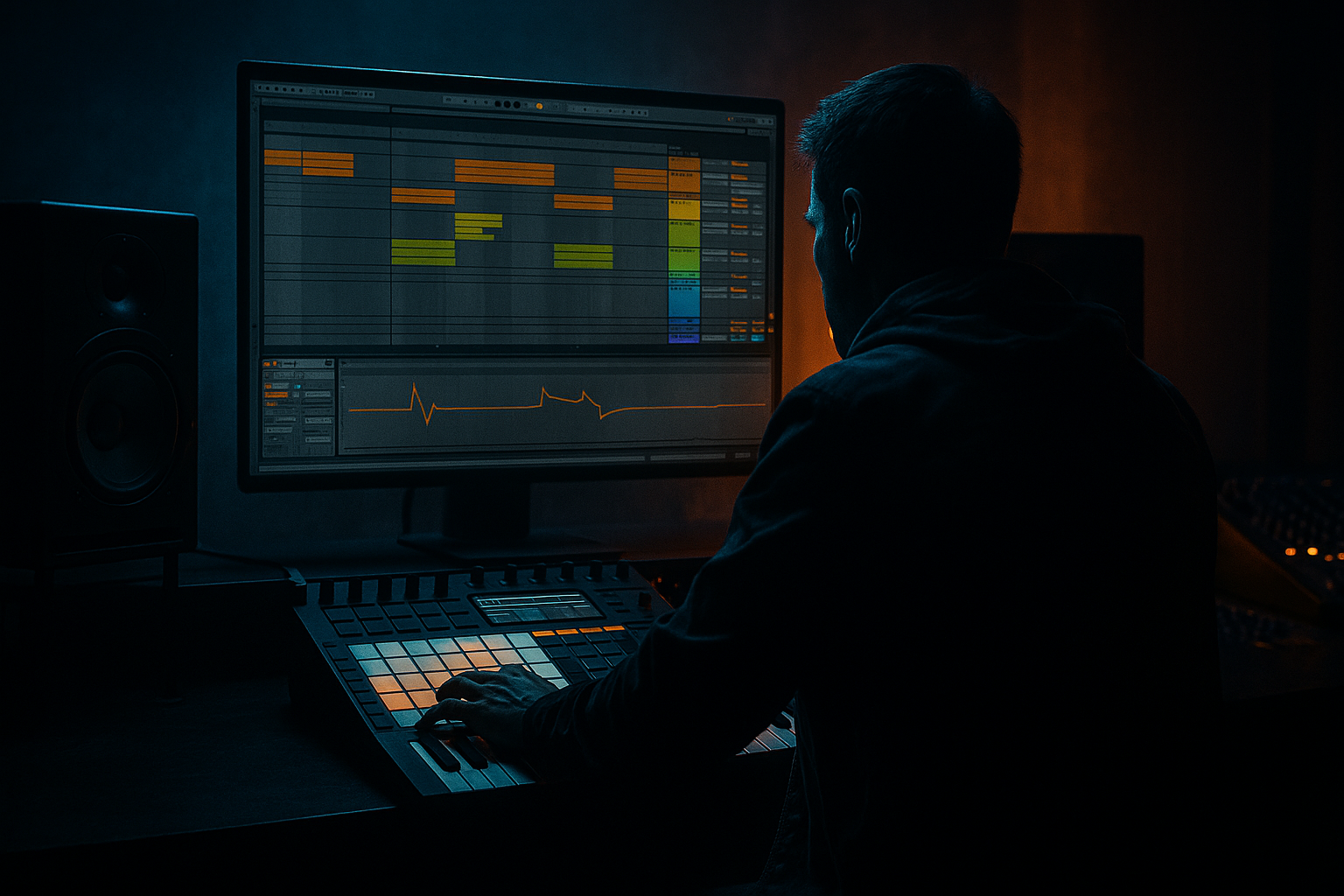
Main tutorial
```markdown
DJ-Style High-Pass Automation for Transitions (DnB in Ableton Live) 🎛️⚡
1) Lesson overview
DJ-style high-pass (HP) automation is one of the fastest ways to create clean, hype transitions in drum & bass: you strip the low end out of a section, build tension, then slam the subs back in right on the drop. In Ableton Live, we’ll do this like a DJ mixer, but with production-grade control—tight timing, clean gain staging, and options for darker/heavier vibes.
You’ll learn:
- The best places to apply HP automation (group vs master vs individual buses)
- How to avoid the classic “why did my drop feel smaller?” mistake
- How to combine HP with reverb/delay throws and noise risers for rolling DnB energy
- A DJ-style high-pass sweep (with resonance control)
- A pre-drop “thin” moment (classic club tension)
- A clean reset at the drop (sub returns hard)
- Optional reverb throw and noise layer to glue it together
- Put drums + music in a PreDrop Group (or two groups: DRUMS, MUSIC)
- Keep SUB on its own track/group and do NOT high-pass it (unless you’re intentionally DJ-filtering everything)
- muted intentionally for the final 1/2–1 bar, or
- kept steady while everything else thins (more modern rolling approach)
- Group your Drums tracks → `Cmd/Ctrl + G` → rename `DRUMS`
- Group your Music tracks (bass mids, synths, atmos) → rename `MUSIC`
- Keep SUB separate (or in its own group)
- Filter type: High-Pass (HP)
- Slope: 24 dB/oct (cleaner DJ-style cut)
- Frequency start: ~ 30–60 Hz
- Frequency end: 250–600 Hz (depends on how extreme you want it)
- Resonance (Q): 0.70–1.20 (small peak = more tension, but don’t whistle)
- You’ll automate Gain slightly if needed because HP + resonance can change perceived loudness.
- Drive: 1–3 dB
- Soft Clip: On
- 8 bars build (classic, fast and functional)
- 16 bars build (more atmospheric / dancefloor drama)
- Identify the last 8 bars before your drop.
- Place a locator at:
- Bars 1–6: gradual rise
- Bar 7: faster rise
- Last 1/2 bar: push harder (optional)
- Press `A` to show automation.
- Choose `Auto Filter > Frequency`.
- Use breakpoints and curve lines (hold `Alt/Option` to bend curves).
- Start: 0.70–0.90
- End (last bar): 1.00–1.30
- Right at drop: snap back to 0.70–0.90
- Auto Filter Frequency → back to 50–70 Hz
- Resonance → back down
- Utility Gain → 0 dB (or whatever your baseline is)
- Automate Utility Gain down quickly (e.g., -inf to -6 dB briefly)
- Then instantly back on at the drop
- `Return A: Reverb` (stock Hybrid Reverb or Reverb)
- Time: 1/4 or dotted 1/8
- Feedback: 20–40%
- Filter in Echo: HP around 200–500 Hz
- This gives you a wash that carries into the drop, without muddying the sub.
- Add Operator (or use a sample)
- Add Auto Filter HP 24 dB/oct
- Automate its Frequency similar to your main sweep (but even higher)
- Sub track is clean and consistent
- Your build doesn’t get louder unintentionally (resonance can spike)
- Your drop feels bigger, not just “different”
- Spectrum (on Master) to see low-end dip and return
- Limiter (temporary, for safety while designing)
- Split your bass into SUB + MID (common in rolling/heavy DnB):
- Use a steeper slope (24 or 48 dB/oct) for ruthless “neuro-style” thinness:
- Add parallel distortion that stays audible while lows vanish
- Pre-drop drum focus trick
- Tension with stereo
- Use Auto Filter HP on DRUMS/MUSIC groups, not automatically on the master.
- Sweep higher than you think (300–600 Hz near the end) for real DJ-style tension.
- Automate Resonance carefully for bite, and reset at the drop.
- Support the sweep with reverb/delay throws and a noise riser for club-ready energy.
- In darker/heavier DnB, keep SUB separate and filter mids, not the foundation.
---
2) What you will build
A practical 8–16 bar transition from an A section to a drop, using:
You’ll end with a reusable Transition Rack you can drop into any DnB project. 🧰
---
3) Step-by-step walkthrough
Step 0 — Choose the right target (where to automate)
For DnB, we usually want to sweep the musical/drum bus, not the whole master.
Recommended approach (most common):
Why: DnB relies on consistent sub energy. A DJ-style HP into the drop works best when the sub is either:
Ableton setup:
---
Step 1 — Create a “DJ Filter” device chain (stock devices)
On the DRUMS group (and optionally on MUSIC too), add this chain:
1) Auto Filter (for the HP sweep)
2) Utility (for gain compensation)
Optional (very DnB):
3) Saturator after the filter (subtle glue)
This can add “pressure” as the low end disappears, keeping energy up.
Pro workflow tip: Save this as an Audio Effect Rack called `DJ HP Transition` so you can reuse it.
---
Step 2 — Decide the transition length (DnB-friendly timing)
Common DnB transition shapes:
In Arrangement View:
- `Build Start`
- `Drop`
---
Step 3 — Automate the high-pass sweep (Arrangement View)
On the DRUMS group Auto Filter, automate Frequency.
A reliable curve (8-bar build):
- from ~50 Hz → 180 Hz
- 180 Hz → 300 Hz
- 300 Hz → 450–600 Hz (for that “thin air” moment)
How to draw it:
DnB feel tip: Don’t do a perfectly linear ramp. A slightly accelerating curve feels more like a DJ hand movement and creates better tension.
---
Step 4 — Automate resonance (Q) for controlled excitement
Resonance adds that “DJ filter bite,” but too much will honk.
Automate Resonance like this:
Key move: At the drop, your filter must reset instantly (or within a few ms). You want the listener to feel the floor return. 🧱
---
Step 5 — Make the drop hit: hard reset + micro-gap (optional)
Two classic options:
#### Option A: Hard reset only (cleanest)
At the drop (beat 1):
#### Option B: Add a tiny “DJ cut” gap (more dramatic)
In the last 1/8 or 1/4 beat before the drop:
This mimics a DJ momentarily cutting the channel before slamming it back.
---
Step 6 — Add the classic reverb/delay throw (DnB spice) 🌫️
This fills space as lows disappear.
On a Return track:
- Decay: 2.0–4.5s
- Pre-delay: 10–25 ms
- High-pass inside reverb (if available): 200–400 Hz (keep it clean)
Optional `Return B: Delay` (stock Echo)
Now automate Send levels on a snare fill, vocal stab, or impact in the last 1–2 bars.
---
Step 7 — Add a noise riser that follows the HP (super effective)
Create an audio track `NOISE RISER`:
- White noise
- ~ 200 Hz → 8–12 kHz
Optional: Add Redux lightly (for jungle grit) and keep it quiet.
This creates “air energy” while your drums/music lose weight.
---
Step 8 — Do the “DnB sanity checks”
Before you commit, check:
Use:
---
4) Common mistakes 🚫
1) Filtering the entire master (and killing sub impact)
- If you must filter master for a special moment, do it lightly and briefly.
2) Too much resonance = honk/whistle
- DnB mixes are dense; resonance spikes can poke out painfully.
3) Not resetting automation at the drop
- Your drop hits and… it’s still filtered. Classic rookie pain.
4) HP sweep ends too low (like 120–150 Hz)
- That’s often not “DJ thin” enough. Push it higher for real tension.
5) No gain compensation
- HP + resonance can trick your ear. Use Utility to keep perceived loudness stable.
---
5) Pro tips for darker/heavier DnB 🖤🔊
- Apply HP automation to MID bass only.
- Keep SUB either steady or intentionally mute it only in the final beat.
- Auto Filter at 24 dB is usually enough; for more surgical control try EQ Eight:
- Enable HP filter, set to 48 dB/oct
- Automate the cutoff
- On MUSIC group: subtle Overdrive or Saturator post-filter
- This keeps aggression even when you strip weight.
- As you HP the DRUMS group, automate Drum Buss on the break/fill:
- Drive up slightly (+2 to +6)
- Boom down (avoid fake low end when you’re filtering)
- Automate Utility Width on atmos/pads up slightly in the last 2 bars (e.g., 100% → 130%)
- Keep kick/sub mono.
---
6) Mini practice exercise 🧪
Goal: Build a clean 8-bar transition into a drop at 174 BPM.
1) Pick an 8-bar phrase before your drop.
2) Put Auto Filter HP 24 dB on `DRUMS` group.
3) Automate Frequency:
- Start: 55 Hz
- Bar 6: 180 Hz
- Bar 7: 300 Hz
- Last 1/2 bar: 500 Hz
4) Automate Resonance:
- Start: 0.8
- End: 1.2
5) Add Utility after Auto Filter and automate:
- If build gets harsh/louder, pull -1 to -2 dB near the end.
6) Add one reverb throw on the last snare hit before the drop.
7) At the drop, reset everything instantly.
Listen for: Does the drop feel heavier than the build? If not, your sweep may be too gentle, or you’re filtering the wrong bus.
---
7) Recap ✅
If you want, tell me your sub strategy (steady vs muted pre-drop) and the vibe (liquid / roller / jump-up / neuro), and I’ll suggest an exact automation curve + device chain tailored to it.
```

