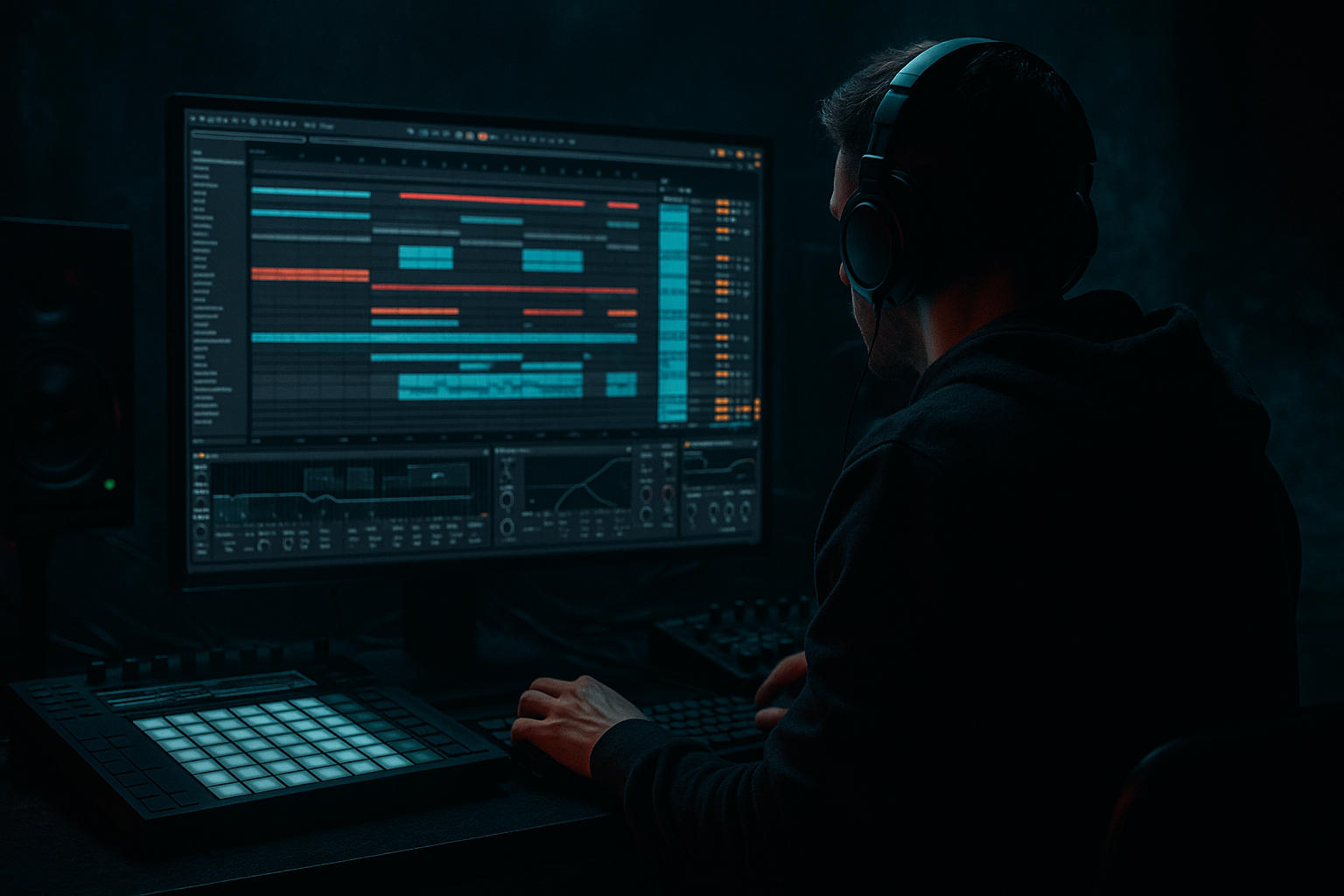
Main tutorial
1. Lesson Overview
This lesson shows a practical Doc Scott approach: modulate a kick and sub lock in Ableton Live 12 for smoky warehouse vibes. You’ll learn a simple, repeatable chain using Ableton stock devices (Sampler/Operator, Auto Filter, Compressor, Saturator, EQ, Utility) to create a punchy, modulating kick and a “locked” mono sub that sits under it without masking or phase issues — the foundation of that dark, smoky, club-ready Drum & Bass feel.
2. What You Will Build
- A two-part kick system: a processed kick body (Sampler) with subtle modulation and grit, and a separate mono sub sine (Operator) that is “locked” to the kick via sidechain and phase alignment.
- A small send/return reverb and processing chain for smoky atmosphere that preserves sub clarity.
- Quick troubleshooting checks (phase, spectrum) to ensure the low end is solid.
- Create a new Live Set. Set tempo to around 174 BPM (typical D&B).
- Create two tracks:
- Automate Auto Filter LFO depth or reverb send during bars to increase tension. Subtlety is key; Doc Scott vibes rely on small, dark movements.
- Letting the kick and sub occupy the same low frequencies: If the kick retains big energy below 50 Hz, you’ll get muddiness. High-pass the kick below ~40–60 Hz or cut sub below 30 Hz.
- Over-sidechaining: If Compressors on the sub duck too hard or have too fast release, the sub will sound unstable. Tune release to match the kick decay.
- Stereo sub: Leaving the sub stereo causes club PA phase problems. Always mono the sub (Utility > Width 0%).
- Overuse of bright reverb on kick: That will smear transient and make the kick lose punch. Low-cut the reverb input.
- Ignoring phase alignment: Even properly EQ’d parts can cancel if not phase aligned; nudge samples or flip phase to check.
- Use Sampler pitch envelope for quick “thump” modulation on the kick — subtle pitch drops give perceived weight and can emulate Doc Scott’s impactful hits.
- Instead of hard cutting the kick’s low end, try gentle shelving so the kick still breathes but leaves space for the sub.
- When sidechaining, use a kick trigger track (a short clean transient clip) if your main kick has noisy tails — this gives a consistent duck envelope.
- Save variations: create two sets of kick body chains (dry & dirtier) and automate switching to create tension.
- Use Spectrum on both Kick Body and Sub soloed to visually ensure the sub fundamental sits around the expected Hz and is the dominant low-frequency energy.
- To add smoky texture without cluttering the low end, use filtered noise layers (highpass above 1 kHz) with long decay and low volume.
- Split kick into body (Sampler) and sub (Operator) so each element is optimized.
- Use Sampler pitch envelope and subtle Auto Filter/LFO to add movement to the kick body.
- Sidechain the mono sub to the kick for a tight “sub lock,” and mono the low end (Utility Width 0%).
- Keep reverb filtered and low so the room is smoky without muddying the sub.
- Always check phase and spectrum soloed and in context.
3. Step-by-Step Walkthrough
(Use Ableton Live 12; all devices are stock Ableton devices.)
A. Project setup
1) Audio or MIDI track for Kick Body (I recommend Instrument Track with Sampler).
2) MIDI track for Sub (Operator).
B. Kick Body (Sampler)
1. Drag a clean, full-spectrum kick sample into Sampler (Classic mode) on the Kick Body track.
2. In Sampler, turn off "Warp" if using an audio clip directly. Use root/key mapping if you want pitch-changes by MIDI.
3. Apply a high-pass in Sampler/after it to remove excessive sub: put an EQ Eight after Sampler and cut everything below ~40–60 Hz with a gentle slope (48 dB if you want very strict separation) so the sub track handles the very low frequencies.
4. Create transient shading:
- In Sampler’s Amp Envelope: set Attack = 0 ms, Decay = 80–180 ms (depending on sample), Sustain ~0, Release = 40–100 ms.
- In Sampler’s Pitch Envelope (Pitch Env): set Amount = -6 to -18 semitones, Attack = 0 ms, Decay = 120–220 ms. This small pitch drop through the first 100–200 ms mimics that Doc Scott “thump” and helps the kick cut through.
5. Add Auto Filter after EQ Eight for timbral movement:
- Type: Low Pass.
- Cutoff around 1.5–3 kHz (we’re shaping top end), Resonance low.
- Add an LFO device (Ableton LFO) after Auto Filter and map its output to the Auto Filter Cutoff. LFO rate: sync to 1/8 - 1/16; amount: very subtle (2–8%). Wave: Triangle or Sine. Phase: offset slightly if needed.
- This gives a slow, repeating “breath” to the kick that contributes to the smoky vibe without sounding like an LFO wobble.
6. Add saturation / grit:
- Put a Saturator after the filter. Drive ~2–5 dB, set Curve to “Analog Clip” or keep default and increase Warmth. Use the Output to avoid clipping.
- If you want extra punch, add a small amount of Frequency Shifter (0.1–0.5 Hz) set to "Ring" off or normal for micro modulation; keep mix low.
7. Final EQ:
- Use EQ Eight to scoop conflicting mids if needed (notch 200–400 Hz) and boost transient presence around 2–4 kHz by 1–3 dB.
C. Sub Track (Operator)
1. Create a MIDI clip that matches the kick pattern’s hits.
2. Load Operator. Init preset:
- Osc A: Sine wave, Level high.
- Osc B/C/D off.
3. Amp envelope: Attack = 0 ms, Decay = match kick decay ~120–250 ms, Sustain = 0, Release = short ~60–180 ms (match to taste).
4. Pitch and tuning: ensure the sub’s root note matches your track key (tune so the fundamental sits under ~60–90 Hz depending on your key).
5. Mono below ~120 Hz:
- Put Utility after Operator and set Width = 0% (mono) to lock the low end to center.
6. Low-pass & cleaning:
- After Utility, add EQ Eight: low-pass at ~180–350 Hz (steep slope not necessary), and gently cut any energy above 300–400 Hz so the sub is pure.
7. Sidechain locking:
- Add Ableton Compressor (not Glue) after EQ Eight. Open Sidechain; choose the Kick Body track as input.
- Compressor settings: Ratio 4:1 (start), Attack 0.5–5 ms (fast but not instant), Release 80–180 ms (tune to match the kick tail; shorter release = more pumping, longer = smoother lock). Threshold: bring down until you hear the sub duck with each kick so the kick transient pokes through; aim for 2–6 dB of gain reduction on each hit. This is the “sub lock” — it allows the kick body to come forward while the sub supports the tail.
8. Fine phase alignment:
- Solo Kick Body + Sub. If they collide, try inverting the Kick Body track phase (Utility > Phase Flip) or nudge the clip by a few samples until the transient line-up feels strongest and lowest cancellation occurs.
- Use Spectrum (device) to visually check sub energy centered and not dipping.
D. Bus & Glue
1. Create a Drum Bus return (group the Kick Body + Sub into a Drum Group track).
2. Put Glue Compressor on the group with light gain reduction (1–3 dB) to glue transient/sub together.
3. Multiband or slight gentle Saturator on the group can add the smoky grit — keep it subtle.
E. Space / Smoky Ambience (preserve low end)
1. Create a Return track with Reverb (Reverb device).
2. On the Reverb:
- Pre-filter the send: open EQ Eight before the Reverb and high-pass at ~600–900 Hz and low-pass at ~6–8 kHz to keep reverb airy and remove low-frequency wash.
- Reverb Decay short (0.6–1.2 s), Diffusion medium, Dry/Wet on Return 20–30% (send amount controls wet).
3. Send small amounts from Kick Body and drum bus to taste — this creates that smoky room without muddying sub.
F. Quick Automation / Movement
4. Common Mistakes
5. Pro Tips
6. Mini Practice Exercise
Goal: Create a locked kick/sub pair in 15–30 minutes.
1. Load a kick sample into Sampler. High-pass at 50 Hz.
2. Apply a pitch envelope in Sampler: -10 semitones decay 160 ms.
3. Add Auto Filter + LFO mapped to cutoff (1/16 synced, amount small).
4. Make a new MIDI track with Operator (sine). Program the same hit pattern as Kick.
5. Utility Width = 0% on Sub. EQ Eight low-pass at 300 Hz.
6. Put Compressor on Sub, sidechain from Kick. Set Attack 2 ms, Release 120 ms, Ratio 4:1, threshold for ~3 dB ducking.
7. Solo both and check phase; flip kick phase if low end collapses.
8. Add small reverb send (EQ before reverb to remove everything below 600 Hz). Listen in context and adjust release/decay times to taste.
7. Recap
You’ve built a Doc Scott approach: modulate a kick and sub lock in Ableton Live 12 for smoky warehouse vibes using stock devices. Key points:
Practice the mini exercise above a few times with different kick samples and sub tuning — the more you match decay/release and phase, the closer you’ll get to that heavy, smoky Doc Scott club sound.

