Main tutorial
Lesson Overview
In oldskool jungle and deeper Drum & Bass, the bassline turn is where the track stops being a loop and starts feeling alive. A “turn” is that moment when your bassline shifts direction, swaps notes, bends energy, or opens up into a new phrase just before or after the drop. Done well, it creates the classic sense of tension, momentum, and “hold tight” movement that makes a tune feel like it’s rolling forward rather than just repeating.
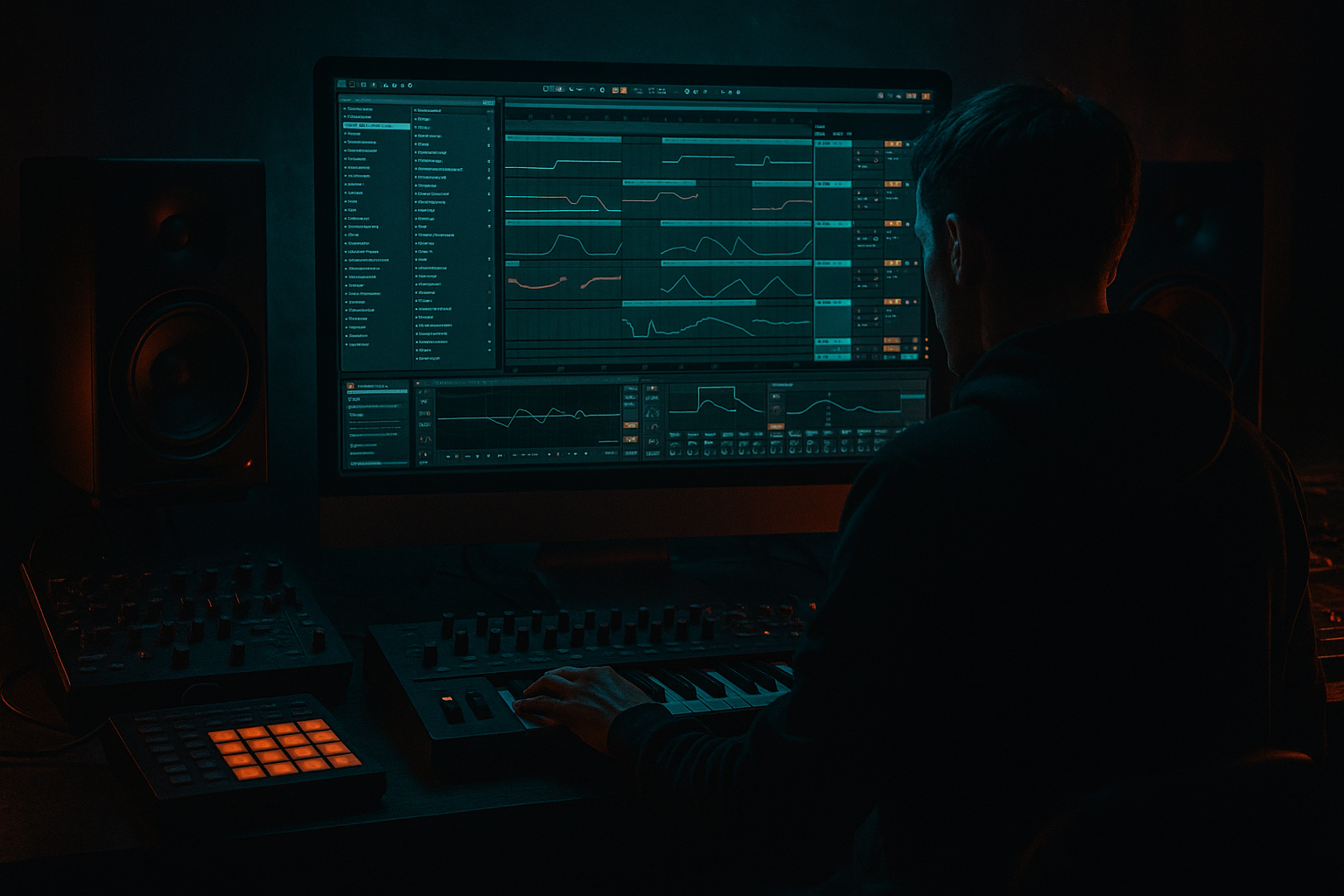
In Ableton Live 12, automation is the fastest way to sculpt that turn without reprogramming the whole bassline every time. You’ll use device automation, clip envelopes, MIDI note edits, and a few stock effects to make your bassline feel like it’s leaning into a corner, then snapping out of it. This is especially important in jungle and oldskool DnB, where the bass often behaves like a conversation with the drums: the kick and snare hit, the bass answers, then the phrase turns and resets.
Why this matters in DnB: a strong bassline turn creates arrangement movement, keeps the low end engaging, and helps the drop breathe. In a roller, it can be a subtle 1-bar shift. In a darker jungle tune, it might be a more dramatic filtered sweep or pitch bend. In neuro-leaning material, the turn might be a carefully automated formant, distortion, or filter move that changes the bass’s character without losing sub control.
What You Will Build
You’ll build a tight 2-bar bassline phrase with a clearly controlled turn on the second bar, designed for jungle / oldskool DnB energy. The result will include:
- a solid mono sub layer
- a reese or mid-bass layer with motion
- a turn phrase that uses automation to open, tilt, or bend the bassline at the right moment
- a DJ-friendly arrangement idea that works in a 16-bar drop section
- clean low-end behavior with enough grit and movement for underground character
- roll underneath breaks without fighting them
- “answer” the snare on 2 and 4
- turn into the next phrase with tension rather than a hard reset
- stay mixable in mono while still sounding wide enough in the mids
- Making the whole bassline wide
- Automating too much at once
- Letting the bass fight the snare
- Over-saturating the sub
- Using a turn that sounds like a random effect
- Ignoring mono compatibility
- Use a two-stage turn: one subtle filter rise, then a quick drop with added drive. That creates menace without overcrowding the drop.
- Resample your bass turn once it works. Flattening it to audio in Ableton lets you edit transients, stretch timing, and add more controlled processing.
- Add a tiny bit of Drum Buss to the mid layer only for extra smack and harmonics. Keep the Boom low or off if your sub is already strong.
- For neuro/darker bass music flavor, automate a narrow filter sweep and a touch of resonance while keeping the envelope tight.
- For more oldskool jungle character, let the bass turn feel slightly imperfect: a small timing push, a bit of grit, and a call-and-response with the break.
- Use contrast. If the first half of the phrase is dark and tight, let the turn briefly open up before snapping back closed.
- Try automation on a return track instead of the bass channel for a temporary echo or reverb bloom, then cut it hard so the next hit feels heavier.
- If the bassline feels too polite, automate a subtle gain lift into the turn, then pull it back. That little swell often makes the phrase feel more alive than adding more distortion.
- Which one works best at low volume?
- Which one feels most DJ-friendly?
- Which one keeps the sub cleanest?
By the end, you’ll have a bassline that can:
Step-by-Step Walkthrough
1. Build the bass instrument as two layers: sub and movement
Start with an Instrument Rack on a MIDI track. Create two chains:
- Chain 1: Sub
- Use Operator or Wavetable with a sine wave.
- Keep it simple: no unneeded unison, no stereo widening.
- Set the oscillator level so the sub sits strong but leaves headroom.
- Chain 2: Mid / reese layer
- Use Wavetable, Analog, or a sampled bass one-shot if you already have a jungle-style source.
- Add light detuning or unison if needed, but keep it controlled.
- Add Saturator after the instrument for grit.
Suggested starting points:
- Sub low-pass or roll-off above roughly 100–140 Hz on the sub chain if needed
- Saturator Drive around 2–6 dB on the mid chain
- Keep the sub chain dry and centered
This split is important because the turn will sound bigger when you automate the mid layer without messing up the sub foundation.
2. Program a 2-bar bassline that already has space for a turn
In the MIDI clip, write a classic DnB phrase that leaves room for drums and movement. For example:
- Bar 1: two or three bass notes, each leaving short gaps
- Bar 2: repeat the idea, but change the final note or rhythm so it feels like it’s “turning”
A simple oldskool structure might be:
- note 1 on beat 1
- answer note on the “and” of 2
- longer note leading into beat 4
- bar 2 ending with a higher or lower note that resolves into the next bar
Keep note lengths tight enough to preserve punch. If the bass is too legato and blurred, the drum groove loses shape. If it’s too short, the turn won’t feel like a phrase.
Why this works in DnB: the genre depends on syncopation and negative space. A bassline turn feels stronger when the rhythm has room to breathe between kick and snare hits.
3. Lock the low end first, then create movement in the mids
Add a Utility on the full bass rack and set the sub layer to mono. If your bass instrument has stereo spread, reduce it on the sub chain so the lowest frequencies remain centered.
On the mid chain, add:
- Auto Filter
- Saturator
- optionally a Phaser-Flanger or Chorus-Ensemble if the sound can handle it, but use lightly
Settings to try:
- Auto Filter cutoff: start around 150–300 Hz on the mid layer, then automate
- Resonance: 5–20% for subtle character, higher only if you want a more aggressive sweep
- Saturator mode: Soft Clip or Analog Clip if you want controlled bite
The goal is not to hear “effects” for their own sake. The goal is to make the bassline turn feel like it changes shape as it moves through the bar.
4. Automate the filter to create the actual turn
Open Arrangement View or keep it inside the MIDI clip—either is fine. For a fast workflow, use clip envelopes on the bass MIDI clip, then refine in Arrangement if the turn needs to be more musical.
Automate the mid-chain Auto Filter cutoff so the bass opens slightly just before the turn and closes or shifts during the resolution.
A strong starting move:
- Bar 1: cutoff around 180–250 Hz for a darker tone
- At the end of bar 1: sweep up to 700–1.5 kHz over a short curve
- Bar 2: pull it back down to 250–400 Hz or push it into a different movement shape
Keep the automation curve deliberate:
- use a smooth rise for tension
- use a sharper drop for a classic “snap back”
- use a stepped or slightly curved movement if you want a more restless jungle feel
This is the turn. It tells the listener that the phrase is changing without requiring a whole new bassline.
5. Add note automation and MIDI expression for more natural movement
In Ableton Live 12, you can make the turn more musical by editing note expression if your source supports it, or by adjusting MIDI velocity and note length. For a bass sound that responds to dynamics, use these ideas:
- Shorten the last note before the turn so the next phrase lands harder
- Increase velocity on the note that introduces the turn
- Add a small pitch drop or pitch rise if the bass patch responds cleanly
- Use glide/portamento only on selected notes if your sound design supports it
Practical examples:
- On a Reese-style bass, a slight pitch fall on the last note can add menace
- On a chopped jungle bass stab, a small velocity rise on the turn note can help it cut through breaks
- On a sub-heavy roller, keep pitch movement subtle and let filter automation do more of the work
Don’t overdo pitch modulation in the sub region. The low end should feel intentional, not seasick.
6. Tie the bass turn to the drums with call-and-response
Now place the bass against the break. If your drums have a classic amen-style or chopped break pattern, let the bass turn happen in the gap after a snare, or just before the next one. That gives it a natural rhythmic anchor.
Workflow:
- solo drums and bass together
- listen for clashes around the snare transient
- nudge bass notes so they answer the break rather than sit on top of every kick
If needed, use a second MIDI clip variation for the second 8 bars:
- first 8 bars: more restrained
- second 8 bars: slightly more open filter turn or extra note at the end of bar 8
Arrangement example:
- Bars 1–8: establish the groove
- Bars 9–16: repeat with a bigger turn on bar 12 or 16
- Bars 17–24: strip elements away or introduce a new drum edit so the bass turn feels like a transition
This keeps the phrase DJ-friendly and avoids the “loop with no story” problem.
7. Shape the movement with rack macros for faster control
Group your bass chain into an Instrument Rack and map a few controls to Macros. This is one of the best intermediate workflows in Ableton because it makes the turn easy to revise later.
Useful macro mappings:
- Macro 1: filter cutoff
- Macro 2: Saturator drive
- Macro 3: chorus or unison amount on the mid layer
- Macro 4: reverb send amount for a tiny tail on the turn only
- Macro 5: utility gain or mid-layer volume
Then automate the Macro instead of individual device parameters when possible. This makes editing cleaner and more musical.
Suggested range ideas:
- Filter Macro: low at 20%, high at 65–80%
- Drive Macro: 0 dB to about +5 dB
- Mid layer volume: automate only a subtle +1 to +3 dB lift during the turn
Use Macro automation for performance-like movement and leave device detail for final polish.
8. Add transition FX only where the bassline turn needs extra emphasis
If the turn is supposed to feel like a bigger arrangement event, reinforce it with light FX rather than clutter.
Good stock Ableton choices:
- Echo for a short mid-range throw on the turning note
- Auto Pan for a brief movement burst on the mid layer only
- Reverb with a very short decay, sent subtly from the bass turn, not the full bassline
- Drum Buss on a parallel return if you want extra smack on the bass mids
Keep the low end dry. If you want a halo around the turn, make it happen above the sub layer. One useful trick is to automate a send to Echo only for the last bass note of the phrase, then drop it back immediately on the next bar.
This adds personality while preserving the “straight through the chest” DnB foundation.
9. Check the bass turn in context with the break and mix balance
Turn off solo mode and listen in context with drums, pads, and any atmospheres. The key checks:
- Does the bass turn fight the snare?
- Does the sub stay centered in mono?
- Does the mid movement disappear when the drums come in?
- Is the automation audible without being cheesy?
Use Utility on the master or on the bass bus for mono checking. If the bass loses too much power in mono, reduce stereo spread on the mid layer or remove phasey effects.
For mix balance:
- keep the sub clear under the kick pattern
- if the bass masks the snare body, dip 150–300 Hz slightly on the bass bus
- if the turn feels weak, boost the mid layer a little rather than pushing the sub louder
In DnB, the best turns usually feel exciting because of contrast, not because everything gets bigger at once.
10. Finalize the arrangement so the turn serves the track, not just the loop
Place the turn where it helps the tune move forward:
- at the end of an 8-bar phrase
- just before a break edit
- into a drop variation
- before a DJ-friendly 16-bar exit
A strong oldskool arrangement move is to let the bassline turn happen on bar 8 or 16, then strip elements for 1–2 bars before the next section. That creates breathing room and makes the next drop land harder.
If you want more jungle tension, automate a slight filter close on the last half-bar before the new section, then reopen it on the downbeat. If you want a darker roller feel, keep the automation subtler and let the rhythm do more of the work.
Common Mistakes
- Fix: keep the sub mono and reserve width for the mid layer only.
- Fix: choose one main turn move first, usually filter cutoff or resonance, then add only one supporting change.
- Fix: move bass notes off the snare transient, or cut a little low-mid if the two overlap too heavily.
- Fix: distort the mid layer more than the sub. The low end should stay controlled.
- Fix: make sure the automation follows the phrase rhythm. The turn should feel like a musical answer, not a preset trick.
- Fix: check in mono often, especially if you’ve used chorus, phaser, or stereo unison on the bass.
Pro Tips for Darker / Heavier DnB
Mini Practice Exercise
Spend 10–20 minutes making three versions of the same 2-bar bassline turn in Ableton Live:
1. Version A: filter-based turn only
- Build a sub + mid bass rack.
- Automate only Auto Filter cutoff on the mid layer.
- Aim for a clear but subtle rise into bar 2.
2. Version B: filter + drive
- Copy Version A.
- Add Saturator Drive automation so the turn gets slightly harder near the peak.
- Keep the drive increase small, around 1–4 dB.
3. Version C: filter + drive + note change
- Copy Version B.
- Change the final note of bar 2 by one or two scale degrees, or shorten it so the next bar feels more urgent.
- Test it with a break loop under it.
Then compare all three in context:
Export the winner as a short 16-bar loop idea and save the rack as a preset for future tunes.
Recap
A strong bassline turn in DnB is about phrase movement, not random FX. Keep the sub solid, automate the mid layer for shape, and make the turn answer the drums with musical timing. Use Ableton stock tools like Auto Filter, Saturator, Utility, Echo, and Instrument Racks to build tension, then release it at the right moment. If the turn feels clean in mono, supports the break, and helps the arrangement move forward, you’ve nailed the vibe.

