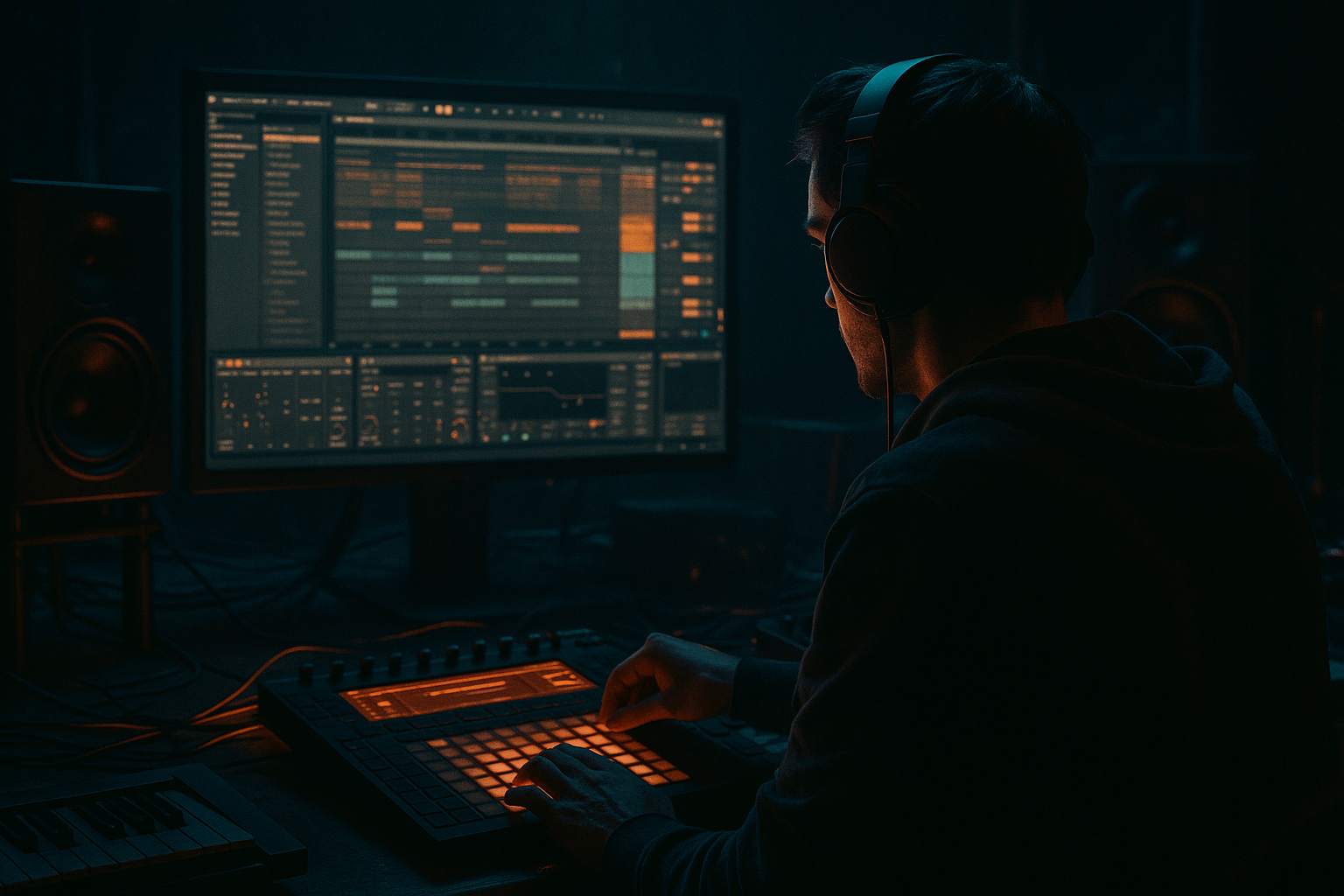
Main tutorial
Drive Jungle Vocal Texture for 90s-Inspired Darkness in Ableton Live 12 (DnB/Jungle Edits) 🖤🎛️
1. Lesson overview
This lesson is about turning plain vocals (or vocal one-shots) into dark, driven, 90s-jungle-style texture—the kind of gritty, haunted “radio-through-concrete” vocal vibe that sits inside a rolling DnB mix without sounding like a clean pop acapella.
You’ll build an editable vocal rack that lets you:
- Push harmonic drive + crunch while staying mix-safe
- Create time-warped jungle movement (pitch dips, stutters, resampling artifacts)
- Add dark space (short rooms, dubby throws) without washing out drums
- Short phrases (“selecta”, “come again”, “rewind”, “original”, etc.)
- Spoken or shouty vocals with midrange content
- 90–140 BPM vocals work great because warp artifacts become part of the texture when pushed to 170–174
- Macro 1: Core Level
- Macro 2: Grit Level
- Macro 3: Ghost Level
- Macro 4: Grit Drive (Roar/Drum Buss drive)
- Macro 5: Band Limit (EQ Eight LPF freq in GRIT)
- Macro 6: Ghost Duck (Compressor threshold in GHOST)
- Macro 7: Throw Amount (Echo feedback or Hybrid Reverb mix in GHOST)
- Macro 8: Stutter (see next step)
- Interval: 1 Bar or 2 Bars
- Grid: 1/8 or 1/16
- Chance: 10–35%
- Variation: 0–25%
- Pitch: -12 or +0 (taste)
- Gate: 40–80%
- Put reversed vocal tail 1/8–1/4 before snare on 2 and 4
- High-pass it so it doesn’t cloud the kick
- Intro (16 bars): GHOST-heavy, filtered, distant vocal atmos
- Build (8 bars): add GRIT hits on phrase ends, stutters increase
- Drop (32 bars):
- Breakdown: resampled vocal phrase stretched in Texture warp + heavy filtering
- Second drop: introduce a new edit rule (reverse pickups or different stutter grid)
- Too much full-band distortion → turns to harsh fizz and masks hats/snares. Band-limit before driving.
- No sidechain on reverb/delay → ghost chain swallows the groove. Duck it from the breaks.
- Over-warping without intent → artifacts can be sick, but random warping kills phrasing. Place markers musically.
- Stereo everywhere → wide distorted vocals can smear the center. Keep CORE mono-ish, widen only GHOST.
- Ignoring level matching → distortion sounds “better” because it’s louder. Always output-trim.
- Midrange “system” bite: In GRIT, try a small bell boost around 1.6 kHz, then drive. That’s where shout vocals become menacing.
- Make it feel sampled: After resampling, add tiny imperfections:
- Dark-space discipline: Use short rooms more than long halls. Jungle darkness is often tight and dirty, not huge and glossy.
- Call-and-response with bass: Put vocal chops in gaps of your reese/rollers:
- Break-driven timing: Align some edits to amen ghost notes (1/16 swings) so vocals feel “inside the break,” not pasted on top.
- You built a parallel vocal texture rack designed for jungle/DnB: CORE clarity, GRIT dirt, GHOST atmosphere.
- You used warp artifacts as a feature (Texture/Complex Pro), not a mistake.
- You made it mix-safe with band-limited distortion, ducked ambience, and smart stereo strategy.
- You locked it into DnB arrangement by using chops, pickups, and controlled throws, then resampling for authentic 90s edit energy.
This is an Advanced / Edits workflow: fast, repeatable, and designed for arranging.
---
2. What you will build
A Vocal Texture Rack with 3 parallel lanes:
1. Core (Intelligible) – controlled saturation + EQ + tight dynamics
2. Grit (Jungle Dirt) – heavy drive + band-limited distortion + “cassette/radio” character
3. Ghost (Atmos + Throws) – pitch/time artifacts + reverb/delay throws + resample-ready tails
Plus: an edit strategy for placing vocal chops in a 90s-inspired DnB arrangement (2-step/amen/rollers).
---
3. Step-by-step walkthrough
Step 0 — Pick the right vocal source (important)
You’ll get best results from:
DnB target tempo: 172 BPM.
---
Step 1 — Prep the vocal clip for jungle-style warp 🎚️
1. Drop the vocal into an Audio Track.
2. Set Warp = ON.
3. Try these warp modes (choose based on the vocal):
- Complex Pro (best if you want intelligibility)
- Formants: 0 to +2 (keep it human-ish)
- Envelope: 60–120 (tighter = more “edited”)
- Texture (best for ghostly, grainy darkness)
- Grain Size: 20–60 ms (smaller = more robotic/gritty)
- Flux: 10–30% (movement)
- Tones (great for hollow, synthetic vowel vibes)
- Grain Size: 20–40
- Add later distortion for “system” feel
4. In Clip view, do tight start trimming and add a tiny fade-in (1–5 ms) to avoid clicks.
Micro-edit tip: Add 1–3 warp markers and slightly skew timing so the vocal leans into the snare (classic jungle pull).
---
Step 2 — Create a 3-lane parallel rack (Audio Effect Rack) 🧱
On the vocal track, add:
Audio Effect Rack → create 3 Chains: `CORE`, `GRIT`, `GHOST`
Right-click chain list → Create Chain x3.
Enable Chain Volume and Chain Activator for quick A/B.
---
Step 3 — Build the CORE chain (clarity + controlled dirt)
Device order (CORE):
1. EQ Eight
- HPF at 90–150 Hz (24 dB/oct)
- Gentle cut if boxy: 250–450 Hz -2 to -4 dB
- Slight presence if needed: 2.5–5 kHz +1 to +3 dB
2. Saturator
- Mode: Soft Clip ON
- Drive: 2–6 dB
- Output: match level (don’t fool yourself)
3. Compressor
- Ratio: 3:1 to 5:1
- Attack: 10–25 ms
- Release: 60–120 ms
- Aim: 3–6 dB GR for consistency
4. Utility
- Width: 80–100% (keep core mostly mono)
- Gain: trim to fit rack balance
Why: CORE is the “readable” layer so your vocal still translates on small systems.
---
Step 4 — Build the GRIT chain (band-limited jungle distortion) 🔥
This is where the 90s darkness comes from: mid-forward, crushed, slightly broken.
Device order (GRIT):
1. EQ Eight (pre-distortion shaping)
- HPF 200–350 Hz
- LPF 4.5–8 kHz (12 or 24 dB/oct)
- Optional: narrow boost 1.2–2.5 kHz +2 to +5 dB (for snarl)
2. Roar (Ableton Live 12) 🐗
- Start with a distortion type like Tube / Diod / Fold (use ears)
- Drive: 20–45%
- Tone/Filter: keep it midrange-focused
- If Roar has dynamics/feedback options available in your setup: keep it stable, not squealing
3. Redux
- Bit Reduction: 6–10 bits
- Sample Rate: 8–16 kHz
- (Use subtly if you want “AM radio” artifacts; heavy for pure junglism)
4. Drum Buss (yes, on vocals)
- Drive: 5–20
- Crunch: 10–35%
- Boom: OFF (usually)
- Transients: slightly negative if too pokey
5. Gate (optional but very jungle)
- Threshold: set so tails clamp down fast
- Return: 0
- This makes “chops” feel tight and sampled
Key concept: Band-limit before distortion so the distortion grows in the midrange instead of fizzing out the top.
---
Step 5 — Build the GHOST chain (dark space, pitch/time artifacts) 🌫️
This chain creates the haunt around the vocal without stepping on drums.
Device order (GHOST):
1. Pitch hack (choose one):
- Shifter (Frequency Shifter mode) for eerie detune
- Fine: ±10 to ±30 cents (slow modulation if desired)
- Or Transpose clip -5 to -12 semitones (then warp to taste)
2. Auto Filter
- Mode: Band-Pass
- Freq: 300–2.5k (move until it feels “ghostly”)
- Resonance: 0.7–1.2
- Add subtle LFO: Rate 1/8–1/4, Amount small
3. Hybrid Reverb
- Algo: small/medium dark room OR convolution small space
- Decay: 0.8–2.5 s (keep it controlled)
- Predelay: 10–25 ms
- HP/LP inside reverb: HP 250–500, LP 4–8k
4. Echo
- Time: 1/8 or 1/4 (try dotted 1/8 for classic shuffle)
- Feedback: 15–35%
- Filter: keep it dark (LP ~5–7k, HP ~200–400)
- Mod: small for movement
5. Compressor (sidechain from drums)
- Sidechain input: your Drum Group / Break bus
- Ratio: 4:1
- Attack: 1–5 ms
- Release: 80–180 ms
- GR: 4–10 dB on hits
6. Utility
- Width: 120–160% (GHOST can be wide)
- Gain: keep low; it’s support, not lead
---
Step 6 — Rack macro controls (make it playable) 🎛️
Map these to macros:
---
Step 7 — Add jungle “edit” movement: stutters, reverse, resample 🎬
#### Option A: Beat Repeat “tape stutter”
Add Beat Repeat after the rack (or only on GHOST via separate track routing):
Map Chance or Gate to Macro 8 for performance stutters.
#### Option B: Clip reverse hits (classic jungle)
Duplicate the vocal clip, reverse it, and use it as a pickup into the snare:
#### Option C: Resample for “sampled-from-a-track” realism
1. Create a new audio track: `RESAMPLED VOX`.
2. Set input to Resampling.
3. Record a pass while you tweak macros (especially throws + drive).
4. Now chop that audio like a break: tight edits, hard cuts, little fades.
This is the fastest route to authentic 90s “you can’t undo it” texture.
---
Step 8 — Placement in a rolling DnB/jungle arrangement 🥁
Here’s a reliable pattern (172 BPM):
- Use CORE very sparingly (don’t fight the lead bass)
- Place GRIT chops on:
- the & of 2 or & of 4
- 1/16 pickups into snares
- Use Ghost throws only at end of 4- or 8-bar phrases (classic restraint)
DnB mix reality: Your snare owns 180–250 Hz snap + 2–5 kHz crack; keep vocals out of the snare’s “weapon zone” unless intentional.
---
4. Common mistakes
---
5. Pro tips for darker/heavier DnB 🧨
- Clip gain nudges
- micro fades
- occasional hard cuts
- vocal hit answers bass stab
- silence is part of the vibe
---
6. Mini practice exercise (15–25 minutes) ⏱️
1. Choose one vocal phrase (1–2 seconds).
2. Set project to 172 BPM, Warp ON.
3. Build the 3-chain rack (CORE/GRIT/GHOST).
4. Create a 16-bar loop with:
- Break on top (Amen or tight 2-step)
- Sub + reese (simple rolling pattern)
5. Arrange vocal edits:
- Bars 1–8: mostly GHOST texture, 2 throws total
- Bars 9–16: introduce GRIT chops on & of 4 every 2 bars
6. Resample a performance pass while tweaking:
- GRIT Drive
- Throw Amount
- Beat Repeat Chance
7. Chop the resample into 6–10 one-shots, then re-sequence them.
Deliverable: a 16-bar drop loop that feels like it came off a white label 🖤
---
7. Recap
If you want, tell me what kind of vocal you’re using (spoken/shout/sung, male/female, clean/noisy) and whether your beat is more Amen tearout or rolling 2-step, and I’ll suggest exact macro ranges + a bar-by-bar edit blueprint.

