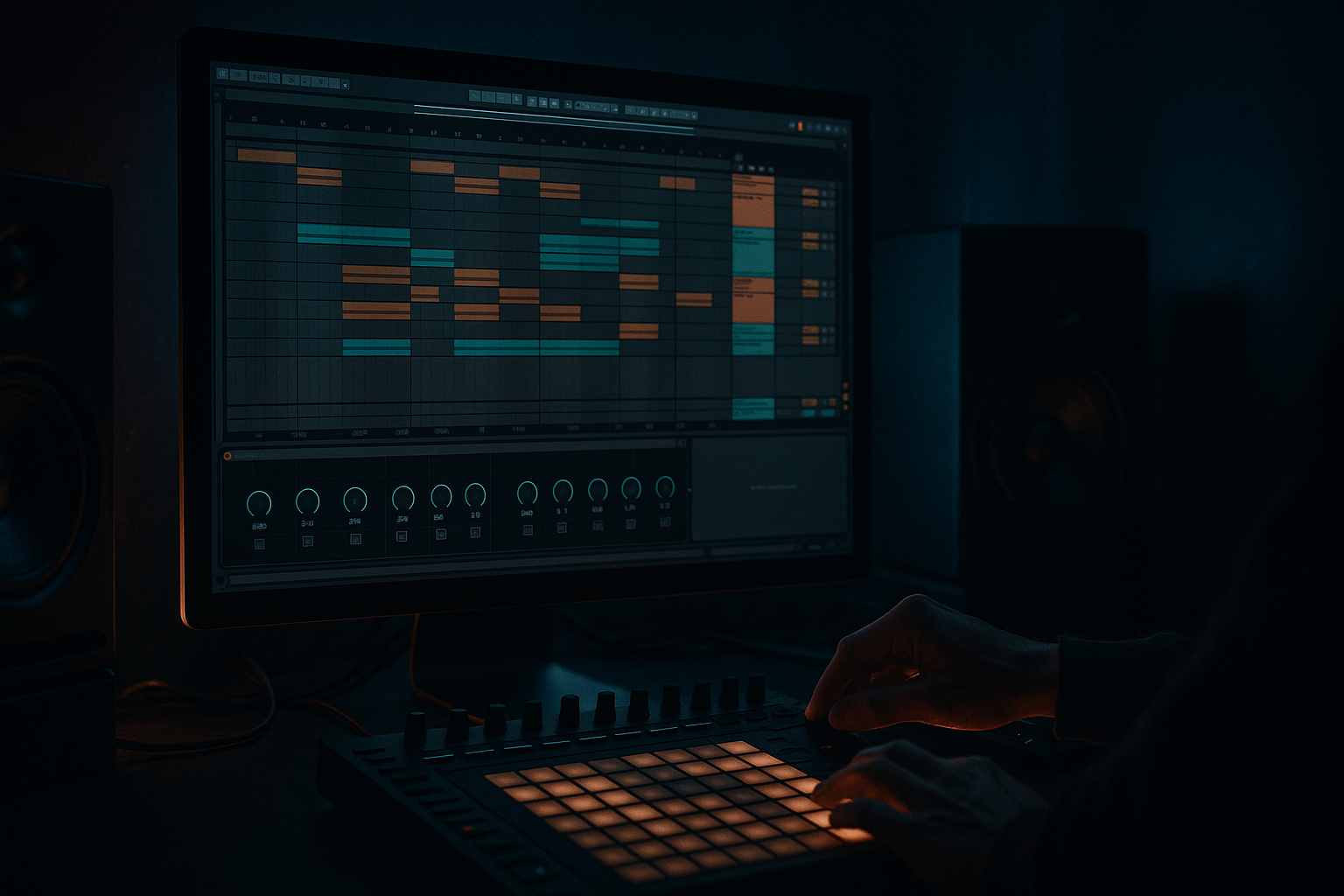
Main tutorial
Drop Ghost Method for Smoky Warehouse Vibes in Ableton Live 12
Jungle / oldskool DnB mastering tutorial for intermediate producers 🔥
1. Lesson overview
The drop ghost method is a mastering-focused arrangement and processing technique for making the first impact of the drop feel bigger, darker, and more “physical” without actually overloading the master.
In DnB, jungle, and oldskool-inspired rollers, this is especially useful for smoky warehouse vibes:
- the intro breathes and feels spacious
- the drop lands with weight, contrast, and menace
- the listener feels the drop hit harder because the energy was controlled before it
- a darker intro master feel
- a ghosted pre-drop drop illusion
- a harder first downbeat
- a controlled low-end and sub floor
- a smoky, warehouse-style loudness profile
- a master that still works for fast breaks + heavy bass movement
- Intro has less width, less sub pressure, and a slightly muted top
- Drop opens up with fuller stereo image, stronger transient punch, and more low-end authority
- The master remains clean enough for jungle break detail and heavy enough for rolling bass systems
- Leave -6 dB to -3 dB peak headroom on the master
- No limiter clipping the mix buss
- Keep the kick/sub relationship clear
- Breaks should already be balanced against bass
- snap
- movement
- room for mastering contrast
- Spectrum for checking the tonal balance
- Drum Buss for subtle punch/weight
- Compressor with sidechain for dynamic control if needed
- Width: 80%–90%
- If the tune is very sparse, even 70% can work for a claustrophobic warehouse feel
- Keep Bass Mono engaged if needed for low-end solidity
- Automate width to 100%
- Open the stereo image for hats, ambience, and break detail
- gentle high shelf cut around 8–12 kHz: -1 to -2.5 dB
- tiny dip in upper mids if the intro feels too “present”
- avoid major low cuts unless the sub is muddy
- restore air around 8–12 kHz
- keep low-end intact
- don’t over-hype 3–6 kHz; that can make jungle breaks brittle
- a touch less 4–7 kHz in the intro
- slightly more presence at the drop so snares and hats “appear”
- Ratio: 2:1
- Attack: 10 ms
- Release: Auto or 0.3–0.6 sec
- Gain reduction: keep it around 1–2 dB, maybe 3 dB max on loud sections
- Soft Clip: On if needed
- the break and bass to feel glued
- the kick to retain punch
- no pumping that collapses the groove
- Drive: 1–4 dB
- Soft Clip: On
- Curve: default or gentle
- Output: level-match carefully
- Adds audibility to sub harmonics on small systems
- Thickens bass without making it too loud
- Gives breaks a vintage, slightly worn texture
- your reese or sub is already harmonically busy
- your break is already crunchy from resampling
- Keep everything below roughly 120 Hz mono if needed
- In Live, Utility is simple and effective for this
- muddy buildup around 180–350 Hz
- boxiness around 400–700 Hz
- excessive sub rumble below 30 Hz
- High-pass gently at 20–30 Hz if needed
- Small cut at 250 Hz if the mix feels cloudy
- Avoid removing too much body from the break
- Tame the low band if the sub jumps too hard on the drop
- Slightly control the high band if hats become spitty
- Keep changes subtle
- Low band compression: light, just a few dB of gain reduction
- Mid band: often leave mostly alone
- High band: minimal reduction only if needed
- Ceiling: -0.8 dB
- Lookahead: default
- Threshold: lower until you hit target loudness while preserving punch
- oldskool/jungle benefits from transient life
- too much limiting destroys break impact
- the drop ghost method relies on contrast, so don’t flatten it
- reduce stereo width slightly
- trim top end a touch
- use a filtered break or filtered bass tail
- let reverb decay into darkness
- create a moment of negative space before the first hit
- the full drum break
- sub/bass back in full
- wider ambience
- more top-end air
- a stronger kick-snare relationship
- automate a low-pass filter on the master? Usually no.
- automate Reverb return down
- automate Utility width down
- let the bass and drums re-enter full spectrum at the drop
- Decay: 1.2–2.5 s
- Low cut: 150–250 Hz
- High cut: 6–9 kHz
- Keep send subtle
- Ping pong off or minimal
- Filtered repeats
- Keep it murky, not shiny
- oldskool jungle rollers
- smoky darkstep-adjacent DnB
- warehouse pressure with break detail
- sub extension
- top-end brightness
- snare crack
- stereo width
- perceived punch at the drop
- Utility width: down slightly
- EQ Eight high shelf: down slightly
- Saturator drive: maybe slightly less if the intro is too bright
- Limiter threshold: leave static, don’t automate for loudness tricks unless you really know the result
- Return to flat EQ balance
- Width back to 100%
- Let the low end breathe fully
- more width
- more bass authority
- more transient clarity
- slightly more top-end air
- headphones
- nearfields
- small speakers
- a sub-equipped system if possible
- 8 bars intro
- 4 bars buildup
- 4 bars drop
- Utility
- EQ Eight
- Glue Compressor
- Saturator
- Limiter
- Width to 85%
- High shelf down 1.5 dB
- Optional: reduce saturation drive by a tiny amount
- Width to 100%
- EQ shelf returns to normal
- Keep compression the same
- Let the limiter do minimal work
- Does the drop feel wider?
- Does the snare hit harder?
- Does the bass feel more physical?
- Does the room “open up”?
- width
- top end
- low-end mono
- saturation
- a slightly narrower, darker intro
- controlled low-end and stereo image
- subtle saturation and compression
- a drop that opens up in width, brightness, and impact
- mastering choices that preserve transient life and bass authority
- Utility for width and mono control
- EQ Eight for tonal shaping
- Glue Compressor for cohesion
- Saturator for thickness and smoke
- Limiter for final loudness control
- Spectrum for visual checking
- Reverb / Echo / Drum Buss for style and movement
This lesson shows you how to build that effect in Ableton Live 12, using practical tools and a workflow that works for jungle, rollers, and dark oldskool DnB. We’ll focus on mastering-adjacent choices: stereo control, transient focus, low-end management, contrast, and “ghosting” the drop so the real impact feels massive.
---
2. What you will build
You’ll build a mastering chain and arrangement strategy that creates:
Final result characteristics
---
3. Step-by-step walkthrough
Step 1: Prepare your premaster properly
Before you master, make sure your mix is behaving.
Premaster export targets
Important DnB note
For jungle and oldskool DnB, don’t overcompress the break buss before mastering.
You want:
If the break is already smashed, the ghost method won’t feel as dramatic.
---
Step 2: Build the master chain in Ableton Live 12
Create a mastering chain on the master track. A simple, effective chain:
1. Utility
2. EQ Eight
3. Glue Compressor
4. Saturator
5. Multiband Dynamics or Maximizer-style limiting approach
6. Limiter
You may also use:
---
Step 3: Set up the “ghost” concept
The ghost method works by making the pre-drop section feel slightly smaller, darker, and narrower than the drop section.
There are two ways to do this:
Method A: Automated master contrast
Automate key master parameters between intro and drop.
Method B: Pre-rendered section contrast
Render intro and drop stems with different tonal balances, then master the full track with a gentle overall chain.
For most Ableton users, Method A is faster and more flexible.
---
Step 4: Use Utility to control width and impact
Place Utility first in the master chain.
Suggested automation:
#### Intro / buildup:
#### At the drop:
Why this works
A narrower intro makes the drop feel wider even if the actual arrangement doesn’t change much. It’s a psychoacoustic trick that fits smoky DnB perfectly.
---
Step 5: Shape the tonal ghost with EQ Eight
Use EQ Eight early in the chain.
Intro EQ idea
For the ghost section:
- try around 2.5–5 kHz, -1 dB to -1.5 dB
Drop EQ idea
At the drop, return the top end to flat or slightly lifted:
DnB-specific tip
If your break loop is sharp and crunchy, you usually want:
---
Step 6: Add Glue Compressor for drop cohesion
Use Glue Compressor lightly.
Suggested starting settings
What to listen for
You want:
Ghost method trick
If the intro feels more compressed or denser than the drop, the drop will feel like it expands.
That’s the illusion. Use compression carefully, not aggressively.
---
Step 7: Add saturation for smoky thickness
Use Saturator to add harmonic density and a smoky warehouse edge.
Suggested settings
Where saturation helps in DnB
Important warning
Don’t overdo saturation on the master if:
In oldskool/jungle DnB, too much saturation can turn the mix into fizzy mush fast.
---
Step 8: Control the low end with Mono and EQ discipline
For smoky warehouse vibes, the low end must be solid, centered, and calm.
Use Utility
Use EQ Eight
Check for:
Suggested corrections
DnB note
Jungle breaks need the mid-bass body to stay alive.
If you over-clean the master, the track loses the “smoke” and becomes sterile.
---
Step 9: Use Multiband Dynamics only if necessary
If you need extra control, use Multiband Dynamics very gently.
What to do
Starting point
Better alternative
In many cases, a gentle EQ + Glue Compressor + Saturator is enough.
Don’t force multiband processing if the mix already sounds balanced.
---
Step 10: Final limiting for loudness
Place Limiter last.
Suggested starting point
DnB mastering reality
For modern DnB, loudness matters, but:
Rule of thumb
If the limiter is shaving off more than 3–4 dB consistently, check the mix again.
You may be trying to master a mix problem.
---
Step 11: Create arrangement-based ghosting
This is where the method becomes powerful.
Before the drop
For 1–4 bars before the drop:
On the drop
Make sure the drop has:
Practical arrangement trick
Right before the drop:
Better: automate it on specific buses or return tracks if you need a momentary darken effect.
A safer approach:
---
Step 12: Use return tracks to sell the warehouse feel
While this is a mastering lesson, the master will sound better if the send FX are controlled.
Useful return setup
#### Return A: Dark room reverb
Use Reverb
#### Return B: Dub-style delay wash
Use Echo
Ghost method application
In the intro, let returns be slightly more noticeable.
At the drop, tighten them up so the dry impact feels stronger.
---
Step 13: Check your master against reference tracks
Use Spectrum and your ears.
Reference track style
Pick one or two references in the lane of:
Compare:
What you want
Your track should feel like it opens up at the drop, not just gets louder.
---
Step 14: Automate subtle mastering contrast if needed
If your drop still doesn’t feel big enough, automate these master-safe moves:
Intro
Drop
Key idea
The drop ghost method works best when the intro is coherent but slightly constrained.
---
4. Common mistakes
1) Making the intro too thin
If you strip too much low end or body from the intro, the mix sounds weak instead of mysterious.
2) Overcompressing the master
This kills the dynamic reveal. The drop won’t feel like it arrived.
3) Too much stereo width in the intro
If everything is already huge, the drop has nowhere to go.
4) Over-saturating the sub
Dirty subs can be cool, but too much saturation on the master makes the bottom end blurry.
5) Brightening the top too early
If the intro already has all the high-end energy, the drop loses excitement.
6) Limiting too hard
Jungle breaks need transient detail. If the limiter is crushing the groove, the track loses swing and urgency.
---
5. Pro tips for darker/heavier DnB
Tip 1: Keep the low end mono and disciplined
A centered sub is essential for warehouse systems. Use Utility and check phase regularly.
Tip 2: Let the break breathe
Oldskool jungle energy comes from the break’s natural transient shape. Avoid flattening it.
Tip 3: Use subtle harmonic weight, not just loudness
Saturator, Drum Buss, and mild Glue compression can make a bassline feel heavier without needing more peak level.
Tip 4: Make the drop feel like the room opens
The best smoky drop is not always “more stuff.”
Often it’s:
Tip 5: Use contrast in the arrangement
A filtered, narrow, slightly darker pre-drop into a full-spectrum drop is a classic warehouse move.
Tip 6: Check at low volume
If the drop still hits quietly on low monitoring volume, your contrast and low-mid balance are probably working.
Tip 7: Listen on different speakers
Warehouse-style DnB needs to translate on:
---
6. Mini practice exercise
Exercise: Build a ghosted drop master in 20 minutes
#### Step 1
Export a 16-bar section of your track:
#### Step 2
Put this chain on the master:
#### Step 3
Automate the intro:
#### Step 4
At the drop:
#### Step 5
Compare the intro and drop at matched loudness.
Ask:
#### Step 6
Refine one element only:
Don’t change everything at once.
---
7. Recap
The drop ghost method is about creating contrast that feels like energy release. In smoky warehouse DnB and jungle, that means:
Core Ableton Live 12 tools to remember
If you do this well, the listener won’t just hear the drop — they’ll feel the room change. That’s the warehouse magic. 🖤🔥
If you want, I can also turn this into a DAW-ready Ableton template chain with exact parameter values for a jungle/oldskool DnB mastering preset.

