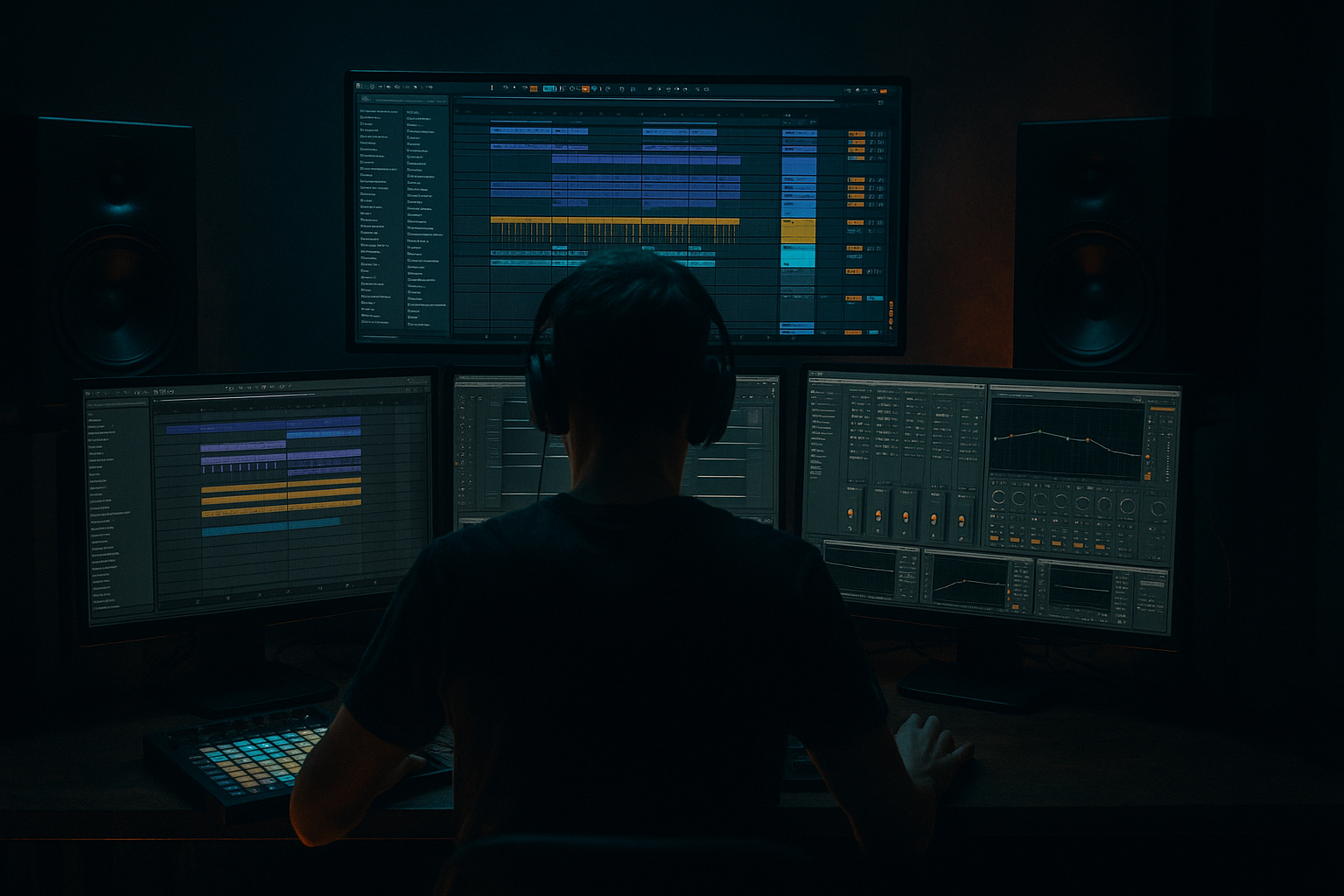
Main tutorial
```markdown
Drop Hook Writing From Scratch (90s Rave Flavor) — Drum & Bass in Ableton Live 🥁⚡
1) Lesson overview
This lesson is about writing a drop hook (the “you remember that bit” moment) with a 90s rave/jungle DNA, but executed with modern rolling DnB weight and mix discipline.
You’ll build the hook from three interlocking layers:
- Rave stab / chord riff (instant identity)
- Bass motif (movement + grit)
- Call/response ear candy (phrases that “talk”)
- A 2-bar hook that loops cleanly (classic rave repetition)
- Variations every 4 bars (arrangement momentum)
- A rave stab that feels sampled from the 90s (even if you synthesize it)
- A rolling bass that leaves space for drums
- A “DJ-friendly” structure: 8 bars statement + 8 bars variation
- 1.1.1 (hit)
- 1.1.3 (ghost/quiet)
- 1.2.2 (hit)
- 1.3.1 (hit)
- 1.3.4 (ghost)
- 1.4.2 (hit)
- 2.1.1 (hit)
- 2.2.2 (hit)
- 2.2.4 (ghost)
- 2.3.3 (hit)
- 2.4.2 (hit)
- Hits: 95–120
- Ghosts: 35–60
- Add Random (MIDI Effect) to Velocity: Chance 10–20, Scale 10–20
- Add Redux subtly: Downsample 2–4, Dry/Wet 5–12% (instant 90s grain)
- Fm9 → Dbmaj7 (or just triads: Fm → Db)
- Fm → Eb → Db → Eb (classic lift-return motion)
- Use 2–3 notes per hit (e.g., root + minor 3rd + 7th)
- Keep voicings midrange: C3–C5 zone
- Drop Chord on the `RAVE STAB` track
- Set shifts: +3, +7 for minor triad
- Later, automate one chord tone for variations (+10 for a 7th-ish feel, etc.)
- Instrument: Operator
- Osc A: Sine
- Add Saturator very lightly (Drive 1–3 dB) to help translation
- EQ Eight: low-pass around 120–150 Hz if needed
- Anchor most notes on F1
- Add a quick approach note like Eb1 just before a stab hit (1/16 or 1/8)
- Instrument: Wavetable (or Operator with waveshaping)
- Wavetable: saw or “complex” table
- Filter: LP24, cutoff 200–800 Hz (automate!)
- Add:
- If the stab hits on 1.1.1, let bass answer on 1.1.3 / 1.2.1 etc.
- Use short notes (1/8–1/16) for roll energy.
- Snare on 2 and 4 (or 2 and 4 with ghost notes if you want jungle lean)
- Add a break layer on `TOPS/BREAK` (high-passed) for movement
- On `RAVE STAB`: Compressor sidechained from `SNARE`
- Fast attack, medium release, just 1–2 dB dip on snare hits
- Downsample 2–6
- Bit reduction 0–2 (tiny!)
- Dry/Wet 5–15%
- Full drums
- Stab hook as written
- Bass solid, minimal variation
- Add one extra stab pickup (1/16 before a main hit)
- Open hats slightly more
- Automate midbass filter to open +10–20%
- Remove the stab for half a bar (negative space) then slam it back
- Or transpose stab up +3 for bar 9 only
- Add a short vocal “hey” / “come on” style one-shot (keep it tasteful) 🎤
- Bring in an extra rave layer (noise riser, crash, ride)
- Add a turnaround fill on bar 16 (snare fill or reversed stab)
- End bar 16 with a sub drop-out for 1/4–1/2 bar to set up the next phrase
- Too many notes. 90s rave hooks are often simple but loud in character. If it’s busy, it’s not memorable.
- Stab and bass in the same register. If your stab has energy below ~200 Hz, it will mask the bass.
- No phrasing. A 2-bar loop repeated for 64 bars gets stale. You need 4-bar and 8-bar events.
- Over-widening the hook. Wide stabs + wide breaks = mono incompatibility and weak center punch. Use Utility to check Mono.
- Ignoring the snare. In DnB, the hook must respect the backbeat or it won’t slam.
- Detune down, don’t brighten up: Pitch the stab down -2 to -5 semitones, then shorten decay. Darker without mud.
- Use minor seconds sparingly: Add a single dissonant neighbor note (e.g., Gb against Fm) on one ghost hit every 2 bars for menace.
- Mid/Side control:
- Parallel dirt: Create a return track with:
- Sub discipline: If the drop feels heavy but unclear, low-pass the SUB at 90–120 Hz and let MIDBASS carry the aggression above.
- Start with a 2-bar rhythmic hook (velocity + gaps = sampled feel).
- Build a rave stab using Wavetable → resample into Simpler for authentic behavior.
- Make bass answer the stab: sub = simple, midbass = movement.
- Arrange the drop with 4/8/16-bar events (statement, variation, switch, turnaround).
- Use resampling, subtle Redux, and tight bus processing to lock the hook as one unit.
You’ll do it in Ableton Live using mostly stock devices (Wavetable, Simpler/Sampler, Saturator, Redux, Auto Filter, Glue Compressor, EQ Eight, Reverb, Echo, Utility).
---
2) What you will build
A 16-bar drop at 172–176 BPM with:
Target vibe references (conceptually): early jungle rave stabs, classic hardcore harmonic movement, modern rollers’ drum clarity.
---
3) Step-by-step walkthrough
Step 0 — Session setup (fast but important)
1. Tempo: 174 BPM (start here).
2. Time signature: 4/4.
3. Loop length: 16 bars for the drop sketch.
4. Create tracks:
- `DRUMS (bus)`
- `KICK`
- `SNARE`
- `TOPS/BREAK`
- `BASS (bus)`
- `SUB`
- `MIDBASS`
- `RAVE STAB`
- `FX / HOOK VOCAL`
Ableton workflow tip: Color-code busses and Group related tracks early. It makes hook iteration faster.
---
Step 1 — Write the hook rhythm before the notes 🎯
A 90s-style hook works because the rhythm is hypnotic. Build a 2-bar rhythmic grid first.
1. On `RAVE STAB`, create a 2-bar MIDI clip.
2. Set Grid: 1/16 and turn Groove Pool off for now (we’ll add swing later).
3. Place “stabs” on a pattern like this (2 bars):
Bar 1:
Bar 2:
Velocity plan (important):
This gives you that “sampled phrase” feel instead of robotic MIDI.
---
Step 2 — Build a proper 90s rave stab (stock Ableton) 🔥
You’ve got two authentic routes:
#### Option A (very “real”): Simpler with a resampled stab
1. Make a temporary instrument on a new track: Wavetable.
2. Wavetable patch:
- Osc 1: Saw
- Osc 2: Square (slightly detuned +7 cents)
- Unison: 2–4 voices, Amount ~ 40–60%
- Filter: LP24, Cutoff around 2–4 kHz, Drive 3–6 dB
- Amp Env: Attack 0–5 ms, Decay 300–600 ms, Sustain 0, Release 100–250 ms
3. Add these devices after Wavetable:
- Saturator: Soft Clip ON, Drive 3–8 dB
- Chorus-Ensemble: subtle widen (Amount 10–20%)
- Reverb: Decay 1.2–2.0 s, Pre-delay 10–25 ms, Low Cut 300–500 Hz, High Cut 7–10 kHz, Dry/Wet 10–18%
4. Resample:
- Freeze/Flatten or record to audio.
- Drag the resulting audio into Simpler on `RAVE STAB`.
5. In Simpler:
- Mode: One-Shot
- Warp: OFF (if it’s already tight)
- Filter: HP around 150–250 Hz (keep it out of the sub lane)
- Pitch Env (optional): small downward blip (-5 to -12 st) with short decay for extra bite.
This is the “fake sample that behaves like a sample.”
#### Option B (direct): Wavetable as the stab instrument
Keep Wavetable live, but you’ll need to humanize:
---
Step 3 — Choose a rave-happy chord move (simple, iconic)
90s rave flavor often leans on minor key with suspensions or minor 7 color, but not jazz-level complex.
Pick a key like F minor (DnB-friendly).
Try a 2-chord loop that feels like old rave:
Or a darker option:
Practical move: Don’t write full block chords. Write stabs that imply harmony:
Ableton trick: Use the Chord MIDI effect to audition voicings quickly.
---
Step 4 — Write a bass motif that answers the stab (not fights it) 🧠
The hook becomes “classic” when bass and stab interlock.
#### Sub (clean, stable)
On `SUB`:
Write a 2-bar sub pattern that is mostly roots, with one standout pickup note.
Example in F minor:
Keep the sub simple and legible.
#### Midbass (movement, growl, 90s grit)
On `MIDBASS`:
- Saturator (Drive 4–10 dB, Soft Clip ON)
- Auto Filter (for rhythmic motion if needed)
- Amp (stock) very lightly for bite
- EQ Eight: carve 250–400 Hz if muddy
Pattern idea: Put midbass in the gaps of the stab.
---
Step 5 — Drums: lock the hook to the 2 & 4 like it’s law 🥁
Your hook will only feel “rave” if the snare is authoritative.
Quick Ableton chain for `DRUMS (bus)`:
1. EQ Eight
- HP at 25–35 Hz
- Small dip 250–350 Hz if boxy
2. Glue Compressor
- Attack 3 ms
- Release Auto
- Ratio 2:1
- Aim for 1–2 dB GR
3. Saturator
- Drive 1–3 dB (just to thicken)
Hook tip: Sidechain the stab to the snare slightly so the backbeat stays dominant:
---
Step 6 — Make it 90s with resampling + pitch play 🎛️✨
This is where the “rave artifact” magic happens.
1. Resample your RAVE STAB to audio (again), including effects.
2. Chop it like a sample:
- Warp mode: Beats
- Preserve: 1/16 or 1/8
- Transient loop OFF
3. Duplicate the audio clip and make two versions:
- Version A: normal pitch
- Version B: +3 semitones (or -2 for darker)
4. Use clip envelopes:
- Clip Gain micro moves (±1–2 dB) on certain hits
- Filter frequency automation (Auto Filter or clip EQ)
Old-school trick (but controlled):
Add Redux on the stab bus:
---
Step 7 — Write the “phrase” (arrangement: 16-bar drop blueprint)
Now you’ve got a 2-bar hook. Turn it into a 16-bar drop that evolves like classic DnB:
Bars 1–4 (Statement):
Bars 5–8 (Add tension):
Bars 9–12 (Switch / Answer):
Bars 13–16 (Peak + Exit setup):
Ableton arrangement workflow:
Use Locator markers: “Drop A”, “Drop A var”, “Drop B”, “Turnaround”. You’ll iterate faster.
---
Step 8 — Glue the hook as a “unit” (bus processing)
Group `RAVE STAB` + `FX / HOOK VOCAL` into `HOOK BUS`.
HOOK BUS chain (stock, practical):
1. EQ Eight
- HP 120–200 Hz
- Dip 2–4 kHz if harsh (depends on stab)
2. Glue Compressor
- Ratio 2:1
- Attack 10 ms
- Release Auto
- 1–2 dB GR to unify the phrase
3. Echo (very subtle)
- Time: 1/8 or 1/4
- Feedback 10–20%
- Filter: keep low end out (HP ~300 Hz)
- Dry/Wet 5–10%
Keep it tight: the hook should feel like one sampled “thing,” not separate clean layers.
---
4) Common mistakes
---
5) Pro tips for darker/heavier DnB 🖤
- Put EQ Eight on the Hook Bus, switch to M/S mode
- Roll off some high end on the Sides above ~8–10 kHz if it’s fizzy.
- Saturator (hard) + Redux + Auto Filter
- Send only the stab to it at -18 to -10 dB send level
- This gives “hardware abuse” character without wrecking your main.
---
6) Mini practice exercise (15–25 minutes) ⏱️
1. Pick a key (F minor or G minor).
2. Write three different 2-bar stab rhythms using only:
- 6–10 hits total
- At least 2 ghost hits
3. For each rhythm, make a 16-bar drop using the same drums and bass, changing only:
- Stab pitch variation (one transposed bar)
- One “negative space” moment (mute stab for 1/2 bar)
4. Bounce each version and A/B them:
- Which one feels most memorable after a 5-minute break?
Goal: train your instinct for what’s “hooky” versus “busy.”
---
7) Recap ✅
If you want, tell me a reference vibe (e.g., “more jungle,” “more rollers,” “more hardcore-rave”), and I’ll suggest three specific chord/stab motifs that fit—and how to vary them across 32 bars without losing the hook.
```

