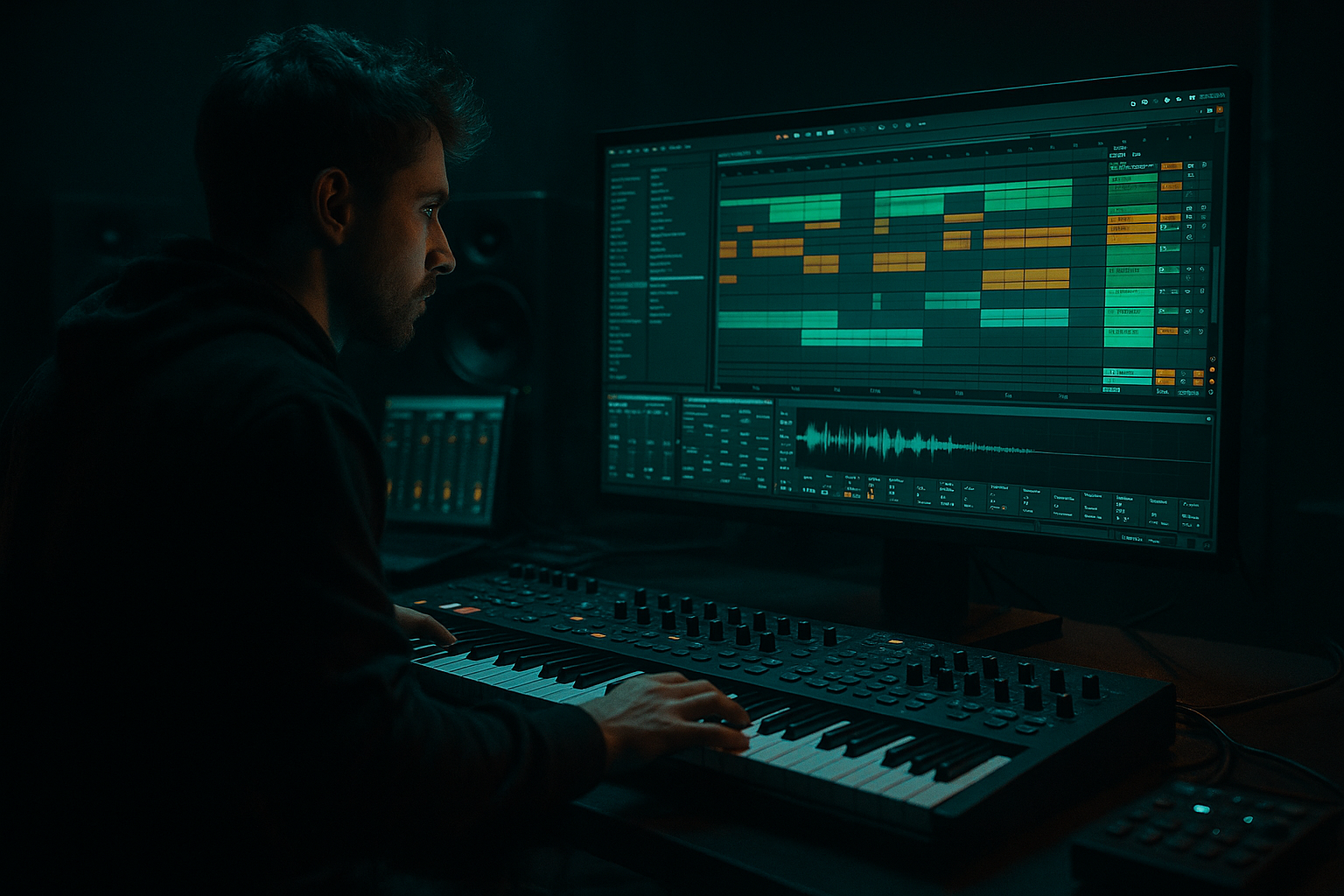
Main tutorial
```markdown
Drop Hook Writing (DnB) Using Session View in Ableton Live 🎛️⚡
1) Lesson overview
In drum & bass, the drop hook is the instantly recognizable call sign of the tune—usually a 2–8 bar idea that survives repetition and still hits hard. Session View is perfect for hook writing because it lets you audition variations fast, swap layers, and test arrangement energy without committing to a linear timeline.
In this lesson you’ll write a drop hook built from:
- A main bass phrase (the “statement”)
- A response/variation (movement + evolution)
- A lead/stab layer (identity)
- A drum hook (pattern + fills)
- A negative-space moment (impact)
- 4–6 Scenes that represent different drop hook variations (A/B/C + fills)
- A rolling drum groove with hook fills
- A Reese/Neuro-ish bass hook (or rolling jump-up style) using stock devices
- A top-line stab/lead for character
- A performance-ready drop that you’ll record into Arrangement View
- Kick
- Snare
- Hats/Tops
- Perc
- Drum Bus / Drum Group
- Sub
- Mid Bass (Reese)
- Bass FX / Fills
- Stab/Lead
- Atmos/Noise
- Impacts
- Risers/Downlifters
- Create a 2-bar MIDI clip on Kick.
- Snare: place snare on beat 2 and 4.
- Make a 2-bar hat clip:
- Add Swing/Groove:
- Auto Filter (HP around 200–400 Hz) to keep tops clean
- Saturator (Soft Clip on, Drive 1–3 dB) for presence
- Add a syncopated percussion clip (rim, woodblock, foley) that repeats every 2 bars.
- Keep it quiet—it’s glue, not the hook yet.
- Bar 1: Call (strong phrase)
- Bar 2: Response (variation, fill, or different rhythm)
- Osc A: Sine
- Add Saturator after:
- Add EQ Eight:
- Wavetable:
- Add:
- Bar 1: a strong rhythmic motif (e.g., 1/8 + 1/16 syncopation)
- Bar 2: same motif but change last 2 beats (turnaround)
- Bar 1: `E1—E1—(rest)—G1—E1`
- Bar 2: `E1—E1—(rest)—A1—(quick 1/16 run back to E1)`
- Sidechain input: Kick (and optionally Snare for extra snap)
- Ratio: 4:1
- Attack: 1–5 ms
- Release: 60–120 ms (tempo-dependent)
- Aim for obvious ducking that still feels musical
- Device: Simpler (one-shot stab) or Wavetable (synth stab)
- If using Simpler:
- Stab on the “and” of 1 or beat 3 is classic
- Leave space around snares
- Keep drums the same
- Change mid bass rhythm in bar 2
- Add a small pitch jump or triplet fill right before snare on beat 4
- Set Global Quantization to 1/2 Bar
- Make a bass clip with a more aggressive rhythm (more 1/16s)
- Reduce hats slightly so bass reads as the hook
- Keep bass identical to Scene A
- Add a 1-bar fill in the last bar:
- Use Beat Repeat (stock) lightly on a return (see below)
- Mute bass for 1/2 bar right before the loop restarts
- Or cut tops briefly
- Combine the best bass variation + fill
- Add an FX impact and a short noise sweep
- Beat Repeat
- Reverb (short, 10–20% wet)
- On Mid Bass clip → Envelopes
- Choose your Auto Filter Cutoff (or Wavetable filter cutoff)
- Draw a subtle motion:
- In hats/percs clips, shape velocity to emphasize the pocket.
- DnB often feels better when the “in-between” hits are quieter.
- Set certain fill clips to Legato (so they don’t restart timing)
- Use Follow Actions (optional but powerful):
- 8 bars: Drop Hook A (establish)
- 8 bars: Drop Hook A + fills (build intensity)
- 16 bars: Drop Hook B (variation / second phrase)
- 8 bars: Strip-back (negative space)
- 8 bars: Peak (Scene F)
- Too many new elements per variation: change one thing at a time so the hook stays recognizable.
- No negative space: constant sound = no impact. Mute something intentionally every 4–8 bars.
- Bass fights the snare: leave room around beat 2 and 4; sidechain properly.
- Over-wide low end: keep sub mono (Utility Width 0% under ~120 Hz).
- Scenes that don’t loop cleanly: ensure bass tails/reverbs don’t smear the restart unless that’s intentional.
- Hook is only sound design, not rhythm: in DnB, rhythm is identity—make the groove memorable.
- Layer the mid bass into roles:
- Use Roar (if you have it) or Saturator for controlled aggression:
- Jungle spice: add a tiny break layer (very low):
- Mid/Side discipline (stock EQ Eight):
- Impact trick: automate a short downlifter + sub drop into the first bar of the hook, then remove it for later repeats so the first hit feels special.
- The drop hook in DnB is about repeatable identity + controlled variation.
- Session View is your hook laboratory: Scenes = variations, Clips = ingredients.
- Use Call & Response phrasing, negative space, and one-change-at-a-time scene design.
- Capture the best jam by recording Scene launches into Arrangement, then tighten and consolidate.
We’ll work like a real DnB producer: build scenes as drop variations, then record the best performance into Arrangement.
---
2) What you will build
A Session View “hook lab” containing:
Target vibe: rolling, dark, club-ready DnB with strong mid-bass phrasing and tight drums.
---
3) Step-by-step walkthrough
Step 0 — Setup: tempo, grid, and loop discipline 🧭
1. Set tempo to 174 BPM (or 172–176).
2. Turn on 1 Bar global quantization (top-left, next to play).
- Later we’ll switch to 1/2 Bar for faster switching.
3. In Session View, plan tracks like this:
Group 1: DRUMS
Group 2: BASS
Group 3: MUSIC
Group 4: FX
Workflow tip: Color-code groups. Keep each clip 2 or 4 bars at first.
---
Step 1 — Build a reliable “drop backbone” Scene (Scene A) 🥁
We want a foundation that never fails. Start with drums.
#### Kick + Snare (core DnB pattern)
- Typical pattern: kick on 1, and often another kick on “and” of 2 (depends on style).
Ableton stock chain (Drum Group)
On the Drum Group (or Drum Bus track), add:
1. EQ Eight
- HP at 25–30 Hz (gentle) to remove rumble
- Small dip if boxy around 250–400 Hz (context-dependent)
2. Drum Buss
- Drive: 5–15%
- Boom: 0–10% (careful in DnB—sub needs control)
- Transients: +5 to +15
3. Glue Compressor
- Attack 3 ms, Release Auto, Ratio 2:1
- Aim for 1–2 dB gain reduction
#### Hats/Tops (rolling energy)
- Closed hats: 1/8 or 1/16 pattern
- Add small velocity changes for groove (don’t make it robotic)
- Use Groove Pool: try MPC 16 Swing 55–60 (subtle)
Top chain suggestion:
#### Perc loop for movement
✅ Scene A goal: When Scene A loops, it already feels like a drop—solid, rolling, uncluttered.
---
Step 2 — Write the bass hook using “Call & Response” (Scene A) 🐍
A DnB drop hook often works like a conversation:
#### Sub bass track
Use Operator (stock) for a clean sub:
- Soft Clip ON
- Drive 2–6 dB
- Low-pass around 120–160 Hz (keep sub pure)
Write a simple sub pattern that follows your bass rhythm. Keep notes short to avoid overlap.
#### Mid bass (Reese) track
Use Wavetable (stock) or Operator (for classic reese):
- Osc 1: Basic Shapes or a harsher table
- Unison: 2–4 voices, Amount 20–40
- Filter: LP24, drive a bit
1. Saturator (Drive 3–8 dB, Soft Clip ON)
2. Auto Filter (for movement; map cutoff to Macro)
3. Chorus-Ensemble (very subtle width—DnB needs mono stability)
4. EQ Eight: cut mud around 200–400 Hz if needed
Hook writing move:
Create a 2-bar MIDI clip with:
Example concept (not exact notes):
#### Sidechain (critical)
Use Compressor on Sub and Mid Bass:
✅ Scene A goal: Drums + bass already “says something” every 2 bars.
---
Step 3 — Add a simple lead/stab identity layer 🎯
DnB hooks often rely on midrange identity: a stab, foghorn hit, rave chord, or simple lead.
Create a Stab/Lead track:
- Mode: One-Shot
- Envelope: short decay, no sustain
- Add Reverb (short room) + Auto Filter (band-pass movement)
Write a 2-bar phrase that answers the bass:
Tip: Keep lead/stab mostly mono (Utility Width 0–30%) and push width via short room reverb (but keep low end filtered).
---
Step 4 — Turn Session View into a hook “variation engine” (Scenes B–F) 🔁
Now we use Session View properly: same core, multiple variations.
Duplicate Scene A into new scenes and change one element at a time.
#### Scene B — “Answer bass”
#### Scene C — “Half-bar switch”
#### Scene D — “Drum hook fill”
- Snare ghost notes or a tom hit
- Quick break-style edit (jungle flavor)
#### Scene E — “Negative space”
This creates that “drop re-impact” feeling without adding more sounds.
#### Scene F — “Peak”
Performance return for fills (stock):
Create a Return Track called `FILL`:
- Interval: 1 Bar
- Grid: 1/8 or 1/16
- Chance: 10–25%
- Filter ON (to keep low end clean)
Send only tops/percs into it for controlled chaos.
---
Step 5 — Clip controls: make your hook evolve automatically 🧠
In each clip, use these features:
#### Clip Envelope for filter movement
- Bar 1: slightly closed
- Bar 2: opens into the turnaround
#### Velocity as groove control
#### Clip Launch Settings
- Main bass clip: Follow Action after 2 bars → “Other” with 1–2 variations
- Great for generating evolving hooks while you jam
---
Step 6 — Record a hook performance into Arrangement View 🎬
1. Arm Arrangement Record (top transport).
2. Trigger Scenes in this order (example):
- Scene A (2x)
- Scene B (1x)
- Scene A (1x)
- Scene D fill (1x)
- Scene C (2x)
- Scene E (1x)
- Scene F peak (2x)
3. Stop recording. Go to Arrangement View.
4. Consolidate (Cmd/Ctrl+J) your best 8–16 bars into a clean “Drop” section.
Arrangement idea (classic DnB):
---
4) Common mistakes 🚫
---
5) Pro tips for darker/heavier DnB 😈
- Layer 1: “Body” reese (200–800 Hz)
- Layer 2: “Bite” (1–3 kHz) using Saturator + EQ
- Layer 3: “Air/noise” (5–10 kHz) very subtle for texture
Use Audio Effect Rack to macro-control each layer’s level.
- Put Roar/Saturator before EQ so EQ isn’t boosting harshness after the fact.
- Add Limiter last on bass bus to catch peaks (not to crush).
- High-pass it around 200–400 Hz
- Use Redux lightly for grit
- Gate it with Gate sidechained from your main hats for rhythmic coherence
- On Bass Bus: use EQ Eight in M/S mode
- Cut some low-mid in the Sides to keep mono punch
---
6) Mini practice exercise 🧪
Goal: Create 5 hook scenes from one core idea in 20 minutes.
1. Build Scene A: drums + sub + mid bass (2 bars).
2. Duplicate to Scene B: change only the last 1/2 bar of bass.
3. Duplicate to Scene C: add a stab that appears only in bar 2.
4. Duplicate to Scene D: add a drum fill (last 1 bar).
5. Duplicate to Scene E: introduce negative space (mute bass 1/2 bar).
6. Record a 32-bar performance by triggering A → B → A → D → C → E → A.
Constraint: You may add only 1 new sound total. Everything else must be rhythm, automation, or arrangement.
---
7) Recap ✅
If you want, tell me your subgenre (roller, jump-up, jungle, neuro, deep) and I’ll suggest a specific 6-scene template and a stock-device bass rack to match it.
```

