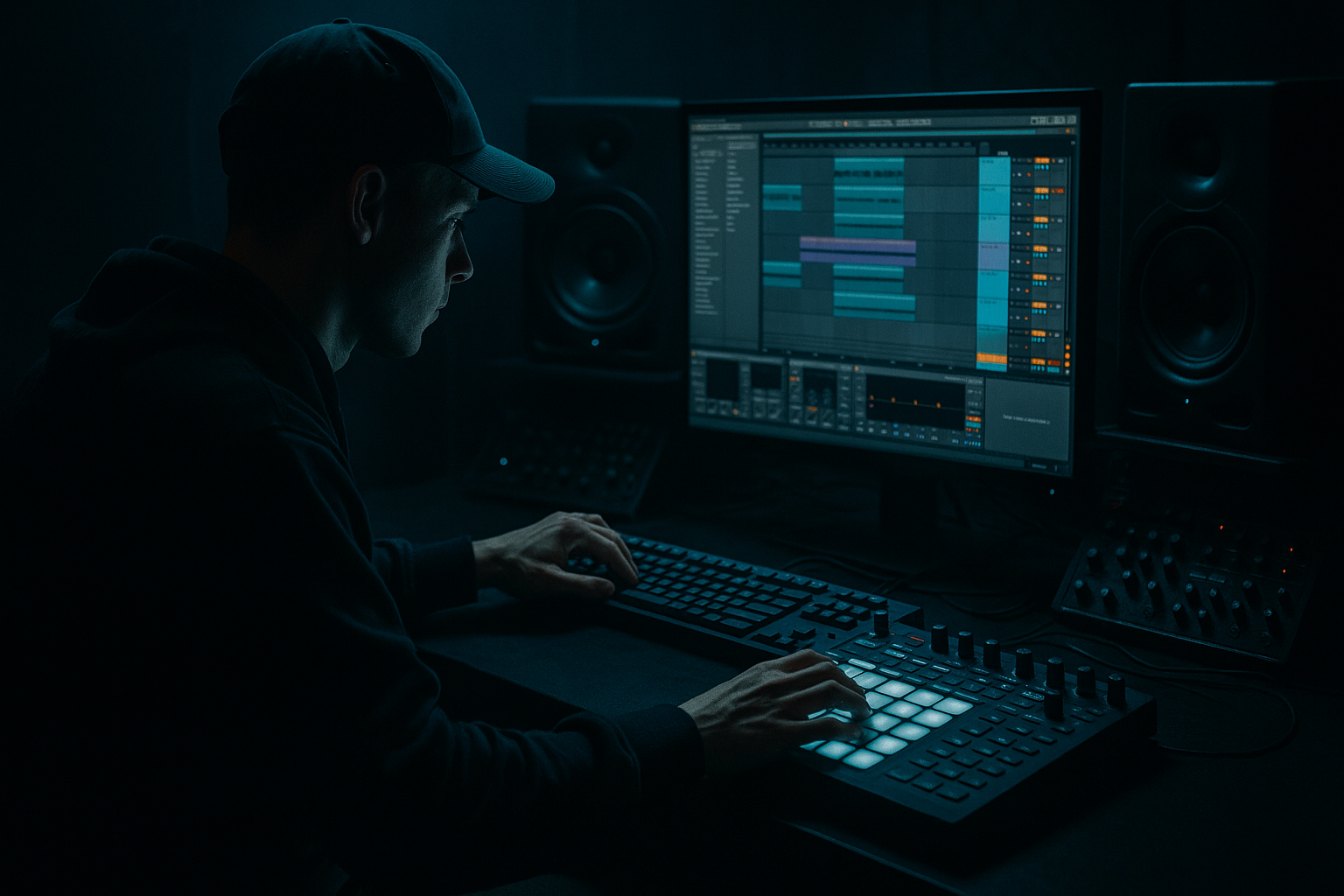
Main tutorial
```markdown
Drop in Ableton Live 12: Distort it for oldskool rave pressure 🔥🔊
Skill level: Intermediate
Category: Arrangement (DnB / Jungle)
---
1) Lesson overview
Oldskool rave pressure is not just “add distortion.” It’s about how the drop hits—the contrast, the midrange roar, and the controlled chaos that still punches on a system. In this lesson you’ll build a drop arrangement in Ableton Live 12 where distortion is used like an arrangement tool: it ramps up, flips at the drop, and glues drums + bass into a gritty, 90s-inspired wall of energy. 🧱
We’ll use Ableton stock devices (Saturator, Roar, Overdrive, Amp, Drum Buss, Glue Compressor, EQ Eight, Auto Filter) with some smart routing and automation.
---
2) What you will build
A DnB drop section (16–32 bars) with:
- Rolling break + punchy kick/snare layer
- Reese / bass groove that “opens up” with distortion at the drop
- A distortion bus that adds rave grit without destroying the low end
- Automated drive, filtering, and parallel smash for impact
- A clean, loud drop that still has headroom + clarity
- `Kick` (one-shot)
- `Snare` (one-shot)
- `Break` (Amen / Think / vintage loop)
- `Drum Bus (Group)` (group the above)
- Keep kick/snare relatively clean compared to the break.
- On Snare: try Roar lightly for harmonics:
- High-pass the break to ~200–400 Hz and reduce volume a bit.
- Use Wavetable or Operator.
- Use a 2-bar pattern with notes hitting around 1, the “and” of 2, and 3/4 syncopations.
- Keep it simple: the distortion + drum groove will do a lot of the movement.
- EQ Eight: Low-pass around 90–120 Hz
- Saturator: Drive 1–3 dB, Soft Clip On (optional)
- Keep this chain mostly clean.
- EQ Eight: High-pass 90–120 Hz
- Roar (Ableton Live 12) or Overdrive + Saturator combo
- Auto Filter
- Break (moderately)
- Reese MID (more heavily)
- Snare top (a little for crack)
- Break: -18 to -12 dB send
- Reese MID: -12 to -6 dB send
- Snare: -24 to -18 dB send
- Full drums + full bass.
- RAVE DISTORT send jumps up at the drop (automation step).
- Add a very short room/plate hit on snare (tasteful).
- Keep it stable. Let listeners lock in.
- Don’t over-automate yet—power comes from consistency.
- Increase bass MID distortion slightly (small increments: +1–2 dB drive equivalent).
- Add a tiny rhythmic gate:
- Add a second break layer or a ride/hat loop.
- Add a “rave stab” or resampled hit only on bar 13 or 15 for hype.
- Automate RAVE DISTORT return EQ to open slightly brighter in the last 4 bars (subtle!).
- On bass MID chain (or whole bass rack), add Compressor
- Put a Compressor after distortion on the Return
- Sidechain from Drum Group
- Gentle ducking keeps the groove readable.
- Distorting the sub: If your sub is getting fuzzy, your drop will lose weight. Split SUB/MID and keep SUB clean.
- Too much send too early: If the build is already maxed, the drop has nowhere to go. Save a clear “jump” for bar 1.
- Harsh top-end fizz: Distortion can scream at 6–10 kHz. Use post-EQ and gentle low-pass.
- Flattening transients: Over-compression after distortion can kill punch. If your snare stops snapping, back off the Glue or add Transients in Drum Buss.
- No contrast: Oldskool pressure is contrast. If every section is distorted, it stops feeling exciting.
- Tune your distortion:
- Saturate in stages:
- Use clip gain/utility before distortion:
- Mono discipline:
- Drop B “fear factor”:
- Oldskool rave pressure comes from contrast + midrange saturation, not destroying everything.
- Split bass into clean SUB and distorted MID for weight + aggression.
- Use a parallel distortion return to glue breaks + bass into a rave wall while keeping control.
- Automate sends/drive/filtering as arrangement moves: the drop should step up in density and aggression.
- Resampling adds that authentic “printed” grit—layer it quietly for realism.
---
3) Step-by-step walkthrough
Step 0 — Session setup (so the drop actually hits)
1. Tempo: 172–175 BPM (classic modern DnB range).
2. Arrangement view: Create markers for:
- `Pre-drop / Build (8 bars)`
- `Drop A (16 bars)`
- `Drop B / variation (16 bars)`
3. Gain staging:
- Aim for your Master peak around -6 dB during the drop while building.
- Keep individual tracks peaking around -12 to -6 dB.
Distortion multiplies level fast—this prevents “why is everything exploding?” moments.
---
Step 1 — Build the drum foundation (rolling + break pressure 🥁)
Tracks:
A) Break track chain (oldskool bite, modern control)
1. EQ Eight
- HP filter: 30–40 Hz (remove rumble)
- Small dip: 250–400 Hz if boxy
- Gentle shelf: +1 to +3 dB at 8–12 kHz if dull
2. Drum Buss
- Drive: 10–25%
- Crunch: 5–15%
- Boom: 0–10% (careful—Boom can blur your kick)
- Transients: +5 to +20 (bring back snap if distortion softens)
3. Saturator (optional if you want more “tape”)
- Mode: Analog Clip
- Drive: 2–6 dB
- Soft Clip: On
B) Kick/Snare reinforcement (drop must be readable)
- Drive: low/moderate (start 5–15% depending on preset)
- Tone: slightly bright
- Mix: 20–40%
Arrangement tip:
In the last bar before the drop, do a break “tease”:
Then at the drop, slam the full break back in. Classic contrast move. 🎚️
---
Step 2 — Create a reese / rolling bass that loves distortion 🎛️
Track: `Bass (Reese)`
Sound source (fast approach):
- Wavetable: 2 saws, detune slightly.
- Operator: 2 oscillators, both saw-ish, detune a little.
Basic bass MIDI (DnB roll):
Bass chain (clean low, nasty mid):
1. EQ Eight (pre)
- HP at 20–30 Hz
2. Audio Effect Rack → make 2 chains: `SUB` and `MID`
#### SUB chain (clean & stable)
#### MID chain (where the rave happens 😈)
- If using Roar:
- Start with a “distortion” style preset, then tweak:
- Drive: moderate/high (aim for obvious harmonics)
- Tone: push mids (don’t over-hype air yet)
- Mix: 50–80%
- If using Overdrive:
- Freq: 700–1.5k
- Drive: 20–50%
- Tone: 40–60%
- Mode: LP24
- Envelope: subtle, or just automate cutoff
- Keep resonance moderate (10–25%) for rave vowel-ish movement
Key concept:
You want the sub to stay solid, while the mid layer gets mangled.
---
Step 3 — Build a dedicated “RAVE DISTORT” bus (parallel smash 💥)
Create a Return track (Send) called: `RAVE DISTORT`.
On Return A (RAVE DISTORT) put this chain:
1. EQ Eight (pre-filter)
- HP: 120–180 Hz (keep sub out)
- Optional dip: 3–5 kHz if harsh later
2. Roar (or Amp if you want that gnarlier, speaker-ish vibe)
- Push Drive until it’s clearly aggressive
- Mix: 100% on the return (since it’s parallel)
3. Saturator
- Mode: Analog Clip
- Drive: 3–8 dB
- Soft Clip: On
4. Glue Compressor
- Attack: 3 ms
- Release: Auto
- Ratio: 4:1
- Aim for 2–6 dB gain reduction (it should grab)
5. EQ Eight (post)
- Tame fizz if needed: gentle low-pass around 12–16 kHz
- Notch any whistle frequencies
Send into it:
Send levels (starting point):
This is where the “rave wall” lives—without ruining your low end.
---
Step 4 — Drop arrangement: make distortion part of the impact ⚡
We’ll do an 8-bar build into a 16-bar drop.
#### A) Pre-drop (8 bars): tighten and tease
1. Automate the bass MID chain
- Auto Filter cutoff slowly rises (or dips then opens)
- Roar/Overdrive drive slightly increases into the drop
2. Automate the RAVE DISTORT return
- During build: keep the send lower
- On the last 1 bar: ramp the send up slightly, then hard cut it right before the drop (1/8–1/4 bar)
3. Drum trick (oldskool move):
- Last 1 bar: use Auto Filter HP on the Drum Group up to 200–500 Hz, then snap back on the drop.
#### B) The drop (16 bars): slam, then evolve
Bar 1 (impact bar):
Bars 1–4 (establish the groove):
Bars 5–8 (add movement):
- Use Auto Pan on the MID chain set to 100% phase, Amount low-medium, Rate synced (1/8 or 1/16). This gives a “chatter” without needing extra notes.
Bars 9–16 (variation / extra pressure):
---
Step 5 — Controlled chaos: resample for authentic grit (optional but gold 🧪)
To get that “sampled-through-a-mixer” vibe:
1. Create an Audio track named `Resample Print`.
2. Set its input to Resampling.
3. Solo Drum Group + Bass + RAVE DISTORT return (or just the drop bus).
4. Record 8 bars of the drop.
5. On the resampled audio:
- Redux (lightly)
- Bits: 12–14
- Downsample: slight
- EQ Eight: HP at 25–35 Hz, gentle dip harshness
- Blend this resample back in quietly under the clean mix for texture.
This is a classic jungle/DnB trick: layer the attitude.
---
Step 6 — Make room for distortion (so it hits, not hisses)
Distortion creates midrange density, which can mask drums.
Sidechain the bass MID to the snare:
- Sidechain from Snare track
- Ratio 2:1 to 4:1
- Attack 5–15 ms
- Release 60–120 ms
- Aim for 1–3 dB GR on snare hits
Sidechain RAVE DISTORT return to the kick/snare (optional):
---
4) Common mistakes
---
5) Pro tips for darker/heavier DnB 🌑
Move Overdrive’s Freq or Roar’s tone controls until the growl sits around 200–800 Hz (meaty), not just fizz.
Instead of one brutal device, use 2–3 lighter stages (Drum Buss → Saturator → Glue). It sounds more “hardware.”
Put Utility before Roar/Saturator to drive consistently (e.g., +3 to +8 dB), then compensate after. Controlled in = controlled out.
Keep SUB mono (Utility Width 0% under ~120 Hz using chain split). Wide distorted mids are fine, but the foundation must be stable.
In the second 16 bars, automate:
- Slightly more RAVE DISTORT send
- Slightly lower low-pass cutoff on bass (darker)
- Add a short reverse crash into a snare hit for tension
---
6) Mini practice exercise (20–30 minutes) 🎯
1. Take an existing 16-bar drop loop you’ve got.
2. Add a `RAVE DISTORT` return with:
- EQ Eight HP 150 Hz → Roar → Saturator (Analog Clip) → Glue
3. Automate:
- Break send: -inf at the last 1/4 bar before drop → jump to -14 dB at drop
- Bass MID send: from -12 dB to -7 dB on bar 9
4. Print an 8-bar resample of the drop and blend it in at -18 to -24 dB under the clean mix.
5. A/B:
- Distort return ON/OFF
- SUB clean vs SUB distorted
You’re listening for more attitude without losing weight and punch.
---
7) Recap ✅
If you want, tell me your current drop elements (break type, bass style, key, and tempo) and I’ll suggest a specific 16–32 bar drop arrangement with exact automation moves for your project.
```

