Main tutorial
Drop Reveal Automation for Smoky Late‑Night Moods (DnB in Ableton Live) 🌙🔥
1. Lesson overview
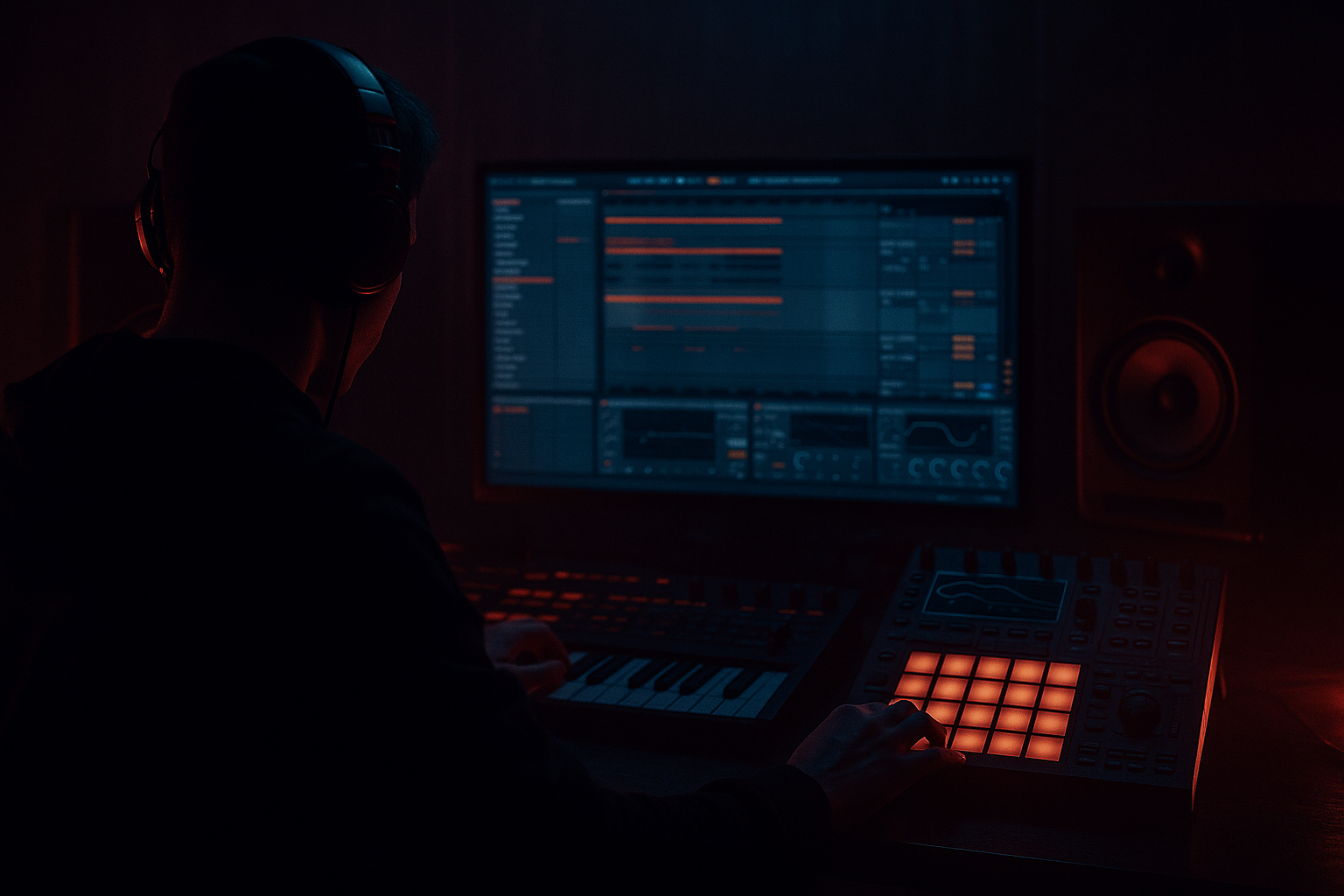
This lesson is about making your drop feel like it “emerges from smoke”—that late-night, rolling DnB vibe where the groove is already implied, but the impact is revealed through automation rather than a huge “festival” slam.
You’ll learn how to automate:
- Filters + resonance for a teasing, moody reveal
- Reverb/delay throws to smear the pre-drop into the downbeat
- Saturation/drive to “wake up” the bass and drums
- Stereo width + mono control so the drop hits focused and heavy
- Drum “clarity ramps” (hats/ghosts + transient definition) to go from foggy to crisp
- A smoky pre-drop (filtered, wide, hazy)
- A drop that reveals (tight, forward, punchy) without changing the core pattern too much
- A repeatable automation system you can re-use in any project
- Tempo: 172–176 BPM (try 174 BPM)
- Time signature: 4/4
- Markers:
- Kick: on 1 and “and” of 2 (or a 2-step variant)
- Snare: on 2 and 4
- Closed hat: 1/8s or shuffly 1/16s
- Ghost snare/rim: low velocity between 2 and 4
- Break layer: subtle chopped Amen/think break for movement
- Drum Buss on the drum group (Boom 10–25%, Drive 3–8)
- Glue Compressor (2:1, Attack 3–10ms, Release Auto, 1–3 dB GR)
- EQ Eight: cut junk < 30 Hz, tame harshness around 7–10 kHz if needed
- Auto Filter
- Bars 17–29: slowly open from ~900 Hz to ~3–5 kHz
- Bars 29–33: quicker open to full range
- At bar 33 (drop): snap fully open
- Duplicate snare track or make a return-style parallel inside the group
- Leave it less filtered (or not filtered)
- Keep it low in pre-drop, then bump it slightly into the drop
- EQ Eight
- Auto Filter (LPF)
- On ATMOS/FX group, add Utility
- Echo
- Increase send for a few 1/4-note moments (end of bar 32 especially)
- Cut it sharply at the drop (same method as the reverb return)
- Drum Buss
- Saturator
- Bring back true sub:
- Width: 0% (mono)
- Optional: Bass Mono (if you use it via Utility width only)
- Make sure sub stays centered throughout; the reveal is usually in mids/highs, not sub width.
- Drums filtered (LPF ~900 Hz)
- Bass filtered (LPF ~250–350 Hz)
- Atmos wide (Utility width 140%)
- Tiny hat groove still present (don’t mute all percussion)
- Open drum filter to ~3 kHz
- Introduce a break layer very low (filtered)
- Add short vocal stab with Echo send
- Slight resonance lift on bass filter
- Increase reverb send on hats/snare ghost
- Add a noise riser (Operator noise or sample)
- Big reverb wash (Return A)
- Delay smear moments (Return B)
- Optional: 1-beat drum drop-out (last beat before drop)
- At bar 33: filters open, returns cut, transients/punch up
- Over-filtering the drums so the pre-drop loses groove entirely. Keep some rhythmic definition.
- Leaving long reverb tails into the drop (unless that’s the aesthetic). For heavy rolling, usually cut/duck them.
- Automating too many things at once and losing the “why.” Pick 3–5 core reveal moves and commit.
- Making the drop wider than the pre-drop. Often the opposite works better: pre-drop wide/hazy → drop more centered/punchy.
- Not gain-matching saturation/processing, leading to “it’s better because it’s louder.”
- Use subtle pitch automation on a riser or bass layer: +2 to +5 semitones over 8 bars, then snap back at the drop.
- Put Redux (very lightly) on an atmosphere bus:
- Try Gate on the reverb return keyed by the snare (sidechain-style):
- Add a short room reverb (separate from the big wash) that stays on in the drop:
- Use Auto Pan on noise/atmos with slow rate (0.05–0.15 Hz) for uneasy movement—then reduce at the drop.
- Smoky late-night drop reveals come from controlled contrast: hazy pre-drop → tight, punchy drop.
- The strongest tools in Ableton stock are Auto Filter, Hybrid Reverb, Echo, Drum Buss, Saturator, Utility, EQ Eight.
- Automate with intention:
- Keep the groove alive in the fog—DnB lives and dies by momentum.
All examples are tailored to rolling DnB / jungle-influenced arrangement language.
---
2. What you will build
A 16-bar pre-drop → 32-bar drop structure with:
You’ll end with an Ableton workflow that feels like a pro template: macro controls + grouped automation lanes.
---
3. Step-by-step walkthrough
Step 0 — Session setup (fast + clean)
- Bar 1–17: Intro / atmosphere
- Bar 17–33: Pre-drop / tension (16 bars)
- Bar 33: Drop
Ableton tip: Right-click the timeline → Add Locator for “Pre-drop start” and “Drop”.
---
Step 1 — Build a solid “rolling” core first 🥁
Before automating, ensure the drop groove is already working.
Drum Group (typical rolling DnB):
Stock device suggestions:
Lock this in. The reveal works best when the destination (drop) is already strong.
---
Step 2 — Create “Reveal Control” groups (so automation stays organized)
Make three groups in Arrangement:
1. DRUMS (all drum tracks inside)
2. BASS (sub + reese/rollers + mid layers)
3. ATMOS/FX (pads, noise, vox, risers)
Now add a utility track called: REVEAL MACROS (MIDI track)
On REVEAL MACROS, add an Audio Effect Rack (yes, on a MIDI track—it’s fine) and map useful parameters to 8 macros. You’ll use these macros to drive consistent automation across the song.
Example Macro set:
1. PreDrop LPF (Drums)
2. PreDrop LPF (Bass)
3. Reverb Wash (Send amount)
4. Delay Smear (Echo feedback/mix)
5. Crunch (Saturator drive)
6. Width (Utility width on atmos)
7. Punch (Drum transient/Drum Buss)
8. Sub Tight (Utility bass mono / HP on reese)
You can also do this without macros, but macros keep you fast and consistent.
---
Step 3 — Smoky pre-drop: “Fog the mix” without killing momentum 🌫️
In bars 17–33, you want energy implied but obscured.
#### A) Filter the drums (but don’t remove the groove)
On DRUMS group, add:
- Filter type: Lowpass
- Frequency: start around 600–1.2 kHz, open to 18–20 kHz at the drop
- Resonance: 0.8–1.4 (subtle)
- Drive: 2–6 if you want a slightly gritty filter
Automation idea (16 bars):
Keep kick/snare presence:
If the filter makes the snare disappear, create a snare “clean parallel” track:
#### B) Bass tease: remove weight + add “air movement”
On BASS group, add:
- High-pass (gentle): 30–40 Hz in pre-drop (to reduce true sub)
- Optional dip: 150–300 Hz if it gets boxy
- Start: 200–400 Hz (you’ll hear just the movement)
- Open to: full at the drop
Key move: in the last 2 bars, automate a tiny resonance rise (e.g., 0.8 → 1.6) for that “whistling through smoke” effect—don’t overdo it.
#### C) Stereo haze: widen atmos, narrow the drop impact
- Width in pre-drop: 120–160%
- At drop: bring back toward 100–120% (so drums/bass feel more centered and punchy)
Why: The drop feels heavier when the center suddenly owns the space.
---
Step 4 — Reverb “wash” into a hard stop (classic late-night tension) 💨
This is a signature move for smoky DnB.
1. Create a Return Track A: WASH
- Hybrid Reverb
- Algorithmic or Convolution (Plate/Hall)
- Decay: 3–6 s
- Pre-delay: 10–25 ms
- High Cut: 6–10 kHz
- EQ Eight after it
- HP: 200–400 Hz (keep low end clean)
- Optional notch if it rings
2. In pre-drop (bars 31–33), automate send amounts from:
- Hats
- Vox bits
- Snare ghost / break layer
- A noise riser
3. Hard cut the reverb at the drop:
- Add Utility after the EQ on the return
- Automate Utility Gain: from 0 dB → -inf right on bar 33
- Or automate Hybrid Reverb Dry/Wet down fast
That “wash then vacuum” makes the drop feel like the room suddenly shrinks and hits you.
---
Step 5 — Delay smear + micro throws (Echo is your friend) 🛰️
Add a Return Track B: SMEAR
- Time: 1/8 or 3/16 (3/16 is super DnB for swingy smears)
- Feedback: 25–45%
- Filter: HP around 250–500 Hz, LP around 4–8 kHz
- Modulation: subtle (Depth 5–15%)
Automation:
Pro move: Put Saturator after Echo on the return (Drive 2–6) to thicken the repeats.
---
Step 6 — The “impact reveal”: make the drop feel louder without just turning it up 📈
At bar 33, do multiple small changes that add up.
#### A) Add transient clarity on drums
On DRUMS group:
- In pre-drop: Drive lower (e.g., 2–4), Transients lower (0–10)
- At drop: Drive up (e.g., 4–8), Transients up (10–25)
Automate either the Drive or Transients (not everything at once).
#### B) Bass “wakes up”: saturation + sub return
On BASS group:
- Analog Clip
- Drive: automate from 1–3 (pre) to 4–7 (drop)
- Keep Output matched (avoid fake loudness jumps)
- If you high-passed in pre-drop, automate EQ Eight HP down/off
- Or automate sub track volume up by 1–2 dB at the drop
#### C) Mono focus: tighten low-end image
On the sub track, add Utility
---
Step 7 — Arrangement: 16-bar pre-drop that feels “inevitable”
Here’s a practical 16-bar blueprint (bars 17–33):
Bars 17–25 (Set the fog):
Bars 25–29 (Movement + hints):
Bars 29–31 (Pressure):
Bars 31–33 (The inhale):
---
4. Common mistakes
---
5. Pro tips for darker/heavier DnB 🖤
- Downsample just a bit (e.g., 12–16) to add grain
- Automate it down at the drop so the mix becomes “high-definition.”
- Makes the wash pulse and feel more “jungle room” than ambient pad.
- Hybrid Reverb, short decay 0.3–0.7s
- Keeps drums glued without washing them out.
---
6. Mini practice exercise (20 minutes) ⏱️
1. Take an existing 32-bar drop loop you’ve made.
2. Duplicate it so you have: 16 bars pre-drop + 32 bars drop.
3. In the pre-drop, implement only these 4 automations:
- DRUMS Auto Filter frequency: 900 Hz → full open
- BASS Auto Filter frequency: 300 Hz → full open
- Return A (WASH) send: ramp up last 2 bars, then cut at drop
- Drum Buss Transients: +0 → +18 at drop
4. Bounce/export a quick draft and listen on:
- headphones
- low volume
- mono (Utility on Master, Width 0%)
Goal: The drop should feel clearer, closer, and heavier—not just louder.
---
7. Recap
- Filters open
- Reverb/delay wash cuts
- Transients + saturation rise
- Width narrows toward impact
If you want, tell me your sub/bass style (clean sub + reese, foghorn, neuro-ish mid bass, jungle break focus) and I’ll suggest a tailored 8-macro “Reveal Rack” mapping for your template.

