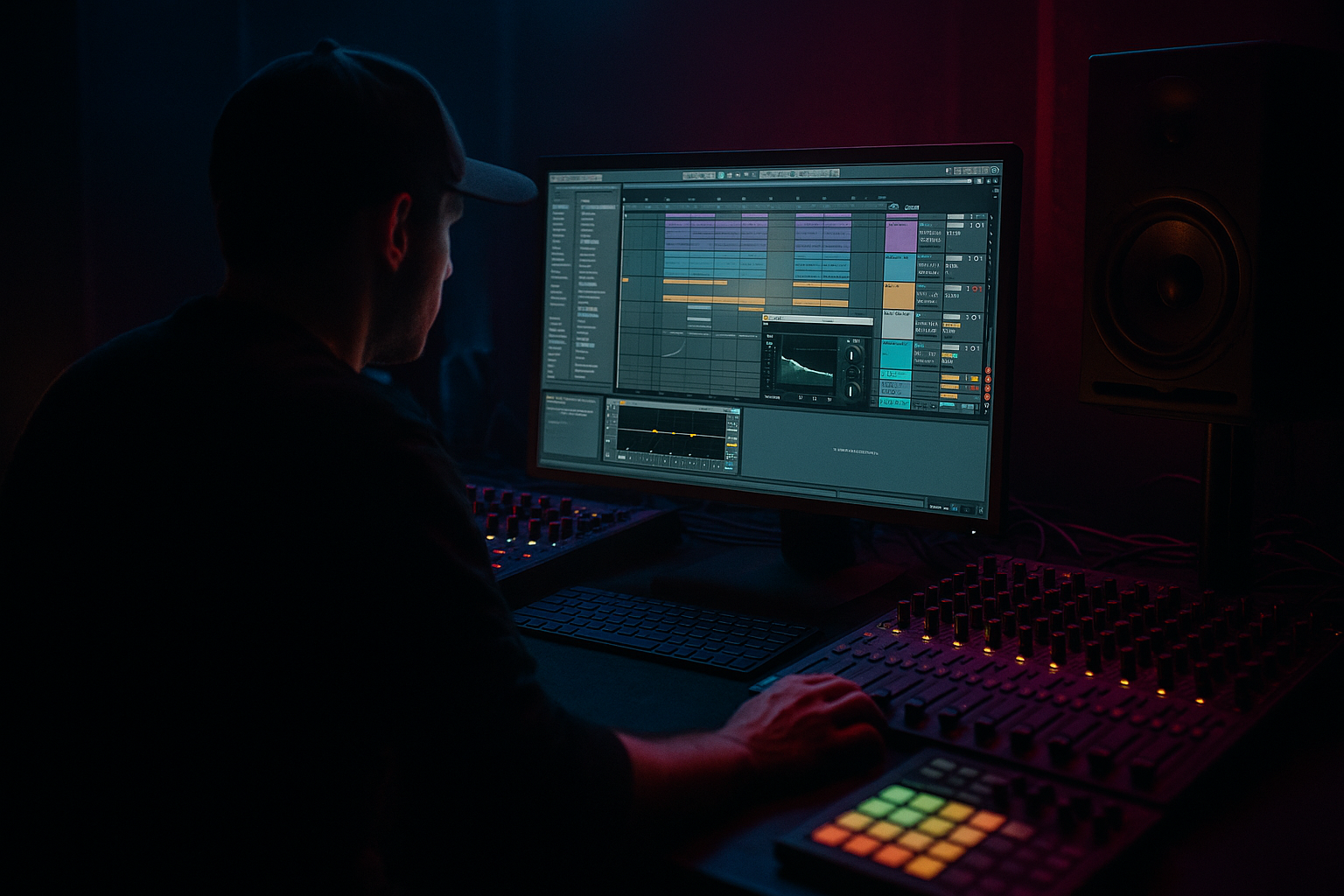
Main tutorial
```markdown
Drum Bus Drive Approach for Floor-Shaking Low End (Ableton Live 12)
Oldskool jungle / DnB vibes — Intermediate — DJ Tools 🔊🥁
---
1. Lesson overview
This lesson is about making your drums hit like a rig without killing your sub. In oldskool jungle and rolling DnB, the drum bus isn’t just “glue”—it’s a controlled distortion + transient shaping stage that creates weight, density, and perceived loudness while keeping the kick + sub relationship clean.
In Ableton Live 12, we’ll build a Drum Bus Drive chain using mostly stock devices, then route it in a way that keeps your low end stable and your breaks crunchy.
---
2. What you will build
You’ll create a two-lane drum bus system:
1. DRUM BUS (Clean Punch): transient clarity + low-end control
2. DRUM DRIVE (Dirty Parallel): saturated, band-limited “hair” + crunch for jungle character
3. DRUMS ALL: final glue/limit and easy macro control 🎛️
Result: floor-shaking low end that stays consistent, with breaks that feel louder and heavier without simply turning up.
---
3. Step-by-step walkthrough
Step 0 — Session setup (DnB-friendly defaults)
- Tempo: 168–174 BPM
- Warp: make sure your breaks are tight (Complex Pro is often overkill—try Beats mode for breaks).
- Group your drums:
- Enable HPF at 25–30 Hz, 24 dB/oct (remove rumble)
- Optional: tiny dip if needed:
- Drive: 2–6
- Crunch: 0–10% (keep subtle here)
- Boom: Off (we’ll manage low end more deliberately)
- Damp: adjust so cymbals don’t fizz (often 10–25%)
- Transients: +5 to +20 depending on break sharpness
- Attack: 3 ms (fast enough to control, not kill snap)
- Release: Auto or 0.1–0.3 s
- Ratio: 2:1
- Threshold: aim for 1–3 dB gain reduction on peaks
- Soft Clip: On (very DnB-friendly)
- HPF: 90–140 Hz, 24 dB/oct
- Optional: small boost into saturation:
- Style: Tube or Warm (classic, thick)
- Drive: 10–25% (don’t max it yet)
- Tone: slightly dark (oldskool jungle isn’t super bright)
- Dynamics (if available in your Roar view): keep it moderate so transients still speak.
- Use Multiband in Roar:
- Mode: Soft Clip On
- Drive: 2–8 dB
- Output: adjust so the return isn’t jumping in level
- Drive: 5–15
- Crunch: 10–35%
- Transients: -5 to +10 (often slightly negative here to smooth)
- Damp: 15–35% if hats get too spitty
- Filter type: LP 12 or 24
- Cutoff: 8–14 kHz
- Resonance: low (0.5–1.5)
- Lookahead: default is fine
- Ceiling: -0.3 dB
- Aim for only 1–3 dB reduction on peaks
- Sub region (40–80 Hz) should be stable
- No constant build-up at 200–400 Hz
- Drop automation: automate DRIVE send up +1 to +3 dB on drops, down on verses/breakdowns. 🔥
- Fill moments: on the last 1/2 bar before a drop, push DRIVE send hard for a “tape overload” moment.
- Break switch-ups: when you change break layer, rebalance sends—different breaks saturate wildly differently.
- Mid-focused drive = heavier without ruining low end
- Use Roar multiband to keep lows clean
- Sidechain your bass to DRUMS (not to DRIVE)
- Add mono control on low mids if things smear
- Clip tastefully for “tape/rave” density
- Build clean punch first (EQ → Drum Buss → Glue).
- Create parallel drive that is high-passed and band-limited (EQ → Roar → Saturator → Drum Buss → Filter).
- Blend the drive like seasoning: mostly snare + breaks, minimal kick.
- Use automation like a DJ tool—drive up on drops, down in verses. 🎚️
- Aim for weight + density + bounce, not constant distortion.
- Kick
- Snare
- Break(s)
- Tops / Hats
- Perc
Route all these tracks to a group called DRUMS.
---
Step 1 — Create the routing (clean vs dirty)
Inside your DRUMS group:
1. Create two Return tracks inside the group (Live allows group returns):
- Return A: DRIVE
- Return B: SMACK (optional)
2. Set sends from your drum tracks:
- Kick: Send to DRIVE very low (-inf to -20 dB)
- Snare: -12 to -6 dB (snare loves drive)
- Breaks: -10 to -4 dB (main character)
- Hats/Tops: -18 to -10 dB
🎯 Goal: parallel dirt mostly from snare + breaks, not sub-heavy kick.
---
Step 2 — Clean Punch chain on the DRUMS group
On the DRUMS group (main channel) insert:
#### Device 1: EQ Eight (sub hygiene + headroom)
- If kick is boxy: 250–400 Hz -1 to -3 dB
- If harsh break: 3–6 kHz -1 to -2 dB
#### Device 2: Drum Buss (tight punch, not heavy drive yet)
✅ This stage is about impact, not grit.
#### Device 3: Glue Compressor (classic bus grab)
---
Step 3 — Build the DRIVE return (the “rig dirt”)
On Return A (DRIVE) insert this chain:
#### Device 1: EQ Eight (pre-filter to keep subs out of distortion)
(Start at 110 Hz and adjust)
- 1–2 kHz +1 to +3 dB for snare crack/texture
This is key: don’t distort sub unless you’re doing a specific neuro-style trick.
#### Device 2: Roar (Live 12 — perfect for controlled dirt)
Pick a starting point:
If you want more “AM radio” break attitude:
- Low band: minimal drive
- Mid band (200 Hz–4 kHz): most drive
- High band: controlled, or even less to avoid fizzy hats
#### Device 3: Saturator (soft clipper stage)
#### Device 4: Drum Buss (crunch + density)
#### Device 5: Auto Filter (band-limit for oldskool vibe)
This keeps the drive return thick and controlled, not a hissy mess.
📌 Return level tip: bring the DRIVE return up until you miss it when muted, then back off slightly. The best drive feels like “the drums got bigger,” not “a distortion effect turned on.”
---
Step 4 — Optional SMACK return (parallel transient/control)
If you want extra “front” without too much distortion:
On Return B (SMACK):
1. Compressor (not Glue)
- Attack: 10–30 ms (let transient through)
- Release: 50–120 ms
- Ratio: 4:1
- Threshold: 5–10 dB GR (yes, heavier parallel)
2. EQ Eight
- HPF 80–120 Hz
- Gentle shelf up at 6–10 kHz if needed (+1–2 dB)
3. Blend very quietly.
This can help breaks “talk” on smaller systems.
---
Step 5 — Final DRUMS ALL control (safe loudness)
After the DRUMS group (or on a “DRUMS ALL” bus if you route to one), add:
#### Device 1: Limiter
#### Device 2: Spectrum (or Meter)
Watch:
---
Step 6 — Arrangement moves (DJ tools mindset)
Oldskool jungle energy is as much arrangement as mixing:
---
4. Common mistakes
1. Distorting the sub region
If your drive chain isn’t high-passed, your kick/sub will turn to mush fast.
2. Too much parallel level
Parallel dirt should feel like density and excitement, not like a second drum mix on top.
3. Over-compressing the clean bus
If your main DRUMS group is slamming 6–10 dB GR constantly, you’ll lose bounce.
4. Letting hats dominate the distortion
Hats into distortion = harshness. Filter, damp, or reduce send from tops.
5. No gain staging
Saturation is level-dependent. If you change levels upstream, your “perfect” drive settings shift.
---
5. Pro tips for darker/heavier DnB 🖤
High-pass your DRIVE at 120 Hz, then boost 200–300 Hz slightly into saturation for that “wood + chest” weight.
Minimal drive <150 Hz, heavier 150 Hz–5 kHz, controlled highs. This is modern control with oldskool attitude.
Keep bass moving around kick/snare in the clean domain. Let the drive return be “character,” not the timing boss.
Try Utility on DRUMS group:
- Width: 80–100%
- (Keep sub mono elsewhere in your mix chain if needed.)
Glue Soft Clip + a touch of Saturator Soft Clip is often enough. You’re going for loud illusion, not flatlined audio.
---
6. Mini practice exercise (15 minutes) ⏱️
1. Load:
- One classic break (Amen, Think, Hot Pants, etc.)
- A clean kick + snare layer
2. Build the exact routing:
- DRUMS group + DRIVE return (with HPF at ~110 Hz)
3. Set targets:
- Clean DRUMS group: 1–3 dB GR on Glue
- DRIVE return: audible but subtle (mute/unmute test)
4. Automate:
- Send to DRIVE up +2 dB for the drop (8 bars)
- Send down -2 dB for the breakdown (8 bars)
5. Bounce a 16-bar loop and A/B:
- With DRIVE return
- Without DRIVE return
Listen on headphones + monitors if possible. The “with” version should feel bigger and more forward without getting harsher.
---
7. Recap
If you want, tell me what break/kick you’re using and whether your sub sits around 45–55 Hz or 55–70 Hz, and I’ll suggest exact crossover points and drive amounts for your particular vibe.
```

