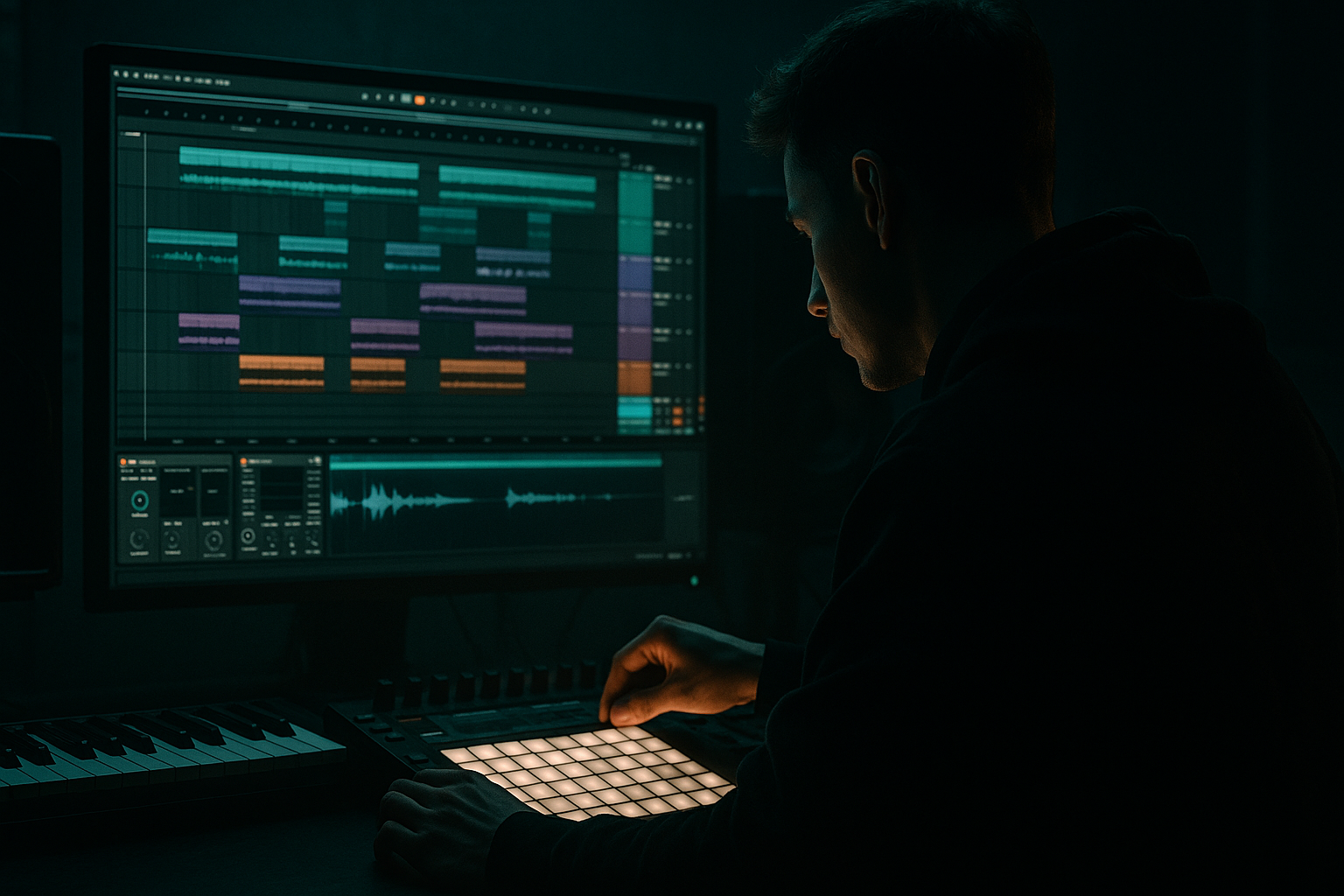
Main tutorial
Drum Bus Weight From Scratch (90s Rave Flavor) — Ableton Live (DnB/Jungle) 🥁⚡
1. Lesson overview
In classic 90s jungle/DnB, the drums feel heavy, glued, crunchy, and loud—but still fast and punchy at 170–175 BPM. That “rave weight” usually comes from bus processing: subtle saturation, compression that “breathes,” a touch of room, and intentional midrange grit.
In this lesson you’ll build a drum bus chain from scratch in Ableton Live using mostly stock devices, tuned for rolling breaks + punchy kick/snare—think Metalheadz-style weight with rave edge. 🔥
---
2. What you will build
A practical drum-bus workflow that gives you:
- Low-end weight without flab (kick + break coexist)
- Snare crack + body that carries in the mix
- 90s-style crunch (saturation/soft clip behavior)
- Glue that feels musical at DnB tempos
- A parallel “smash” lane for controllable aggression
- A small rave room vibe without washing out transients
- Aim for the DRUM BUS peak around -10 to -6 dBFS.
- If your kick/snare are already hot, turn them down at the track faders, not after the bus chain.
- High-pass filter: 24 dB/oct at 25–35 Hz
- Mud control (optional): wide bell -1 to -3 dB at 250–400 Hz
- Harshness check: small dip -1 to -2 dB at 3–5 kHz
- Cut a little low-mid (200–350 Hz) in the Side to keep the center punchy.
- Mode: Soft Clip
- Drive: 2 to 6 dB (start at 3 dB)
- Output: pull down to match level (A/B fairly)
- Soft Clip: ON
- Color: ON (optional, try it if it adds bite)
- Dry/Wet: 70–100% (if your drums are already edgy, back it off)
- Snare gets thicker, ghost notes become audible
- Break gains grain and “tape-ish” density
- Kick gets a little chewiness without booming
- Try Roar in a subtle setting:
- Attack: 3 ms (lets transients through but still grabs)
- Release: Auto (often best for breaks)
- Ratio: 2:1 (or 4:1 if you want firmer control)
- Threshold: lower until you see 1–3 dB GR
- Soft Clip: ON (this is big for rave flavor)
- Makeup: OFF initially; level-match manually
- The break should feel “connected” to the kick/snare.
- If your snare gets smaller, slow the attack (to 10 ms) or raise threshold.
- Kick weight: +0.5 to +2 dB at 55–75 Hz (wide Q)
- Snare body: +0.5 to +2 dB at 180–220 Hz
- Snare crack / break snap: +0.5 to +2 dB at 2–4 kHz
- Air (careful): +0.5 to +1.5 dB shelf at 9–12 kHz
- Drive: 2–8% (tiny!)
- Crunch: 0–10% (adds break grit; too much gets fizzy)
- Transient:
- Boom: OFF for most DnB (your bass owns the sub)
- Size: small/medium
- Decay: 0.3–0.7 s
- Pre-delay: 5–15 ms
- High Cut: 6–10 kHz
- Low Cut: 150–250 Hz
- Dry/Wet: 3–8%
- Drop impact trick: automate the Drum Smash send up +2 to +4 dB for the first 8 bars of the drop, then back slightly.
- Break variation: duplicate your break and low-pass it at 3–6 kHz, tuck it under for body (then bus glue makes it feel like one loop).
- Pre-drop tension: in the last bar before the drop, cut the drum bus at 200 Hz (EQ Eight automation), then snap back full-spectrum on the drop. Makes the drums feel heavier without changing volume.
- Sidechain the break (slightly) to the kick before the drum bus
- Clip instead of limit (most of the time)
- Midrange weight lives around 180–300 Hz
- Tame harsh breaks with multiband control
- Mono discipline
- Build weight with gain staging → subtle saturation → glue compression → tone shaping → transient polish.
- Use Soft Clip (Saturator/Glue) for authentic 90s-style density.
- Get aggression safely via a parallel Drum Smash return (high-passed).
- Keep reverb small and controlled for rave room flavor.
- Let arrangement + automation create “bigness” without just turning things up. ✅
You’ll end with a drum bus like:
[Drum Group] → (Cleanup EQ) → (Glue/Clip) → (Tone EQ) → (Transient control) → (Optional room) → (Limiter for safety)
Plus a Parallel Drum Smash Return.
---
3. Step-by-step walkthrough
Step 0 — Set up the drum routing (fast + clean)
1. Put your drum elements into a Group Track named: `DRUM BUS`.
- Typical DnB layout inside the group:
- `Kick`
- `Snare/Clap`
- `Break 1` (main break)
- `Break 2` (ghost/texture)
- `Hats/Rides`
- `Perc`
2. Set your project tempo to 172 BPM (good middle ground).
Key idea: Most of the “weight” comes from treating the whole drum picture—after your individual samples already sound decent.
---
Step 1 — Gain staging (don’t skip this) 🎚️
Before any processing:
Why: 90s-style crunch happens when you push into saturation/compression intentionally—not accidentally clip every stage.
---
Step 2 — Cleanup EQ (remove useless sub + tame mud)
Add EQ Eight first on `DRUM BUS`.
Suggested moves (starting points):
- Keep sub info for the bass; drums don’t need 20 Hz rumble.
- Especially if breaks feel “boxy.”
- Only if hats/breaks are ripping your head off.
Tip: Use EQ Eight in Mid/Side mode if your break is wide:
---
Step 3 — Add 90s crunch + density (Saturator / Roar) 🔧
Add Saturator next (stock and perfect for this).
Saturator settings (classic rave weight):
What to listen for:
Optional upgrade (if you own Live 12 Suite & want nastier):
- Drive low, keep dynamics intact, mix 20–40% wet.
- Great for darker techy DnB weight.
---
Step 4 — Glue compression (make it move as one) 🧲
Now add Glue Compressor.
Goal: 1–3 dB of gain reduction on peaks—not squashing.
Glue Compressor settings (rolling DnB starting point):
or try 0.1–0.3 s if you want rhythmic pumping
DnB listening check:
---
Step 5 — Add “weight EQ” (shape the vibe after glue)
Add another EQ Eight after compression.
Try these musical boosts (small, wide moves):
Rule: If you’re boosting more than ~2–3 dB on a bus, reassess the source sounds first.
---
Step 6 — Transient control (tighten fast drums without killing them)
Ableton’s Drum Buss device can be excellent here, but use it lightly—DnB transients are sacred.
Add Drum Buss (stock).
Suggested Drum Buss settings (subtle but effective):
- If your drums feel soft: +5 to +15
- If too spiky: -5 to -10
or ON very subtly if your kick needs weight:
- Boom: 5–15%
- Freq: 50–70 Hz
- Decay: short
Why this works: Drum Buss helps you “present” the hits upfront after glue/saturation.
---
Step 7 — Add a tiny rave room (optional but very 90s) 🏭
A lot of 90s drums have a sense of space—not lush reverb, more like a tight room.
Option A (simple): Reverb on the DRUM BUS at very low mix
Option B (better control): put Reverb on a Return track `DRUM ROOM` and send snare/breaks lightly.
DnB tip: Send more snare + break, less kick. Keep the kick center-dry and punchy.
---
Step 8 — Create a parallel “Drum Smash” return (the secret weapon) 💥
This is where you get that 90s “overcooked sampler/mixer” vibe—without ruining your main bus.
1. Create a Return Track named: `A - DRUM SMASH`
2. Add this chain on the return:
Return chain (stock):
1) Saturator
- Mode: Soft Clip
- Drive: 6–12 dB
- Wet: 100%
2) Glue Compressor
- Ratio: 4:1
- Attack: 0.3–1 ms (fast = smack)
- Release: Auto or 0.1 s
- Aim for 5–10 dB GR
- Soft Clip ON
3) EQ Eight
- High-pass: 80–120 Hz (so parallel doesn’t mess your sub)
- Optional presence boost: +1–3 dB at 2–5 kHz
4) Utility
- Width: 80–100% (keep it controlled)
- Gain: adjust as needed
3. Send your `DRUM BUS` (or just breaks + snare) into it:
- Start with send at -18 to -12 dB and creep up.
Result: You get density, sustain, and aggression under your clean drums. Classic “rave pressure.” 😤
---
Step 9 — Arrangement moves that make weight feel bigger (DnB-specific)
Bus processing works best when the arrangement supports it:
---
4. Common mistakes
1. Over-compressing the bus
- If your drums lose punch at 172 BPM, you’re likely compressing too hard or too fast.
2. Using Boom/sub enhancers on the drum bus
- Sub belongs to bass in most DnB. Keep drum low-end tight.
3. Parallel smash with too much low end
- High-pass the return or it will blur kick/bass and kill headroom.
4. Not level-matching when A/B’ing
- Louder always sounds “better.” Match output to judge tone, not volume.
5. Reverb too wet
- 90s vibe is small room, not a cathedral. Keep it subtle.
---
5. Pro tips for darker/heavier DnB 🖤
- Compressor on break: Sidechain from kick
- Ratio 2:1, fast attack, release 50–120 ms, just 1–2 dB reduction
This makes the kick feel heavier without turning it up.
- Using Soft Clip (Saturator/Glue) gives more “hardware” attitude than a limiter shaving peaks.
- Carefully manage this region—too much = cardboard; just right = chest hit.
- Use Multiband Dynamics lightly:
- High band (5k+): gentle compression to stop splashy hats taking over.
- Put Utility at the end of drum bus:
- Turn Bass Mono behavior on by using Utility + EQ (or just keep lows centered by avoiding stereo wideners pre-EQ).
Wide breaks are cool, but the punch should be centered.
---
6. Mini practice exercise (15–25 minutes) 🧪
1. Load:
- One classic break (Amen/Think-style)
- A punchy DnB kick
- A snare (rim/909-ish layered works great)
2. Make a 16-bar loop:
- Bars 1–8: basic roll
- Bars 9–16: add ghost hats/percs and a small snare fill
3. Build your DRUM BUS chain in this order:
1) EQ Eight (HP 30 Hz, -2 dB at 300 Hz)
2) Saturator (Soft Clip, Drive 3 dB)
3) Glue Compressor (2:1, Attack 3 ms, Auto release, 1–3 dB GR, Soft Clip ON)
4) EQ Eight (tiny boosts: 65 Hz +1 dB, 200 Hz +1 dB, 3 kHz +1 dB)
5) Drum Buss (Drive 5%, Transient +10)
4. Add Return `DRUM SMASH` and blend until you just miss it when muted.
5. Bounce a quick audio export and compare:
- With/without Saturator
- With/without parallel return
Success metric: The drums feel louder and heavier at the same peak level.
---
7. Recap
If you want, tell me what break and kick/snare you’re using (or upload a screenshot of your drum group), and I’ll suggest exact tweaks to hit a specific vibe: Metalheadz weight, Ram Records punch, or classic jungle ragga crunch.

