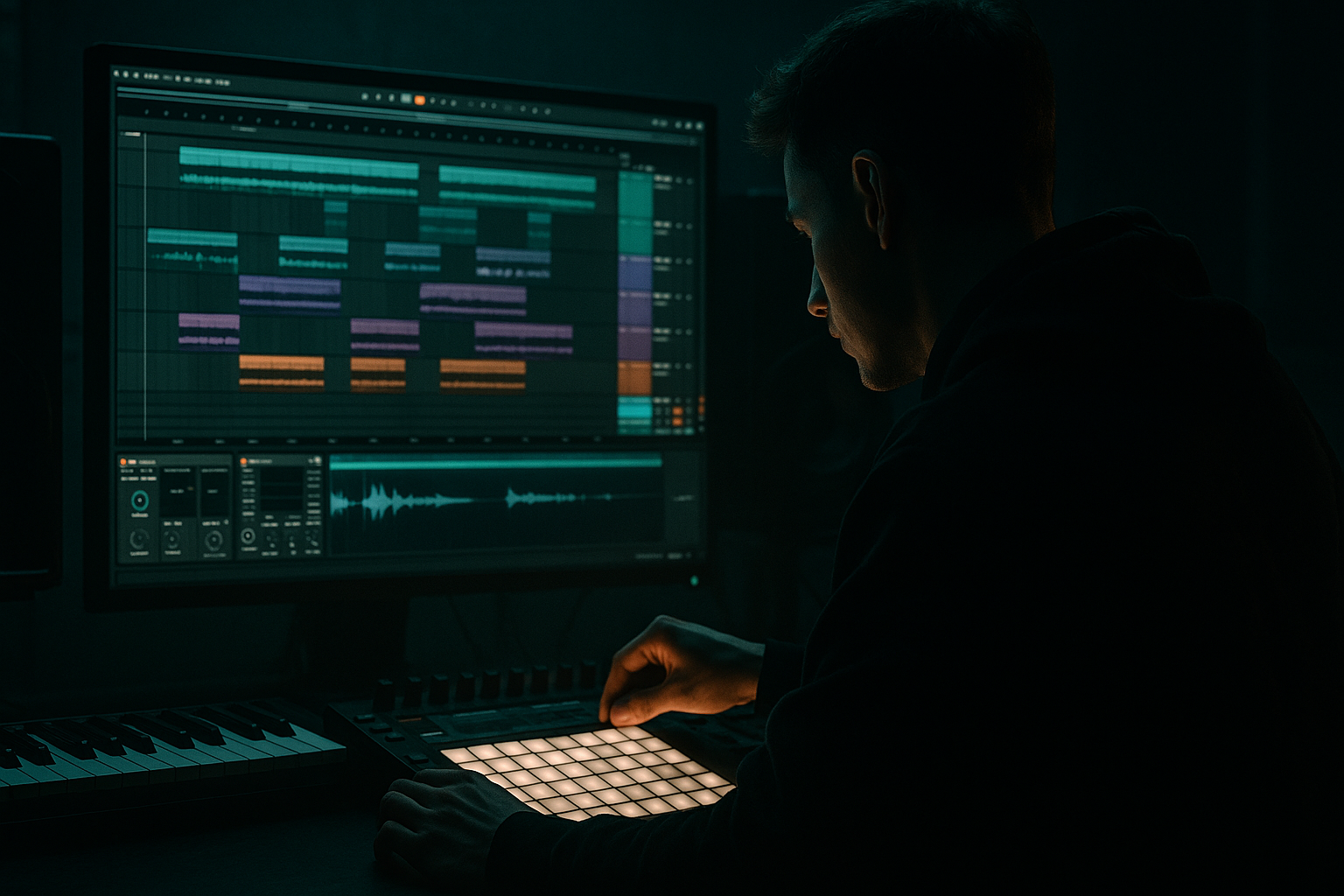
Main tutorial
Drum Bus Weight From Scratch (DnB) in Ableton Live 12 🥁⚙️
Skill level: Intermediate • Category: Drums • Focus: Drum & Bass / Jungle / Rolling styles
---
1) Lesson overview
In drum and bass, “weight” isn’t just loudness—it’s the feeling that the kick + snare + breaks sit like concrete in the mix while still punching through a dense bassline. In this lesson you’ll build a drum bus chain from scratch in Ableton Live 12 using mostly stock devices, plus a clean routing workflow that keeps your drums powerful, controlled, and mix-ready.
You’ll learn how to:
- Create low-end authority without mud
- Add punch + density with tasteful saturation and compression
- Use parallel “crush” and transient shaping for aggression
- Keep hi-hats crisp while the bus stays heavy
- DRUMS BUS (main)
- DRUMS CRUSH (Parallel) return/aux for aggressive density
- Optional: BREAK BUS if you want separate break control
- Saturator / Roar → Compressor → EQ Eight → Utility
- Individual drum tracks: peaks around -10 to -6 dBFS
- Drum Bus (pre-processing): peaks around -8 to -4 dBFS
- Master: keep headroom; peaks below -6 dBFS while building
- High-pass filter?
- Low-mid control (mud zone):
- Presence (snap/attack):
- Drive: 5–12% (go higher if drums are too clean)
- Crunch: 0–10% (use sparingly; too much = harsh hats)
- Boom: On
- Damp: 5–20% (tames fizzy top end)
- Trim: adjust so output level matches input (A/B fairly)
- Loop a bar with kick + snare.
- Sweep Boom Frequency until the kick feels bigger but not “basketball-y.”
- If it starts to blur the bassline, reduce Decay first, then Amount.
- Attack: 3 ms (more punch) or 1 ms (tighter)
- Release: 0.3 s or Auto
- Ratio: 2:1 or 4:1
- Threshold: aim for 1–3 dB gain reduction on the loudest hits
- Soft Clip: On (subtle peak control, very useful for DnB)
- Snare stays forward
- Kick doesn’t disappear
- Hats don’t pump in an annoying way
- Start with a gentle preset or default and do this:
- Mix control (if available): blend to taste; keep it subtle
- Mode: Analog Clip
- Drive: 2–6 dB
- Soft Clip: On
- Output: level-match
- Ceiling: -0.8 dB
- Lower Threshold until you see only 1–2 dB reduction on the hardest snare hits.
- Saturator:
- Ratio: 8:1 to 12:1
- Attack: 10–30 ms (lets crack through)
- Release: 50–120 ms (energy + bounce)
- Threshold: aim 6–12 dB GR (yes, big)
- High-pass at 70–120 Hz (keep sub clean in main bus)
- Dip harshness 3–6 kHz if it gets spitty
- Optional: small boost around 180–250 Hz if you want “meat”
- Start with Utility gain -6 dB
- Blend the return until you miss it when muted but don’t hear it as “distortion layer.”
- Kick/snare consistency: Keep your main kick and snare mostly consistent in the drop. Variations come from ghost hits and breaks.
- Ghost snares: Add low-velocity (10–30%) ghost notes just before or after the 2 and 4 to create roll.
- Break layering:
- Micro-edits: Slice one clean snare tail into a reverb-only hit before a phrase change (classic jungle vibe).
- Split your drum processing by groups:
- Midrange “grit pocket”: Add subtle harmonics around 200–800 Hz (Roar/Saturator) so drums still hit on phones/laptops.
- Controlled mono:
- Jungle edge:
- Sidechain the drum crush return to the snare (subtle):
- EQ Eight first: clear space (especially 220–350 Hz) and avoid unnecessary sub-rumble.
- Drum Buss: your fast path to weight—tune Boom carefully and keep Decay tight for DnB.
- Glue Compressor: light glue (1–3 dB GR), not destruction.
- Parallel Crush: the “density layer” that makes drums feel expensive without flattening transients.
- Arrangement matters: ghost notes, break layers, and consistent core hits create weight as much as processing.
---
2) What you will build
A practical DnB drum routing + processing system:
Routing
- Kick
- Snare
- Hats/perc
- Break layer (optional)
Main Drum Bus chain (stock)
1. EQ Eight (cleanup + sculpt)
2. Drum Buss (thump + drive)
3. Glue Compressor (cohesion)
4. Roar (optional: darker weight / harmonics)
5. Limiter (safety / ceiling)
Parallel Crush chain (stock)
---
3) Step-by-step walkthrough
Step 0 — Prep: get your gain staging right 🎛️
Before processing, your drum bus should not already be clipping.
Targets (practical):
In Live 12, you can quickly check with Meter or just watch track meters.
---
Step 1 — Route all drums into a DRUMS BUS
1. Create a new Audio Track and name it: `DRUM BUS`.
2. Select all drum tracks (kick, snare, hats, break) → set Audio To → `DRUM BUS`.
Why: This lets you shape weight once and keep your drums feeling like one instrument.
---
Step 2 — Add EQ Eight (cleanup + “weight pocket”)
Put EQ Eight first on `DRUM BUS`.
Settings (starting point):
- In DnB, avoid aggressive HP on the whole drum bus because you can thin the kick.
- Instead:
- Set a gentle HP at 20–25 Hz (24 dB/Oct if needed) to remove sub-rumble only.
- Bell cut -1.5 to -3 dB around 220–350 Hz, Q ~1.0–1.4
- Adjust by ear while bass is playing.
- Tiny lift +1 dB around 3–5 kHz if your snare needs presence (optional)
DnB tip: If your bass is huge at 50–80 Hz, you may want the drum bus to lean slightly higher (e.g., kick fundamental at ~60–90 Hz) and keep the real sub for bass.
---
Step 3 — Add Drum Buss for instant “weight” (the secret weapon) 💥
Drop Drum Buss after EQ Eight.
Starting settings for rolling DnB:
- Frequency: try 55–80 Hz (tune to your kick)
- Amount: 10–25%
- Decay: 150–250 ms
How to tune Boom quickly:
---
Step 4 — Glue Compressor for cohesion (not for smashing) 🧲
Add Glue Compressor after Drum Buss.
Goal: light-to-medium bus glue so the drums “move together.”
Starting settings:
Listen for:
If pumping happens: increase Attack a bit, or reduce GR.
---
Step 5 — Add controlled harmonics (optional but powerful): Roar 😈
If you want darker, weightier drums that still read on small speakers, add Roar after Glue.
Easy mode settings:
- Drive: low (2–8 dB depending on mode)
- Choose a warmer mode (avoid overly fizzy distortion)
- Use Filter inside Roar to avoid overcooking the highs
- Low-pass around 10–14 kHz (gentle)
Alternative stock option: use Saturator instead
---
Step 6 — Safety: Limiter (catch only the wild peaks) 🧯
Put Limiter last on the drum bus.
Starting point:
If you’re taking 4–6 dB off, you’re probably flattening transients—use parallel crush instead.
---
Parallel “Crush” for serious weight (without killing punch) 🔥
This is where a lot of modern DnB density comes from.
Step 7 — Create a DRUM CRUSH return track
1. Create Return Track → name: `DRUM CRUSH`.
2. Send your `DRUM BUS` to this return (start around -18 to -12 dB send level).
Step 8 — Build the Crush chain (stock)
On `DRUM CRUSH`, add:
#### 1) Saturator (or Roar)
- Drive: 8–16 dB
- Soft Clip: On
- Output: reduce to avoid clipping
#### 2) Compressor (aggressive)
Use Compressor (not Glue) for heavier grab.
#### 3) EQ Eight (shape the crush)
#### 4) Utility (blend control)
DnB sweet spot: The crush return often sits quietly but makes everything feel thicker.
---
Arrangement moves that add “weight” (without more processing) 🧠
Weight is also composition + timing:
- High-pass the break at 120–200 Hz so it adds motion, not mud.
- Keep the main kick/snare responsible for the low-mid punch.
---
4) Common mistakes
1. Over-boosting 50–80 Hz on the drum bus → fights the bassline, makes mastering harder.
2. Too much Drum Buss Boom decay → “boooom” that smears fast DnB rhythms.
3. Smashing Glue Compressor (5–10 dB GR) → loses punch, hats pump, snare collapses.
4. Distorting the whole top end → crunchy hats = instant amateur. Use EQ before/after saturation.
5. No level matching when A/B testing → you think louder = better. Match output to input.
---
5) Pro tips for darker/heavier DnB 🌑
- `KICK+SNARE BUS` (punch/weight)
- `TOPS BUS` (hats/perc/air)
Then both feed `DRUM BUS`. This keeps weight focused.
- Keep lows mono using Utility (Width 0% below ~120 Hz using EQ M/S or separate groups).
- Wide tops = bigger perceived impact.
- Use a short room reverb only on snare (0.4–0.8s, pre-delay 10–25ms), then gate or shorten tail so it stays aggressive.
- If crush masks snare crack, sidechain compress the return keyed by snare to let the transient breathe.
---
6) Mini practice exercise (15–25 min) 🧪
1. Load a basic DnB drum pattern: kick on 1, snare on 2 & 4, hats 1/8 or 1/16. Add a break loop quietly.
2. Route all into `DRUM BUS`.
3. Build this chain exactly in order:
- EQ Eight → Drum Buss → Glue Compressor → Limiter
4. Now create `DRUM CRUSH` return with:
- Saturator → Compressor → EQ Eight → Utility
5. Do three A/B checks (level-matched):
- Drum Buss ON vs OFF
- Crush return ON vs OFF
- Boom ON vs OFF
6. Export a 16-bar drop loop and listen on two systems (headphones + phone speaker).
- If drums vanish on phone: add a touch more saturation (not more sub).
---
7) Recap ✅
If you tell me your tempo (e.g., 174) and whether you’re going for liquid, neuro, jungle, or rollers, I can suggest a tighter set of starting values (Boom freq, compression timings, and a bus layout) tailored to that substyle.

