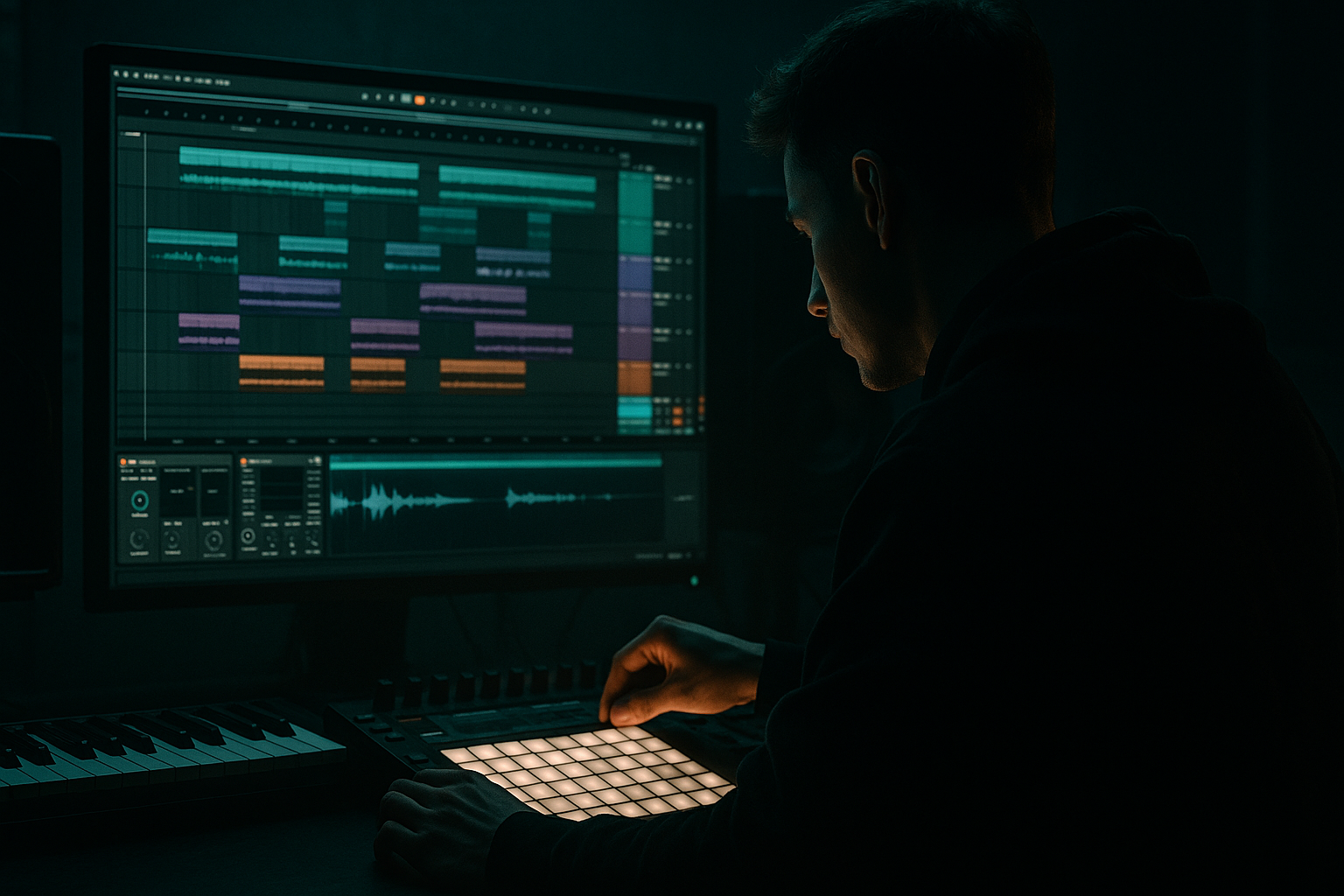
Main tutorial
```markdown
Drum Folds & Stutters Before Reloads (DnB in Ableton Live) 🥁⚡
1) Lesson overview
In drum & bass and jungle, the reload (or “pull-up”) is often preceded by a moment of tension and chaos—tight drum stutters, folds, and micro-edits that make the crowd lean in before the track slams back.
In this lesson you’ll learn beginner-friendly ways to create those edits using Ableton Live stock tools, while keeping your drums tight, punchy, and musical.
---
2) What you will build
You’ll build a 4–8 bar pre-reload fill that:
- Grabs a slice of your break/drums
- Creates stutters (1/8 → 1/16 → 1/32 style)
- Adds a drum fold feel (rapid repeats + filtering + gating)
- Ends with a clean stop or impact, ready for a reload/drop
- A “stutter lane” (audio) you can copy/paste before any reload
- A simple device chain for extra aggression (Saturator, Auto Filter, Redux, Reverb)
- Bar 15: normal groove
- Bar 16: stutter/fold madness
- Downbeat of bar 17: reload/drop
- Split the last bar into 4 chunks and use different loop sizes:
- Place cursor → Cmd/Ctrl + E to split the audio
- On each slice/clip, set a smaller loop brace
- Start at `1/8`, then go `1/16`, then `1/32` right before the reload.
- Split the audio right before the reload downbeat
- Delete the final 1/8–1/4 beat so there’s a silence
- Decay: `1.2–2.5s`
- Pre-delay: `10–25ms`
- Low Cut: `250–500Hz` (keeps it clean)
- Add a crash, sub drop, or vocal “RELOAD!”
- Use Utility to mono the low end if it gets messy.
- Overdoing stutter length: If your repeated slice is too long, it sounds like a skip, not a roll. Keep it 1/16 and smaller near the end.
- No contrast: If your track is already max-chaos, the fill won’t read. Make the bar before it slightly simpler.
- Low-end smear: Repeating kick-heavy slices can create sub mud. High-pass the stutter channel (Auto Filter low cut or EQ Eight).
- Beat Repeat everywhere: Don’t leave it on for the whole track. Automate Chance or use a separate “Fill” track.
- Clicks/pops on cuts: Add tiny fades:
- Parallel distortion for the stutter only:
- Gate the stutter to be tighter:
- Pitch dive on the last repeat:
- Use break-specific slices:
- “Fake double-time” energy:
- Stutters and folds work best when they accelerate (1/8 → 1/16 → 1/32) and then stop right before the reload.
- Use audio editing + clip looping for clean control, and Beat Repeat for that authentic “folded” DnB glitch energy 🔁
- Add tension with Auto Filter, control spikes with Saturator/Drum Buss, and protect your low end with EQ/filters.
You’ll end up with:
---
3) Step-by-step walkthrough
Step 0 — Set the scene (DnB defaults)
1. Set tempo to 174 BPM (170–176 works).
2. Use a basic drum pattern:
- Kick on 1 and 3 (or 1 and “& of 2” for rollers)
- Snare on 2 and 4
- Hats/shuffles to taste
Good sources: an Amen-style break, a clean 2-step kit, or both layered.
---
Step 1 — Choose your editing workflow (Audio is easiest)
For stutters/folds, Audio clips are fastest and most visual.
1. Consolidate your drum loop:
- Select a clean 1–2 bar section of drums
- Press Cmd/Ctrl + J (Consolidate)
2. Duplicate the consolidated clip so you can destroy the copy safely 😄
> Tip: If you’re using Drum Rack MIDI, consider Freezing + Flattening the drum group to audio for editing:
> - Right-click track → Freeze Track
> - Right-click again → Flatten
---
Step 2 — Create a “pre-reload” edit region
1. Decide where the reload happens (example: end of bar 16).
2. Create an 1-bar or 2-bar build just before it (bars 15–16).
3. Duplicate your drum audio into that region.
Arrangement idea (classic):
---
Step 3 — The simplest stutter (clip loop + automation)
This is the cleanest beginner method.
1. Double-click the audio clip in bar 16 to open Clip View.
2. Turn Loop ON.
3. Set the loop brace to a tight slice:
- Start with 1/8 note (half-beat-ish feel)
4. Automate the loop length smaller over time:
- In Arrangement view, show automation for the clip’s Loop Length (you can also duplicate clips with different loop sizes if automation feels fiddly)
Easy “manual” approach (recommended for beginners):
1. First 1/2 bar: loop a 1/8
2. Next 1/4 bar: loop a 1/16
3. Next 1/8 bar: loop a 1/32
4. Final hit: stop or impact
How to do it:
This gives that classic “speeding up” stutter: duh-duh-duh → drr-drr → bzzzt ⚡
---
Step 4 — Drum “fold” feel using Beat Repeat (stock device) 🔁
Now we’ll add controlled chaos.
1. Put Beat Repeat on your drum audio track (or on a return track for parallel).
2. Use these starter settings:
- Interval: `1 Bar` (so it triggers once per bar)
- Grid: `1/16`
- Variation: `0%` (keep it consistent)
- Gate: `1/16` (tight)
- Chance: `100%` (for the fill section)
- Mix: `30–60%` (depending on how hard you want it)
- Pitch: `0` (start clean)
- Decay: low to mid
3. Automate Chance so Beat Repeat only goes crazy in the last bar:
- Bars 1–15: Chance = 0%
- Bar 16: Chance ramps to 100%
DnB move: automate Grid too:
> If Beat Repeat feels too random, keep Variation at 0% and control it with Chance + Grid automation.
---
Step 5 — Add the “telephone-to-doom” filter sweep
This is what makes the stutter sound like it’s “folding in” rather than just repeating.
1. Add Auto Filter after Beat Repeat (or on the stuttered clip).
2. Choose:
- Filter type: Band-Pass or Low-Pass
- Drive: `3–8 dB` (adds bite)
- Resonance (Q): `0.7–1.3` (don’t over-whistle)
3. Automate cutoff:
- Start higher (brighter), sweep down to dark
- Or do the reverse for a rising panic effect 😈
Classic jungle trick: end on a low-pass sweep down to almost silence, then hard-cut.
---
Step 6 — Make the stop / reload moment hit
A reload needs a “gap” or “punctuation.”
Options (choose one):
A) Hard mute
B) Reverb tail + cut
1. Put Reverb on a Return track.
2. Send the last stutter hit into it (automate send).
3. Then mute everything for a tiny gap.
Reverb starting point:
C) Impact marker
---
Step 7 — Glue it together so it sounds “intentional”
1. Group your drums (Cmd/Ctrl + G).
2. On the Drum Group, add:
- Drum Buss
- Drive: `5–15%`
- Boom: Off or subtle (Boom can mess with sub)
- Saturator
- Soft Clip: On
- Drive: `2–6 dB`
3. Use Limiter lightly if your stutters spike.
Goal: the fill should feel louder/more urgent but not wreck your master.
---
4) Common mistakes
- Clip Fade handles (or enable Create Fades on Clip Edges in Live settings)
---
5) Pro tips for darker/heavier DnB 🖤
Duplicate the drum track → on the copy add:
- Redux (Downsample slightly)
- Saturator (Hard Curve)
- Auto Filter (Band-pass)
Keep it low in the mix for grime.
Use Gate after distortion to clamp tails.
- Threshold: adjust so only the hits open
- Fast attack, short release
Use Clip Transpose automation down -2 to -12 semitones right at the end for a sick “fall into the reload”.
The Amen’s ghost notes and snare tone make stutters sound alive. Try grabbing slices that include snare + ghost hat, not just kick.
Switch your stutter grid to 1/32 briefly, then cut to silence. That sudden contrast screams reload incoming.
---
6) Mini practice exercise (10 minutes) ⏱️
1. Load a breakbeat loop (1 bar) at 174 BPM.
2. Place it for 16 bars.
3. In bar 16, make:
- First half: loop 1/8
- Next quarter: loop 1/16
- Next eighth: loop 1/32
- Last eighth: silence
4. Add Beat Repeat with:
- Interval `1 Bar`, Grid `1/16`, Chance automated from `0% → 100%` in bar 16
5. Add Auto Filter sweep down across bar 16.
Export that 16-bar loop and label it:
“Reload Fill 01 – 174 – Amen”
---
7) Recap
If you tell me what style you’re aiming for (rollers, jump-up, jungle, neuro), I can suggest a specific 8-bar fill pattern and a matching device chain.
```

